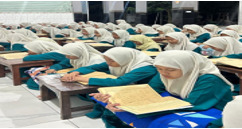
Internalizing Religious Moderation in an Al-Qur’an-Based School: Strategies for Developing Inclusive Student Character at SMP IQ Al Husna Mayong
DOI:
https://doi.org/10.61455/sujiem.v4i02.666Keywords:
religious moderation, value internalization, inclusive character, islamic education, al-Qur'an-based schoolAbstract
Objective: This study critically examines the mechanisms of internalization of religious moderation values in fostering inclusive student character at SMP IQ Al Husna Mayong. Theoretical framework: This study grounds its analytical framework on the three-stage value internalization model, comprising value transformation, value transaction, and value transinternalization, supported by core principles of Islamic religious moderation (wasathiyyah). Literature review: Previous studies have primarily examined religious moderation in general schools and madrasahs. However, limited empirical attention has been given to how religious moderation values are integrated into formal Islamic education and dormitory life within Al-Qur'an-based schools with relatively homogeneous religious environments. Methods: This study employed a qualitative approach with a case study design. Data were collected through interviews with an Islamic Religious Education (PAI) teacher, a dormitory supervisor, and Grade 8 students, complemented by observations and document analysis. Results: The findings reveal three interconnected stages of value internalization. First, value transformation occurs through the delivery of religious moderation principles in classroom instruction and dormitory activities. Second, value transaction is implemented through habituation and the cultivation of an inclusive school culture. Third, value transinternalization is reflected in students' daily behaviours, including openness, respect for differences, and rejection of violent extremism. Implications: The findings suggest that integrating religious moderation values into classroom learning and dormitory practices may support the development of inclusive student character through consistent educational experiences and daily social interactions. Novelty: This study offers a context-specific perspective by examining the integration of the three stages of value internalization within formal Islamic education and dormitory life in an Al-Qur'an-based Islamic school.
References
T. Y. Harjatanaya, “Contextualising religious education in multi-religious Indonesia to achieve unity-in-religious diversity,” J. Beliefs Values, vol. 46, no. 3, pp. 488–506, 2025, https://doi.org/10.1080/13617672.2025.2450958.
I. E. Putra, W. Yustisia, C. Osteen, J. Hudiyana, and E. A. Meinarno, “‘We support unity in diversity, but politics is a privilege for my group’: The paradoxical influence of national identification × religious identification in predicting unity in diversity and political orientations,” Int. J. Intercult. Relations, vol. 87, pp. 108–118, 2022, https://doi.org/10.1016/j.ijintrel.2022.01.011.
T. Wijaya Mulya and A. Aditomo, “Researching religious tolerance education using discourse analysis: a case study from Indonesia,” Br. J. Relig. Educ., vol. 41, no. 4, pp. 446–457, 2019, https://doi.org/10.1080/01416200.2018.1556602.
M. Samsul Hady et al., “Cultural transformation: religious moderation from manuscripts heritage to living tradition in Indonesia and Malaysia,” Cogent Educ., vol. 12, no. 1, p. 2556891, 2025, https://doi.org/10.1080/2331186X.2025.2556891.
A. Muis, “Incorporating religious moderation values into the Islamic religious education curriculum in secondary education: a systematic review of goals, experiences, methods, and evaluation,” Br. J. Relig. Educ., vol. 48, no. 2, pp. 248–262, 2026, https://doi.org/10.1080/01416200.2025.2598619.
M. M. J. Alabdulhadi, “Religious tolerance in secondary Islamic Education textbooks in Kuwait,” Br. J. Relig. Educ., vol. 41, no. 4, pp. 422–434, 2019, https://doi.org/10.1080/01416200.2019.1585329.
I. Ikhrom, I. Abdullah, R. Kafipour, Z. Mubaraq, and A. Sutiyono, “Intolerance in Islamic textbooks: The quest for an Islamic teaching model for Indonesian schools,” Cogent Educ., vol. 10, no. 2, p. 2268454, 2023, https://doi.org/10.1080/2331186X.2023.2268454.
M. Firdaus, M. Hilmy, H. S. Zainiyati, A. S. Hamdani, and Kusaeri, “Religious education textbook assessment in Indonesia: a multi-faith approach to religious moderation,” Br. J. Relig. Educ., pp. 1–15, 2026, https://doi.org/10.1080/01416200.2026.2627926.
I. Ihsan, M. Pabbajah, I. Abdullah, and H. Hidayati, “The contestation of national and religious curricula in Indonesia’s madrasas since the passage of the UUSPN,” Educ. Stud., vol. 50, no. 4, pp. 434–447, 2024, https://doi.org/10.1080/03055698.2021.1958757.
M. Mukhibat, M. Effendi, W. H. Setyawan, and M. Sutoyo, “Development and evaluation of religious moderation education curriculum at higher education in Indonesia,” Cogent Educ., vol. 11, no. 1, p. 2302308, 2024, https://doi.org/10.1080/2331186X.2024.2302308.
Zulkarnain, S. Bulan, I. Karya Bakti, S. Nursyah Ismail, M. Najihul Huda, and Kusaeri, “Religious moderation in Islamic education as an approach to preventing sexual harassment: implementation analysis in Indonesian madrasahs,” Br. J. Relig. Educ., pp. 1–23, 2025, https://doi.org/10.1080/01416200.2025.2570481.
T. Wijaya Mulya, A. Aditomo, and A. Suryani, “On being a religiously tolerant Muslim: discursive contestations among pre-service teachers in contemporary Indonesia,” Br. J. Relig. Educ., vol. 44, no. 1, pp. 66–79, 2022, https://doi.org/10.1080/01416200.2021.1917338.
L. Váradi, L. Morhayim, R. Németh, and L. R. Tropp, “Intergroup contact buffers influence of objective and perceived peer norms on prejudice among adolescents,” Int. J. Intercult. Relations, vol. 107, p. 102199, 2025, https://doi.org/10.1016/j.ijintrel.2025.102199.
N. K. Reimer, A. Love, R. Wölfer, and M. Hewstone, “Building Social Cohesion Through Intergroup Contact: Evaluation of a Large-Scale Intervention to Improve Intergroup Relations Among Adolescents,” J. Youth Adolesc., vol. 50, no. 6, pp. 1049–1067, 2021, https://doi.org/10.1007/s10964-021-01400-8.
E. Yücel, H. Ekici, and A. B. Çelik, “‘We are One Team’: An evaluation of an intervention for improving relations between Turkish local and refugee adolescents,” Int. J. Intercult. Relations, vol. 96, p. 101865, 2023, https://doi.org/10.1016/j.ijintrel.2023.101865.
M. D. Birtel, G. A. Di Bernardo, L. Vezzali, R. N. Turner, R. J. Crisp, and R. Martin, “Dispositional empathy and personality as predictors of contact quality: The mediating roles of contact self-efficacy and effort towards contact,” Int. J. Intercult. Relations, vol. 102, p. 101986, 2024, https://doi.org/10.1016/j.ijintrel.2024.101986.
G. R. Policardo, S. Karataş, and F. Prati, “A blind spot in intergroup contact: A systematic review on predictors and outcomes of inter-minority contact experiences,” Int. J. Intercult. Relations, vol. 104, p. 102099, 2025, https://doi.org/10.1016/j.ijintrel.2024.102099.
Y. Güleç, “Factors affecting religious tolerance and prejudice in school context: a mixed-method research synthesis,” Br. J. Relig. Educ., vol. 48, no. 1, pp. 35–56, 2026, https://doi.org/10.1080/01416200.2025.2471100.
I. Boer, J. Thijs, and F. Fleischmann, “Discussing diversity in the classroom: do teachers address both ethnic and socioeconomic differences?,” Soc. Psychol. Educ., vol. 29, no. 1, p. 3, 2026, https://doi.org/10.1007/s11218-026-10170-9.
Faridi and D. Mardiana, “Inclusive education and character of tolerance: a model of religious education in religious and non-religious schools in Indonesia,” Cogent Educ., vol. 13, no. 1, p. 2713946, 2026, https://doi.org/10.1080/2331186X.2026.2713946.
R. Bahri et al., “Moral leadership development in Indonesian Islamic boarding schools: a comparative study of two pesantren,” Br. J. Relig. Educ., pp. 1–17, 2026, https://doi.org/10.1080/01416200.2026.2627921.
W. Sanderse, “Adolescents’ moral self-cultivation through emulation: Implications for modelling in moral education,” J. Moral Educ., vol. 53, no. 1, pp. 139–156, 2024, https://doi.org/10.1080/03057240.2023.2236314.
E. Henderson, “The educational salience of emulation as a moral virtue,” J. Moral Educ., vol. 53, no. 1, pp. 73–88, 2024, https://doi.org/10.1080/03057240.2022.2130882.
L. Nyirenda et al., “Using research networks to generate trustworthy qualitative public health research findings from multiple contexts,” BMC Med. Res. Methodol., vol. 20, no. 1, p. 13, 2020, https://doi.org/10.1186/s12874-019-0895-5.
M. Qorib and Umiarso, “The religious moderation model based on the unity of theo-socio-anthropological values in Muhammadiyah and NU pesantren in Indonesia,” Cogent Educ., vol. 12, no. 1, 2025, https://doi.org/10.1080/2331186X.2025.2584644.
W. Ai, “The case study approach,” Teach. Undergrad. Polit. Methodol., vol. 11, no. 100, pp. 189–196, 2022, https://doi.org/10.4337/9781800885479.00033.
Muthoifin and P. Putri, “Social Level Parameters of Banjar Society in the Tradition of Jujuran Islamic Law Perspective,” Proc. Int. Conf. Eng. Technol. Soc. Sci. (ICONETOS 2020), vol. 529, no. ICONETOS 2020, pp. 87–90, 2021, https://doi.org/10.2991/assehr.k.210421.014.
C. Chotimah, S. Z. Qudsy, and M. Yusuf, “Superficial implementation of religious moderation in Islamic educational management,” Cogent Educ., vol. 12, no. 1, 2025, https://doi.org/10.1080/2331186X.2024.2442235.
S. Syabuddin, M. Muhammad, S. Sakdiah, F. Fithriani, and M. Furqan, “The Integrative Construction Model: A Strategic Management Approach to Religious Moderation in Indonesian Islamic Boarding Schools,” Kharisma, vol. 5, no. 1, pp. 113–129, 2026, https://doi.org/10.59373/kharisma.v5i1.131.
Zulkifli, R. Latifa, M. Fahri, and S. Sa’diyah, “The Influence of Socioeconomic Factors and Religiosity on Religious Tolerance Among Students At Indonesian Islamic Higher Education Institutions,” J. Pendidik. Islam, vol. 12, no. 1, pp. 132–144, 2026, https://doi.org/10.15575/jpi.v12i1.48952.
M. W. B. H. M. Yahya, M. Rahmat, P. Parihat, G. Munawar, and A. Amiruddin, “Artificial Intelligence in Islamic Education: Strengthening Religious Tolerance or Reproducing New Socio-Legal Risks?,” Petita J. Kaji. Ilmu Huk. dan Syariah, vol. 11, no. 1, pp. 618–641, 2026, https://doi.org/10.22373/petita.v11i1.1184.
Ismail, Suja’i, M. Ridwan, N. Siswayanti, and U. Masfiah, “From Fear to Belonging: Learning Experiences of Muslim Minority International Students in Islamic Education in Indonesia,” J. Int. Students, vol. 16, no. 11, pp. 157–186, 2026, https://doi.org/10.32674/5qwbd524.
U. Supriadi, M. Rahmat, G. E. Subakti, M. I. Firmansyah, E. Sumarna, and N. Nurjanah, “Qur’Anic Pedagogy for Interreligious Tolerance in Islamic Religious Education,” J. Pendidik. Islam, vol. 12, no. 1, pp. 48–61, 2026, https://doi.org/10.15575/jpi.v12i1.48465.
M. Faishol, Wasino, Fakhruddin, and Asrori, “Enacting interreligious learning in Indonesian Islamic education: a phenomenological study of teacher practice,” Front. Educ., vol. 11, 2026, https://doi.org/10.3389/feduc.2026.1810960.
W. Said, Ahdar, N. Rasyid, N. Futhira, and F. Hanafing, “Mappepaccing Bubung, Religious Moderation, and Ecotheology: Implementing Multicultural Islamic Education in the Bone Community,” El-Usrah, vol. 9, no. 2, pp. 900–922, 2026, https://doi.org/10.22373/UJHK.V9I2.34548.
A. Yusuf, M. Jamhuri, and R. Z. Abidin, “Developing the Digital Trilogy Integration Model for Multicultural Islamic Education in the Digital Age,” Daengku, vol. 6, no. 3, pp. 414–432, 2026, https://doi.org/10.35877/454RI.daengku5003.
S. M. Harimurti, I. Hilmi, S. A. Makruf, and R. W. Suwarno, “Study of Al-Qur’an Verses about the Value of Religious Moderation in Islamic Education Textbooks in Muhammadiyah and Nahdlatul Ulama Elementary Schools,” Afkaruna, vol. 22, no. 1, pp. 161–178, 2026, https://doi.org/10.18196/afkaruna.v22i1.27194.
H. Hosaini, K. Kandiri, M. Minhaji, L. Maktumah, and Z. Hassan Sain, “Religious Moderation and National Commitment at Sukorejo Pesantren, Indonesia: A Phenomenological Study,” Relig. J. Stud. Agama-Agama dan Lintas Budaya, vol. 10, no. 2, pp. 105–126, 2026, https://doi.org/10.15575/rjsalb.v10i2.40576.
Suyadi and Hairiyah, “Neuroscience-Based Higher Order Thinking Skills Development Model for Religious Moderation,” Afkaruna, vol. 22, no. 1, pp. 129–144, 2026, https://doi.org/10.18196/afkaruna.v22i1.30370.
Rosmini, Nursalam, W. S. Darmadali, and K. Zainuddin, “Toward a Moderate Islamic Parenting Model: Qur’anic Care, Positive Discipline from the Perspective of Islamic Family Law in Pesantren of South Sulawesi,” El-Usrah, vol. 9, no. 2, pp. 742–765, 2026, https://doi.org/10.22373/ujhk.v9i2.35152.
A. N. Kawakip, M. K. F. Raya, N. Chanifah, L. Azizah, M. Abidin, and A. Ridho, “Framework for Islamic education in Muslim minority countries: experiences from Finland,” Cogent Educ., vol. 13, no. 1, 2026, https://doi.org/10.1080/2331186X.2026.2706227.
W. Wahab et al., “Local Wisdom-Based Religious Moderation Education: The Sambas Malay Tradition in a Multi-Ethnic Society,” Munaddhomah J. Manaj. Pendidik. Islam, vol. 7, no. 4, pp. 892–904, 2026, https://doi.org/10.31538/munaddhomah.v7i4.3100.
A. Saefuddin and I. Berdiati, “Improving Moderate Attitudes among PGMI Students at UIN Sunan Gunung Djati Through Internalising the Values of Religious Moderation in Fiqh Education Courses,” El-Usrah, vol. 9, no. 1, pp. 662–683, 2026, https://doi.org/10.22373/ujhk.v9i1.34546.
M. A. Hermawan, A. Asdlori, A. A. Yenuri, T. Toifur, and H. Busri, “Local Wisdom Accommodation Models for Religious Moderation in Madrasah Aliyah: A Multiple-Case Study,” Kharisma J. Adm. dan Manaj. Pendidik., vol. 5, no. 3, pp. 547–565, 2026, https://doi.org/10.59373/kharisma.v5i3.208.