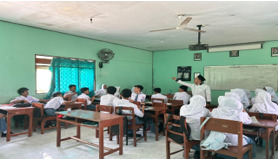
Implementing a Humanistic Approach in Akidah Akhlak Learning to Cultivate Students’ Love of Science at MAN 2 Klaten
DOI:
https://doi.org/10.61455/sujiem.v4i02.663Keywords:
humanistic approach, love of science, akidah akhlak learning, madrasah aliyah, teacher-student relationshipAbstract
Objective: This study describes how an Akidah Akhlak teacher applies a humanistic approach at State Islamic Senior High School (Madrasah Aliyah Negeri, MAN) 2 Klaten, Indonesia, and interprets how these practices may support the conditions for students’ love of science. Theoretical framework: The analysis draws on Maslow’s hierarchy of needs, Rogers’ person-centred learning, Freire’s dialogical education and Deci and Ryan’s self-determination theory, and treats hubb al-ʿilm as an Islamic educational orientation that overlaps with, but is not identical to, intrinsic motivation. Literature review: The literature review examines humanistic Islamic education through Maslow, Rogers, Freire, and self-determination theory, highlighting the relationship between student autonomy, emotional needs, moral learning, and hubb al-ʿilm. Research gap: Earlier studies of humanistic Akidah Akhlak learning have mostly examined primary-level madrasahs and moral outcomes such as courtesy and discipline, leaving field evidence on knowledge-oriented outcomes at the Madrasah Aliyah level limited. Methods: A qualitative case study used semi-structured interviews, passive participatory classroom observation and documentation review. Data were analysed with the interactive model of Miles, Huberman and Saldaña, and credibility was supported by source triangulation and member checking. Results: Three interrelated strategies emerged: differentiating methods according to class conduciveness; negotiating relational agreements that recognise students’ basic needs and autonomy, namely a responsibility-based eating and drinking policy and the absence of homework; and responding to mistakes with mild consequences followed by reflective dialogue on the purpose of seeking knowledge. Together, these practices appear to create a low-threat climate that is conducive to curiosity and to a shift from external towards more internalised motivation. Because the evidence rests mainly on the teacher’s account, supported by classroom observation and documents, the study does not claim that students’ love of science was measured or has increased. Implications: The three-stage model offered here is a contextual interpretation of one case, and may inform teacher reflection and training in comparable madrasahs. Novelty: The study foregrounds hubb al-ʿilm as an affective orientation in humanistic Akidah Akhlak learning at the Madrasah Aliyah level and documents concrete relational agreements that are rarely reported.
References
D. Sari, “Implementasi pembelajaran akidah akhlak dalam meningkatkan perilaku siswa,” FATHIR: Jurnal Studi Islam, vol. 2, no. 1, pp. 113–125, 2025, doi: 10.71153/fathir.v2i1.221.
A. Sahin, “Love of learning as a humanizing pedagogic vocation: Perspectives from traditions of higher education in Islam,” in Higher Education and Love: Institutional, Pedagogical and Personal Trajectories, V. de Rijke, A. Peterson, and P. Gibbs, Eds. Cham, Switzerland: Palgrave Macmillan, 2022, pp. 135–187, doi: 10.1007/978-3-030-82371-9_8.
A. H. Maslow, “A theory of human motivation,” Psychological Review, vol. 50, no. 4, pp. 370–396, 1943, doi: 10.1037/h0054346.
C. R. Rogers, Freedom to Learn. Columbus, OH, USA: Charles E. Merrill, 1969.
S. Idris and T. Za, “Realitas konsep pendidikan humanisme dalam konteks pendidikan Islam,” Jurnal Edukasi: Jurnal Bimbingan Konseling, vol. 3, no. 1, pp. 96–110, 2017, doi: 10.22373/je.v3i1.1420.
A. M. Abidin, “Konsep pendidikan humanistik dan relevansinya dengan pendidikan Islam,” Didaktika: Jurnal Kependidikan, vol. 15, no. 2, pp. 101–115, 2022, doi: 10.30863/didaktika.v15i2.61.
M. C. Muzaini and I. Ichsan, “Implementasi nilai humanisme dalam pembelajaran akidah akhlak pada peserta didik Madrasah Ibtidaiyah,” Jurnal Ilmiah Wahana Pendidikan, vol. 9, no. 2, pp. 329–338, 2023, doi: 10.5281/zenodo.7572953.
M. Musthofa, N. Nasikhin, and A. Z. M. Zabidi, “Implementation of humanistic education in shaping to a moderate attitude in elementary schools,” Edukasia Islamika: Jurnal Pendidikan Islam, vol. 8, no. 1, pp. 1–21, 2023, doi: 10.28918/jei.v8i1.363.
Y. A. Arofaturrohman, Z. Alqudsi, and E. Fauziati, “Implementasi teori belajar humanisme dalam pembelajaran pendidikan agama Islam perspektif Carl Rogers,” TSAQOFAH, vol. 3, no. 1, pp. 140–147, 2023.
F. D. Insani, “Teori belajar humanistik Abraham Maslow dan Carl Rogers serta implikasinya dalam pembelajaran pendidikan agama Islam,” As-Salam: Jurnal Studi Hukum Islam & Pendidikan, vol. 8, no. 2, pp. 209–230, 2019, doi: 10.51226/assalam.v8i2.140.
S. Sultani, A. Alfitri, and N. Noorhaidi, “Teori belajar humanistik dan penerapannya dalam pembelajaran pendidikan agama Islam,” ANSIRU PAI: Pengembangan Profesi Guru Pendidikan Agama Islam, vol. 7, no. 1, pp. 177–190, 2023, doi: 10.30821/ansiru.v7i1.16108.
M. I. Chailani, A. W. Fahrub, L. L. F. Rohmatilah, and A. Kurniawan, “Teori belajar humanistik dan implikasinya dalam pembelajaran PAI,” Jurnal Pendidikan, vol. 33, no. 2, pp. 583–594, 2024, doi: 10.32585/jp.v33i2.5287.
D. L. Roorda, H. M. Y. Koomen, J. L. Spilt, and F. J. Oort, “The influence of affective teacher–student relationships on students’ school engagement and achievement: A meta-analytic approach,” Review of Educational Research, vol. 81, no. 4, pp. 493–529, 2011, doi: 10.3102/0034654311421793.
M. A. Fabris, D. Roorda, and C. Longobardi, “Editorial: Student-teacher relationship quality research: Past, present and future,” Frontiers in Education, vol. 7, Art. no. 1049115, 2022, doi: 10.3389/feduc.2022.1049115.
M. A. Fabris, S. Lin, and C. Longobardi, “A cross-cultural comparison of teacher-student relationship quality in Chinese and Italian teachers and students,” Journal of School Psychology, vol. 99, Art. no. 101227, 2023, doi: 10.1016/j.jsp.2023.101227.
C. Longobardi, E. Sagone, and A. Crescentini, “Editorial: Highlights in educational psychology: Teacher-student relationship,” Frontiers in Psychology, vol. 15, Art. no. 1529198, 2024, doi: 10.3389/fpsyg.2024.1529198.
F. Hasanah, C. Kamalludin, and K. Kamalludin, “Implementasi pendidikan karakter religius melalui pembelajaran akidah akhlak di Madrasah Ibtidaiyah Nurul Yaqin Kota Bogor,” Ibriez: Jurnal Kependidikan Dasar Islam Berbasis Sains, vol. 4, no. 2, pp. 217–222, 2019, doi: 10.21154/ibriez.v4i2.80.
D. Ambarsari and A. Darmiyati, “Implementasi pembelajaran akidah akhlak dalam membentuk karakter siswa di MI Tarbiyatussibyan Telukjambe Timur Karawang,” Jurnal Education and Development, vol. 10, no. 1, pp. 371–378, 2022. [Online]. Available: https://journal.ipts.ac.id/index.php/ED/article/view/3466
P. Putra, “Implementasi pendidikan karakter dalam pembelajaran aqidah akhlak (studi multi kasus di MIN Sekuduk dan MIN Pemangkat Kabupaten Sambas),” Al-Bidayah: Jurnal Pendidikan Dasar Islam, vol. 9, no. 2, 2017. [Online]. Available: https://ejournal.uin-suka.ac.id/tarbiyah/albidayah/article/view/9095
C. R. Rogers and H. J. Freiberg, Freedom to Learn, 3rd ed. New York, NY, USA: Merrill/Macmillan, 1994.
R. M. Ryan and E. L. Deci, “Self-determination theory and the facilitation of intrinsic motivation, social development, and well-being,” American Psychologist, vol. 55, no. 1, pp. 68–78, 2000, doi: 10.1037/0003-066X.55.1.68.
E. L. Deci and R. M. Ryan, “The ‘what’ and ‘why’ of goal pursuits: Human needs and the self-determination of behavior,” Psychological Inquiry, vol. 11, no. 4, pp. 227–268, 2000, doi: 10.1207/S15327965PLI1104_01.
R. M. Ryan and E. L. Deci, “Intrinsic and extrinsic motivation from a self-determination theory perspective: Definitions, theory, practices, and future directions,” Contemporary Educational Psychology, vol. 61, Art. no. 101860, 2020, doi: 10.1016/j.cedpsych.2020.101860.
P. Freire, Pedagogy of the Oppressed, M. B. Ramos, Trans., 30th anniversary ed. New York, NY, USA: Continuum, 2000 (original work published 1970).
I. Prajoko and M. S. Abrori, “Penerapan teori humanistik Carl Rogers dalam pembelajaran PAI,” Tarbawiyah: Jurnal Ilmiah Pendidikan, vol. 5, no. 1, pp. 15–26, 2021, doi: 10.32332/tarbawiyah.v5i1.2894.
M. M. Solichin, “Teori belajar humanistik dan aplikasinya dalam pendidikan agama Islam: Telaah materi dan metode pembelajaran,” Islamuna: Jurnal Studi Islam, vol. 5, no. 1, pp. 1–18, 2018, doi: 10.19105/islamuna.v5i1.1856.
B. A. Habsy, D. Afkar, N. N. Nejwa, and P. Nurkumalasari, “Peranan teori belajar humanistik untuk meningkatkan efektivitas pembelajaran,” TSAQOFAH, vol. 4, no. 1, pp. 66–78, 2023, doi: 10.58578/tsaqofah.v4i1.2130.
K. H. Dewantara, Pendidikan: Bagian Pertama. Yogyakarta, Indonesia: Majelis Luhur Persatuan Taman Siswa, 1977.
M. I. Alqosam, A. Maulida, and M. Priyatna, “Implementasi pembelajaran akidah akhlak dalam membentuk karakter religius siswa tingkat SMP,” Cendikia, 2022. [Online]. Available: https://jurnal.staialhidayahbogor.ac.id/index.php/cendikia/article/view/2990
F. D. Sabrina and Nurfuadi, “Implementasi pembelajaran akidah akhlak dalam membentuk karakter anak,” Jurnal Citra Pendidikan, vol. 3, no. 4, pp. 1587–1593, 2023, doi: 10.38048/jcp.v3i4.3024.
N. Sari, J. Januar, and A. Anizar, “Implementasi pembelajaran akidah akhlak sebagai upaya mendidik kedisiplinan siswa,” Educativo: Jurnal Pendidikan, vol. 2, no. 1, pp. 45–53, 2023, doi: 10.56248/educativo.v2i1.107
S. M. N. Al-Attas, The Concept of Education in Islam: A Framework for an Islamic Philosophy of Education. Kuala Lumpur, Malaysia: Akademi Belia Islam Malaysia (ABIM), 1980.
J. Reeve and S. H. Cheon, “Autonomy-supportive teaching: Its malleability, benefits, and potential to improve educational practice,” Educational Psychologist, vol. 56, no. 1, pp. 54–77, 2021, doi: 10.1080/00461520.2020.1862657.
C. P. Niemiec and R. M. Ryan, “Autonomy, competence, and relatedness in the classroom: Applying self-determination theory to educational practice,” Theory and Research in Education, vol. 7, no. 2, pp. 133–144, 2009, doi: 10.1177/1477878509104318.
M. R. B. Siregar, A. D. Angelina, M. Maisarah, L. Annisa, M. Mardianto, and H. Haidir, “Peran literasi baca tulis dalam menumbuhkan minat membaca siswa di Madrasah Tsanawiyah Negeri,” Munaddhomah: Jurnal Manajemen Pendidikan Islam, vol. 3, no. 2, pp. 149–159, 2023, doi: 10.31538/munaddhomah.v3i2.237.
M. R. Andhika, “Upaya guru dalam meningkatkan minat belajar siswa,” Al-Ihtirafiah: Jurnal Ilmiah Pendidikan Guru Madrasah Ibtidaiyah, vol. 9, no. 2, pp. 54–63, 2021.
Y. Fernando, P. Andriani, and H. Syam, “Pentingnya motivasi belajar dalam meningkatkan hasil belajar siswa,” Alfihris: Jurnal Inspirasi Pendidikan, vol. 2, no. 3, pp. 61–68, 2024, doi: 10.59246/alfihris.v2i3.843.
D. Darmawan and N. A. Pernaningtik, “Ekosistem pembentukan motivasi: keteladanan guru dan pendampingan orang tua pada siswa madrasah,” Jurnal Pahlawan, vol. 22, no. 1, pp. 89–112, 2026, doi: 10.57216/pah.v22i1.51.
M. Zulqarnain, “An investigation of teacher-student relationship in Islamic history of education,” Tarbiya: Journal of Education in Muslim Society, vol. 4, no. 1, pp. 13–21, 2017, doi: 10.15408/tjems.v4i1.5317.
J. Cornelius-White, “Learner-centered teacher-student relationships are effective: A meta-analysis,” Review of Educational Research, vol. 77, no. 1, pp. 113–143, 2007, doi: 10.3102/003465430298563.
S. Kumari, “Humanism in education: Fostering student-centered learning through Maslow’s and Rogers’ theories,” International Journal of Research Publication and Reviews, vol. 5, no. 6, pp. 2447–2452, 2024, doi: 10.55248/gengpi.5.0724.1911.
J. W. Creswell and C. N. Poth, Qualitative Inquiry and Research Design: Choosing Among Five Approaches, 4th ed. Thousand Oaks, CA, USA: SAGE, 2018.
Sugiyono, Metode Penelitian Kualitatif, rev. ed. Bandung, Indonesia: Alfabeta, 2021.
B. Flyvbjerg, “Five misunderstandings about case-study research,” Qualitative Inquiry, vol. 12, no. 2, pp. 219–245, 2006, doi: 10.1177/1077800405284363.
M. B. Miles, A. M. Huberman, and J. Saldaña, Qualitative Data Analysis: A Methods Sourcebook, 3rd ed. Thousand Oaks, CA, USA: SAGE, 2014.
L. Birt, S. Scott, D. Cavers, C. Campbell, and F. Walter, “Member checking: A tool to enhance trustworthiness or merely a nod to validation?,” Qualitative Health Research, vol. 26, no. 13, pp. 1802–1811, 2016, doi: 10.1177/1049732316654870.