Islamic Human Capital Model Based on Sharia Economics and SDGs: A Study at Abdullah Al Busyroni Tahfiz Al-Qur'an Islamic Boarding School
DOI:
https://doi.org/10.61455/sujiem.v4i02.658Keywords:
islamic education, human capital, islamic boarding school, sharia economics, sdgsAbstract
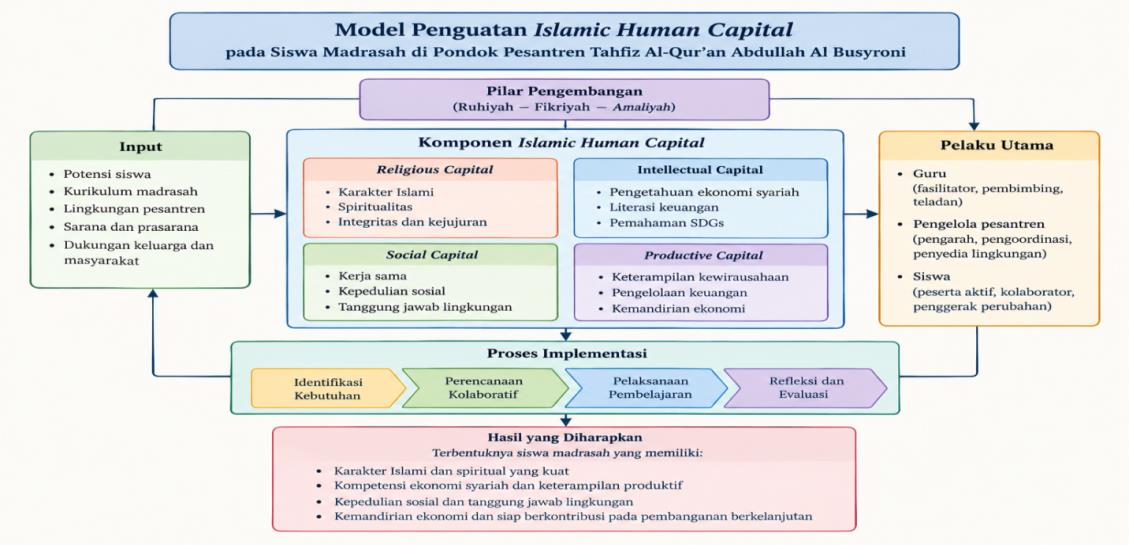
Objective: This study aims to develop an Islamic Human Capital strengthening model through Sharia economics education integrated with the Sustainable Development Goals at the Abdullah Al Busyroni Tahfiz Al-Qur'an Islamic Boarding School, Serdang Bedagai, North Sumatra. Theoretical Framework: The framework integrates Islamic Human Capital, Sharia economics education, and sustainable development, emphasizing spiritual values, intellectual capacity, social responsibility, and productive competencies. Literature Review: Previous studies have examined Islamic education, character development, entrepreneurship, and SDGs separately. Limited research has explored their integration into a comprehensive model of Islamic Human Capital development in Islamic boarding schools. Methods: This study employs qualitative applied research using Participatory Action Research. Data were collected through interviews, observations, documentation, and Focus Group Discussions , then analyzed using Miles, Huberman, and Saldaña's interactive model. Results: The findings reveal integration through fiqh muamalah, Islamic business principles, syirkah, mudharabah simulations, cooperative management, and environmentally responsible practices. The proposed model comprises four components: Religious Capital, Intellectual Capital, Social Capital, and Productive Capital, supported by three pillars: Spiritual Capital, Fikriyah Capital, and Amaliyah Capital. Teachers, administrators, and students contribute as facilitators, coordinators, and active participants, respectively. Implications: The model offers guidance for integrating Islamic values, economic competencies, and sustainability into pesantren education, although systematic validation remains necessary. Novelty: This study introduces an integrated Islamic Human Capital model connecting religious integrity, intellectual development, social engagement, and productive capabilities within an SDG-oriented Sharia economics education framework.
References
M. Adnan, “Islamic Education and Character Building in The 4.0 Industrial Revolution,” Nazhruna J. Pendidik. Islam, vol. 5, no. 1, Feb. 2022, doi: https://doi.org/10.31538/nzh.v5i1.1771.
I. O. N. Umami and M. Yasin, “Integrating Islamic Ethical Values into Human Resource Development: Enhancing Educational Quality in Indonesian Islamic Schools,” Dirosatuna J. Islam. Stud., vol. 7, no. 2, Feb. 2025, doi: https://doi.org/10.31538/dirosatuna.v7i2.7683.
H. Kader, “Human well-being, morality and the economy: an Islamic perspective,” Islam. Econ. Stud., vol. 28, no. 2, pp. 102–123, 2021, doi: https://doi.org/10.1108/IES-07-2020-0026.
Ahmad Kholil, Muhammad Zuardi, Amrin, and Juryatina, “Optimizing Islamic Financial Instruments in Indonesia to Support SDGs: Maqashid Syariah Perspective,” Profetika J. Stud. Islam, vol. 26, no. 01, pp. 191–210, 2025, doi: https://doi.org/10.23917/profetika.v26i01.9217.
K. Kaharuddin, A. Amrin, M. R. Nurdin, S. Sugiyarto, S. Su’ud, and S. Supriyanto, “The Role of Islamic Financial Literacy and Local Wisdom in Decisions to Use Sharia Banking Products: A Systematic Literature Review,” Mimb. Agama Budaya, vol. 41, no. 1, pp. 61–79, 2024, doi: https://doi.org/10.15408/mimbar.v41i1.38602.
F. Khan and M. K. Hassan, “Financing the Sustainable Development Goals (SDGs): The Socio-Economic Role of Awqaf (Endowments) in Bangladesh,” in Revitalization of Waqf for Socio-Economic Development, Volume II, K. M. Ali, M. K. Hassan, and A. elrahman E. S. Ali, Eds., Cham: Springer International Publishing, 2019, pp. 35–65. doi: https://doi.org/10.1007/978-3-030-18449-0_3.
A. A. R. Supriyanto, Amrin, “ISLAMIC EDUCATION PARADIGM ( A Case Study at Islamic Boarding School of Al-Muayyad Surakarta ),” Akad. J. Pemikir. Islam, vol. 27, no. 1, pp. 31–46, 2022, doi: https://doi.org/10.32332/akademika.v27i1.4562.
A. Supriyanto, “Concepts and Paradigms of Islamic Education in Indonesian Islamic Boarding Schools (Study at Al-Mukmin Ngruki Islamic Boarding School) 1),” Int. J. Humanit. Educ. Soc. Sci., vol. 2, no. 2, pp. 454–468, 2022, doi: https://doi.org/10.55227/ijhess.v2i2.257.
G. S. Becker, “Human Capital and the Economy,” Proc. Am. Philos. Soc., vol. 136, no. 1, pp. 85–92, May 1992, [Online]. Available: http://www.jstor.org/stable/986801
P. N. Teixeira, “Gary Becker’s early work on human capital – collaborations and distinctiveness,” IZA J. Labor Econ., vol. 3, no. 1, p. 12, 2014, doi: https://doi.org/10.1186/s40172-014-0012-2.
S. Mandal, G. V. Misra, S. M. Abbas Naqvi, and N. Kumar, “Situational analysis of agricultural land leasing in Uttar Pradesh,” Land use policy, vol. 88, no. March, p. 104106, 2019, doi: https://doi.org/10.1016/j.landusepol.2019.104106.
M. U. Chapra, The Future of Economics: An Islamic Perspective. Leicester: Kube Publishing, 2016.
P. Smagorinsky, “Vygotsky’s Stage Theory: The Psychology of Art and the Actor under the Direction of Perezhivanie ,” Mind, Cult. Act., vol. 18, no. 4, pp. 319–341, Oct. 2011, doi: https://doi.org/10.1080/10749039.2010.518300.
J. D. Sachs, W. T. Woo, N. Yoshino, and F. Taghizadeh-Hesary, “Importance of Green Finance for Achieving Sustainable Development Goals and Energy Security,” in Handbook of Green Finance: Energy Security and Sustainable Development, J. D. Sachs, W. T. Woo, N. Yoshino, and F. Taghizadeh-Hesary, Eds., Singapore: Springer Singapore, 2019, pp. 3–12. doi: https://doi.org/10.1007/978-981-13-0227-5_13.
B. J. Caldwell, “Decentralisation and the Self-Managing School,” in International Handbook of Educational Research in the Asia-Pacific Region: Part One, J. P. Keeves, R. Watanabe, R. Maclean, P. D. Renshaw, C. N. Power, R. Baker, S. Gopinathan, H. W. Kam, Y. C. Cheng, and A. C. Tuijnman, Eds., Dordrecht: Springer Netherlands, 2003, pp. 931–944. doi: https://doi.org/10.1007/978-94-017-3368-7_64.
N. S. Nag, “Government, Governance and Good Governance,” Indian J. Public Adm., vol. 64, no. 1, pp. 122–130, 2018, doi: https://doi.org/10.1177/0019556117735448.
E. Ostrom, Governing the commons: The evolution of institutions for collective action. Cambridge University Press., 1990.
S. R. Arnstein, “A Ladder of Citizen Participation,” J. Am. Plan. Assoc., vol. 85, no. 1, pp. 24–34, 2019, doi: https://doi.org/10.1080/01944363.2018.1559388.
D. C. North, “The Contribution of the New Institutional Economics to an Understanding of the Transition Problem,” in Wider Perspectives on Global Development, A. B. Atkinson, K. Basu, J. N. Bhagwati, D. C. North, D. Rodrik, F. Stewart, J. E. Stiglitz, and J. G. Williamson, Eds., London: Palgrave Macmillan UK, 2005, pp. 1–15. doi: https://doi.org/10.1057/9780230501850_1.
Sugiyono, Metode Penelitian Kuantitatif, Kualitatif dan R&D. Bandung: CV. Alfabeta, 2018.
J. W. Creswell and J. D. Creswell, Research Design: Qualitative, Quantitative, and Mixed Methods Approaches. California: Sage publications, 2017.
M. B. Miles, A. M. Huberman, and J. Saldana, Qualitative data analysis: A methods sourcebook. Sage Publications, Inc, 2014.
L. J. Moleong, Metodologi Penelitian Kualitatif. In Metodologi Penelitian Kualitatif, 36th ed. Bandung: PT REMAJA ROSDAKARYA, 2017.
S. Oskamp and P. W. Schultz, Attitudes and Opinions. New York: Psychology Press, 2005. doi: https://doi.org/10.4324/9781410611963.
G. S. Becker, Human capital : a theoretical and empirical analysis, with special reference to education. The University of Chicago Press, 2009.
A. Rumjaun and F. Narod, “Social Learning Theory—Albert Bandura,” in Science Education in Theory and Practice: An Introductory Guide to Learning Theory, B. Akpan and T. J. Kennedy, Eds., Cham: Springer Nature Switzerland, 2025, pp. 65–82. doi: https://doi.org/10.1007/978-3-031-81351-1_5.
Muhammad Zuardi, Ahmad Kholil, Amrin, and Ishma Amelia, “Transformation of the Concept of Maslahah in Sustainable Islamic Finance: a Hermeneutic Analysis of al-Ghazali’s Thoughts and ash-Syatibi,” Profetika J. Stud. Islam, vol. 26, no. 01, pp. 211–228, 2025, doi: https://doi.org/10.23917/profetika.v26i01.9616.
N. Hoque, M. A. Khan, and K. D. Mohammad, “Poverty alleviation by Zakah in a transitional economy: a small business entrepreneurial framework,” J. Glob. Entrep. Res., vol. 5, no. 1, p. 7, 2015, doi: https://doi.org/10.1186/s40497-015-0025-8.
F. Menne, S. Mardjuni, M. Yusuf, M. Ruslan, A. Arifuddin, and I. Iskandar, “Sharia Economy, Islamic Financial Performance and Factors That Influence It—Evidence from Indonesia,” Economies, vol. 11, no. 4, 2023, doi: https://doi.org/10.3390/economies11040111.
Wartoyo and N. Haida, “The Actualization Of Sustainable Development Goals (SDGs) And Indonesia’s Economic Growth On Islamic Economic,” Iqtishaduna J. Ekon. dan Keuang. Islam, vol. 14, no. 1, pp. 107–124, 2023.
M. M. Alshater, I. Saba, I. Supriani, and M. R. Rabbani, “Fintech in islamic finance literature: A review,” Heliyon, vol. 8, no. 9, p. e10385, 2022, doi: https://doi.org/10.1016/j.heliyon.2022.e10385.
Z. Zaidi M, “Linguistic Clarity in Mudharabah Contracts: Ensuring Transparency and Fairness in Indonesian Islamic Financial Institutions,” J. Lang. Lang. Teach., vol. 12, no. 2, p. 708, 2024, doi: https://doi.org/10.33394/jollt.v12i2.9658.
A. Kolb and D. Kolb, “Eight important things to know about the experiential learning cycle,” Aust. Educ. Lead., vol. 40, no. 3, pp. 8–14, Sep. 2018, [Online]. Available: https://search.informit.org/doi/10.3316/informit.192540196827567
A. Sen, “Development as Freedom: an India perspective,” Indian J. Ind. Relat., pp. 157–169, 2006, [Online]. Available: https://www.jstor.org/stable/27768063
R. H. S. Lestari, A. K. Damayanti, and M. A. Masuwd, “Optimising Societal Welfare:: The Strategic Role of Maqashid Shariah and Maslahah in Contemporary Islamic Economics and Business,” Al-Insyiroh J. Stud. Keislam., vol. 11, no. 1, pp. 20–40, Mar. 2025, doi: https://doi.org/10.35309/alinsyiroh.v11i1.363.
OECD, Bridging the digital divide: Challenges and opportunities in education. Paris: OECD Publishing, 2021. doi: https://doi.org/10.1787/4d4c3c45-en.
M. Holdo, “Critical Reflection: John Dewey’s Relational View of Transformative Learning,” J. Transform. Educ., vol. 21, no. 1, pp. 9–25, 2023, doi: https://doi.org/10.1177/15413446221086727.
G. S. Becker, J. J. Elias, and Kevin M. Murphy, The Economic Approach: Unpublished Writings of Gary S. Becker. New York: University of Chicago Press, 2023.
R. H. Frank, “Melding Sociology and Economics: James Coleman’s Foundations of Social Theory,” J. Econ. Lit., vol. 30, no. 1, pp. 147–170, Dec. 1992, [Online]. Available: http://www.jstor.org/stable/2727881
M. D. Wojciechowska, “The role of public libraries in the development of social capital in local communities – a theoretical study,” Libr. Manag., vol. 42, no. 3, pp. 184–196, Jan. 2021, doi: https://doi.org/10.1108/LM-10-2020-0139.
T. Lickona, “Character Education The Cultivation of Virtue,” in Instructional-design Theories and Models, London: Routledge, 1999, p. 22.
A. Rijal, A. Kosasih, and E. S. Nurdin, “Thomas Lickona and Yusuf Qardhawi: Creating Value for Character Education Through Narrative,” in Proceedings of the International Conference on Language, Education, and Social Science (ICLESS 2022), Atlantis Press, 2022, pp. 15–24. doi: https://doi.org/10.2991/978-2-494069-15-2_3.
M. E. Hoque, “Three Domains of Learning: Cognitive, Affective and Psychomotor,” J. EFL Educ. Res., vol. 2, pp. 2520–5897, 2016, [Online]. Available: www.edrc-jefler.org
A. Amrin, “Strategi Ekonomi Syariah dalam Mewujudkan Kemakmuran Umat di Indonesia pada Era Modern,” Al-Ahkam J. Ilmu Syari’ah dan Huk., vol. 7, no. 1, pp. 35-55., 2022, doi: https://doi.org/10.22515/alahkam.v7i1.5108.
E. Munastiwi and S. Puryono, “Unprepared management decreases education performance in kindergartens during Covid-19 pandemic,” Heliyon, vol. 7, no. 5, p. e07138, 2021, doi: https://doi.org/10.1016/j.heliyon.2021.e07138.
A. Supriyanto, “Management of Islamic Religious Education Learning Based on Cooperative Problem E-Learning During The Covid-19 Pandemic (Study on Muhammadiyah High School Sukoharjo, Central Java),” J. Pendidik. dan Konseling, vol. 4, no. 3, pp. 30–36, 2022, [Online]. Available: https://core.ac.uk/download/pdf/322599509.pdf
R. Vhalery, C. Wardoyo, E. Soesilowati, and W. P. Rahayu, “A Conceptual Model of Economics Learning Based on Local Wisdom: Integrating the Theories of Lev Vygotsky and John Dewey,” Asian J. Interdiscip. Res., vol. 8, no. 2 Articles, pp. 124–141, Jun. 2025, doi: https://doi.org/10.54392/ajir2528.
D. A. Abdullah, A. Alimuddin, and B. Mukaddas, “Enhancing Student Creativity Through Plastic Waste Integration in Visual Art Education,” J. Innov. Res. Prim. Educ., vol. 4, no. 4, pp. 3463–3473, Oct. 2025, doi: https://doi.org/10.56916/jirpe.v4i4.2525.
Amrin, Muthoifin, S. Shobron, and H. R. Putra, “Islamic Values in the Peta Kapanca Tradition at the Mbojo Community tribe’s Marriage in West Nusa Tenggara, Indonesia,” Cakrawala J. Stud. Islam, vol. 15, no. 2, pp. 93–104, 2020, doi: https://doi.org/10.31603/cakrawala.3405.
M. Prince, “Addressing Teaching and Learning Challenges Amidst the Covid 19 Pandemic: Implications for the Nigeria Primary Schools,” Int. J. Integr. Educ., vol. 4, no. 1, pp. 1–7, 2021, [Online]. Available: https://www.neliti.com/publications/334464/
UNESCO, Education in the digital age: Opportunities and challenges. Paris: UNESCO Publishing, 2020. doi: https://unesdoc.unesco.org/ark:/48223/pf0000373715.
H. Oe, Y. Yamaoka, and H. Ochiai, “A Qualitative Assessment of Community Learning Initiatives for Environmental Awareness and Behaviour Change: Applying UNESCO Education for Sustainable Development (ESD) Framework,” International Journal of Environmental Research and Public Health, vol. 19, no. 6. p. 3528, 2022. doi: https://doi.org/10.3390/ijerph19063528.