Strategies for Enhancing Teaching and Learning Quality in the Implementation of the Merdeka Curriculum at SDIT Ar-Risalah Surakarta, Indonesia
DOI:
https://doi.org/10.61455/sujiem.v4i02.655Keywords:
teaching and learning quality, merdeka curriculum, transformational leadership, instructional supervision, islamic elementary educationAbstract
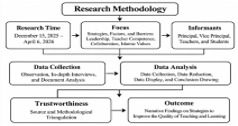
Objective: This study examines strategies for improving teaching and learning quality and identifies enabling and inhibiting factors in implementing the Merdeka Curriculum at SDIT Ar-Risalah Surakarta, Indonesia. Theoretical framework: The study draws on transformational leadership, organizational culture, instructional supervision, and teacher professionalism to explain how school leadership and collaborative practices support educational quality improvement. Literature review: Previous studies have emphasized the importance of curriculum implementation, teacher competence, and school leadership in improving learning outcomes. However, the integration of leadership transformation, coaching-based supervision, adaptive organizational culture, and teachers’ roles as learning designers requires further investigation within Islamic integrated elementary schools. Methods: This research employed a qualitative approach with a case study design. Participants included the principal, vice principal for curriculum affairs, teachers, and students. Data were collected through participant observation, in-depth interviews, and document analysis. Trustworthiness was established through source and methodological triangulation. Data analysis involved collection, reduction, display, and conclusion drawing. Results: Quality improvement strategies encompassed transformational instructional leadership, organizational culture strengthening, and resource optimization. The principal acted as an agent of change by promoting transformative role modeling, while teachers developed innovative and reflective learning practices. Implementation involved collaborative planning, coaching-based supervision, and continuous professional development. Enabling factors included transformational leadership, religiously grounded collaboration, and professional learning communities. Barriers comprised administrative demands during curriculum transition, diverse student learning needs, and limited digital resources. Implications: Effective curriculum implementation requires school leaders to foster collaboration, provide continuous professional support, adapt instruction to student diversity, and optimize available digital resources. Policymakers should strengthen administrative support and professional development opportunities. Novelty: This study proposes an integrative strategy model combining transformational leadership, coaching-based supervision, adaptive organizational culture, and teachers’ roles as learning designers to improve teaching and learning quality within the Merdeka Curriculum framework.
References
S. Friesen and B. Brown, “Knowledge brokering pivotal in professional learning : quality use of research contributes to teacher-leaders ’ confidence,” no. August, pp. 1–13, 2024, https://doi.org/10.3389/feduc.2024.1430357.
Y. Wang, “Exploring the impact of workload , organizational support , and work engagement on teachers ’ psychological wellbeing : a structural equation modeling approach,” no. January, pp. 1–13, 2024, https://doi.org/10.3389/fpsyg.2023.1345740.
L. A. Reddy, C. M. Dudek, and M. S. Poulou, “Teachers and school administrators ’ experiences with professional development feedback : The classroom strategies assessment system implementation,” no. February, pp. 1–10, 2023, https://doi.org/10.3389/fpsyg.2023.1074278.
J. I. Pendidikan, A. F. Nisa, and N. F. Uktolseja, “Cakrawala Pendidikan The nature-based school curriculum : A solution to learning-teaching that promotes students ’ freedom,” vol. 41, no. 3, pp. 643–652, 2022, https://doi.org/10.21831/cp.v41i3.47903.
A. Succarie, “education sciences Examining the Implications of Islamic Teacher Education and Professional Learning : Towards Professional Identity Renewal in Islamic Schools,” 2024, https://doi.org/10.3390/educsci14111192.
J. I. Pendidikan, R. Dwi, and A. Yuliantri, “Cakrawala Pendidikan Islamic character education model : An in-depth analysis for Islamic boarding school,” vol. 43, no. 2, pp. 370–380, 2024, https://doi.org/10.21831/cp.v43i2.66516.
J. I. Pendidikan, A. Komariah, B. B. Wiyono, and R. Meizatri, “Cakrawala Pendidikan E-leadership capacity and readiness for change in tackling learning innovation disruption in implementing Merdeka Belajar policy,” vol. 43, no. 2, pp. 398–410, 2024, https://doi.org/10.21831/cp.v43i2.71589.
D. M. Wijayanti, S. E. Pramono, and E. Handoyo, “Principal decision-making in implementing Merdeka Curriculum in elementary schools : a review,” vol. 13, no. 6, 2024, https://doi.org/10.11591/ijere.v13i6.28940.
F. R. Baharuddin, “May student-centered principles affect active learning and its counterpart ? An empirical study of Indonesian curriculum implementation,” no. December, pp. 1–16, 2023, https://doi.org/10.1177/21582440231214375.
J. Van Der Steen, T. Van Schilt-mol, and C. Van Der Vleuten, “Supporting Teachers in Improving Formative Decision-Making : Design Principles for Formative Assessment Plans,” vol. 7, no. June, pp. 1–9, 2022, https://doi.org/10.3389/feduc.2022.925352.
A. Kaya, “The association between transformational leadership and teachers ’ creativity : professional resilience and job satisfaction as mediators,” no. 1990, 2023, https://doi.org/10.3389/fpsyg.2024.1514621.
S. K. Amemasor, S. O. Oppong, B. Benuwa, and D. D. Essel, “A systematic review on the impact of teacher professional development on digital instructional integration and teaching practices,” no. May, pp. 1–14, 2025, https://doi.org/10.3389/feduc.2025.1541031.
M. Grgić and M. Jutzi, “Linking School Culture to Successful Curriculum Reform,” pp. 1–16, 2024, https://doi.org/10.3390/educsci14060558.
K. Meutstege, M. Vrielink, and M. Van Geel, “A cognitive task analysis of the teacher skills and knowledge required for differentiated instruction in secondary education,” no. October, pp. 1–14, 2023, https://doi.org/10.3389/feduc.2023.1171554.
J. I. Pendidikan, M. Solehuddin, D. Budimansyah, and A. Dahliyana, “Cakrawala Pendidikan Tracing Pancasila : unveiling the impact of the Pancasila student profile strengthening project on student well-being in Indonesia,” vol. 43, no. 3, pp. 773–787, 2024, https://doi.org/10.21831/cp.v43i3.78328.
M. Grgi, “education sciences Linking School Culture to Successful Curriculum Reform,” 2024, https://doi.org/10.3390/educsci14060558.
M. A. Kraft, D. Blazar, and D. Hogan, “The Effect of Teacher Coaching on Instruction and Achievement: A Meta-Analysis of the Causal Evidence Matthew A. Kraft,” vol. 88, no. 4, pp. 547–588, https://doi.org/10.3102/0034654318759268.
M. Antinluoma, L. Ilomäki, and A. Toom, “Practices of Professional Learning Communities,” vol. 6, no. April, pp. 1–14, 2021, https://doi.org/10.3389/feduc.2021.617613.
A. E. Smale-jacobse, A. Meijer, M. Helms-lorenz, and R. Maulana, “Differentiated Instruction in Secondary Education : A Systematic Review of Research Evidence,” vol. 10, no. November, 2019, https://doi.org/10.3389/fpsyg.2019.02366.
Z. H. Duraku and L. Hoxha, “Impact of Transformational and Transactional Attributes of School Principal Leadership on Teachers ’ Motivation for Work,” vol. 6, no. June, pp. 1–9, 2021, https://doi.org/10.3389/feduc.2021.659919.
I. W. Suastra and I. W. Lasmawan, “Implementation Challenges of Merdeka Curriculum in Primary Schools,” vol. 11, no. 4, pp. 952–959, 2023, https://doi.org/10.33394/j-ps.v11i4.8079.
A. Akbar, “Analyzing the Impact of the Merdeka Curriculum on Classroom Learning Quality : A Literature Review,” vol. 5, pp. 386–409, 2025.
M. Abdalla, “Exploring Tarbiyah in Islamic Education : A Critical Review of the English- and Arabic-Language Literature,” 2025, https://doi.org/10.3390/educsci15050559.
L. L. Torres, “education sciences School Organizational Culture and Leadership : Theoretical Trends and New Analytical Proposals,” 2022, https://doi.org/10.3390/educsci12040254.
D. I. Indonesia and U. Kepemimpinan, “How Is Social Media Used By Indonesian School Principals,” vol. 40, no. 1, pp. 70–80, 2021, https://doi.org/10.21831/cp.v40i1.32925.
H. Haq, “Evaluation of the Implementation of the Merdeka Belajar Curriculum in Secondary Schools in the Digital Era,” vol. 2, no. 4, pp. 215–228, 2024, https://doi.org/10.59944/postaxial.v2i4.391.
J. Penelitian, “Jurnal Paedagogy : Jurnal Paedagogy :,” vol. 12, no. 4, pp. 1255–1268, 2025.
M. Sa and Y. Agustyarini, “Improving Learning Quality through Implementation of Merdeka Curriculum in Elementary Schools,” vol. 3, no. 2, pp. 103–113, 2023, https://doi.org/10.31538/adrg.v3i2.1290.
J. I. Pendidikan, M. Nurhisyam, and A. Setiawan, “Cakrawala Pendidikan The influence of instructional leadership and work commitment on teacher performance,” vol. 43, no. 3, pp. 546–561, 2024, https://doi.org/10.21831/cp.v43i3.66677.
W. Sulaiman, M. Nur, and S. Ismail, “Merdeka Curriculum Learning Strategy in Effort Building Student Potential,” 2023, https://doi.org/10.70177/ijen.v2i1.628.
J. I. Pendidikan, L. Yuliana, L. D. Prasojo, A. Akalili, and F. M. Firdaus, “Cakrawala Pendidikan Development of a learning leadership model for vocational high school principals to foster student well-being within the framework of Merdeka Belajar,” vol. 44, no. 1, pp. 1–8, 2025, https://doi.org/10.21831/cp.v44i1.78373.
Y. Sari, L. P. Artini, M. H. Santosa, and I. P. I. Kusuma, “Merdeka Curriculum : Exploring Teachers ’ Strategies In Implementing 21st Century Skills,” no. 2015, pp. 98–107, 2024.
C. Azmi, “National Curriculum Education Policy " Curriculum Merdeka And Its Implementation ",” vol. 6, no. 1, pp. 303–309, 2023, https://doi.org/10.24036/ijeds.v6i1.437.
J. I. Pendidikan et al., “Cakrawala Pendidikan E-leadership capacity and readiness for change in tackling learning innovation disruption in implementing Merdeka Belajar policy,” vol. 43, no. June, pp. 1–9, 2023, https://doi.org/10.3389/feduc.2023.1171554.
S. Arani, “Optimizing Merdeka Curriculum in West Aceh : Challenges and Opportunities in Education,” vol. 20, no. 1, pp. 42–54, 2024, https://doi.org/10.32939/tarbawi.v20i1.3765.
N. Rahma, “Implementation of the Merdeka Curriculum in a Pioneer Elementary School : A Qualitative Study of Planning , Pedagogy , and Assessment Practices,” vol. 4, no. 4, pp. 3221–3234, 2025, https://doi.org/10.56916/jirpe.v4i4.2322.
R. Ahmad, M. Ansori, A. Pratama, and A. Hairit, “The Implementation of the Merdeka Curriculum ( Independent Curriculum ) in Strengthening Students ’ Character in Indonesia,” vol. 1, no. 1, 2023, https://doi.org/10.58223/aqlamuna.v1i1.237.
B. Volume, “The Implementation of the Merdeka Curriculum for English Teachers,” vol. 7, pp. 686–700, 2025, https://doi.org/10.24903/bej.v7i2.2202.
M. Astuti, “The Relevance Of The Merdeka Curriculum In Improving The Quality Of Islamic Education In Indonesia,” vol. 23, no. 6, pp. 56–72, 2024, https://doi.org/10.26803/ijlter.23.6.3.
B. Inggris, I. P. Raya, B. Inggris, and I. P. Raya, “Jurnal Ilmu Pendidikan Nasional The Teacher ’ s Role in The Implementation of Curriculum Merdeka in English Classroom Jurnal Ilmu Pendidikan Nasional,” vol. 1, no. 1, pp. 111–117, 2023, https://doi.org/10.59435/jipnas.v1i3.104.
I. G. P. Suharta, “Transforming Education in Indonesia : The Impact and Challenges of the Merdeka Belajar Curriculum,” vol. 10, no. 6, pp. 5026–5039, 2024, https://doi.org/10.22178/pos.105-31.