The Effectiveness of Differentiated Instruction Modules in Enhancing Sociology Learning Outcomes among Eleventh-Grade Students under the Merdeka Curriculum
DOI:
https://doi.org/10.61455/sujiem.v4i01.649Keywords:
differentiated learning, learning modules, learning outcomes, sociology, merdeka curriculumAbstract
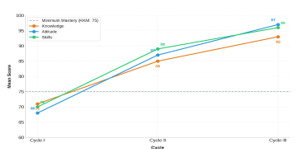
Objective: Uniform teaching ignores students' readiness, interests, and learning styles, resulting in suboptimal outcomes. To address diverse needs, differentiated learning adapts process, content, and product. This study aims to evaluate the implementation of differentiated learning in improving students' knowledge, attitudes, and skills. Theoretical framework: Three cycles of the Classroom Action Research (CAR) technique, which is based on the Kemmis & McTaggart model, were utilised in this study. Each cycle had the following stages: planning, action implementation, observation, and reflection. The research participants were 36 Grade XI SOSHUM students at Al-Azhar High School in Medan. The instruments used in this study were learning outcome tests for knowledge aspects, observation sheets for attitudes, and performance assessments for skill aspects. Literature review: Through differentiated content, method, and product, differentiated education takes into account students' varied learning profiles, interests, and readiness. Differentiated instruction has been shown in earlier research to have a positive impact on student learning outcomes. The application of varied teaching modules to enhance students' sociology knowledge, attitudes, and abilities is examined in this study. Method: The data were analyzed qualitatively and quantitatively to determine the improvement in the students' average learning outcomes. The research method used a differentiated learning approach through content, process, and product. This method was adapted to the students' learning styles (visual, auditory, and kinesthetic), as well as their interests and readiness. The study's findings demonstrate an improvement in students' learning outcomes in three areas, including knowledge. Results: In cycle I, students' average score was 71, which fell short of the required minimum. The average score increased to 85 in cycle II and 93 in cycle III. The average attitude score increased from 68 in cycle I to 87 in cycle II and 97 in cycle III. The average skill score increased from 70 in cycle I to 89 in cycle II and 96 in cycle III. Differentiated instruction can enhance students' cognitive, emotional, and psychomotor learning outcomes. Implications: The implementation of differentiated teaching modules can be a solution to overcome low learning outcomes by emphasizing readiness, interest, and learning styles, which is in line with Carol Ann Tomlinson's view. Novelty: The use of differentiated teaching modules that incorporate students' readiness, interests, and learning profiles through differentiated content, methods, and results in sociology learning is what makes this study interesting.
References
C. A. Tomlinson, “The Rationale for Differentiating Instruction in Academically Diverse Classrooms,” Differ. Instr. Acad. Divers. Classrooms, pp. 12–18, 2017. https://www.google.com/search?q=https://books.google.com/books%3Fid%3D14p3AwAAQBAJ
R. Smale-Jacobse, A. E., Meijer, A., Helms-Lorenz, M., & Maulana, “Differentiated instruction in secondary education: A systematic review of research evidence,” 2019, https://doi.org/10.3389/fpsyg.2019.02366.
Ç. Çetinkaya, “The Effect of Differentiated Social Studies Curriculum on Secondary School Gifted Students’ Verbal Creativity in İstanbul,” Sustain., vol. 15, no. 12, 2023, https://doi.org/10.3390/su15129205.
J. Van Tassel-Baska, “Differentiation in action: The Integrated Curriculum Model,” Rev. Educ., no. 368, pp. 225–244, 2015, https://doi.org/10.4438/1988-592X-RE-2015-368-296.
H. Elhoweris, N. Alhosani, N. Alsheikh, R.-M. G. Bacsal, and E. Bonti, “The Impact of an Enrichment Program on the Emirati Verbally Gifted Children,” J. Intell., vol. 10, no. 3, 2022, https://doi.org/10.3390/jintelligence10030068.
J. VanTassel-Baska and E. F. Brown, “Toward best practice: An analysis of the efficacy of curriculum models in gifted education,” Gift. Child Q., vol. 51, no. 4, pp. 342–358, 2007, https://doi.org/10.1177/0016986207306323.
and I. A. D. R. Prihandini, S. A. Azizah, “Sinergi antara pelaksanaan pembelajaran berdiferensiasi dengan Teaching at The Right Level dalam menghadirkan lingkungan belajar inklusif,” J. Teknol. Pendidikan, vol. 1, no. 2, pp. 1–11, 2023, https://doi.org/10.47134/jtp.v1i2.76.
I. Fitriah and A. Widiyono, “Analisis Kesulitan Pembelajaran Berdiferensiasi pada Materi Bagian Tubuh Tumbuhan di Sekolah Dasar,” Indo-MathEdu Intellectuals J., vol. 4, no. 2, pp. 961–974, 2023, https://doi.org/10.54373/imeij.v4i2.302.
N. G. Kahveci and Ö. Atalay, “Use of integrated curriculum model (ICM) in social studies: Gifted and talented students’ conceptions,” Eurasian J. Educ. Res., no. 59, pp. 91–112, 2015, https://doi.org/10.14689/ejer.2015.59.6.
J. VanTassel-Baska and S. Wood, “The Integrated Curriculum Model (ICM),” Learn. Individ. Differ., vol. 20, no. 4, pp. 345–357, 2010, https://doi.org/10.1016/j.lindif.2009.12.006.
M. B. Usman, Metodologi pembelajaran agama Islam. Ciputat Pers., 2002. https://books.google.co.id/books?id=rvXcDwAAQBAJ
S. Dharma, Penulisan Modul. Direktorat Tenaga Kependidikan, Direktorat Jenderal Peningkatan Mutu Pendidik dan Tenaga Kependidikan, Departemen Pendidikan Nasional, 2008. https://repositori.kemdikbud.go.id/https://repositori.kemdikbud.go.id/
N. A. Suprawoto, Mengembangkan bahan ajar dengan menyusun modul. Dinas Pendidikan Kabupaten Kebumen, 2009. http://eprints.uny.ac.id/66604/
Sukiman, Pengembangan sistem evaluasi. Insan Madani, 2012. https://opac.perpusnas.go.id/
N. H. P. and A. Danis, Desain pengembangan bahan ajar berbasis sains. Yayasan Kita Menulis, 2020. https://kitamenulis.id/2020/12/30/desain-pengembangan-bahan-ajar-berbasis-sains/
C. A. Tomlinson, “Classroom Responding to the Needs of All Learners 2nd Edition,” Artículo científico, pp. 1–25, 2014. https://books.google.com/books?id=14p3AwAAQBAJ
Hamalik, Proses Belajar Mengajar. Bumi Aksara, 2007. https://books.google.com/books?id=hKtJAQAACAAJ
S. Nasution, Berbagai pendekatan dalam proses belajar dan mengajar. Bumi Aksara, 2005. https://www.google.com/search?q=https://books.google.com/books%3Fid%3DwiBQEAAAQBAJ
Slameto, Belajar dan faktor-faktor yang mempengaruhinya. Rineka Cipta, 2013. https://www.google.com/search?q=https://opac.perpusnas.go.id/DetailOpac.aspx%3Fid%3D1046779
M. & Rostrienigsih, “Peningkatan Hasil Belajar Siswa dengan Menggunakan Metode Pembelajaran Active Learning Tipe Quiz Team Mata Pelajaran Keterampilan Dasar Komunikasi di SMK Negeri 1 Bogor,” J. Ekon. dan Pendidik., 2010, https://doi.org/10.21831/jep.v7i2.571.
Pusat Penelitian Kebijakan, "Dampak Penyederhanaan Kurikulum terhadap Pembelajaran: Belajar dari Penerapan Kurikulum Darurat di Masa Pandemi COVID-19," Badan Penelitian dan Pengembangan dan Perbukuan, Kementerian Pendidikan, Kebudayaan, Riset, dan Teknologi, Jakarta, Indonesia, Laporan Penelitian, 2021 https://repositori.kemdikbud.go.id/25838/
Kementerian Pendidikan, Kebudayaan, Riset, dan Teknologi Republik Indonesia, "Peraturan Menteri Pendidikan, Kebudayaan, Riset, dan Teknologi Nomor 12 Tahun 2024 tentang Kurikulum pada Pendidikan Anak Usia Dini, Jenjang Pendidikan Dasar, dan Jenjang Pendidikan Menengah, Jakarta, Indonesia, 2024 https://peraturan.bpk.go.id/Details/281847/permendikbudriset-no-12-tahun-2024
R. Kemmis, S., McTaggart, R., & Nixon, “The action research planner: Doing critical participatory action research,” Springer. https://doi.org/10.1007/978-981-4560-67-2.
S. Arikunto, Prosedur penelitian: Suatu pendekatan praktik (Ed. revisi VI, Cet. 13). Rineka Cipta, 2006. https://opac.perpusnas.go.id/DetailOpac.aspx?id=557184
Sudjiono, Pengantar evaluasi pendidikan. Rajawali Press, 2015. https://www.scribd.com/document/614546986/Pengantar-Evaluasi-Pendidikan-Oleh-Anas-Sudijono
Sugiyono, Metode Penelitian Kuantitatif, Kualitatif, dan R&D. Alfa Beta, 2021. https://opac.perpusnas.go.id/DetailOpac.aspx?id=1543971
Setiyowati, “Design/methodology/approach: This is an exploratory qualitative research, employing a thematic analysis approach. Six Muslim Wills (State) Enactments [Enakmen Wasiat Orang Islam (Negeri)] in Malaysia, Islamic Law Compilation (Kompilasi Hukum Islam) in Ind,” Croat. Int. Relations Rev., vol. 28, no. 89, pp. 136–149, 2022, https://doi.org/10.2478/CIRR-2022-0008.
J. Zahle, “Objective data sets in qualitative research,” Synthese, vol. 199, no. 1–2, pp. 101–117, 2021, https://doi.org/10.1007/s11229-020-02630-2.
H. Hasanah, “Teknik-Teknik Observasi (Sebuah Alternatif Metode Pengumpulan Data Kualitatif Ilmu-ilmu Sosial),” At-Taqaddum, vol. 8, no. 1, p. 21, 2020, https://doi.org/10.21580/at.v8i1.1163.
M. B. Miles and A. M. Huberman, Qualitative Data Analysis: An Expanded Sourcebook, 2nd ed. Thousand Oaks, CA, USA: SAGE Publications, 1994. https://books.google.com/books?id=U44-5685D3gC.
G. A. Bowen, “Document analysis as a qualitative research method,” Qual. Res. J., vol. 9, no. 2, pp. 27–40, 2009, https://doi.org/10.3316/QRJ0902027.
D. P. N. R. Indonesia, Peraturan Menteri Pendidikan Nasional Republik Indonesia Nomor 20 Tahun 2007 tentang standar penilaian pendidikan. 2007. https://sumsel.bpk.go.id/2009/10/20/peraturan-menteri-pendidikan-nasional-ri-no-20-tahun-2007-tentang-standar-penilaian-pendidikan/
T. Hidayat, A. S. Rizal, A. Abdussalam, and A. G. Fawwaz, “Designing Islamic Values Integration Into Sociology Learning,” J. Pendidik. Islam, vol. 6, no. 1, pp. 37–56, 2020, https://doi.org/10.15575/jpi.v6i1.8119.
J. K. Brigham and P. Imbertson, “Energy-Transition Education in a Power Systems Journey: Making the Invisible Visible and Actionable,” Am. J. Econ. Sociol., vol. 79, no. 3, pp. 981–1022, 2020, https://doi.org/10.1111/ajes.12347.
Mahmudulhassan, Muthoifin, A. Nirwana, Waston, and M. Abuzar, “Islam in Bangladesh: The Legacy of Hazrat Shah Jalal and the Spread of Islam in Bengal,” J. Al-Tamaddun, vol. 20, no. 2, pp. 127–144, 2025, https://doi.org/10.22452/JAT.vol20no2.9.
X. Lu, “Navigating ethnic capital and ethnic penalty: Chinese Muslim internal migrants in an international trade hub,” Ethn. Racial Stud., 2024, https://doi.org/10.1080/01419870.2024.2388688.
E. Supriyanto, “Model Penguatan Sekolah Madrasah Untuk Melayani Siswa Berkecerdasan Tinggi Melalui Implementasi Pembelajaran Berbasis Sistem Kredit Semester (Sks),” Profetika J. Stud. Islam, vol. 17, no. 02, pp. 15–28, 2017, https://doi.org/10.23917/profetika.v17i02.5294.
R. M. Abdelrahman, “Metacognitive awareness and academic motivation and their impact on academic achievement of Ajman University students,” Heliyon, vol. 6, no. 9, 2020, https://doi.org/10.1016/j.heliyon.2020.e04192.
P. Allison and T. Stott, “Journeying in Outdoor and Environmental Education,” in International Explorations in Outdoor and Environmental Education, vol. 9, The Pennsylvania State University, State College, PA, United States: Springer Science and Business Media B.V., 2021, pp. 161–172. https://doi.org/10.1007/978-3-030-75980-3_14.
H. Alidou, A. Boly, B. Brock-Utne, and Y. Diallo, “Optimizing Learning and Education in Africa – the Language Factor,” in Association for the Development of Education in Africa (ADEA) UNESCO Institute for Education Deutsche Gesellschaft für Technische Zusammenarbeit, Libreville, Gabon: Association for the Development of Education in Africa (ADEA), 2006, pp. 1–186. https://unesdoc.unesco.org/ark:/48223/pf0000147053
W. Waston, S. Amini, and M. Arifin, “A moral-based curriculum to improve civilization and human resource development in Bangladesh,” Multidiscip. Rev., vol. 7, no. 8, 2024, https://doi.org/10.31893/multirev.2024137.