The Crisis and Reconstruction of Islamic Educational Thought: A Philosophical Analysis of Knowledge, Identity, and Modernity
DOI:
https://doi.org/10.61455/sujiem.v4i01.644Keywords:
islamic educational thought, modernity, muslim identity, philosophy of education, knowledgeAbstract
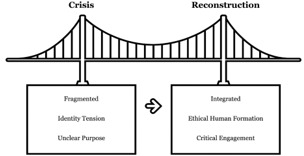
Objective: This research aims to critically analyze the crisis and reconstruction of Islamic educational thought through a philosophical study of the concepts of knowledge, identity, and modernity. The main focus is to understand the philosophical basis that underlies Islamic education in the midst of contemporary knowledge changes. Theoretical framework: The theoretical framework rests on the relationship between revelation, ratio, ethical formation, and social transformation in the Islamic educational tradition. This framework is used to analyze the tension between Islamic epistemology and the paradigm of modern knowledge. Literature review: The literature review covers the classical Islamic educational tradition as well as contemporary intellectual debates on the relationship between revelation, reason, and modern knowledge systems. The literature is used to identify epistemological crises, identity issues, and challenges of modernity in Islamic education. Method: The research uses a philosophical inquiry approach by philosophically analyzing the classical Islamic educational tradition and contemporary thought. This approach is used to critically examine the foundation of knowledge, educational goals, and human development in the context of modernity. Results: The results of the analysis show that the crisis of Islamic education is related to the tension between inherited epistemological traditions and modern paradigms that tend to separate scientific rationality from spiritual and ethical dimensions. The reconstruction of Islamic education requires an integrative epistemological framework. Implications: The findings imply that Islamic educational reform needs to be directed not only at the modernization of institutions or curricula, but also at the philosophical reconstruction of human knowledge and development. Education needs to integrate knowledge, ethical formation, and Muslim identity in the face of contemporary reality. Novelty: The novelty of the article lies in the placement of the crisis of Islamic education as a philosophical and epistemological problem, not merely an institutional or pedagogical problem. The article offers the idea of reconstructing Islamic education through the integration of modern knowledge with the philosophical foundation of Islam.
References
B. M. Nur, “Politics of epistemology in postcolonial Africa: The Islamisation of knowledge in the Sudan,” Polit. Relig. Ideol., vol. 23, no. 4, pp. 475–496, 2022, https://doi.org/10.1080/21567689.2022.2139688.
S. S. Susanti et al., “Innovative Digital Media in Islamic Religious Education Learning,” J. Pendidik. Agama Islam, vol. 21, no. 1, pp. 40–59, 2024, https://doi.org/10.14421/jpai.v21i1.7553.
L. Safitri, F. M. Manshur, and H. Thoyyar, “Nurcholish Madjid on Indonesian Islamic Education: A Hermeneutical Study,” J. Ilm. Islam Futur., vol. 22, no. 2, pp. 244–259, 2022, https://doi.org/10.22373/jiif.v22i2.5749.
A. Darwanto, R. C. I. Prahmana, A. Susanti, and I. A. Khalil, “Transformation of Boarding School Management Models in Enhancing Student Accessibility and Educational Quality,” J. Pendidik. Agama Islam, vol. 21, no. 1, pp. 145–164, 2024, https://doi.org/10.14421/jpai.v21i1.8632.
Imran and A. Mardhiah, “Revitalizing Islamic Education: Professionalism of State Islamic Religious College Lecturers in Welcoming the Industrial Era 4.0,” J. Ilm. Peuradeun, vol. 11, no. 3, pp. 811–830, 2023, https://doi.org/10.26811/peuradeun.v11i3.1032.
A. Wedi, D. Mardiana, and Umiarso, “Digital Transformation Model of Islamic Religious Education in the AI Era: A Case Study of Madrasah Aliyah in East Java, Indonesia,” Int. J. Learn. Teach. Educ. Res., vol. 24, no. 8, pp. 842–863, 2025, https://doi.org/10.26803/ijlter.24.8.37.
S. H. Wahid, “Exploring the intersection of Islam and digital technology: A bibliometric analysis,” Soc. Sci. Humanit. Open, vol. 10, 2024, https://doi.org/10.1016/j.ssaho.2024.101085.
A. W. Muqoyyidin, N. Naim, and A. Z. Fitri, “Inclusive multicultural Islamic education and educational reform in Nurcholish Madjid’s thought: a bibliometric and systematic review,” Discov. Glob. Soc., vol. 4, no. 1, 2026, https://doi.org/10.1007/s44282-026-00507-2.
T. Lovat, “Teacher Ethos in Islam and the Pre-Islamic East,” The International Handbook of Teacher Ethos: Strengthening Teachers, Supporting Learners. Springer International Publishing, University of Newcastle, Australia, Callaghan, NSW, Australia, pp. 25–35, 2021. https://doi.org/10.1007/978-3-030-73644-6_3.
J. Jones, “Muslim feminism as Islamic modernism: Women’s activism in India between the Quran and the Constitution,” Mod. Asian Stud., vol. 58, no. 2, pp. 421–447, 2024, https://doi.org/10.1017/S0026749X23000495.
Azwar, A. H. Usman, U. M. Noor, and M. F. R. Abdullah, “Iṣlāḥ of Al-Ghazālī’S Ideas and Movements and Their Relevance to Contemporary Islamic Preaching,” Ulumuna, vol. 28, no. 1, pp. 453–484, 2024, https://doi.org/10.20414/ujis.v28i1.513.
M. Saja, N. B. Ali, K. A. A. Rashid, M. R. Rosli, and M. A. Redzuan, “Business Funding for Asnaf Zakat Entrepreneurs in Higher Education Institutions from Islamic Perspective,” in Lecture Notes in Networks and Systems, B. Alareeni and A. Hamdan, Eds., Academy of Contemporary Islamic Studies, Segamat, Malaysia: Springer Science and Business Media Deutschland GmbH, 2025, pp. 414–422. https://doi.org/10.1007/978-3-032-00441-3_40.
S. Tambak et al., “Continuous professional development for madrasa teacher professionalism: engaging motivation for engagement,” Int. J. Eval. Res. Educ., vol. 14, no. 4, pp. 3171–3182, 2025, https://doi.org/10.11591/ijere.v14i4.33501.
M. J. Thalgi, “Global citizenship from an Islamic educational perspective,” Cumhur. Dent. J., vol. 23, no. 2, pp. 1027–1051, 2019, https://doi.org/10.18505/cuid.527285.
S. Sertkaya, “Prophet Muhammad as an Educator and Dār al-Arqam as a Pioneering Educational Facility During the Formation of Islam,” Handbook of Islamic Philosophy: With 4 Figures and 10 Tables. Springer Nature, Charles Sturt University, Bathurst, NSW, Australia, pp. 837–859, 2026. https://doi.org/10.1007/978-981-95-4666-4_37.
H. Ghanbari, “An introduction to the educational tradition in the Persianate world: A historicist approach to philosophical foundations,” Soc. Sci. Humanit. Open, vol. 12, 2025, https://doi.org/10.1016/j.ssaho.2025.102167.
A. F. R. Putra et al., “Transmission of knowledge from Mā Warā’ Al-Nahr to Nusantara: The Central Asia Ulama network and its influence on Islamic intellectual traditions in the Malay archipelago - 18th-19th century,” Res. J. Adv. Humanit., vol. 6, no. 3, 2025, https://doi.org/10.58256/9xc13216.
M. Hisham, A. Ameen, and H. Hagras, “Sites of the Independent Madrasas in Cairo From Ṣalāh Al-Dīn Reign To the Ayyubid Dynasty’S End an Inductive and Analytical Study,” J. Gen. Union Arab Archaeol., vol. 11, no. 1, pp. 238–262, 2026, https://doi.org/10.21608/jguaa2.2025.318362.1214.
A. Wakano, S. Ernas, and U. Sai’dah, “Reproduction of multiculturalism in the development of information and communication technology at Islamic higher education institutions in Indonesia,” Int. J. Adv. Sci. Technol., vol. 29, no. 7, pp. 681–695, 2020.
Ja’far, M. Syahnan, Asrul, Z. Dahlan, and S. Ritonga, “Discovering the Legacy of Mandailing Ulama: Education, Intellectuals, and Politics in North Sumatra in the Early 20th Century,” Ulumuna, vol. 26, no. 2, pp. 296–336, 2022, https://doi.org/10.20414/ujis.v26i2.502.
Hayadin, K. Niam, Munawiroh, and R. Lukens-Bull, “Contemporary Changes in Islamic Higher Education in Indonesia: Dynamic Encounter between Modernization and Tradition,” J. Al-Tamaddun, vol. 20, no. 1, pp. 189–200, 2025, https://doi.org/10.22452/JAT.vol20no1.14.
Suroyo, B. M. Putra, and N. A. Fredyarini Soedjiwo, “Lir Ilir and the decolonial pedagogy of Sunan Kalijaga: Reclaiming Javanese epistemology in Islamic philosophy of education,” Educ. Philos. Theory, vol. 58, no. 11, pp. 987–1005, 2026, https://doi.org/10.1080/00131857.2026.2653155.
N. Yesmaganbet and N. Kairbekov, “Examination of the Activities of Religious Educators of the Soviet Period in the Context of the Development of European Religious Thought,” Pharos J. Theol., vol. 106, no. 3, pp. 1–15, 2025, https://doi.org/10.46222/pharosjot.106.3030.
M. F. A. Hamid et al., “Integrated Management Model of Malaysian Private Tahfiz Centers for User Acceptance Satisfaction by Using Linear Regression,” Baghdad Sci. J., vol. 22, no. 1, pp. 335–348, 2025, https://doi.org/10.21123/bsj.2024.9560.
S. H. M. Harizan and S. A. H. Mydin, “Tabayyun Measures for Self-Regulating Social Media Behaviour Among Muslim Consumers,” in Springer Proceedings in Business and Economics, Eds., Ed., Universiti Sains Malaysia: School of Distance Education, 2024, pp. 385–402. https://doi.org/10.1007/978-981-97-5400-7_21.
V. R. Wood and M. W. Pitts, “Globalization and the Islamic-Arab Region: The Need for and Role of Advanced Business Education in the Middle East and Northern Africa,” in Developments in Marketing Science: Proceedings of the Academy of Marketing Science, Richmond, United States: Virginia Commonwealth University, 2015, p. 248. https://doi.org/10.1007/978-3-319-10963-3_144.
M. Gerashi and A. Khalifeh, “The Importance of an Education-Oriented Approach to Neo-Sadrian Logic and Epistemology in Defining Scientific Terms: A Case Study on ‘Technology,’” J. Philos. Investig., vol. 19, no. 50, pp. 437–464, 2025, https://doi.org/10.22034/jpiut.2025.65527.3987.
Karwadi, A. R. Bin Zakaria, A. Setiyawan, and M. Ferdi Hasan, “Integration of critical pedagogy in Islamic education: a case study of pre-service teacher training,” Br. J. Relig. Educ., 2025, https://doi.org/10.1080/01416200.2025.2560905.
S. Vasalou, Al-Ghazālī and the Ideal of Godlikeness. Birmingham, United Kingdom: University Of Birmingham, 2025. https://doi.org/10.1093/9780198912477.001.0001.
R. Ravanbakhsh and M. Taqavi, “Muslim scholars and technological volition,” Technol. Soc., vol. 61, 2020, https://doi.org/10.1016/j.techsoc.2020.101263.
S. A. Muthalib, Masrizal, I. Abdullah, M. Yusuf, and H. A. Melayu, “Public Services for Non-Muslims in Aceh: Non-Muslim Rights in the Application of Islamic Sharia Law,” Res Mil., vol. 12, no. 2, pp. 85–101, 2022.
J. Meliza, E. Erwansyah, H. Harianto, and K. H. K. Ariffin, “Islamic entrepreneurship nurturing new ventures through Islamic principles,” in Strategies and Applications of Islamic Entrepreneurship, Kota Medan, Indonesia: IGI Global, 2023, pp. 56–66. https://doi.org/10.4018/978-1-6684-7519-5.ch004.
Z. N. Rashed, N. M. Zhaffar, S. S. Ihwani, and M. Iswantir, “Driving Islamic Education in the Era of the Industrial Revolution 4.0: Challenges and Strategies,” Glob. J. Al-Thaqafah, vol. 15, no. 1, pp. 18–33, 2025, https://doi.org/10.7187/GJAT072025-2.
K. A. Ahmad et al., “Mobile Learning of Islamic Studies: A Comprehensive Review,” J. Adv. Res. Appl. Sci. Eng. Technol., vol. 48, no. 2, pp. 211–224, 2025, https://doi.org/10.37934/araset.48.2.211224.
V. J. Pratana, R. Situmorang, C. Kustandi, and R. E. Indrajit, “Fostering Adaptive and Intelligent Learning Management Systems in Education 4.0: A Novel Framework for Implementation and Assessment,” Util. Math., vol. 122, pp. 750–763, 2025.
Ismail, M. A. Parinduri, and F. P. Ibarra, “Strengthening the Ideology of Islamic Religious Education in the Era of Technological Disruption,” J. Ilm. Ilmu Terap. Univ. Jambi, vol. 9, no. 2, pp. 465–473, 2025, https://doi.org/10.22437/jiituj.v9i2.41841.
Murdianto, “Islamic Virtues in Tradition: The Values of Islamic Education in the Ngasek Tradition in Lombok,” Int. J. Interdiscip. Soc. Community Stud., vol. 20, no. 1, pp. 47–66, 2025, https://doi.org/10.18848/2324-7576/CGP/v20i02/47-66.
E. Hadiati, A. Dwiyanto, D. A. Setianingrum, A. Jatmiko, and Iqbal, “Women Academic Leadership in Islamic Higher Education: Embracing the Society 5.0 Era,” Munaddhomah, vol. 6, no. 2, pp. 345–357, 2025, https://doi.org/10.31538/munaddhomah.v6i2.1860.
S. Sapiudin, T. Supriyadi, A. Rijal, and D. Mulyono, “Developing a Digitally Integrated Critical-Contextual Learning Model of Ushul Fiqh for Future Islamic Education Teachers,” Int. J. Learn. Teach. Educ. Res., vol. 24, no. 6, pp. 653–671, 2025, https://doi.org/10.26803/ijlter.24.6.30.
M. Fauziah, A. Hasanah, T. Priatna, and Q. Y. Zaqiah, “Reconstructing Curriculum Epistemology through the Tawhidic Worldview: A Conceptual Framework Based on Syed Muhammad Naquib al-Attas,” Int. J. Islam. Khazanah, vol. 16, no. 1, pp. 55–77, 2026, https://doi.org/10.15575/ijik.v16i1.54317.
Y. Baiza, Are Contemporary Islamic Education and Their Pedagogical Approaches Fit for Purpose? A Critique and Way Forward. London: Taylor And Francis, Institute Of Ismaili Studies, 2022. https://doi.org/10.4324/9781003193432-3.
M. R. M. Nor and I. Bahroni, “Iqbal’s philosophy on Islamic education: A historical perspective,” Glob. J. Al-Thaqafah, vol. 1, no. 1, pp. 15–24, 2011, https://doi.org/10.7187/gjat022011.01.01.
N. Ain Norman and M. Eisa Ruhullah, “Ibn Sina’S Contributions to Modernity: Integrating Medieval Philosophy, Neurophilosophy, and Educational Reform in Islamic Thought and Civilization,” Al-Shajarah, vol. 2024, no. Special issue, pp. 225–248, 2024, https://doi.org/10.31436/shajarah.vi.1936.
S. Baizhuma et al., “Spiritual and Theological Aspects of Personal Development in the Heritage of Al-Farabi,” Pharos J. Theol., vol. 106, no. 4, 2025, https://doi.org/10.46222/pharosjot.106.4035.
W. K. Abdul-Jabbar, “Al-Kindi on the Anthropocene Curriculum: Intercultural Anthropo-Ethics and Citizenship Education,” Glob. Soc. Educ., 2025, https://doi.org/10.1080/14767724.2025.2529955.
H. Husni, H. Bisri, D. Darisman, and D. S. Munandar, “Beyond the Dichotomy of Science and Religion: Islamic Education in the Shadow of the Interconnected Theology of Fritjof Capra,” Pharos J. Theol., vol. 106, no. 4, pp. 1–12, 2025, https://doi.org/10.46222/pharosjot.106.4030.
H. M. F. Robby and I. A. Shafia, “Philosophizing Movement, Mobilizing Philosophers: Rausyan Fikr Institute and the Dissent Narratives of the Shia Islam Community in Indonesia,” Religions, vol. 16, no. 11, 2025, https://doi.org/10.3390/rel16111415.
M. A. S. Qatawneh and A. A. Al-Naimat, “Islamic Sustainable Development Theories and Their Intellectual Role in Developing Education During Pandemics,” Afkar, vol. 2022, pp. 221–244, 2022, https://doi.org/10.22452/afkar.sp2022no1.7.
R. Subhi, R. Karnedi, and A. M. Jibril, “Tashwir Between Tradition and Modernity: Contemporary Debates in Hadith and Scholarly Thought,” Nusant. J. Law Stud., vol. 3, no. 2, pp. 116–136, 2024, https://doi.org/10.5281/zenodo.17382483.
A. Zahoor et al., “A Phenomenological Analysis of Challenges and Benefits of Online Learning Transformation in the Master's of Health Professions Education,” Int. J. Interact. Mob. Technol., vol. 17, no. 22, pp. 117–135, 2023, https://doi.org/10.3991/IJIM.V17I22.41417.
Z. Berlian, M. Isnaini, R. Farwati, K. Metafisika, Y. Velina, and V. Fitriyanni, “Paper vs. Digital Assessments: Evaluating Critical Thinking on Ecological Issues in Indonesian Madrasahs,” J. Appl. Sci. Eng. Technol. Educ., vol. 7, no. 1, pp. 41–55, 2025, https://doi.org/10.35877/454RI.asci3785.
R. O. H. Serour, M. H. Musolin, M. A. Abdelmaksoud, and M. Huda, “Virtual Reality-Oriented Design for Islamic Learning Instruction: A Critical Review,” in Lecture Notes in Networks and Systems, vol. 1492 LNNS, R. S. Silhavy and P., Eds., Malaysia: Springer Science and Business Media Deutschland GmbH, 2025, pp. 355–368. https://doi.org/10.1007/978-3-031-96775-7_30.
K. A. Abdul Jaleel et al., “Cultivating knowledge: A comprehensive examination of madrasa education system in India,” in Studies in Systems, Decision and Control, vol. 525, Mangalore, India: Springer Science and Business Media Deutschland GmbH, 2024, pp. 787–801. https://doi.org/10.1007/978-3-031-54383-8_60.
G. H. Rassool, Advancing Islāmic Psychology Education: Knowledge Integration, Model, and Application. India: Riphah International University, Department Of Psychology, 2023. https://doi.org/10.4324/9781003329596.