Artificial Intelligence Literacy and Digital Ethics among University Students: An Islamic Education Perspective at Universitas Muhammadiyah Kudus
DOI:
https://doi.org/10.61455/sujiem.v4i01.639Keywords:
artificial intelligence literacy, digital ethics, university students, islamic education, responsible ai useAbstract
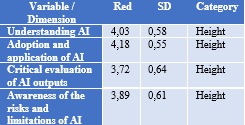
Objective: This study aims to analyze the level of artificial intelligence (AI) literacy and digital ethics among students at Universitas Muhammadiyah Kudus and to examine the effect of AI literacy on digital ethics from an Islamic education perspective. Theoretical framework: The study is grounded in the integration of AI literacy, digital ethics, and Islamic educational values. AI literacy encompasses understanding, application, critical evaluation, and risk awareness, while digital ethics emphasizes academic integrity, information verification, privacy protection, transparency, and responsible AI use. Islamic values of amanah (trustworthiness), sidq (truthfulness), tabayyun (verification), maslahah (public benefit), and hifz al-‘aql (protection of intellect) provide an ethical foundation for responsible AI use. Literature review: Previous studies have highlighted the importance of AI literacy for students’ technological competence and the growing need for digital ethics in academic environments. However, limited research has empirically examined the relationship between AI literacy and digital ethics while integrating Islamic educational values into a single analytical framework. Method: This study employed a quantitative explanatory approach using a cross-sectional survey design. Data were collected through a five-point Likert-scale questionnaire measuring AI literacy and digital ethics. Data were analyzed using descriptive statistics and simple linear regression at a significance level of 0.05. Results: AI literacy was categorized as high (mean = 3.96), as was digital ethics (mean = 4.05). AI use and application obtained the highest score, whereas critical evaluation of AI-generated outputs was the lowest. Regression analysis revealed a positive and significant relationship (R = 0.621; R² = 0.386; p < 0.001), indicating that AI literacy explained 38.6% of the variance in digital ethics. Implications: AI education should integrate technical competence, critical evaluation, information verification, privacy awareness, and ethical character formation. Novelty: The study’s novelty lies in integrating AI literacy, digital ethics, and Islamic values into one empirical framework, demonstrating that AI literacy is an important factor in strengthening students’ digital ethical behavior.
References
D. Anurogo, Hardin La Ramba, Nabila Diyana Putri, and Ulfah Mahardika Pramono Putri, “Digital Literacy 5.0 to Enhance Multicultural Education,” Multicult. Islam. Educ. Rev., vol. 1, no. 2, pp. 109–179, Dec. 2023, doi: 10.23917/mier.v1i2.3414.
J. Southworth et al., “Developing a model for AI Across the curriculum: Transforming the higher education landscape via innovation in AI literacy,” Comput. Educ. Artif. Intell., vol. 4, 2023, doi: 10.1016/j.caeai.2023.100127.
M. Abuzar, Mahmudulhassan, and Muthoifin, “University Students’ Trust in AI: Examining Reliance and Strategies for Critical Engagement,” Int. J. Interact. Mob. Technol., vol. 19, no. 07, pp. 70–82, Apr. 2025, doi: 10.3991/ijim.v19i07.52875.
J. C. R. Härtel and C. E. J. Härtel, “What the Digital Age Is and Means for Workers, Services, and Emotions Scholars and Practitioners,” Res. Emot. Organ., vol. 16, pp. 9–17, 2022, doi: 10.1108/S1746-979120200000016003.
U. (Ed) Carlsson, Understanding Media Literacy in the Digital Age. A question of democracy, no. Mil. Sweden: Department of Journalism, Media and Communication (JMG) University of Gothenburg, 2019.
N. Susilowati, I. N. Aeni, and A. P. Wijaya, “Examining religiosity to determine student ethical behavior intention,” Int. J. Eval. Res. Educ., vol. 11, no. 3, pp. 1107–1115, 2022, doi: 10.11591/ijere.v11i3.22185.
A. A. Mohamed, M. W. Shohib, and L. E. Rahmawati, “The Contribution of K.H. Ahmad Dahlan’s Thought to the Advancement of the Muslim Community in Indonesia,” J. World Thinkers, vol. 2, no. 1, pp. 153–164, 2024.
R. Al-sabahi and A. Said, “The Relevance of Abdul Fattah Abu Ghuddah ’ s Educational Thought for Society 5 . 0 and SDGs,” J. World Thinkers, vol. 2, no. 2, pp. 129–146, 2025.
M. Lister, J. Dovey, S. Giddings, K. Kelly, and I. Grant, Women & media: a critical introduction, vol. 44, no. 04. 2006. doi: 10.5860/choice.44-1949.
M. N. U. Sukisno, Sholihul Anwar, “Pendidikan islam di era society 5.0 sebagai upaya pengembangan ilmu pengetahun,” in Prosiding Seminar Internasional, 2023, pp. 275–283.
M. Abuzar, S. Uddin, and A. Khondoker, “Exploring the Dynamics of Student Motivation and Behavior : A Qualitative Analysis of Influencing Factors and Effective Interventions,” Solo Univers. J. Islam. Educ. Multicult., vol. 2, no. 3, pp. 195–206, 2024.
A. A. Rifa’i, P. K. Rahman, A. Wibowo, Y. Triana, A. Fadholi, and R. Ibrahim, “Study on Higher Education Vision Statement: Case From State Islamic Universities in Indonesia,” J. High. Educ. Theory Pract., vol. 21, no. 16, pp. 143–152, 2021, doi: 10.33423/jhetp.v21i16.4921.
D. M. Putri, “The Impact of Social Inequality on Educational Quality in Indonesia: Challenges and Policy Recommendations,” Solo Univers. J. Islam. Educ. Multicult., vol. 3, no. 1, pp. 43–56, 2025.
M. Zuhdi, “International Conference on Education in Muslim Society (ICEMS), held by the Faculty of Education UIN Syarif Hidayatullah Jakarta. Bandung, August 23, 2022.,” 2022.
U. Shakilla and E. P. Saputro, “Revolutionizing Management : The Role of AI and Technology in Modern Leadership Practices,” Solo Int. Colab. Publ. Soc. Sci. Humanit., vol. 3, no. 1, pp. 53–68, 2025.
A. Said, M. Ahmed, and A. Barry, “Balancing Digital Innovation and Sharia Compliance in Islamic Banking : A Legal and Governance Perspective,” J. Econ-Islamic Law Soc. Res., vol. 1, no. 3, pp. 195–210, 2025.
N. N. K. Warumman, “Faith-Based Pathways to SDG 16: Interfaith Engagement for Sustainable Peace,” Maktab. Rev. Sustain. Dev. Goals, vol. 2, no. 2, pp. 101–114, 2025.
S. A. Khosibah, A. Rahmaningrum, and C. T. Kusumawardani, “Potensi dan Praktik Literasi Artificial Intelligence (AI) dalam Pendidikan Anak Usia Dini di Indonesia: Systematic Literature Review,” JEA (Jurnal Edukasi AUD), vol. 11, no. 1, pp. 55–69, 2025, doi: 10.18592/jea.v11i1.16329.
D. S. Schiff, S. Kelley, and J. Camacho Ibáñez, “The emergence of artificial intelligence ethics auditing,” Big Data Soc., vol. 11, no. 4, 2024, doi: 10.1177/20539517241299732.
I. Celik, “Towards Intelligent-TPACK: An empirical study on teachers’ professional knowledge to ethically integrate artificial intelligence (AI)-based tools into education,” Comput. Human Behav., vol. 138, 2023, doi: 10.1016/j.chb.2022.107468.
C. A. Bail, “Can Generative AI improve social science?,” Proc. Natl. Acad. Sci. U. S. A., vol. 121, no. 21, pp. 1–10, 2024, doi: 10.1073/pnas.2314021121.
C.-P. Yen and T.-W. Hung, “Achieving Equity with Predictive Policing Algorithms: A Social Safety Net Perspective,” Sci. Eng. Ethics, vol. 27, no. 3, 2021, doi: 10.1007/s11948-021-00312-x.
K. Mamak, “AGI crimes? The role of criminal law in mitigating existential risks posed by artificial general intelligence,” AI Soc., 2024, doi: 10.1007/s00146-024-02036-5.
F. R. Omotoyinbo, “Smart soldiers: towards a more ethical warfare,” AI Soc., vol. 38, no. 4, pp. 1485–1491, 2023, doi: 10.1007/s00146-022-01385-3.
A. R. Et al., “A Study on Application of Artificial Intelligence and Machine Learning in Indian Taxation System,” Psychol. Educ. J., vol. 58, no. 2, pp. 1226–1233, 2021, doi: 10.17762/pae.v58i2.2265.
S. D. Maharani, K. Amin, and A. F. Taufiqoh, “Technological Progress, Artificial Intelligence Development and Ethical Paradigms,” Wisdom, vol. 22, no. 2, pp. 103–117, 2022, doi: 10.24234/wisdom.v22i2.636.
Mahmudulhassan, Muthoifin, and S. Begum, “Artificial Intelligence in Multicultural Islamic Education : Opportunities , Challenges , and Ethical Considerations,” Solo Univers. J. Islam. Educ. Multicult., vol. 2, no. 1, pp. 19–26, 2024.
W. Osama and A. Said, “SDGs-Driven People-Oriented Learning Environment and Institutional Adaptability in the Society 5.0 Era Walaa,” Maktab. Rev. Sustain. Dev. Goals, vol. 2, no. 1, pp. 63–78, 2025.
D. Anurogo, N. S. Sasmita, U. A. Syarif, R. Awaliah, B. M. Rachman, and J. Yi, “The Art of Healthy Neurophilocommunication,” vol. 1, no. 2, pp. 63–82, 2023.
A. N. An, F. Q. A. Tamami, Z. Daud, N. M. Salleh, M. H. bin Ishak, and M. Muthoifin, “Understanding the Integration of Deep Learning and Artificial Intelligence in Quranic Education and Research through Bibliometric Analysis,” Educ. Process Int. J., vol. 14, 2025, doi: 10.22521/edupij.2025.14.12.
M. Alfin Syahrian Dwi Nugraha, Diah Fatmawati, Isnaini Dwi Saputri, Olyvia Azzahra Putri Hartono, Rosela Dike Rantis, Mush’ab Umar Budihargo, “Islamic Principles and Pharmaceutical Innovation: Ethical Pathways Toward Sustainable Health Development,” Maktab. Rev. Sustain. Dev. Goals, vol. 1, no. 3, pp. 169–180, 2024.
K. Sholeha and W. Salsabilla, Najwa, “Moral Development Strategy In The Era Of Artifical Intelligence (AI),” in 1 st International Conference On Islamic Education And Islamic Business ( ICoBEI ) Islamic Studies Faculty Universitas Islam Riau 2024, 2024, pp. 2022–2025.
A. A. Mohamed, A. Anshori, and M. Yunus, Usman Aliyu, “Digital Waqf: The Role of Technology in Revitalizing Islamic Endowments for Sustainable Development,” Maktab. Rev. Sustain. Dev. Goals, vol. 2, no. 1, pp. 1–14, 2025.
P. Chatterjee, J. Chen, A. Yousafzai, I. Kawachi, and S. V. Subramanian, “When social identities intersect: understanding inequities in growth outcomes by religion- caste and religion-tribe as intersecting strata of social hierarchy for Muslim and Hindu children in India,” Int. J. Equity Health, vol. 22, no. 1, pp. 1–27, 2023, doi: 10.1186/s12939-023-01917-3.
S. Begum, “Artificial Intelligence in Multicultural Islamic Education : Opportunities , Challenges , and Ethical Considerations,” Solo Univers. J. Islam. Educ. Multicult., vol. 2, no. 1, pp. 19–26, 2024.
A. Yunita, H. B. Santoso, and Z. A. Hasibuan, “‘Everything is data’: towards one big data ecosystem using multiple sources of data on higher education in Indonesia,” J. Big Data, vol. 9, no. 1, 2022, doi: 10.1186/s40537-022-00639-7.
N. H. Naswa, “Ramadhan in the Digital Era: Tradition, Technology, and SDGs in Sragen,” Maktab. Rev. Sustain. Dev. Goals, vol. 2, no. 2, pp. 79–100, 2025.
T. A. Rafsanjani, M. Abdurrozaq, and F. Inayati, “Strategies for Implementing Character Education Curriculum to Mitigate Adolescent Delinquency at SMK Muhammadiyah Mayong,” Solo Int. Colab. Publ. Soc. Sci. Humanit., vol. 3, no. 1, pp. 27–40, 2025.
N. Kurnia Putra, A. Amrin, M. M. Abu Zinah, M. Masuwd, and S. Subhan, “Consumption from an Islamic Economic Perspective: Study of Quranic Verses on Consumption,” Demak Univers. J. Islam Sharia, vol. 1, no. 01, pp. 37–45, 2023, doi: 10.61455/deujis.v1i01.21.
T. Ardi Rafsanjani, R. Putri Rahmawati, and M. Abdurrozaq, “Sharia Pharmacy in the Perspective of the Qur’an: An Analysis of Verses About Medicine,” Demak Univers. J. Islam Sharia, vol. 3, no. 01, pp. 55–66, 2025, doi: 10.61455/deujis.v3i01.246.
M. A. R. Toni Ardi Rafsanjani and 1, “Educational Problems in Indonesia,” Solo Univers. J. Islam. Educ. Multicult., vol. 2, no. 2, pp. 135–144, 2024.
T. A. Rafsanjani and M. A. Rozaq, “Peran Gerakan Jama’Ah Dan Dakwah Jama’Ah Dalam Internalisasi Nilai-Nilai Islam Di Ranting Muhammadiyah Blimbingrejo,” Profetika J. Stud. Islam, vol. 23, no. 1, pp. 146–152, 2021, doi: 10.23917/profetika.v23i1.16804.
M. A. Rozaq and T. A. Rafsanjani, “The Effect of Speech Therapy With Hijaiyyah Letters on the Capability of Verbal Communication of Stroke Patients,” vol. 27, no. ICoSHEET 2019, pp. 233–235, 2020.