Inclusive Community Engagement in Mosque Networks: Developing a Communication Model for a Multicultural Society through the FOSIL BKM Medan Case Study
DOI:
https://doi.org/10.61455/sujiem.v4i01.637Keywords:
participatory communication, community, multicultural society, mosque networks, social capitalAbstract
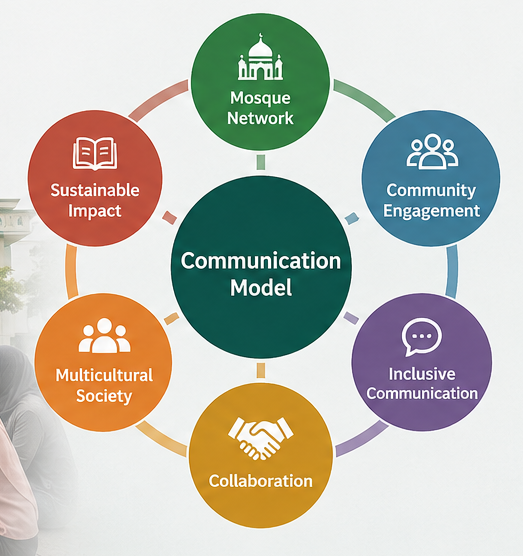
Objective: This study analyzes communication and inclusive community engagement in FOSIL BKM Medan and develops an initial communication model for mosque networks in a multicultural society. Theoretical framework: The study draws on participatory communication, social capital, collaborative governance, and symbolic interaction to explain relationships between dialogue, trust, collective action, and organizational meaning. Literature review: Previous studies address religious volunteering, community empowerment, and collaboration. The remaining question concerns how relational closeness becomes traceable decisions and coordinated action across mosque organizations while accommodating different community perspectives. Methods: A qualitative single-case approach uses participant observation, in-depth interviews, focus group discussions, and organizational document analysis. Interview excerpts from Informants support thematic interpretation. Analysis involves data condensation, presentation, verification, and pattern matching, distinguishing reported practices from normative policy proposals. Results: The accounts identify silaturahim as relational capital and emphasize documented follow-up, responses to aspirations, transparent commitments, and complementary digital and direct communication. These themes inform seven CECMN components: needs and asset mapping, structured dialogue, joint planning, collaborative implementation, network strengthening, hybrid communication, and participatory evaluation. Four propositions connect voice with influence, trust with commitment, networks with resources, and experience with learning. Implications: The model offers guidance for inclusive dialogue, responsibility allocation, and shared learning within Medan’s culturally plural setting. North Sumatran relational traditions provide contextual insights without establishing interethnic or interfaith outcomes. Implementation testing remains necessary. Novelty: The contribution is a context-specific integration of relational communication mechanisms and governance supports in the Community Engagement Communication Model for Mosque Network.
References
M. Amin and S. Muhammadah, “Improving mosque management: Strategies towards a center for Islamic activities,” Journal of Research and Community Service, vol. 1, no. 1, pp. 31–43, 2024, doi: https://doi.org/10.65663/dedica.v1i1.54.
A. D. N. Khalim, “The mosque as the centre of the Islamic political movement: Uncovering Al-Faruqi’s strategic vision in the contemporary era,” Dirasah: Jurnal Pendidikan Islam, vol. 6, no. 1, pp. 83–95, 2025, doi: https://doi.org/10.31332/jpi.v6i1.11418.
Dinas Pariwisata Kota Medan, “Pariwisata Kota Medan,” official city profile, n.d. [Online]. Available: https://medantourism.medan.go.id/profile. Accessed: Oct. 9, 2026.
Pemerintah Provinsi Sumatera Utara, “Edy Rahmayadi Yakin Dalihan Natolu Perekat Persaudaraan Perantau,” May 27, 2023. [Online]. Available: https://sumutprov.go.id/artikel/artikel/edy-rahmayadi-yakin-dalihan-natolu-perekat-persaudaraan-perantau. Accessed: Oct. 9, 2026.
L. Servaes and J. Servaes, “Participatory communication for social change,” in Handbook of Communication and Development, R. Obregon and S. Tufte, Eds. Cheltenham, U.K.: Edward Elgar, 2021, doi: https://doi.org/10.4337/9781789906356.00015.
R. D. Putnam, Bowling Alone: The Collapse and Revival of American Community. New York, NY, USA: Simon & Schuster, 2000.
M. Peucker, “Muslim community volunteering: The civic-religious ‘culture of benevolence’ and its sociopolitical implications,” Journal of Ethnic and Migration Studies, vol. 46, no. 11, pp. 2367–2386, 2020, doi: https://doi.org/10.1080/1369183X.2018.1543020.
W. Liu, W. W. Xu, and J.-Y. J. Tsai, “Developing a multi-level organization-public dialogic communication framework to assess social media-mediated disaster communication and engagement outcomes,” Public Relations Review, vol. 46, no. 4, Art. no. 101949, 2020, doi: https://doi.org/10.1016/j.pubrev.2020.101949.
R. Afriyanti, “Mosques-based community empowerment in developing sustainable communities,” in Proceedings of the 6th Open Society Conference (OSC 2024), 2024, pp. 153–163, doi: https://doi.org/10.2991/978-2-38476-340-5_14.
J. South et al., “Exploring community engagement in place-based approaches in areas of poor health and disadvantage: A scoping review,” Health & Place, vol. 81, Art. no. 103026, 2023, doi: https://doi.org/10.1016/j.healthplace.2023.103026.
V. Russell, “Communicating about social justice in participatory budgeting in the United States: ‘Coming together’ to benefit communities,” Journal of Applied Communication Research, vol. 51, no. 3, pp. 249–269, 2023, doi: https://doi.org/10.1080/00909882.2023.2178856.
S. R. Arnstein, “A ladder of citizen participation,” Journal of the American Institute of Planners, vol. 35, no. 4, pp. 216–224, 1969, doi: https://doi.org/10.1080/01944366908977225.
A. Cornwall, “Unpacking ‘participation’: Models, meanings and practices,” Community Development Journal, vol. 43, no. 3, pp. 269–283, 2008, doi: https://doi.org/10.1093/cdj/bsn010.
J. N. Pretty, “Participatory learning for sustainable agriculture,” World Development, vol. 23, no. 8, pp. 1247–1263, 1995, doi: https://doi.org/10.1016/0305-750X(95)00046-F.
Z. Mthembu and M. Chimbari, “Community engagement: Health research through informing, consultation, involving and empowerment in Ingwavuma community,” Frontiers in Public Health, vol. 11, Art. no. 1050589, 2023, doi: https://doi.org/10.3389/fpubh.2023.1050589.
N. Wallerstein and B. Duran, “Community-based participatory research contributions to intervention research: The intersection of science and practice to improve health equity,” American Journal of Public Health, vol. 100, suppl. 1, pp. S40–S46, 2010, doi: https://doi.org/10.2105/AJPH.2009.184036.
C. Ansell and A. Gash, “Collaborative governance in theory and practice,” Journal of Public Administration Research and Theory, vol. 18, no. 4, pp. 543–571, 2008, doi: https://doi.org/10.1093/jopart/mum032.
K. Emerson, T. Nabatchi, and S. Balogh, “An integrative framework for collaborative governance,” Journal of Public Administration Research and Theory, vol. 22, no. 1, pp. 1–29, 2012, doi: https://doi.org/10.1093/jopart/mur011.
K. G. Provan and P. Kenis, “Modes of network governance: Structure, management, and effectiveness,” Journal of Public Administration Research and Theory, vol. 18, no. 2, pp. 229–252, 2008, doi: https://doi.org/10.1093/jopart/mum015.
J. M. Bryson, B. C. Crosby, and M. M. Stone, “The design and implementation of cross-sector collaborations: Propositions from the literature,” Public Administration Review, vol. 66, suppl. 1, pp. 44–55, 2006, doi: https://doi.org/10.1111/j.1540-6210.2006.00665.x.
A. M. Thomson and J. L. Perry, “Collaboration processes: Inside the black box,” Public Administration Review, vol. 66, suppl. 1, pp. 20–32, 2006, doi: https://doi.org/10.1111/j.1540-6210.2006.00663.x.
J. W. Selsky and B. Parker, “Cross-sector partnerships to address social issues: Challenges to theory and practice,” Journal of Management, vol. 31, no. 6, pp. 849–873, 2005, doi: https://doi.org/10.1177/0149206305279601.
W. H. Voorberg, V. J. J. M. Bekkers, and L. G. Tummers, “A systematic review of co-creation and co-production: Embarking on the social innovation journey,” Public Management Review, vol. 17, no. 9, pp. 1333–1357, 2015, doi: https://doi.org/10.1080/14719037.2014.930505.
T. Nabatchi, A. Sancino, and M. Sicilia, “Varieties of participation in public services: The who, when, and what of coproduction,” Public Administration Review, vol. 77, no. 5, pp. 766–776, 2017, doi: https://doi.org/10.1111/puar.12765.
T. Bovaird, “Beyond engagement and participation: User and community coproduction of public services,” Public Administration Review, vol. 67, no. 5, pp. 846–860, 2007, doi: https://doi.org/10.1111/j.1540-6210.2007.00773.x.
J. Nahapiet and S. Ghoshal, “Social capital, intellectual capital, and the organizational advantage,” Academy of Management Review, vol. 23, no. 2, pp. 242–266, 1998, doi: https://doi.org/10.5465/amr.1998.533225.
J. S. Coleman, “Social capital in the creation of human capital,” American Journal of Sociology, vol. 94, suppl., pp. S95–S120, 1988, doi: https://doi.org/10.1086/228943.
M. Woolcock and D. Narayan, “Social capital: Implications for development theory, research, and policy,” The World Bank Research Observer, vol. 15, no. 2, pp. 225–249, 2000, doi: https://doi.org/10.1093/wbro/15.2.225.
J. Dewey, The Public and Its Problems. New York, NY, USA: Henry Holt, 1927.
G. H. Mead, Mind, Self, and Society: From the Standpoint of a Social Behaviorist. Chicago, IL, USA: University of Chicago Press, 1934.
H. Blumer, Symbolic Interactionism: Perspective and Method. Englewood Cliffs, NJ, USA: Prentice-Hall, 1969.
Pimpinan Pusat FOSIL BKM Indonesia, “Naskah Kebijakan Strategis: Transformasi Tata Kelola dan Komunikasi FOSIL BKM Indonesia,” dokumen kelembagaan tidak diterbitkan, 2026.
M. B. Miles, A. M. Huberman, and J. Saldaña, Qualitative Data Analysis: A Methods Sourcebook, 3rd ed. Thousand Oaks, CA, USA: Sage, 2014.
M. R. Warren, “Community organizing in Britain: The political engagement of faith-based social capital,” City & Community, vol. 8, no. 2, pp. 99–127, 2009, doi: https://doi.org/10.1111/j.1540-6040.2009.01276.x.
C. Lim and R. D. Putnam, “Religion, social networks, and life satisfaction,” American Sociological Review, vol. 75, no. 6, pp. 914–933, 2010, doi: https://doi.org/10.1177/0003122410386686.
C. E. Smidt, “Religion and civic engagement: A comparative analysis,” The ANNALS of the American Academy of Political and Social Science, vol. 565, no. 1, pp. 176–192, 1999, doi: https://doi.org/10.1177/000271629956500112.
R. L. Wood and M. R. Warren, “A different face of faith-based politics: Social capital and community organizing in the public arena,” International Journal of Sociology and Social Policy, vol. 22, no. 11/12, pp. 6–54, 2002, doi: https://doi.org/10.1108/01443330210790157.
Republik Indonesia, Undang-Undang Nomor 41 Tahun 2004 tentang Wakaf, Jakarta, Indonesia, 2004.
N. B. Ellison, C. Steinfield, and C. Lampe, “The benefits of Facebook ‘friends’: Social capital and college students’ use of online social network sites,” Journal of Computer-Mediated Communication, vol. 12, no. 4, pp. 1143–1168, 2007, doi: https://doi.org/10.1111/j.1083-6101.2007.00367.x.
S. Valenzuela, N. Park, and K. F. Kee, “Is there social capital in a social network site? Facebook use and college students’ life satisfaction, trust, and participation,” Journal of Computer-Mediated Communication, vol. 14, no. 4, pp. 875–901, 2009, doi: https://doi.org/10.1111/j.1083-6101.2009.01474.x.
H. Gil de Zúñiga, N. Jung, and S. Valenzuela, “Social media use for news and individuals’ social capital, civic engagement and political participation,” Journal of Computer-Mediated Communication, vol. 17, no. 3, pp. 319–336, 2012, doi: https://doi.org/10.1111/j.1083-6101.2012.01574.x.
K. Lovejoy, R. D. Waters, and G. D. Saxton, “Engaging stakeholders through Twitter: How nonprofit organizations are getting more out of 140 characters or less,” Public Relations Review, vol. 38, no. 2, pp. 313–318, 2012, doi: https://doi.org/10.1016/j.pubrev.2012.01.005.
M. L. Kent and M. Taylor, “Building dialogic relationships through the World Wide Web,” Public Relations Review, vol. 24, no. 3, pp. 321–334, 1998, doi: https://doi.org/10.1016/S0363-8111(99)80143-X.
M. Taylor, M. L. Kent, and W. J. White, “How activist organizations are using the Internet to build relationships,” Public Relations Review, vol. 27, no. 3, pp. 263–284, 2001, doi: https://doi.org/10.1016/S0363-8111(01)00086-6.
Republik Indonesia, Undang-Undang Nomor 23 Tahun 2011 tentang Pengelolaan Zakat, Jakarta, Indonesia, 2011.
K. C. Mulinge and D. B. Sambuo, “Community engagement in the planning phase of community projects sustainability in Kenya,” The Journal of Indonesia Sustainable Development Planning, vol. 5, no. 3, pp. 217–226, 2024, doi: https://doi.org/10.46456/jisdep.v5i3.641.
F. Amosse et al., “The development and implementation of a community engagement strategy to improve maternal health in southern Mozambique,” PLOS Global Public Health, vol. 3, no. 1, Art. no. e0001106, 2023, doi: https://doi.org/10.1371/journal.pgph.0001106.
F. Xiao and T. E. D. Yeo, “Peer appraisal, participatory surveillance, and experiential mentoring: Explicating communicative practices of participatory learning in an online support group for people with binging experiences,” Chinese Journal of Communication, vol. 17, no. 4, pp. 416–434, 2024, doi: https://doi.org/10.1080/17544750.2024.2333554.
L. R. Men and W.-H. S. Tsai, “Perceptual, attitudinal, and behavioral outcomes of organization-public engagement on corporate social networking sites,” Journal of Public Relations Research, vol. 26, no. 5, pp. 417–435, 2014, doi: https://doi.org/10.1080/1062726X.2014.951047.
G. D. Saxton and C. Guo, “Accountability online: Understanding the Web-based accountability practices of nonprofit organizations,” Nonprofit and Voluntary Sector Quarterly, vol. 40, no. 2, pp. 270–295, 2011, doi: https://doi.org/10.1177/0899764009341086.