Reconstruction of the Islamic Education Paradigm Based on Islamic Boarding Schools in Building Inclusive Religiousness
DOI:
https://doi.org/10.61455/sujiem.v4i01.634Keywords:
islamic education paradigm, islamic boarding schools, inclusive religiosity, religious moderation, islamic pedagogyAbstract
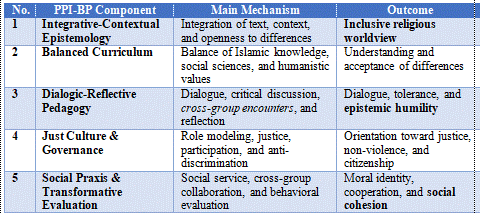
Objective: This study aims to reconstruct the paradigm of Islamic education based on Islamic boarding schools to build inclusive religiosity in a pluralistic society. Theoretical framework: The theoretical framework integrates the concepts of ta'dīb, tarbiyah, and ta'līm; Maqāṣid al-sharī'ah; the theory of multicultural education patterns; critical pedagogy; peace education; and social capital. Literature review: Previous studies generally discuss religious moderation, Islamic boarding school transformation, multicultural curriculum, and the prevention of extremism separately. The literature also tends to assess inclusivity as an additional teaching material, rather than as a result of the configuration of epistemology, authority, pedagogy, institutional culture, and the social experiences of students. This fragmentation has not yet produced an integrative explanation of the educational mechanisms that shape inclusive religiosity. Methods: The study used a qualitative approach through a structured literature review, thematic content analysis, and critical interpretive synthesis. Sources included indexed articles, academic books, policy documents, regulations, and reports from international institutions. Data were coded based on epistemological foundations, curriculum orientation, pedagogical relations, value inculcation, dialogical openness, and social outcomes of education. Results: The synthesis revealed five layers of reconstruction: integrative-contextual epistemology; a balanced curriculum between turāth, contemporary science, citizenship, and digital literacy; dialogical-reflective pedagogy; a pesantren culture that practices adab, justice, and encounter; and evaluation that measures moral reasoning and social action. The integration of these layers forms a religious worldview that is rooted in tradition but open to differences. Implications: Theoretically, the study reframes moderation as an educational paradigm, while practically informing curriculum, ustaz competency, pesantren governance, partnerships, and inclusive religiosity assessment. Novelty: The PPI-BP model integrates epistemology, curriculum, pedagogy, institutional ecology, and social praxis to foster inclusive religiosity grounded in justice, dialogue, dignity, and the common good.
References
UNESCO, Global Citizenship Education: Topics and Learning Objectives. Paris, France: UNESCO, 2015.
United Nations, Transforming Our World: The 2030 Agenda for Sustainable Development. New York, NY, USA: United Nations, 2015.
J. Galtung, “Violence, peace, and peace research,” Journal of Peace Research, vol. 6, no. 3, pp. 167–191, 1969, doi: https://doi.org/10.1177/002234336900600301.
I. M. Harris and M. L. Morrison, Peace Education, 3rd ed. Jefferson, NC, USA: McFarland, 2013.
UNESCO, Preventing Violent Extremism through Education: A Guide for Policy-Makers. Paris, France: UNESCO, 2017.
S. M. N. al-Attas, The Concept of Education in Islam: A Framework for an Islamic Philosophy of Education. Kuala Lumpur, Malaysia: ABIM, 1980.
S. H. Nasr, Islamic Philosophy from Its Origin to the Present. Albany, NY, USA: State University of New York Press, 2006. https://doi.org/10.1515/9780791481554
J. M. Halstead, “An Islamic concept of education,” Comparative Education, vol. 40, no. 4, pp. 517–529, 2004, doi: https://doi.org/10.1080/0305006042000284510.
S. Niyozov and N. Memon, “Islamic education and Islamization: Evolution of themes, continuities and new directions,” Journal of Muslim Minority Affairs, vol. 31, no. 1, pp. 5–30, 2011, doi: https://doi.org/10.1080/13602004.2011.556886.
A. A. Panjwani, “Fazlur Rahman and the search for authentic Islamic education: A critical appreciation,” Curriculum Inquiry, vol. 42, no. 1, pp. 33–55, 2012, doi: https://doi.org/10.1111/j.1467-873X.2011.00574.x.
Y. Waghid, Islamic Education and Cosmopolitanism: A Philosophical Interlude. Dordrecht, The Netherlands: Springer, 2014.
Z. Dhofier, Tradisi Pesantren: Studi Pandangan Hidup Kiai dan Visinya Mengenai Masa Depan Indonesia, rev. ed. Jakarta, Indonesia: LP3ES, 2011.
R. A. Lukens-Bull, “Two sides of the same coin: Modernity and tradition in Islamic education in Indonesia,” Anthropology & Education Quarterly, vol. 32, no. 3, pp. 350–372, 2001, doi: https://doi.org/10.1525/aeq.2001.32.3.350.
R. A. Lukens-Bull, A Peaceful Jihad: Negotiating Identity and Modernity in Muslim Java. New York, NY, USA: Palgrave Macmillan, 2005. https://doi.org/10.1057/9781403980298
F. Pohl, “Islamic education and civil society: Reflections on the pesantren tradition in contemporary Indonesia,” Comparative Education Review, vol. 50, no. 3, pp. 389–409, 2006, doi: https://doi.org/10.1086/503882.
R. W. Hefner, Ed., Making Modern Muslims: The Politics of Islamic Education in Southeast Asia. Honolulu, HI, USA: University of Hawai‘i Press, 2009. https://doi.org/10.21313/hawaii/9780824832803.001.0001
Kementerian Agama Republik Indonesia, Moderasi Beragama. Jakarta, Indonesia: Badan Litbang dan Diklat Kementerian Agama RI, 2019.
J. A. Banks, Cultural Diversity and Education: Foundations, Curriculum, and Teaching, 6th ed. New York, NY, USA: Routledge, 2016.
J. A. Banks, “Diversity, group identity, and citizenship education in a global age,” Educational Researcher, vol. 37, no. 3, pp. 129–139, 2008, doi: https://doi.org/10.3102/0013189X08317501.
Raihani, “Report on multicultural education in pesantren,” Compare: A Journal of Comparative and International Education, vol. 42, no. 4, pp. 585–605, 2012, doi: https://doi.org/10.1080/03057925.2012.672255.
J. Auda, Maqasid al-Shariah as Philosophy of Islamic Law: A Systems Approach. London, UK: International Institute of Islamic Thought, 2008. https://doi.org/10.2307/j.ctvkc67tg
A. Sen, Identity and Violence: The Illusion of Destiny. New York, NY, USA: W. W. Norton, 2006.
M. W. Apple, Ideology and Curriculum, 3rd ed. New York, NY, USA: RoutledgeFalmer, 2004.
https://doi.org/10.4324/9780203487563
M. H. Tuna, “Fundamentals of a pluralism-fostering Islamic religious education and didactics,” Religious Education, 2024, doi: https://doi.org/10.1080/00344087.2024.2384690.
Raihani, Creating Multicultural Citizens: A Portrayal of Contemporary Indonesian Education. New York, NY, USA: Routledge, 2014, doi: https://doi.org/10.4324/9781315851716.
P. Freire, Pedagogy of the Oppressed, 30th anniversary ed. New York, NY, USA: Continuum, 2000.
S. Ma’arif, “Education as a foundation of humanity: Learning from the pedagogy of pesantren in Indonesia,” Journal of Social Studies Education Research, vol. 9, no. 2, pp. 104–123, 2018, doi: https://doi.org/10.17499/jsser.58854.
S. Ni’am, “Pesantren: The miniature of moderate Islam in Indonesia,” Indonesian Journal of Islam and Muslim Societies, vol. 5, no. 1, pp. 111–134, 2015, doi: https://doi.org/10.18326/ijims.v5i1.111-134.
G. W. Allport, The Nature of Prejudice. Reading, MA, USA: Addison-Wesley, 1954.
Republik Indonesia, “Undang-Undang Republik Indonesia Nomor 18 Tahun 2019 tentang Pesantren,” Jakarta, Indonesia, 2019.
N. H. Rofiah, N. Kawai, and D. Sudiraharja, “Pesantren and inclusion: Bridging religion and disability in Islamic education in Indonesia,” African Journal of Disability, vol. 14, Art. no. 1741, 2025. https://doi.org/10.4102/ajod.v14i0.1741
I. Mujahid, “Islamic orthodoxy-based character education: Creating moderate Muslim in a modern pesantren in Indonesia,” Indonesian Journal of Islam and Muslim Societies, vol. 11, no. 2, pp. 185–212, 2021, doi: https://doi.org/10.18326/ijims.v11i2.185-212.
G. Biesta, “Good education in an age of measurement: On the need to reconnect with the question of purpose in education,” Educational Assessment, Evaluation and Accountability, vol. 21, no. 1, pp. 33–46, 2009, doi: https://doi.org/10.1007/s11092-008-9064-9.
A. Ashraf, New Horizons in Muslim Education. Cambridge, UK: Hodder and Stoughton/The Islamic Academy, 1985.
N. Memon, “What Islamic school teachers want: Towards developing an Islamic teacher education programme,” British Journal of Religious Education, vol. 33, no. 3, pp. 285–298, 2011, doi: https://doi.org/10.1080/01416200.2011.595912.
R. D. Putnam, “E pluribus unum: Diversity and community in the twenty-first century,” Scandinavian Political Studies, vol. 30, no. 2, pp. 137–174, 2007, doi: https://doi.org/10.1111/j.1467-9477.2007.00176.x.
UNESCO, Reimagining Our Futures Together: A New Social Contract for Education. Paris, France: UNESCO, 2021.
L. Davies, Educating Against Extremism. Stoke-on-Trent, UK: Trentham Books, 2008.
J. Mezirow, “Transformative learning: Theory to practice,” New Directions for Adult and Continuing Education, no. 74, pp. 5–12, 1997, doi: https://doi.org/10.1002/ace.7401.
M. C. Nussbaum, Not for Profit: Why Democracy Needs the Humanities. Princeton, NJ, USA: Princeton University Press, 2010.
M. Verkuyten and K. Yogeeswaran, “The social psychology of intergroup toleration: A roadmap for theory and research,” Personality and Social Psychology Review, vol. 21, no. 1, pp. 72–96, 2017, doi: https://doi.org/10.1177/1088868316640974.
J. W. Berry, “Multicultural policy and social psychology: The Canadian experience,” in Multiculturalism and Diversity, B. Reitz, R. Breton, K. K. Dion, and K. L. Dion, Eds. Montreal, Canada: McGill-Queen’s University Press, 2009, pp. 63–84.
C. Tan, Islamic Education and Indoctrination: The Case in Indonesia. New York, NY, USA: Routledge, 2011. https://doi.org/10.4324/9780203817766
A. Sahin, “Critical issues in Islamic education studies: Rethinking Islamic and Western liberal secular values of education,” Religions, vol. 9, no. 11, Art. no. 335, 2018, doi: https://doi.org/10.3390/rel9110335.
Y. Rahman and K. A. Walid, “Critical thinking and religious moderation: Instilling religiously moderate values through the teaching of Islamic philosophy in Indonesia,” Journal of Indonesian Islam, vol. 16, no. 1, pp. 49–74, 2022, doi: https://doi.org/10.15642/JIIS.2022.16.1.49-74.
S. Rohmah, M. S. Ismail, M. A. Kholish, and M. Novita, “The recontextualization of Islamic peace education: A study of the theory of Mohammed Abu-Nimer in the Indonesian context,” Fieldwork in Religion, vol. 13, no. 2, pp. 183–202, 2018, doi: https://doi.org/10.1558/firn.37545.
S. Mashuri, B. Pettalongi, M. Nurdin, B. Paozia, and R. Yusran, “Building sustainable peace through multicultural religious education in the post-conflict area of Poso, Indonesia,” Cogent Education, vol. 11, no. 1, Art. no. 2389719, 2024, doi: https://doi.org/10.1080/2331186X.2024.2389719.
C. Chotimah, A. K. Muhammad, and M. A. Niam, “Superficial implementation of religious moderation in Islamic educational institutions,” Cogent Education, 2025, doi: https://doi.org/10.1080/2331186X.2024.2442235.
M. J. Page et al., “The PRISMA 2020 statement: An updated guideline for reporting systematic reviews,” BMJ, vol. 372, Art. no. n71, 2021, doi: https://doi.org/10.1136/bmj.n71.
M. Dixon-Woods et al., “Conducting a critical interpretive synthesis of the literature on access to healthcare by vulnerable groups,” BMC Medical Research Methodology, vol. 6, Art. no. 35, 2006, doi: https://doi.org/10.1186/1471-2288-6-35