Reimagination of English Language Learning for Vocational Education: An Industry 5.0 Oriented English for Specific Purposes Learning Framework
DOI:
https://doi.org/10.61455/sujiem.v4i01.625Keywords:
english for specific purposes, industry 5.0, vocational education, employability skills, artificial intelligenceAbstract
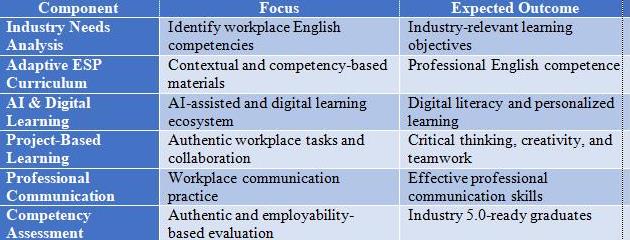
Objective: To analyze the development of English for Specific Purposes (ESP) learning in vocational education and propose an Industry 5.0-oriented learning framework. Theoretical framework: The study integrates ESP, Industry 5.0, employability skills, digital learning, and constructivist learning theories. Literature review: Previous studies emphasize ESP and digital learning, but a comprehensive framework integrating AI, Industry 5.0, and employability skills in vocational education remains limited. Methods: A qualitative Systematic Literature Review (SLR) was conducted by synthesizing articles from reputable databases using content and thematic analysis. Results: The findings indicate that effective ESP learning requires the integration of industry needs analysis, adaptive curriculum design, AI-supported learning, digital learning ecosystems, project-based learning, and employability skills, including communication, collaboration, critical thinking, creativity, and adaptability. These components form the basis of an integrated conceptual learning framework. Implications: The proposed framework provides practical guidance for vocational institutions, educators, and curriculum developers in designing adaptive, technology-enhanced, and industry-aligned English learning to strengthen graduate competitiveness in the Industry 5.0 era. Novelty: This study proposes an integrated Industry 5.0-Oriented ESP Learning Framework that combines AI, digital learning, industry needs, and employability skills into a single conceptual model for vocational English education.
References
Organisation for Economic Co-operation and Development. (2023). Building future-ready vocational education and training systems. OECD Publishing. https://doi.org/10.1787/28551a79-en
United Nations Educational, Scientific and Cultural Organization. (2023). Technical and vocational education and training (TVET): Strategy and programme. UNESCO. https://www.unesco.org
Fadlia, Fadlia, Zulida, Evi, Asra, Asra, Rahmiati, Rahmiati, & Bania, Aisyah Sri. (2020). English subject on English for Specific Purposes (ESP) in vocational schools. Language Literacy: Journal of Linguistics, Literature, and Language Teaching, 4(2), 339–349. https://doi.org/10.30743/ll.v4i2.3009
Muliyah, Puji, & Aminatun, Dian. (2020). Teaching English for Specific Purposes in vocational high school: Teachers' beliefs and practices. Journal of English Teaching, 6(2), 122–135, https://doi.org/10.33541/jet.v6i2.1756.
Abidah, Lailatul, Suhartono, Suhartono, & Mulyadi, Mulyadi. (2022). A study on needs to design English teaching materials at vocational school. Journal of English Language Teaching Innovations and Materials, 5(1), 1–14. https://doi.org/10.26418/jeltim.v5i1.58372
Rahmiani, Nur, & Marwandi, Marwandi. (2022). Teaching English through a bilingual learning ecosystem in the secondary vocational school of industrial technology. Journal of Applied Studies in Language, 6(2), 210–222, https://doi.org/10.31940/jasl.v6i2.496.
Ahmad, Tanzeel, Haroon, Muhammad, Baig, Muhammad, & Hui, Jing. (2023). Generative artificial intelligence and the future of education: A systematic review of ChatGPT for teaching and learning. Education and Information Technologies, 29(1), 1–31.
Organisation for Economic Co-operation and Development. (2024). PISA vocational education and training (VET): Preparing learners for future skills. OECD Publishing. https://www.oecd.org
Hutchinson, Tom, & Waters, Alan. (1987). English for specific purposes: A learning-centred approach. Cambridge University Press, https://doi.org/10.1017/CBO9780511733031.
Basturkmen, Helen. (2020). Developing courses in English for specific purposes (2nd ed.). Palgrave Macmillan.
Zawacki-Richter, Olaf, Marín, Victoria I., Bond, Melissa, & Gouverneur, Franziska. (2019). Systematic review of research on artificial intelligence applications in higher education—Where are the educators? International Journal of Educational Technology in Higher Education, 16(39), 1–27. https://doi.org/10.1186/s41239-019-0171-0
Pooja, M. (2021). Adopting digital technologies in vocational education at the time of crisis. Advances in Management, 14(1), 53-59.
Anam, K. (2025). The Role Of Digital Media In Improving Students' English Speaking Skills At STAI Ma'arif Sampang. AL-MIKRAJ Jurnal Studi Islam dan Humaniora (E-ISSN 2745-4584), 5(2), 2434-2446, https://doi.org/10.37680/almikraj.v5i2.9034.
World Economic Forum. (2025). The future of jobs report 2025. World Economic Forum. https://www.weforum.org/reports/the-future-of-jobs-report-2025
Meniado, J. C. (2023). Digital language teaching 5.0: Technologies, trends and competencies. Relc Journal, 54(2), 461-473, https://doi.org/10.1177/00336882231160610.
Dewantara, K. A. K., Laksana, I. P. Y., Kartika, N. P. R. T. A., & Saraswati, H. (2024). A Systematic Review of AI-Powered Tools in English Language Learning for Vocational Students. International Journal of Natural Science and Engineering, 8(3), 201-214, https://doi.org/10.23887/ijnse.v9i2.101889.
Shahidi Hamedani, S., Aslam, S., Mundher Oraibi, B. A., Wah, Y. B., & Shahidi Hamedani, S. (2024). Transitioning towards tomorrow’s workforce: Education 5.0 in the landscape of society 5.0: A systematic literature review. Education Sciences, 14(10), 1041, https://doi.org/10.3390/educsci14101041.
Pacher, C., Woschank, M., Zunk, B. M., & Gruber, E. (2024). Engineering education 5.0: a systematic literature review on competence-based education in the industrial engineering and management discipline. Production & Manufacturing Research, 12(1), 2337224, https://doi.org/10.1080/21693277.2024.2337224.
Pelaez-Sanchez, I. C., Glasserman-Morales, L. D., & Rocha-Feregrino, G. (2024, October). Exploring digital competencies in higher education: design and validation of instruments for the era of Industry 5.0. In Frontiers in education (Vol. 9, p. 1415800). Frontiers Media SA, https://doi.org/10.3389/feduc.2024.1415800.
Hanapiah, Jihan, Muljanto, Setia, & Setiawati, Pipih. (2025). Implementing English for Specific Purposes (ESP) in a multi-major vocational context: A qualitative case study of software engineering and electrical installation programs. Journal of English Language and Education, 11(2), 120–138, https://doi.org/10.31004/jele.v11i2.2216.
Talib, R., Larasati, Y. G., Tanipu, Z., & Mohammad, T. F. (2026). Barriers to developing effective ESP teaching materials at Gorontalo State University. Cogent Education, 13(1), 2608411, https://doi.org/10.1080/2331186X.2025.2608411.
Allais, S. M. (2011). The impact and implementation of national qualifications frameworks: a comparison of 16 countries. Journal of Education and Work, 24(3-4), 233-258, https://doi.org/10.1080/13639080.2011.584685.
Hagos Baraki, A., & van Kemenade, E. (2013). Effectiveness of Technical and Vocational Education and Training (TVET) Insights from Ethiopia's reform. The TQM Journal, 25(5), 492-506, https://doi.org/10.1108/TQM-11-2012-0099.
Nghia, T. L. H., Anh, N. P., & Kien, L. T. (2023). English language skills and employability: a theoretical framework. In English language education for graduate employability in Vietnam (pp. 71-93). Singapore: Springer Nature Singapore, https://doi.org/10.1007/978-981-99-4338-8_4.
Hatmanto, E. D., Pratolo, B. W., Purwanti, E., & Pasandalan, S. N. (2026). Exploring lecturers' perspectives on enhancing student employability in English education: Curriculum, pedagogy, and departmental support. Teaching English as a Foreign Language Journal, 5(1), 19-31, https://doi.org/10.12928/tefl.v5i1.2121.
Nasihin, A. (2022). The Impact of Using English Curriculum Design Based on Industry Needs in English Teaching in Vocational School to Improve Students' English Skills for Industry Standard Working Communication. Education Quarterly Reviews, 5(1), 138-144.
Kuo, S. M. (2016). Target Needs Analysis of Tertiary-level English for Specific Purposes Curriculum Design from the Perspective of Taiwan’ s Business Community. Journal of Applied Linguistics and Language Research, 3(1), 36-53.
Kyrpychenko, O., Pushchyna, I., Kichuk, Y., Shevchenko, N., Luchaninova, O., & Koval, V. (2021). Communicative competence development in teaching professional discourse in educational establishments. International Journal of Modern Education & Computer Science, 13(4), 16-27, https://doi.org/10.5815/ijmecs.2021.04.02.
Richards, J. C. (2013). Curriculum approaches in language teaching: Forward, central, and backward design. RELC Journal, 44(1), 5-33, https://doi.org/10.1177/0033688212473293.
Procel, G. J. O., Medina, M. L. F., Sotomayor, D. J., & Sanchez, M. A. (2024). Using technology in English teaching. Journal of Environmental Research and Public Health, 17(9), 9.
Bizami, N. A., Tasir, Z., & Kew, S. N. (2023). Innovative pedagogical principles and technological tools capabilities for immersive blended learning: a systematic literature review. Education and Information Technologies, 28(2), 1373-1425, https://doi.org/10.1007/s10639-022-11243-w.
Novawan, A., Walker, S. A., & Ikeda, O. (2024). The new face of technology-enhanced language learning (TELL) with artificial intelligence (AI): Teacher perspectives, practices, and challenges. Journal of English in Academic and Professional Communication, 10(1), 1-18, https://doi.org/10.25047/jeapco.v9i1.3754.
Al-khresheh, M. H. (2024). Bridging technology and pedagogy from a global lens: Teachers’ perspectives on integrating ChatGPT in English language teaching. Computers and Education: Artificial Intelligence, 6, 100218, https://doi.org/10.1016/j.caeai.2024.100218.
Nazeer, I., Ahmad, T., Baseerat, I., & Fatima, N. (2023). The role of ESP in enhancing English language skills for English teachers. Asian Innovative Journal of Social Sciences and Humanities, 7(3), 1-15.
Pranata, A. J., & Afifah, W. (2025). A Holistic Analysis of ESP Learners' Competencies and Expectations to Curriculum. Tarling: Journal of Language Education, 9(2), 287-308, https://doi.org/10.24090/tarling.v9i2.14734.
Sakti, N. S. S., Sarkiah, S., Sukma, S., Amaluddin, A., & Efendi, R. (2024). Redefining ESP: Bridging the gap between traditional methods and modern educational needs. Klasikal: Journal of Education, Language Teaching and Science, 6(3), 806-813, https://doi.org/10.52208/klasikal.v6i3.1164.
Sintia, D., Perdana, I., & Karani, E. (2025). ESP in practice: A literature review of challenges faced by teachers and learners. EJI (English Journal of Indragiri): Studies in Education, Literature, and Linguistics, 9(2), 584-597, https://doi.org/10.61672/eji.v9i2.3003.
Mexhuani, B. (2025). Adopting digital tools in higher education: Opportunities, challenges and theoretical insights. European Journal of Education, 60(1), e12819, https://doi.org/10.1111/ejed.12819.
Singun, A. J. (2025). Unveiling the barriers to digital transformation in higher education institutions: a systematic literature review. Discover Education, 4(1), 37, https://doi.org/10.1007/s44217-025-00430-9.
Shi, J., Sitthiworachart, J., & Hong, J. C. (2024). Supporting project-based learning for students’ oral English skill and engagement with immersive virtual reality. Education and Information Technologies, 29(11), 14127-14150, https://doi.org/10.1007/s10639-023-12433-w.
Alzubi, A. A., Nazim, M., & Ahamad, J. (2024). Examining the effect of a collaborative learning intervention on EFL students’ English learning and social interaction. Journal of Pedagogical Research, 8(2), 26-46, https://doi.org/10.33902/JPR.202425541