Students' Digital Literacy in the Generative AI Era
DOI:
https://doi.org/10.61455/sujiem.v3i03.615Keywords:
digital literacy, generative ai, students, ai literacy, digital educationAbstract
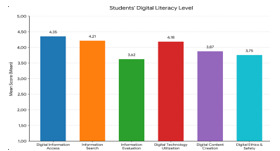
Objective: The development of Generative Artificial Intelligence (Generative AI) technology has brought significant changes in the learning process and access to information in the educational environment. The presence of various generative AI platforms allows students to acquire information, complete tasks, and develop creativity more quickly and efficiently. This research aims to analyze students' digital literacy levels in the Generative AI era as well as identify the factors that affect their ability to use AI technology critically, creatively, and ethically. Theoretical framework: This research refers to the concept of digital literacy put forward by Gilster and developed through a 21st-century digital competency framework that includes the ability to access, evaluate, create, and communicate information effectively. In addition, this study also uses an AI literacy perspective that emphasizes understanding of how it works, benefits, risks, and ethical implications of the use of artificial intelligence in daily life. Literature review: shows that Generative AI has great potential in improving learning experiences, but also risks lowering critical thinking skills if its use is not accompanied by adequate digital literacy. Method: This study used a quantitative approach with a survey method of high school students. Data were collected through questionnaires that measured aspects of digital literacy, frequency of use of AI, information verification capabilities, digital ethical awareness, and attitudes towards AI technology. The data were analyzed using descriptive statistics and correlation analysis to determine the relationship between the use of Generative AI and students' digital literacy levels. Results: The study showed that most students had a level of digital literacy in the medium to high category. The ability to access information and use technology is relatively good, but the ability to evaluate information and understand the ethics of using AI is still relatively low. In addition, a positive relationship was found between the intensity of use of Generative AI and the improvement of digital skills, although excessive use has the potential to reduce learning independence. These findings indicate the need to integrate digital literacy education and AI literacy in school curricula. Implications: This study confirms the importance of developing learning programs that focus not only on technological skills, but also on critical thinking skills, digital ethics, and responsibility in the use of AI. Novelty: The research lies in integrating the concepts of digital literacy and AI literacy in the context of high school students in the era of Generative AI, which is still relatively limited as studied in previous research.
References
A. Restianty, “Literasi Digital, Sebuah Tantangan Baru Dalam Literasi Media,” Gunahumas, vol. 1, no. 1, pp. 72–87, 2018, https://doi.org/10.17509/ghm.v1i1.28380.
Hilda Melani Purba, Humairoh Sakinah Zainuri, M. Falih Daffa, Nurhafizah Nurhafizah, and Yunita Azhari, “Pendidikan Karakter di Era Digital: Tantangan dan Strategi,” J. Pendidik. Dan Ilmu Sos., vol. 2, no. 3, pp. 236–246, 2024, https://doi.org/10.54066/jupendis.v2i3.2038.
E. M. Putri and R. N. Setyowati, “Implementasi Pendidikan Digital Citizenship Dalam Membentuk Good Digital Citizen Pada Siswa Sma Labschool Unesa,” Kaji. Moral dan Kewarganegaraan, vol. 9, no. 3, pp. 580–594, 2021, https://doi.org/10.26740/kmkn.v9n3.p580-594.
S. S. Hasnida and R. Adrian, “Dafus Digital 1,” vol. 2, no. 1, 2024, https://doi.org/10.55606/jubpi.v2i1.2488.
L. Nurholifah, N. Zakia, Nurmuzayanah, and Syarifuddin, “Meningkatkan Pembelajaran Melalui Implementasi Quizizz dalam Konteks Pendidikan Digital,” An-Nashr J. Ilm. Pendidik. dan Sos. Kemasyarakatan, vol. 1, no. 2, pp. 51–61, 2023, https://doi.org/10.65317/an-nashr.v1i2.18.
U. Kulsum and A. Muhid, “Pendidikan Karakter melalui Pendidikan Agama Islam di Era Revolusi Digital,” J. Intelekt. J. Pendidik. dan Stud. Keislam., vol. 12, no. 2, pp. 157–170, 2022, https://doi.org/10.33367/ji.v12i2.2287.
F. Yustiasari Liriwati, S. Marpuah, Wasehudin, and Zulhimma, “Transformasi Kurikulum Merdeka Di Madrasah; Menyongsong Era Pendidikan Digital,” J. IHSAN J. Pendidik. Islam, vol. 2, no. 1, pp. 1–10, 2024, https://doi.org/10.61104/ihsan.v2i1.103.
S. Saqjuddin, A. Aba, and N. H. Aopmonaim, “Inovasi Manajemen Pembelajaran Coding dan AI untuk Meningkatkan Literasi Digital Siswa Sekolah Dasar,” J. Inf. Syst. Educ. Dev., vol. 3, no. 2, pp. 19–24, 2025, https://doi.org/10.62386/jised.v3i2.134.
C. H. Tasya, K. B. Sangka, and D. Octoria, “Pengaruh pemanfaatan artificial intelligence (AI) terhadap motivasi belajar mahasiswa dengan literasi digital sebagai variabel moderating,” J. Pendidik. Ekon., vol. 13, no. 2, pp. 153–165, 2025, https://doi.org/10.26740/jupe.v13n2.p153-165.
M. Fadhilah and K. Isma Nuriza, “Efektivitas Pembelajaran Berbasis AI dan Augmented Reality dalam Meningkatkan Literasi Digital dan Fungsi Eksekutif Otak Siswa SD: Tinjauan Literatur Sistematis,” GHANCARAN J. Pendidik. Bhs. dan Sastra Indones., pp. 881–897, 2025, https://doi.org/10.19105/ghancaran.vi.21670.
D. P. Kesuma and L. Amelia Fransen, “Implementasi Instrumen MAILS (Meta AI Literacy Scale) Untuk Pengukuran Tingkat Literasi AI Pada Mahasiswa Ilmu Komputer,” J. Sist. Informasi, Manaj. dan Teknol. Inf., vol. 3, no. 1, pp. 25–36, 2025, https://doi.org/10.33020/jsimtek.v3i1.811.
M. Yusuf, “Penggunaan Artificial Intelligence (AI) Dalam Meningkatkan Literasi Digital Pada Lembaga Pendidikan Islam,” AKSI J. Manaj. Pendidik. Islam, vol. 2, no. 2, pp. 109–118, 2024, https://doi.org/10.37348/aksi.v2i2.360.
S. A. Khosibah, A. Rahmaningrum, and C. T. Kusumawardani, “Potensi dan Praktik Literasi Artificial Intelligence (AI) dalam Pendidikan Anak Usia Dini di Indonesia: Systematic Literature Review,” JEA (Jurnal Edukasi AUD), vol. 11, no. 1, pp. 55–69, 2025, https://doi.org/10.18592/jea.v11i1.16329.
Hindra Kurniawan, Adiguna Sasama W.U, and R. W. Tambunan, “Potensi AI dalam Meningkatkan Kreativitas dan Literasi dalam Pembelajaran Bahasa Indonesia,” JAMI J. Ahli Muda Indones., vol. 5, no. 1, pp. 10–17, 2024, https://doi.org/10.46510/jami.v5i1.285.
S. Besare, “Hubungan Minat dengan Aktivitas Belajar Siswa,” JINOTEP (Jurnal Inov. dan Teknol. Pembelajaran) Kaji. dan Ris. Dalam Teknol. Pembelajaran, vol. 7, no. 1, pp. 18–25, 2020, https://doi.org/10.17977/um031v7i12020p018.
E. S. Ariananda, S. Hasan, and M. Rakhman, “Pengaruh Kedisiplinan Siswa Di Sekolah Terhadap Prestasi Belajar Siswa Teknik Pendingin,” J. Mech. Eng. Educ., vol. 1, no. 2, p. 233, 2016, https://doi.org/10.17509/jmee.v1i2.3805.
E. Kusuma, A. Handayani, and D. Rakhmawati, “Pentingnya Pengembangan Kemampuan Berpikir Kritis Pada Siswa Sekolah Dasar: Sebuah Tinjauan Literatur,” Wawasan Pendidik., vol. 4, no. 2, pp. 369–379, 2024, https://doi.org/10.26877/jwp.v4i2.17971.
V. Rahmayanti, “Pengaruh Minat Belajar Siswa dan Persepsi atas Upaya Guru dalam Memotivasi Belajar Siswa terhadap Prestasi Belajar Bahasa Indonesia Siswa SMP di Depok,” SAP (Susunan Artik. Pendidikan), vol. 1, no. 2, pp. 206–216, 2016, https://doi.org/10.30998/sap.v1i2.1027.
M. Elendiana, “Upaya Meningkatkan Minat Baca Siswa Sekolah Dasar,” J. Pendidik. dan Konseling, vol. 2, no. 1, pp. 54–60, 2020, https://doi.org/10.31004/jpdk.v1i2.572.
U. Mittal, S. Sai, V. Chamola, and D. Sangwan, “A Comprehensive Review on Generative AI for Education,” IEEE Access, vol. 12, no. August, pp. 142733–142759, 2024, https://doi.org/10.1109/ACCESS.2024.3468368.
J. D. Weisz, J. He, M. Muller, G. Hoefer, R. Miles, and W. Geyer, Design Principles for Generative AI Applications, vol. 1, no. 1. Association for Computing Machinery, 2024. https://doi.org/10.1145/3613904.3642466.
P. Hacker, A. Engel, and M. Mauer, Regulating ChatGPT and other Large Generative AI Models, vol. 1, no. 1. Association for Computing Machinery, 2023. https://doi.org/10.1145/3593013.3594067.
M. Batty, “Generative AI,” Environ. Plan. B Urban Anal. City Sci., vol. 52, no. 5, pp. 1031–1034, 2025, https://doi.org/10.1177/23998083251332093.
A. Taeihagh, “Governance of Generative AI,” Policy Soc., vol. 44, no. 1, pp. 1–22, 2025, https://doi.org/10.1093/polsoc/puaf001.
E. Brynjolfsson, D. Li, and L. Raymond, “Generative AI at Work,” Q. J. Econ., vol. 140, no. 2, pp. 889–942, 2025, https://doi.org/10.1093/qje/qjae044.
C. A. Bail, “Can Generative AI improve social science?” Proc. Natl. Acad. Sci. U. S. A., vol. 121, no. 21, pp. 1–10, 2024, https://doi.org/10.1073/pnas.2314021121.
R. Gozalo-Brizuela and E. E. G. Merchan, “A Survey of Generative AI Applications,” J. Comput. Sci., vol. 20, no. 8, pp. 801–818, 2024, https://doi.org/10.3844/jcssp.2024.801.818.
Z. Lv, “Generative artificial intelligence in the metaverse era,” Cogn. Robot., vol. 3, no. May, pp. 208–217, 2023, https://doi.org/10.1016/j.cogr.2023.06.001.
H. Zohny, J. McMillan, and M. King, “Ethics of generative AI,” pp. 79–80, https://doi.org/10.1136/jme-2023-108909.
L. Banh and G. Strobel, “Generative artificial intelligence,” Electron. Mark., vol. 33, no. 1, pp. 1–17, 2024, https://doi.org/10.1007/s12525-023-00680-1.
S. Feuerriegel and C. Janiesch, “Generative AI,” vol. 66, no. 1, pp. 111–126, 2024, https://doi.org/10.1007/s12599-023-00834-7.
F. F. Nah, R. Zheng, J. Cai, K. Siau, and L. Chen, “Generative AI and ChatGPT : Applications, challenges, and AI-human collaboration,” J. Inf. Technol. Case Appl. Res., vol. 25, no. 3, pp. 277–304, 2023, https://doi.org/10.1080/15228053.2023.2233814.
D. N. Sari, A. R. Alfiyan, and I. Bisnis, “Peran Adaptasi Game ( Gamifikasi ) dalam Pembelajaran untuk Menguatkan Literasi Digital : Systematic Literature Review,” vol. 1, no. 1, 2023, https://doi.org/10.30812/upgrade.v.
M. F. Muttaqin, “Implementasi Literasi Digital pada Siswa Sekolah Dasar,” vol. 7, pp. 85–94, 2024, https://doi.org/10.23887/jippg.v7i1.75992.
P. Issn and P. M. P. Covid-, “Gerakan literasi digital pada masa pandemi covid-19,” vol. 8, pp. 268–283, 2020, https://doi.org/10.5281/zenodo.3884420.
D. Journal, O. Education, D. Ririen, and F. Daryanes, “Analisis literasi digital mahasiswa,” vol. 8, no. 1, pp. 210–219, 2022, https://doi.org/10.30998/rdje.v8i1.11738.
J. S. Islam, D. Humaniora, and M. F. Hajri, “AL-MIKRAJ Pendidikan Islam di Era Digital: Tantangan dan Peluang pada Abad 21,” vol. 4, 2023, https://doi.org/10.37680/almikraj.v4i1.3006.
F. Fitriani and B. D. Arfini, “Pemanfaatan Artificial Intelligence (AI) untuk Meningkatkan Kemampuan Literasi Mahasiswa,” Transform. J. Penelit. dan Pengemb. Pendidik. Non Form. Informal, vol. 11, no. 1, pp. 141–149, Mar. 2025, https://doi.org/10.33394/jtni.v11i1.16739.
T. Citrawati, T. Supriyanto, T. Suminar, and H. Haryadi, “Futurologi Pendidikan Bahasa di Era Digital: Eksplorasi AI untuk Literasi Anak Usia SD,” GHANCARAN J. Pendidik. Bhs. dan Sastra Indones., Sep. 2025, https://doi.org/10.19105/ghancaran.vi.21690.
W. Widiyanti, N. Nurjanah, L. A. Chisbiyah, M. I. Effendi, S. E. N. Putra, and P. K. Ningtyas, “Transformasi Literasi Digital Guru Sekolah Dasar melalui Program Upskilling Penggunaan Canva for Education dan Gemini AI,” I-Com Indones. Community J., vol. 5, no. 3, pp. 1104–1113, Sep. 2025, https://doi.org/10.70609/i-com.v5i3.7557.
A. Adila, S. Sucipto, and F. S. Hilyana, “Konsentrasi Belajar Siswa Pada Mata Pelajaran IPA,” J. Educ. FKIP UNMA, vol. 8, no. 4, pp. 1261–1268, Dec. 2022, https://doi.org/10.31949/educatio.v8i4.3120.
A. Elvanisi, S. Hidayat, and E. N. Fadillah, “Analisis keterampilan proses sains siswa sekolah menengah atas,” J. Inov. Pendidik. IPA, vol. 4, no. 2, pp. 245–252, Oct. 2018, https://doi.org/10.21831/jipi.v4i2.21426.
M. Rahmawati and E. Suryadi, “Guru sebagai fasilitator dan efektivitas belajar siswa,” J. Pendidik. Manaj. Perkantoran, vol. 4, no. 1, p. 49, Jan. 2019, https://doi.org/10.17509/jpm.v4i1.14954.
B. Dan, S. Indonesia, T. Citrawati, T. Supriyanto, and T. Suminar, “Futurologi Pendidikan Bahasa di Era Digital : Eksplorasi AI untuk Literasi Anak Usia SD,” pp. 463–474, https://doi.org/10.19105/ghancaran.vi.21690.
Fitri Barokah, Z. Sari, and Chanifudin, “Peluang Dan Tantangan Pendidikan Karakter Di Era Digital,” Al-Muaddib J. Kaji. Ilmu Kependidikan, vol. 6, no. 3, pp. 721–737, Jun. 2024, https://doi.org/10.46773/muaddib.v6i3.1209.
V. Andita and D. Rafaela, “Akselerasi Transformasi Digital Untuk Pendidikan Berkualitas,” J. Inf. Syst. Manag., vol. 02, no. 05, 2023, https://doi.org/10.4444/jisma.v3i1.496.
S. B. Dito and H. Pujiastuti, “Dampak Revolusi Industri 4.0 Pada Sektor Pendidikan: Kajian Literatur Mengenai Digital Learning Pada Pendidikan Dasar dan Menengah,” J. Sains dan Edukasi Sains, vol. 4, no. 2, pp. 59–65, Dec. 2021, https://doi.org/10.24246/juses.v4i2p59-65.
B. Arifin, A. N. Salim, A. Muzakki, Suwarsito, and O. Arifudin, “Integrasi Penguatan Pendidikan Karakter Dalam Pembelajaran Berbasis Literasi Digital Pada Peserta Didik Sekolah Dasar,” Innov. J. Soc. Sci. Res., vol. 4, no. 3, pp. 13547–13555, 2024, https://doi.org/10.31004/innovative.v4i3.12108.
A. Chaidar Ghazy, K. Aditiya Wibowo, and K. Kunci, “Transformation of Education: The Development of Methodology and Learning Media in the Digital Era,” 2025.