Developing a Dual-Method Pedagogical Model for Teaching Islamic Calendar Diversity in Indonesian Schools
DOI:
https://doi.org/10.61455/sujiem.v3i03.562Keywords:
islamic education, hisab, rukyat, pedagogical model, religious moderationAbstract
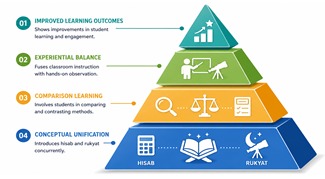
Objective: This study aims to develop a dual-method learning model integrating Hisab and Rukyat to improve students’ understanding, critical thinking, and attitudes toward religious diversity. Theoretical framework: The study is based on constructivist learning theory and Design-Based Research (DBR), emphasizing active learning, comparison, and reflective understanding. Literature review: Previous studies show that separate teaching of Hisab and Rukyat often causes fragmented understanding and confusion among students in Islamic education. Methods: This study uses a qualitative DBR approach through curriculum analysis, teacher interviews, and classroom observations in Muhammadiyah and Nahdlatul Ulama institutions. Results: The findings reveal that segregated teaching of Hisab and Rukyat results in fragmented student comprehension and confusion regarding Islamic calendar determination. In contrast, the implementation of an integrated dual-method pedagogical model enhances students’ conceptual understanding by enabling them to compare and evaluate both approaches simultaneously. The model also promotes critical thinking skills and encourages more inclusive and moderate religious attitudes among students. Implications: The study provides an innovative teaching approach that supports inclusive Islamic education and reduces misunderstandings between different methodologies. Novelty: The novelty of this research is the development of a dual-method pedagogical model that combines Hisab and Rukyat in one integrated classroom learning system.
References
F. Xiang, J. Cao, Y. Zuo, X. Duan, L. Xie, and M. Zhou, “A Novel Training Path to Promote the Ability of Mechanical Engineering Graduates to Practice and Innovate Using New Information Technologies,” Sustain., vol. 16, no. 1, 2024, https://doi.org/10.3390/su16010364.
N. Pincheira and Á. Alsina, “Assessing knowledge to teach early algebra from the Mathematical Knowledge for Teaching (MKT) perspective: A support tool for primary school teachers,” J. Math. Educ., vol. 15, no. 2, pp. 639–660, 2024, https://doi.org/10.22342/jme.v15i2.pp639-660.
A. A. Mohamed, M. W. Shohib, and ..., “The Contribution of KH Ahmad Dahlan’s Thought to the Advancement of the Muslim Community in Indonesia,” J. World …, vol. 2, no. 1, pp. 153–164, 2024, https://journal.walideminstitute.com/index.php/jwt/article/download/234/506
E. Emsen, B. B. Odevci, M. K. Korkmaz, F. Alshamsi, and A. Alkaabi, “Designing Biomimetic Learning Environments for Animal Welfare Education: A Gamified Approach,” Biomimetics, vol. 10, no. 11, 2025, https://doi.org/10.3390/biomimetics10110769.
M. H. Basya and Hamka, “Cultural capital, Islamism, and political distrust in Indonesian general election: an ethnicity-based community engaged in Islamic Defenders Front (FPI),” Indones. J. Islam Muslim Soc., vol. 13, no. 2, pp. 253–277, 2023, https://doi.org/10.18326/ijims.v13i2.253-277.
W. Akmaliah, P. Sulistiyanto, and Sukendar, “Making Moderate Islam in Indonesia,” Stud. Confl. Terror., vol. 47, no. 11, pp. 1495–1509, 2024, https://doi.org/10.1080/1057610X.2022.2034224.
Nur Setia Abuabakar and Alwy Ahmed Mohamed, “Strategies for Cultivating Religious Character in Marginal and Minority Schools: A Case Study at Senior High Schools in the Kupang Archipelago,” Solo Int. Collab. Publ. Soc. Sci. Humanit., vol. 2, no. 03, pp. 341–354, 2024, https://doi.org/10.61455/sicopus.v2i03.292.
A. Alatas, “Education and socio-political change in the 11th and 12th centuries Abbasid realm,” J. Islam. Thought Civiliz., vol. 11, no. 1, pp. 79–98, 2021, https://doi.org/10.32350/jitc.111.05.
D. Berkah and T. Sawarjuwono, “Inheritance wealth distribution model and its implication to the economy,” Humanit. Soc. Sci. Rev., vol. 7, no. 3, pp. 1–10, 2019, https://doi.org/10.18510/hssr.2019.731.
S. M. Brown and M. J. Crawford, “Thinking about developing business leadership for the post-COVID world,” New Engl. J. Entrep., vol. 25, no. 2, pp. 94–102, 2022, https://doi.org/10.1108/NEJE-04-2021-0026.
H. Fansuri, “Transforming Faith Mualaf and Hijrah in Post-Suharto Indonesia,” Entangled Relig., vol. 15, no. 2, 2024, https://doi.org/10.46586/er.15.2024.11748.
K. S. Finch, “Educators and relief workers: teachers during an emergency,” Int. J. Soc. Pedagog., vol. 14, no. 1, 2025, https://doi.org/10.14324/111.444.ijsp.2025.v14.x.004.
A. H. Folorunsho, A. O. Murtadha, and U. K. Belgore, “A Shariah-Based Examination of Selected Jaiz Bank Products,” J. Shariah Law Res., vol. 10, no. 2, pp. 133–150, 2025, https://doi.org/10.22452/jslr.vol10no2.2.
E. Cameron, H. Fleming, R. Mose, and S. Monteiro, “Exploring context and culture in clinical reasoning medical education: A qualitative exploratory study,” J. Eval. Clin. Pract., vol. 31, no. 2, 2025, https://doi.org/10.1111/jep.14126.
A. Okada, T. Sherborne, G. Panselinas, and G. Kolionis, “Fostering Transversal Skills Through Open Schooling Supported by the CARE-KNOW-DO Pedagogical Model and the UNESCO AI Competencies Framework,” Int. J. Artif. Intell. Educ., vol. 35, no. 4, pp. 1953–1998, 2025, https://doi.org/10.1007/s40593-025-00458-w.
F. S. Mensah, “Reclaiming agency in instructional technology integration: a praxeological analysis of pre-service mathematics teachers’ roles in a GeoGebra-based model lesson,” Front. Educ., vol. 10, 2025, https://doi.org/10.3389/feduc.2025.1670170.
O. Calle, A. Antúnez, S. González-Espinosa, S. J. Ibáñez, and S. Feu, “Monitoring the Impact of Two Pedagogical Models on Physical Load in an Alternative School Sport Using Inertial Devices,” Sensors, vol. 25, no. 18, 2025, https://doi.org/10.3390/s25185929.
N. Okuyucu, “Al-Shāfi‘ī’s Theory of Intra-source Abrogation and its Interpretations in Shāfi‘ī School of Thought,” Islam Arastirmalari Derg., vol. 2020, no. 43, pp. 1–44, 2020, https://doi.org/10.26570/isad.650133.
C. A. Andrade-Castellanos and F. G. Yanowsky-Escatell, “Impact of the Flipped Classroom on Medical Education: A Systematic Review with Meta-Analysis,” Rev. Med. Chil., vol. 154, no. 1, pp. 1–12, 2026, https://doi.org/10.4067/s0034-98872026000100001.
N. Rahmi, M. Rizki, N. A. Fajriati, Nurlaila, F. Efendi, and L. S. B. Siregar, “Contestation of the Determination of ‘Idul Adha and its Implementation According to Muhammadiyah and Nahdatul ‘Ulama,” Nurani, vol. 25, no. 1, pp. 262–279, 2025, https://doi.org/10.19109/nurani.v25i1.26563.
N. Alassaf, “Computational Precedent-Based Instruction (CPBI): Integrating Precedents and BIM-Based Parametric Modelling in Architectural Design Studio,” Buildings, vol. 15, no. 8, 2025, https://doi.org/10.3390/buildings15081287.
Q. Wen, J. Wang, Z. Guo, and D. Badulescu, “Divergent Role of AI in Social Development: A Comparative Study of Teachers’ and Students’ Perceptions in Online and Physical Classrooms,” Behav. Sci. (Basel), vol. 15, no. 12, 2025, https://doi.org/10.3390/bs15121649.
S. F. Sembiante, C. Restrepo-Widney, A. Bengochea, and M. Gort, “Sustainable translanguaging pedagogy in support of the vulnerable language: honouring children’s ways of ‘Showing’ and ‘Telling’ in an early childhood dual language bilingual education program,” Int. J. Biling. Educ. Biling., vol. 26, no. 8, pp. 928–942, 2023, https://doi.org/10.1080/13670050.2022.2161814.
S. Nazari, R. N. S. Hossini, E. Norouzi, D. Manzano-Sánchez, and S. Pill, “Combined teaching games for understanding and sport education in PE can improve student emotion regulation, intrapersonal intelligence and psychomotor skills,” Acta Psychol. (Amst), vol. 261, 2025, https://doi.org/10.1016/j.actpsy.2025.105812.
H. Treiber, “A Critical Reading of Max Weber on Law and Its Rationalization,” in The Routledge International Handbook on Max Weber, Taylor and Francis. Scopus, 2022, pp. 353–368. https://doi.org/10.4324/9781003089537-33.
S. Yang, “A hybrid recommendation system for Chinese character components using a dual-tower neural network and a deterministic algorithm,” Discov. Artif. Intell., vol. 5, no. 1, 2025, https://doi.org/10.1007/s44163-025-00460-0.
M. Zunic, M. H. Dlab, N. Hoic-Bozic, and Z. Pribičević, “Educational Potential of the Metaverse: Systematic Review of Pedagogical Approaches,” Int. J. Distance Educ. Technol., vol. 23, no. 1, 2025, https://doi.org/10.4018/IJDET.382480.
H. Yue, J. Wang, I. Yoon, and Q. Hao, “Teachers as Learners, Teachers as Teachers: Culturally Relevant Computational Thinking Professional Development for K-12 In-Service Teachers,” SIGCSE TS 2026 - Proc. 57th ACM Tech. Symp. Comput. Sci. Educ. V.1, vol. V, no. 1, pp. 1193–1199, 2026, https://doi.org/10.1145/3770762.3772586.
J. P. Basson and J. Smallwood, “A Seven-Step BIM Collaboration Model for AEC Education: Bridging Disciplinary Silos Through BIM Maturity Level 3 Implementation †,” Buildings, vol. 16, no. 7, 2026, https://doi.org/10.3390/buildings16071282.
O. Calle, A. Antúnez, S. J. Ibáñez, and S. Feu, “Effect of Active Pedagogical Models on Basic Psychological Needs and Intention to Do Physical Exercise,” Behav. Sci. (Basel), vol. 15, no. 11, 2025, https://doi.org/10.3390/bs15111574.
S. Zhu, Q. Fang, R. Zheng, and D. Z. Zhu, “Automating Classroom Observation: AI-Enabled Behaviour Monitoring for Adaptive Educational Management,” Proc. 2025 2nd Int. Conf. Artif. Intell. Futur. Educ. AIFE 2025, vol. AIFE, pp. 686–693, 2026, https://doi.org/10.1145/3785987.3786101.
R. Paucar-Curasma, R. F. Unsihuay Tovar, C. Acra-Despradel, and K. O. Villalba-Condori, “IBPT: An Approach to Promote Research and Technological Competencies in Higher Education,” Sustain., vol. 17, no. 20, 2025, https://doi.org/10.3390/su17209309.
H. M. Choto and N. M. Remadan, “A transformative practice-based pedagogical model for architectural design education: bridging practice, teaching, and research,” J. Eng. Appl. Sci., vol. 73, no. 1, 2026, https://doi.org/10.1186/s44147-026-00892-0.
N. F. Pato, M. A. Ruíz-Rosillo, L. C. Bueno, I. R. Hurtado, and M. D. Vivas Urias, “A novel teaching model using a massive open online course for soft skills development in the veterinary medicine curriculum,” Front. Vet. Sci., vol. 12, 2025, https://doi.org/10.3389/fvets.2025.1558473.
A. H. Rakha, “Digital feedback via free ChatGPT within the reciprocal teaching style: improving fundamental handball skills and students’ attitudes among university beginners,” Front. Sport. Act. Living, vol. 8, 2026, https://doi.org/10.3389/fspor.2026.1772502.
A. M. Cantel and E. Y. Rha, “Integrating service-learning into information literacy education: A case study from the Philippines,” J. Inf. Lit., vol. 19, no. 2, pp. 34–59, 2025, https://doi.org/10.11645/19.2.724.
M. Luchkevych, V. Luchkevych, and I. Shakleina, “Mobile DevOps in Education: Practical Training through Application Development,” Int. J. Interact. Mob. Technol. , vol. 19, no. 15, pp. 129–141, 2025, https://doi.org/10.3991/ijim.v19i15.55531.
İ. Küçük, “Material Experimentation in the Architectural Design Studio: An Experimental Pedagogical Model for Incorporating Craft Mediums into Studio Education †,” Buildings, vol. 15, no. 5, 2025, https://doi.org/10.3390/buildings15050701.
S. Gandhi et al., “Building Responsible and Sustainable Open Data Literacy Skills for Early Career Researchers: A Decade of the SoRDS Programme,” Data Sci. J., vol. 25, no. 1, 2026, https://doi.org/10.5334/dsj-2026-012.
F. Lima, A. Agnew, E. Schiedemeyer, and V. Williams, “Computational Design and Service Learning in Informal Settlement Planning: A Pedagogical Model for Architectural Education,” Buildings, vol. 16, no. 2, p. 265, 2026, https://doi.org/10.3390/buildings16020265.
F. Jeremiah and R. I. Radics, “Making Sense of Action Bias in Higher Education: Pedagogical Insights on Critical Thinking,” Behav. Sci. (Basel), vol. 15, no. 10, 2025, https://doi.org/10.3390/bs15101372.
K. Cortese and P. Falletta, “Anatomy at the threshold: Teaching the human body in a hybrid age,” Anat. Sci. Educ., vol. 18, no. 11, pp. 1301–1309, 2025, https://doi.org/10.1002/ase.70121.
Z. Li and D. Wang, “A Sustainable Pedagogical Model for Media EFL: Blending Content-Based Instruction with Project-Based Learning,” Sustain., vol. 18, no. 5, 2026, https://doi.org/10.3390/su18052439.
C. Rivera-Naranjo, N. Márquez, and C. Vidal-Silva, “Data Literacy Through Digital Inquiry: A Visual Framework for Teaching Trade Policy (Ecuador, 1979–2024),” Computers, vol. 15, no. 2, 2026, https://doi.org/10.3390/computers15020129.
J. A. A. Gutiérrez, H. R. Pineda, and A. Vera Tasamá, “CDIO Projects in Electronic Engineering Education: An Educational Innovation at the University of Quindío,” J. Hunan Univ. Nat. Sci., vol. 52, no. 11, pp. 121–129, 2025, https://doi.org/10.55463/issn.1674-2974.52.11.11.