Character Education in Muslim Families to Counter the Negative Effects of Digital Technology in the Era of Industry 4.0
DOI:
https://doi.org/10.61455/sujiem.v3i01.395Keywords:
muslim family education, digital technology impact, early childhood development, parental supervision, character formationAbstract
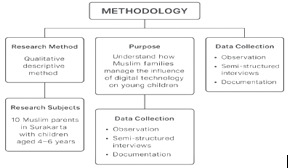
Objective: This study examines the methods applied by Muslim families in dealing with the impact of technological advances on early childhood in the Industrial 4.0 era, especially in the Surakarta area. Theoretical framework: This research is based on the theory of the social impact of technology and childcare in the Muslim family environment, highlighting the importance of the role of the family in shaping behavior and fortifying children from the negative impacts of technology. Literature review: discusses the influence of technology on early childhood development, the role of parents in religious value-based parenting, and strategies that can be applied in dealing with technological developments in the digital era. Methods: This study uses a descriptive qualitative method with the stages of data reduction, data presentation, and conclusion drawn, through observation and interviews with 10 Muslim families in Surakarta. Results: This study shows that Muslim families apply various methods such as preventive measures, supervision of technology use, free children to play outside with peers, being selective in choosing appropriate applications for children, providing examples of good behavior in the use of technology, and limiting the time of use of technology for children. Implication: this research highlights the importance of the active role of the family in accompanying and directing children in using technology wisely to minimize its negative impacts. Novelty: this research lies in its specific focus on the practice of raising Muslim families in the Industrial 4.0 era in the local context of Surakarta, as well as on the identification of concrete methods applied by parents in dealing with digital challenges in early childhood.
References
T. Z. Haq, “Pola Asuh Orang Tua Dalam Perilaku Sosial Generasi Millenial Ditinjau Dari Neurosains,” Al-Mada J. Agama, Sos. dan Budaya, vol. 3, no. 1, pp. 88–108, 2020, https://doi.org/10.31538/almada.v3i1.609.
A. Pratiwi and E. N. K. Asyarotin, “Implementasi literasi budaya dan kewargaan sebagai solusi disinformasi pada generasi millennial di Indonesia,” J. Kaji. Inf. Perpust., vol. 7, no. 1, pp. 65–80, 2019, https://doi.org/10.24198/jkip.v7i1.20066.
A. Faqih, “MAZHAB GOOGLE: Nalar Fikih Generasi Z dan Fatwa Shopping di SMAN 2 Lamongan dan MA ‘Matholi’ul Anwar’ Lamongan,” TA’LIM J. Stud. Pendidik. Islam, vol. 6, no. 2, pp. 140–172, 2023.
S. D. Ramadani, “Internet Dan Perilaku Seksual Remaja Pesisir Madura: Studi Cross Sectional Di Desa Branta,” J. Din. Sos. Budaya, vol. 21, no. 2, p. 91, 2019, https://doi.org/10.26623/jdsb.v21i2.1621.
S. Chalim and E. O. M. Anwas, “Peran Orangtua dan Guru dalam Membangun Internet sebagai Sumber Pembelajaran,” J. Penyul., vol. 14, no. 1, pp. 33–42, 2018, https://doi.org/10.25015/penyuluhan.v14i1.19558.
E. Kurniasari and D. N. Suhartini, “Hubungan penggunaan smartphone dengan kualitas dan kauntitas tidur pada remaja di desa arolipu tahun 2022,” vol. 1, no. 1, pp. 24–31, 2022.
T. N. Faridah, D. A. Dewi, and Y. F. Furnamasari, “Meningkatkan Karakter Generasi Muda di Era 5 . 0 Melalui Pembelajaran Pendidikan Kewarganegaraan,” J. Pendidik. Tambusai, vol. 5, no. 20, pp. 7310–7314, 2021.
S. Widiyono, “Pengembangan Nasionalisme Generasi Muda di Era Globalisasi,” Populika, vol. 7, no. 1, pp. 12–21, 2019, https://doi.org/10.37631/populika.v7i1.24.
E. Agus, “Pengaruh Globalisasi Terhadap Nilai Nasionalisme Generasi Muda,” Iuris Stud. J. Kaji. Huk., vol. 2, pp. 26–33, 2021, https://doi.org/10.55357/is.v2i1.75.
D. Yuniarni, L. Lukmanulhakim, A. Linarsih, D. Miranda, and H. Halida, “Pengembangan Buku Saku Panduan Penggunaan Gadget untuk Optimalisasi Perkembangan Anak Usia Dini,” J. Obs. J. Pendidik. Anak Usia Dini, vol. 7, no. 3, pp. 2820–2828, 2023, https://doi.org/10.31004/obsesi.v7i3.4145.
S. Setianingsih, “Dampak Penggunaan Gadget Pada Anak Usia Prasekolah Dapat Meningkatan Resiko Gangguan Pemusatan Perhatian Dan Hiperaktivitas,” Gaster, vol. 16, no. 2, p. 191, 2018, https://doi.org/10.30787/gaster.v16i2.297.
H. A. Divan, L. Kheifets, C. Obel, and J. Olsen, “Cell phone use and behavioral problems in young children,” J Epidemiol Community Heal., vol. 66, no. 6, pp. 524–529, Jun. 2012, https://doi.org/10.1136/JECH.2010.115402.
I. Palaiologou, “‘Do we hear what children want to say?’ Ethical praxis when choosing research tools with children under five,” Early Child Dev. Care, vol. 184, no. 5, pp. 689–705, 2014, https://doi.org/10.1080/03004430.2013.809341.
F. Gottschalk, “Impacts of technology use on children: Exploring literature on the brain, cognition, and well-being,” OECD Educ. Work. Pap., vol. 3, no. 195, pp. 313–316, 2019, https://doi.org/10.1787/e071a505-en
Wahib A, “Konsep Orang Tua Dalam Membangun Kepribadian Anak,” J. Paradig., vol. 2, no. 1, pp. 2406–9787, 2015.
S. Rahmah, “Pola Komunikasi Keluarga dalam Pembentukan Kepribadian Anak St. Rahmah UIN Antasari Banjarmasin,” J. Alhadharah, vol. 17, no. 33, pp. 13–31, 2018, https://doi.org/10.18592/alhadharah.v17i33.2369.
N. Nurmadiah, “Peranan Pendidikan Agama Dalam Keluarga Terhadap Pembentukan Kepribadian Anak-Anak,” Al-Afkar J. Keislam. Perad., vol. 1, no. 2, pp. 8–25, 2016, https://doi.org/10.28944/afkar.v1i2.6.
F. Y. Ekici, “Parents’ Views on the Use of Technology in the Early Childhood Period,” J. Educ. Train. Stud., vol. 4, no. 12, 2016, https://doi.org/10.11114/jets.v4i12.1925.
A. Hermana, “Perlindungan Hukum Terhadap Anak Pengguna Narkotika Dihunbungkan Dengan Undang-Undang Nomor 23 Tahun 2002 Jo. Undang-Undang Nomor 35 Tahun 2014 Tentang Perubahan Atas Undang-Undang Nomor 23 Tahun 2002 Tentang Perlindungan Anak,” J. Ilm. Galuh Justisi, vol. 4, no. 2, p. 241, 2017, https://doi.org/10.25157/jigj.v4i2.318.
K. A. Nasution, “Sanksi Terhadap Pelaku Penculikan Anak Menurut Nomor 35 Tahun2014 Tentang Perlindungan Anak Dan Hukum Islam,” J. EduTech, vol. 5, no. 1, pp. 37–44, 2019, https://doi.org/10.30596/edutech.v5i1.2760.
H. Perbowosari and I. Sudarsana, The Role of Parents to Educate Their Children in Technology Advancement. Research Gate Publication, 2019. https://doi.org/10.4108/eai.27-4-2019.2286849.
L. Asmawati, “Peran Orang Tua dalam Pemanfaatan Teknologi Digital pada Anak Usia Dini,” J. Obs. J. Pendidik. Anak Usia Dini, vol. 6, no. 1, pp. 82–96, 2021, https://doi.org/10.31004/obsesi.v6i1.1170.
M. Hammer, K. Scheiter, and K. Stürmer, “New technology, new role of parents: How parents’ beliefs and behavior affect students’ digital media self-efficacy,” Computers in Human Behavior, vol. 116. in Computers In Human Behavior, vol. 116. 2021. https://doi.org/10.1016/j.chb.2020.106642.
F. D. Purwaningtyas, Y. Septiana, H. Aprilia, and G. Candra, “Dampak Penggunaan Gadget Terhadap Perkembangan Psikologi Pada Anak Sekolah Dasar,” J. Psikol. Wijaya Putra, vol. 4, no. 1, pp. 1–9, 2023, https://doi.org/10.38156/psikowipa.v.
M. Ngafifi, “Kemajuan Teknologi Dan Pola Hidup Manusia Dalam Perspektif Sosial Budaya,” J. Pembang. Pendidik. Fondasi dan Apl., vol. 2, no. 1, pp. 33–47, 2014, https://doi.org/10.21831/jppfa.v2i1.2616.
K. A. Triana et al., “Pengaruh Kemajuan Teknologi terhadap Perkembangan Pendidikan Karakter Anak Sekolah Dasar,” vol. 7, pp. 24623–24627, 2023.
A. Zahrotunnisa, “The Urgency of Muslim Family Education in the Digital Era,” in The 6th International Conference on Islamic Studies, 2023, pp. 149–159.
M. Rahman, “Multikulturalisasi Pendidikan Islam Sejak Dini di Era Digital,” Fikrotuna, vol. 7, no. 1, pp. 818–833, 2018, https://doi.org/10.32806/jf.v7i1.3172.
I. N. Andriyani, “Pendidikan Anak dalam Keluarga di Era Digital,” Fikrotuna, vol. 7, no. 1, pp. 789–802, 2018, https://doi.org/10.32806/jf.v7i1.3184.
E. Zuni, “Islamic Parenting in Education of Children’s Conduct in The Digital Era,” EDU-RELIGIA J. Keagamaan dan …, vol. 4, no. 2, pp. 80–85, 2021, [Online]. Available: http://e-jurnal.unisda.ac.id/index.php/edureg/article/view/3404%0Ahttp://e-jurnal.unisda.ac.id/index.php/edureg/article/download/3404/2175
R. Astuti, Erni Munastiwi, and Muqowim, “Digital Parenting: Utilizing Technology to Instill Islamic Education Values in Young Children,” TADRIS J. Pendidik. Islam, vol. 17, no. 2, pp. 365–379, 2022, https://doi.org/10.19105/tjpi.v17i2.7468.
S. Gussevi and N. A. Muhfi, “Tantangan Mendidik Generasi Milenial Muslim di Era Revolusi Industri 4.0,” Paedagog. J. Pendidik. Dan Stud. Islam, vol. 2, no. 01, pp. 46–57, 2021, https://doi.org/10.52593/pdg.02.1.05.
M. Muyassarah, “Pengaruh Perkembangan Teknologi Terhadap Cara Mendidik Anak Dan Dampaknya Terhadap Budget Keuangan Keluarga Muslim,” BERDAYA J. Pendidik. dan Pengabdi. Kpd. Masy., vol. 1, no. 1, pp. 1–14, 2019, https://doi.org/10.36407/berdaya.v1i1.101.
A. Rahman, “Pengaruh Negatif Era Teknologi Informasi Komunikasi pada Remaja (Perspektif Pendidikan Islami),” J. Stud. Pendidik., vol. XIV, no. 1, pp. 18–35, 2016.
M. Mulyadi, “Penelitian Kuantitatif Dan Kualitatif Serta Pemikiran Dasar Menggabungkannya [Quantitative and Qualitative Research and Basic Rationale to Combine Them],” J. Stud. Komun. dan Media, vol. 15, no. 1, pp. 128–138, 2019, https://doi.org/10.31445/jskm.2011.150106.
M. Ali, “Teknik Analisis Kualitatif,” Makal. Tek. Anal. II, pp. 1–7, 2006, [Online]. Available: http://staffnew.uny.ac.id/upload/132232818/pendidikan/Analisis+Kuantitatif.pdf
M. M. Ali, T. Hariyati, M. Y. Pratiwi, and S. Afifah, “Metodologi Penelitian Kuantitatif Dan Penerapannya Dalam Penelitian,” Educ. J., vol. 2, no. 2, pp. 1–6, 2022.
S. W. Purwanza dkk., Metodologi Penelitian Kuantitatif, Kualitatif dan Kombinasi, no. March. 2022.
Rahmi, “Metode Penelitian Kuantitatif untuk Penulisan Karya Ilmiah,” J. Univ. Indones., pp. 1–52, 2022, [Online]. Available: https://eprints2.undip.ac.id/id/eprint/5849/1/210422_Kuantitatif %281%29.pdf
T. Aryati, “Kontrol Sosial Orang Tua kepada Anak Balita dalam Penggunaan Gadget di Desa Wukirsari Imogiri Bantul,” Jurnal Pendidikan Sosiologi, vol. 6, no. 4. pp. 1–11, 2017.
Y. Rismala, Aguswan, D. E. Priyantoro, and Suryadi, “Dampak Penggunaan Gadget Terhadap Perkembangan Sosial Anak Usia Dini,” El-Athfal J. Kaji. Ilmu Pendidik. Anak, vol. 1, no. 01, pp. 46–55, 2021, https://doi.org/10.56872/elathfal.v1i01.273.
R. Nugroho, I. K. A. J. Artha, W. Nusantara, A. D. Cahyani, and M. Y. P. Patrama, “Peran Orang Tua dalam Mengurangi Dampak Negatif Penggunaan Gadget,” in Jurnal Obsesi : Jurnal Pendidikan Anak Usia Dini, vol. 6, no. 5, 2022, pp. 5425–5436. https://doi.org/10.31004/obsesi.v6i5.2980.
A. R. Adwiah and R. R. Diana, “Strategi Orang Tua dalam Mengatasi Dampak Penggunaan Gadget terhadap Perkembangan Sosial Anak Usia Dini,” in Jurnal Obsesi : Jurnal Pendidikan Anak Usia Dini, vol. 7, no. 2, 2023, pp. 2463–2473. https://doi.org/10.31004/obsesi.v7i2.3700.
H. S. Wahyudi and M. P. Sukmasari, “Teknologi Dan Kehidupan Masyarakat,” in Jurnal Analisa Sosiologi, vol. 3, no. 1, 2018, pp. 13–24. https://doi.org/10.20961/jas.v3i1.17444.
N. Novitasari, “Strategi Pendampingan Orang Tua terhadap Intensitas Penggunaan Gadget pada Anak,” Al-Hikmah Indones. J. Early Child. Islam. Educ., vol. 3, no. 2, pp. 167–188, 2019, https://doi.org/10.35896/ijecie.v3i2.77.
Fahrurrozi and Sutrisno, “Pendampingan Orang Tua dalam menghadapi Era Digital bagi Siswa SD Setiabudi Kecamatan Karet Jakarta Selatan,” J. Pemberdaya. Sekol. Dasar, vol. 1, no. 1, pp. 19–22, 2018, [Online]. Available: http://hdl.handle.net/11617/10214
M. R. Tasya and S. Masitoh, “Pendampingan Orang Tua Kepada Anak Dalam Mencegah Dampak Negatif Dari Gadget,” J. Ris. Mhs. Dakwah dan Komun., vol. 2, no. 5, p. 229, 2020, https://doi.org/10.24014/jrmdk.v2i5.10556.
E. Sutriyatna, Sosialisasi Dampak Penggunaan Gadget Terhadap Anak-anak (Studi Kasus: Warga Rw.05 Kelurahan Pondok Petir), vol. 1, no. 1. KOMMAS: Jurnal Pengabdian kepada Masyarakat, 2020. [Online]. Available: http://openjournal.unpam.ac.id/index.php/kommas/article/view/4616
I. Nurhidayah, J. G. Ramadhan, I. Amira, and M. Lukman, Peran Orangtua dalam Pencegahan Tergadap Kejadian Adiksi Gadget pada Anak, vol. 4, no. 9. Anak: Literatur Review. Jurnal Ilmu Keperawatan Jiwa, 2021.