Reconstructing Social Justice through Maqasid al-Shariah: A Legal Framework for Sustainable Community Development
DOI:
https://doi.org/10.61455/jeisr.v2i02.627Keywords:
maqasid al-shariah, social justice, islamic law, community development, waqf and zakatAbstract
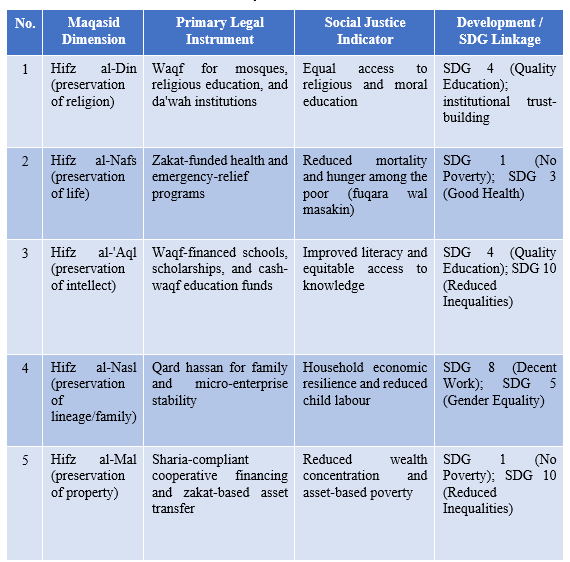
Objective: This study examines how Islamic law (Sharia), particularly the doctrine of maqasid al-shariah (the higher objectives of Islamic law), can be reconstructed into an operational framework for promoting social justice through community development initiatives in Muslim-majority societies. Theoretical framework: The study is grounded in the classical maqasid theory developed by al-Ghazali and al-Shatibi and further systematized by Ibn Ashur, integrating the five essential objectives of Sharia with contemporary theories of social and distributive justice to establish a comprehensive analytical framework. Literature review: Existing scholarship examines zakat, waqf, and Islamic microfinance separately, but rarely links them systematically to the five maqasid dimensions and Sustainable Development Goals (SDGs), creating a conceptual gap. Methods: The research adopts a qualitative doctrinal and library-based approach, employing content analysis of classical fiqh literature, contemporary maqasid scholarship, Islamic economic policy documents, and relevant legal studies to develop a comparative conceptual framework. Results: The analysis produces an integrated framework that connects each maqasid dimension with specific Islamic legal instruments, including zakat, waqf, qard hasan, and Sharia-compliant cooperative financing, alongside measurable indicators of social justice and community development, demonstrating that Islamic law offers both normative principles and practical institutional mechanisms for reducing inequality and promoting sustainable development. Implications: The proposed framework provides policymakers, Sharia supervisory boards, zakat and waqf institutions, and community development practitioners with a practical tool for designing and evaluating Sharia-compliant development programs aligned with sustainable development priorities. Novelty: Unlike previous studies, this article operationalizes maqasid al-shariah by integrating Islamic legal instruments, social justice indicators, and community development outcomes.
References
R. Muin, A. M. T. Bn, M. Ilyas, and T. Putra, “Challenges in the Implementation of Professional Zakat for Civil Servants in Sinjai, South Sulawesi: A Maqāṣid al-Sharī’ah Perspective,” El-Usrah, vol. 9, no. 1, pp. 389–413, 2026, https://doi.org/10.22373/ujhk.v9i1.33640.
U. M. M. Kannike and A. O. Fahm, “Exploring the Ethical Governance of Artificial Intelligence From an Islamic Ethical Perspective,” J. Fiqh, vol. 22, no. 1, pp. 134–161, 2025, https://doi.org/10.22452/fiqh.vol22no1.5.
R. Jureidini, S. F. Hassan, and D. Aassouli, “Introduction to Food Security and Islamic Ethics,” Food Secur. Islam. Ethics, Rights, Policies, Vulnerable Groups, pp. 1–10, 2025, https://doi.org/10.4337/9781035333585.00005.
M. Abdillah, “Equality from the Perspective of Islamic Constitutional Law al-Musāwah and Legal Equality in Islamic Constitutional Frameworks,” Ahkam J. Ilmu Syariah, vol. 25, no. 2, pp. 267–284, 2025, https://doi.org/10.15408/ajis.v25i2.46563.
L. M. Susana, R. I. Tripalupi, S. Kholil, N. Efendi, and G. Sakinah, “Reconstructing Islamic Legal Norms in Environmental Governance: A Maqasid-Based Legal Critique of Indonesia’s Resource Policies,” Al-Istinbath J. Huk. Islam, vol. 10, no. 2, pp. 650–670, 2025, https://doi.org/10.29240/jhi.v10i2.13038.
Y. Helmy, “From Islamic Modernism to Theorising Authoritarianism: Bin Bayyah and the Politicisation of the Maqāṣid Discourse,” Am. J. Islam Soc., vol. 38, no. 3–4, pp. 36–70, 2021, https://doi.org/10.35632/ajis.v38i3-4.2934.
M. O. Rafique and K. M. Raza, “Islamic Green Finance: A Marriage of Ethics and Environmental Responsibility in Light of Maqasid al-Shari’ah,” 2025, Taylor and Francis, Islamic Finance and Management Sciences, SZABIST University, Pakistan. https://doi.org/10.4324/9781003540403-2.
E. Saputra, M. Ridwan, A. Effendi, R. Defriza, and R. Hidayat, “Darul Ahdi wa Syahadah and the Implementation of Maqasid Al-Shariah in the Context of the Pancasila State,” Nurani, vol. 24, no. 2, pp. 460–475, 2024, https://doi.org/10.19109/nurani.v24i2.25028.
B. Al-Sowaidi, “A Socioecological and Maqāṣidi Analysis of Domestic Gender- Based Violence in Yemen Maq idi,” J. Int. Womens. Stud., vol. 26, no. 5, p. 12, 2024, [Online]. Available: https://www.scopus.com/pages/publications/85207339751?origin=resultslist
R. E. A. Gebara, “The relevance of Waqf to the Australian society from the perspective of Maqasidal-Shari’ah (higher objectives of Shari’ah),” Al-Shajarah, vol. 23, no. 1, pp. 149–168, 2018, https://www.scopus.com/pages/publications/85049565766?origin=resultslist
B. S. Sairally, “Integrating Environmental, Social And Governance (ESG) Factors In Islamic Finance: Towards The Realisation Of Maqāṣid Al-Sharīʿah,” ISRA Int. J. Islam. Financ., vol. 7, no. 2, pp. 145–154, 2015, [Online]. Available: https://www.scopus.com/pages/publications/85047489904?origin=resultslist
A. Muqorobin, U. Etica, F. S. Indra, and M. Huda, “Overcoming Barriers To Islamic Agricultural Financing In East Java: A Soft Systems Methodology Perspective,” Petita J. Kaji. Ilmu Huk. dan Syariah, vol. 11, no. 1, pp. 418–444, 2026, https://doi.org/10.22373/petita.v11i1.1017.
A. H. Ibrahim and M. S. Harun, “Applying the Concepts of Benefit and Harm in Malaysian Bioethical Discourse: Analysis of Malaysian Fatwa,” J. Bioeth. Inq., vol. 21, no. 3, pp. 401–414, 2024, https://doi.org/10.1007/s11673-024-10345-z.
A. Alqudah, M. Iseafan, and A. S. Atwa Al-Fandi, “The zakat base in light of contemporary economic changes: a Maqasid-based juristic study according to the Maliki school,” J. Islam. Account. Bus. Res., pp. 1–20, 2026, https://doi.org/10.1108/JIABR-07-2025-0421.
R. Hassan, S. A. Salman, and A. Yusoff, “Idealism versus realism: Performance of Islamic financial institutions in the light of Maqasid-Al Shari’ah,” in Proceedings of the 32nd International Business Information Management Association Conference, IBIMA 2018 - Vision 2020: Sustainable Economic Development and Application of Innovation Management from Regional expansion to Global Growth, S. K.S., Ed., Institute of Islamic Banking and Finance (IIiBF), International Islamic University Malaysia (IIUM), Gombak, Malaysia: International Business Information Management Association, IBIMA, 2018, pp. 7011–7014. [Online]. Available: https://www.scopus.com/pages/publications/85063044320?origin=resultslist
M. Abubakar, “Waqf Philanthropy and Orphans’ Socio-Economic Development in Northern Nigeria Based on Maqasid al Shariah Principles,” 2019, Springer International Publishing, Department of Business Administration, Ahmadu Bello University, Zaria, Nigeria. https://doi.org/10.1007/978-3-030-18445-2_3.
K. Dimyati, “The formulation of welfare state: The perspective of Maqāid al-Sharī’ah,” Indones. J. Islam Muslim Soc., vol. 8, no. 1, pp. 117–146, 2018, https://doi.org/10.18326/ijims.v8i1.117-146.
N. Nordin, M. R. A. Aziz, A. Alam, R. T. Ratnasari, and A. S. Rusydiana, “Waqf-Backed Urban Regeneration In Kuala Terengganu, Malaysia: A Tayyib Approach To Housing And Community Well-Being,” Plan. Malaysia, vol. 24, no. 2, pp. 80–95, 2026, https://doi.org/10.21837/PM.V24I41.1988.
L. Raimi, “Development of Shari’ah Framework for Halal Policy and Standards for Integrating Blue Economy for Halal Industry Sustainability,” 2025, Springer Nature, Department of Business Administration (Entrepreneurship), Universiti Brunei Darussalam, Gadong, Brunei Darussalam. https://doi.org/10.1007/978-981-96-1729-6_9.
F. R. Siregar, M. Syahbudi, and M. L. Ilhamy Nasution, “The Impact of Zakat Utilisation and Business Financing on Welfare with Business Sustainability as a Moderating Variable: A Case Study of BAZNAS Labuhanbatu Utara,” J. Ilm. Mizani, vol. 11, no. 2, pp. 363–377, 2024, https://doi.org/10.29300/mzn.v11i2.4444.
M. A. Dalimunthe and F. Riza, “Islamic Theological Perspectives on Human Rights: Bridging the Gap between Faith and Universal Principles,” Pharos J. Theol., vol. 106, no. SpecialIssue-2, pp. 1–20, 2025, https://doi.org/10.46222/pharosjot.106.207.
Z. S. Ibrahim, S. S. Karimullah, A. I. Assaad, R. Septiani, and H. Okur, “Integration of Maqaṣid al-Shari’ah in the Criminal Law Reform to Achieve Justice and Human Dignity,” J. Huk. Islam, vol. 23, no. 1, pp. 105–144, 2025, https://doi.org/10.28918/jhi.v23i1.04.
A. Nurlela, M. A. Rofiq, Y. G. Abdullah, A. Nizar, and H. S. Rohmawati, “Contemporary Islamic Ethics: An Analysis of Tariq Ramadan’s Perspectives on the Jurisprudence of Minorities and the Realities of Life in the West,” J. Islam. Thought Civiliz., vol. 15, no. 2, pp. 117–136, 2025, https://doi.org/10.32350/JITC.152.08.
S. S. Abd Razak, “Protecting Gig Workers in the Digital Labour Platform Through the Principles of Social Justice in Islam,” Manchester J. Transnatl. Islam. Law Pract., vol. 20, no. 3, pp. 420–424, 2024, [Online]. Available: https://www.scopus.com/pages/publications/85211227443?origin=resultslist
I. A. Oladapo and A. Ab Rahman, “A path analysis approach on the factors of human development among Muslims in Nigeria,” J. Islam. Account. Bus. Res., vol. 9, no. 1, pp. 59–76, 2018, https://doi.org/10.1108/JIABR-01-2016-0014.
I. A. Oladapo and A. Ab Rahman, “Re-counting the determinant factors of human development: a review of the literature,” Humanomics, vol. 32, no. 2, pp. 205–226, 2016, https://doi.org/10.1108/H-02-2016-0018.
W. Wastuti, “Conceptualising Islamic Social Enterprise and Islamic Social Entrepreneurship: Insights from a Systematic Literature Review,” in Lecture Notes in Networks and Systems, I. A., S. J., B. N., and J. A., Eds., Universitas Negeri Jakarta, Jakarta, Indonesia: Springer Science and Business Media Deutschland GmbH, 2026, pp. 358–369. https://doi.org/10.1007/978-3-032-13419-6_34.
N. F. Mahadi, “Islamic world view towards a green economy,” 2025, Taylor and Francis, Student Development and Community Engagement, IIUM Institute of Islamic Banking and Finance (IIiBF), Malaysia. https://doi.org/10.4324/9781003570936-4.
F. Khaleel and A. Avdukić, “Exploring the Epistemology of Utility Function in Islamic Economics: Foundation of Islamic Finance,” 2020, Springer International Publishing, Al-Maktoum College of Higher Education, Dundee, United Kingdom. https://doi.org/10.1007/978-3-030-34420-7_2.
N. Nurani and H. N. Bagja, “Intellectual Property Rights Law Reform Based on Maqāṣid al-Sharī‘ah as a Model for Green Business-Based Creative Industry Protection to Support Sustainable Development,” Jure J. Huk. dan Syar’iah, vol. 18, no. 1, pp. 1–32, 2026, https://doi.org/10.18860/j-fsh.v18i1.40840.
A. M. Suliman, “The Objectives Of Islamic Sharia And Global Human Issues (Poverty-Wars-Displacement),” TPM - Testing, Psychom. Methodol. Appl. Psychol., vol. 32, no. S4, pp. 1692–1695, 2025, https://www.scopus.com/pages/publications/105014356344?origin=resultslist
I. A. Oladapo, N. Omar, A. A. Rahman, R. Arshad, M. M. Hamoudah, and A. A. Abdurraheem, “Assessing good governance practices and development nexus: An application of structural invariance analysis,” Manag. Account. Rev., vol. 18, no. 1, pp. 77–99, 2019, https://doi.org/10.24191/mar.v18i1.802.
Y. Suzuki, S. Anwar, S. Pramono, and T. Supriyanto, “An impact assessment of Islamic saving-loan and financing cooperatives in Indonesia: Preliminary findings from the artificial neural networks technique,” 2018, Taylor and Francis, Ritsumeikan Asia Pacific University, Japan. https://doi.org/10.1201/9781315105673.
I. Z. Asyiqin and A. B. A. Hisyam, “Islamic Legal Framework For Enhancing Takaful Ijtimā‘Ī Through Waqf-Mushārakah Models In Indonesia And Malaysia,” J. Al-dustur, vol. 9, no. 1, pp. 96–112, 2026, https://doi.org/10.30863/aldustur.v9i1.10675.
A. Avdukić and E. Smolo, “Promoting sustainable development through Islamic social finance,” 2024, Emerald Publishing, University of Dundee, United Kingdom. https://doi.org/10.1108/978-1-83549-906-120241008.
M. Billah et al., “Islamic law perspectives and social experiences on stigma toward disabled people in Indonesia,” Front. Sociol., vol. 10, 2025, https://doi.org/10.3389/fsoc.2025.1479243.
M. I. Huda, U. F. Kaamilah, and M. F. El Hijri, “Jasser Auda’s Maqāṣid al-Sharī’ah: Transforming Professional Zakat for People’s Welfare,” Al-Muamalat, vol. 12, no. 1, pp. 77–96, 2025, https://doi.org/10.15575/am.v12i1.40952.
S. A. Yusof, M. A. Budiman, R. M. Amin, and A. Abideen, “Holistic development and wellbeing based on MAQASID AL- SHARI’AH: The case of South Kalimantan, Indonesia,” J. Econ. Coop. Dev., vol. 40, no. 4, pp. 1–21, 2019, [Online]. Available: https://www.scopus.com/pages/publications/85083459873?origin=resultslist
B. Bambang, “Ijtihad and the Dynamics of Islamic Legal Interpretation: An Epistemological Exploration in the Contemporary Context,” Nusant. J. Law Stud., vol. 3, no. 1, pp. 56–67, 2024, https://doi.org/10.5281/zenodo.17373912.
Z. M. O. Channak and Y. J. Amuda, “Legitimacy And Legitimation: A Comparative Analysis Of Islamic Law And European Standards Through The Lens Of Sdg 16,” Access to Justice East. Eur., vol. 9, no. 1, pp. 263–291, 2026, https://doi.org/10.33327/AJEE-18-9.1-a000180.
W. Hefni, I. Mustofa, and R. Ahmadi, “Looking for Moderate Fiqh: The Thought of Mohammad Hashim Kamali on the Reformation of Rigidity and Inflexibility in Islamic Law,” Al-Istinbath J. Huk. Islam, vol. 10, no. 1, pp. 30–57, 2025, https://doi.org/10.29240/jhi.v10i1.10694.
N. S. B. Kasri and A. H. B. Badruddin, “Advancing a Just Transition: A Critical Analysis of Islamic Green Finance Policy Frameworks and Initiatives in Malaysia,” 2025, Taylor and Francis, Islamic Economic Department, ISRA Research Management Centre, INCEIF University, Malaysia. https://doi.org/10.4324/9781003518617-10.
H. Al Madani, K. O. Alotaibi, and S. Alhammadi, “The role of Sukuk in achieving sustainable development: Evidence from the Islamic Development Bank,” Banks Bank Syst., vol. 15, no. 4, pp. 36–48, 2020, https://doi.org/10.21511/bbs.15(4).2020.04.
S. Alhammadi, K. O. Alotaibi, and D. F. Hakam, “Analysing Islamic banking ethical performance from Maqāṣid al-Sharī‘ah perspective: evidence from Indonesia,” J. Sustain. Financ. Invest., vol. 12, no. 4, pp. 1171–1193, 2022, https://doi.org/10.1080/20430795.2020.1848179.
Y. Suzuki and M. D. Miah, “Shari’ah-compliant benchmark and Shari’ah-based “raf’ al-haraj” benchmark on prohibition of riba,” Int. J. Islam. Middle East. Financ. Manag., vol. 14, no. 1, pp. 151–163, 2021, https://doi.org/10.1108/IMEFM-11-2019-0490.
E. Smolo, “Islamic Finance in the Digital Age: Fintech as a Civilizational Tool,” Religions, vol. 17, no. 2, 2026, https://doi.org/10.3390/rel17020218.
A. Abdullah, “Classical Islamic Perspectives on Monetary Theory,” J. King Abdulaziz Univ. Islam. Econ., vol. 35, no. 1, pp. 3–22, 2022, https://doi.org/10.4197/Islec.35-1.1.
M. Alsaghir, “Digital risks and Islamic FinTech: a road map to social justice and financial inclusion,” in Journal of Islamic Accounting and Business Research, Department of Moral Economy and Sustainable Development, Al-Maktoum College of Higher Education, Dundee, United Kingdom: Emerald Publishing, 2025, pp. 1265–1282. https://doi.org/10.1108/JIABR-10-2022-0262.
A. Asy and M. Elbanna, “An Analysis of Jasser Auda ’ s Thought on Maqashid Sharia and Its Implications for Sharia Economic Law,” Solo Int. Collab. Publ. Soc. Sci. Humanit., vol. 3, no. 3, pp. 441–456, 2025, https://doi.org/10.61455/sicopus.v3i03.361.
A. A. Saeed Mohammed and F. Mansor, “Value- based Islamic banking and reporting in Bahrain,” Int. J. Ethics Syst., vol. 37, no. 4, pp. 644–663, 2021, https://doi.org/10.1108/IJOES-09-2020-0141.
M. Elbanna, “The Development of Zakat, Infaq, Sadaqah in Egypt: A Literature Review Approach,” Demak Univers. J. Islam Sharia, vol. 2, no. 03, pp. 375–388, 2024, https://doi.org/10.61455/deujis.v2i03.218.