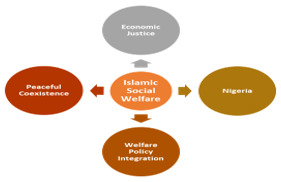
Islamic Social Welfare and Economic Justice for Promoting Peaceful Coexistence in Nigeria: Implications for Conventional Welfare Policies
DOI:
https://doi.org/10.61455/sicopus.v4i03.652Keywords:
economic justice, islamic social welfare, peaceful coexistence, nigeria, welfare policy integrationAbstract
Objective: This study aims to analyze the role of zakat, alms, and waqf in realizing economic justice and strengthening social peace. The research also examines its potential integration with government welfare programs in Nigeria. Theoretical framework: The research integrates the concept of Maqasid al-Shari'ah with the theory of Justice as Fairness from John Rawls. This framework is used to analyze the justice distribution of resources and social cohesion in multicultural societies. Literature review: Previous research has extensively discussed the limitations of social welfare and sectarian conflicts in Nigeria. However, the role of Islamic social institutions in conflict resolution and their integration with government policies is still minimally empirically studied. Methods: The study used a qualitative approach with thematic analysis of Islamic legal sources, government documents, and structured consultations. Data were obtained from 30 participants, including Islamic legal experts, welfare managers, and representatives of conflict-affected communities in Northern Nigeria. Results: Preliminary findings suggest that societies with well-functioning Islamic welfare institutions tend to have lower levels of social conflict. However, their effectiveness is still hampered by organizational fragmentation, weak government recognition, and limitations of public welfare programs. Implications: The study proposes an integrated welfare model linking Islamic social finance with government social protection systems. Strengthening transparency, accountability, and organizational capacity is needed to improve services and reduce social conflicts. Novelty: The novelty of the research lies in an empirical study of the relationship between Islamic social institutions, economic justice, and peace in the Nigerian context. The research also offers an integrative policy model that aligns Islamic economic principles with secular governance.
References
S. A. Ashafa, L. Raimi, and N. B. Bamiro, “Catalytic role of Islam’s social well-being and economic justice as determinants of peaceful coexistence: a systematic literature review using PRISMA,” Int. J. Ethics Syst., vol. 42, no. 4, pp. 1004–1029, 2026, https://doi.org/10.1108/IJOES-10-2024-0321.
S. Sulaeman et al., “Islamic business ethics in the framework of higher ethical objective (Maqasid al-Shariah): a comprehensive analysis and future research directions,” Int. J. Ethics Syst., pp. 1–29, 2025, https://doi.org/10.1108/IJOES-12-2024-0398.
C. Moniz, Social Workers and Policy Practice: Affecting Policy and Achieving Policy Action. Taylor & Francis, 2018. https://doi.org/10.4324/9781315641379-8.
P. Chiwara and A. Lombard, “The challenge to promote social and economic equality in Namibia through social work,” Soc. Work (South Africa), vol. 53, no. 4, pp. 563–578, 2017, https://doi.org/10.15270/53-4-598.
P. Chiwara and A. Lombard, “The challenge to promote social and economic equality in Namibia through social work,” Soc. Work (South Africa), vol. 53, no. 4, pp. 563–578, 2017, https://doi.org/10.15270/52-2-598.
L. S. Waits-Kamau, Shar’ia Law and the Social Policy of ISIS. Springer International Publishing, 2018. https://doi.org/10.1007/978-3-319-20928-9_2647.
A. Alqudah, M. Iseafan, and A. S. Atwa Al-Fandi, “The zakat base in light of contemporary economic changes: a Maqasid-based juristic study according to the Maliki school,” J. Islam. Account. Bus. Res., pp. 1–20, 2026, https://doi.org/10.1108/JIABR-07-2025-0421.
A. Pericoli, “Islamic Instruments for Refugee Financing: The IsDB and UNHCR Collaborative Approach,” Glob. Policy, vol. 16, no. S1, pp. 46–56, 2025, https://doi.org/10.1111/1758-5899.13476.
A. Pericoli, Islamic Aid and Gulf States in Contemporary Crises. Edinburgh University Press, 2026. https://doi.org/10.3366/9781399548335.
R. Jawad and R. Eseed, “Social Policy and the Islamic World in Comparative Perspective: Taking Stock, Moving Forward,” Int. Ser. Public Policy, pp. 37–62, 2021, https://doi.org/10.1007/978-3-030-57753-7_3.
K. Salim, W. N. W. Mohd Noor, and S. M. Ramadili Mohd, The Potential Applications of Artificial Intelligence in Managing Zakat Funds. World Scientific Publishing Co., 2025. https://doi.org/10.1142/9781800616295_0016.
R. Warden, J. Scourfield, and P. Huxley, “Islamic Social Work in the UK: The Service User Experience,” Br. J. Soc. Work, vol. 47, no. 3, pp. 737–754, 2017, https://doi.org/10.1093/bjsw/bcw006.
A. Bunting, Family Law’s Legal Pluralism: Private ‘Opting-Out’ in Canada and South Africa. Taylor and Francis, 2017. https://doi.org/10.4324/9781351152884-4.
H. Ahmad, W. N. W. Hasan, and S. M. Saniff, “Constructing Ethnographic Protocols for Zakat Studies in the Muslim Community,” Int. J. Islam. Financ. Sustain. Dev., vol. 17, no. 1, pp. 75–91, 2025, https://doi.org/10.55188/ijifsd.v17i1.935.
S. Zhang, Q. Ci, and M. Zhan, “Public assistance in urban and rural China: A tale of two stories,” Int. J. Soc. Welf., vol. 26, no. 4, pp. 303–313, 2017, https://doi.org/10.1111/ijsw.12248.
Z. M. O. Channak and Y. J. Amuda, “Legitimacy and Legitimation: a Comparative Analysis of Islamic Law and European Standards Through the Lens of Sdg 16,” Access to Justice East. Eur., vol. 9, no. 1, pp. 263–291, 2026, https://doi.org/10.33327/AJEE-18-9.1-a000180.
D. Béland and R. Mandelkern, “Ideas and the changing relationship between states and markets in social policy: A review essay,” Int. J. Soc. Welf., vol. 34, no. 2, 2025, https://doi.org/10.1111/ijsw.12701.
M. L. Goodman, S. Gitari, P. H. Keiser, and L. Raimer-Goodman, “Economic empowerment or cash-dependency for orphans and vulnerable children in Kenya: Evidence from an alternative to cash-only models,” Int. J. Soc. Welf., vol. 26, no. 1, pp. 37–48, 2017, https://doi.org/10.1111/ijsw.12226.
M. Gray and A. Lombard, “Progress of the social service professions in South Africa’s developmental social welfare system: Social work, and child and youth care work,” Int. J. Soc. Welf., vol. 32, no. 4, pp. 429–441, 2023, https://doi.org/10.1111/ijsw.12562.
M. Asutay and I. Yilmaz, “Constituting an Islamic social welfare function: an exploration through Islamic moral economy,” Int. J. Islam. Middle East. Financ. Manag., vol. 14, no. 3, pp. 524–540, 2020, https://doi.org/10.1108/IMEFM-03-2019-0130.
Khamim, A. Muala, and M. L. Hakim, “Cash Waqf Linked Sukuk for Islamic Social Welfare and National Development: Evidence from Indonesia,” Glob. J. Al-Thaqafah, vol. 13, no. 1, pp. 16–34, 2023, https://doi.org/10.7187/GJAT072023-2.
Z. Farhat and I. Ahmed, Muslim Women and Zakat: Empowerment Through Islamic Social Welfare and Finance. Emerald Group Publishing Ltd., 2026. https://doi.org/10.1108/978-1-80592-054-020261010.
S. Ashurov, A. H. Abdullah Othman, S. M. Bin Syed Jaafar Alhabshi, M. Habibullah, and M. S. Muhamad Yusof, Developing a Conceptual Framework for Zakat Collection and Distribution Impact on Social Welfare Through Implications of SDGs, vol. 2. IGI Global, 2022. https://doi.org/10.4018/978-1-6684-3885-5.ch022.
O. S. Oyesanya and A. O. Azeez, “AṢ-Ṣadaqah Al-Munaẓẓamah (Institutionalised Ṣadaqah) and Social Welfare Programmes in Al-Hayat Relief Foundation, Nigeria,” J. King Abdulaziz Univ. Islam. Econ., vol. 39, no. 2, pp. 73–89, 2026, https://doi.org/10.64064/1658-4244.1079.
J. Gärde, “Concepts on Zakat, Caritas, and Diaconia in the changing social welfare landscape of Europe,” J. Relig. Spiritual. Soc. Work, vol. 36, no. 1–2, pp. 164–198, 2017, https://doi.org/10.1080/15426432.2017.1311242.
S. Alhammadi, K. O. Alotaibi, and D. F. Hakam, “Analysing Islamic banking ethical performance from Maqāṣid al-Sharī‘ah perspective: evidence from Indonesia,” J. Sustain. Financ. Invest., vol. 12, no. 4, pp. 1171–1193, 2022, https://doi.org/10.1080/20430795.2020.1848179.
Z. A. H. Munir, “Wealth Distribution among Sasak Communities Through Inheritance: A Quest for Justice,” Samarah, vol. 7, no. 3, pp. 1627–1643, 2023, https://doi.org/10.22373/sjhk.v7i3.10835.
M. Subhan, “A Mathematical Model of Economic Population Dynamics in a Country That Has Optimal Zakat Management,” IOP Conf. Ser. Mater. Sci. Eng., vol. 335, no. 1, p. 012051, Apr. 2018, https://doi.org/10.1088/1757-899X/335/1/012051.
Zainuddin and Sahban, “Reinterpretasi Riqab Sebagai Korban Eksploitasi Seksual Dalam Hukum Zakat,” Masal. Huk., vol. 50, no. 1, pp. 17–23, 2021, https://doi.org/10.14710/mmh.50.1.2021.17-23.
M. O. Rafique and K. M. Raza, Islamic Green Finance: A Marriage of Ethics and Environmental Responsibility in Light of Maqasid al-Shari’ah. Taylor & Francis, 2025. https://doi.org/10.4324/9781003540403-2.
Chandra, B. A. Saebani, I. Suntana, and H. Bisri, “Contracts as the Main Legal Basis in Islamic Economic Disputes: A Juridical-Empirical Study of Lawlessness in Religious Courts,” J. Ilm. Mizani, vol. 13, no. 1, pp. 134–150, 2026, https://doi.org/10.29300/mzn.v13i1.10669.
M. A. Omar, M. I. A. Mohsin, I. S. Beik, and S. M. Zulkarnaini, “Inceif Impact Index Model (Iiim) for Assessing Material and Spiritual Welfare in Islamic Social Finance,” Int. J. Islam. Financ. Sustain. Dev., vol. 18, no. 3, pp. 117–138, 2026, https://doi.org/10.55188/ijifsd.v18i3.1392.
U. M. M. Kannike and A. O. Fahm, “Exploring the Ethical Governance of Artificial Intelligence From an Islamic Ethical Perspective,” J. Fiqh, vol. 22, no. 1, pp. 134–161, 2025, https://doi.org/10.22452/fiqh.vol22no1.5.
A. S. Baharuddin, “Expanding Horizons in Syariah and Law Scholarship: Insights From the Malaysian Journal of Syariah and Law,” Malaysian J. Syariah Law, vol. 11, no. 1, pp. i–iv, 2023, https://doi.org/10.33102/mjsl.vol11no1.444.
E. Qutieshat, M. Al Adwan, and M. Khater, “Artificial Intelligence in Islamic Law: Ethics, Governance, and Accountability,” J. Sustain. Dev. Regul. Issues, vol. 4, no. 2, pp. 467–714, 2026, https://doi.org/10.53955/jsderi.v4i2.236.
A. Riwanto and S. Suryaningsih, “Realizing Welfare State and Social Justice: A Perspective on Islamic Law,” Volksgeist J. Ilmu Huk. dan Konstitusi, vol. 5, no. 1, pp. 41–51, 2022, https://doi.org/10.24090/volksgeist.v5i1.6430.
J. Akhtar, “Social Justice and Equality in the Qur’ān: Implications for Global Peace,” Unity and Dialogue, vol. 79, no. 1, pp. 23–45, 2024, https://doi.org/10.34291/Edinost/79/01/Akhtar.
T. A. Saputro, Isman, D. Setiawati, A. Alam, and N. R. Febriandika, “Geographical Indications and Maqāṣid al-Sharī‘ah: Realizing Intellectual Property as an Instrument of Economic Justice,” Al-Muamalat, vol. 12, no. 2, pp. 339–358, 2025, https://doi.org/10.15575/am.v12i2.51236.
S. A. Ashafa and L. Raimi, “Exploring the impact of Islam’s social well-being and economic justice on peaceful coexistence in Nigeria: implications for conventional welfare policy,” J. Entrep. Public Policy, vol. 14, no. 2, pp. 230–250, 2025, https://doi.org/10.1108/JEPP-11-2023-0116.
Zainuddin, A. Aswari, and Salle, “Voluntary System: The Legal Problems of Zakat Management For The Fulfillment of Socio-Economic Justice,” Yuridika, vol. 38, no. 3, pp. 685–704, 2023, https://doi.org/10.20473/ydk.v38i3.43885.
Z. Nurdin, Suryani, and Agusten, “From Classical Kafā’ah to Contemporary Economic Justice: A Hadith-Based Legal Reassessment in Islamic Family Law,” Al-Istinbath J. Huk. Islam, vol. 10, no. 2, pp. 809–830, 2025, https://doi.org/10.29240/jhi.v10i2.12880.