Connectivity Without Proximity: Technoconferencing and the Transformation of Family Communication in the Gadget Era
DOI:
https://doi.org/10.61455/sicopus.v4i03.633Keywords:
family communication, gadgets, technoference and phubbing, emotional closeness, digital parentingAbstract
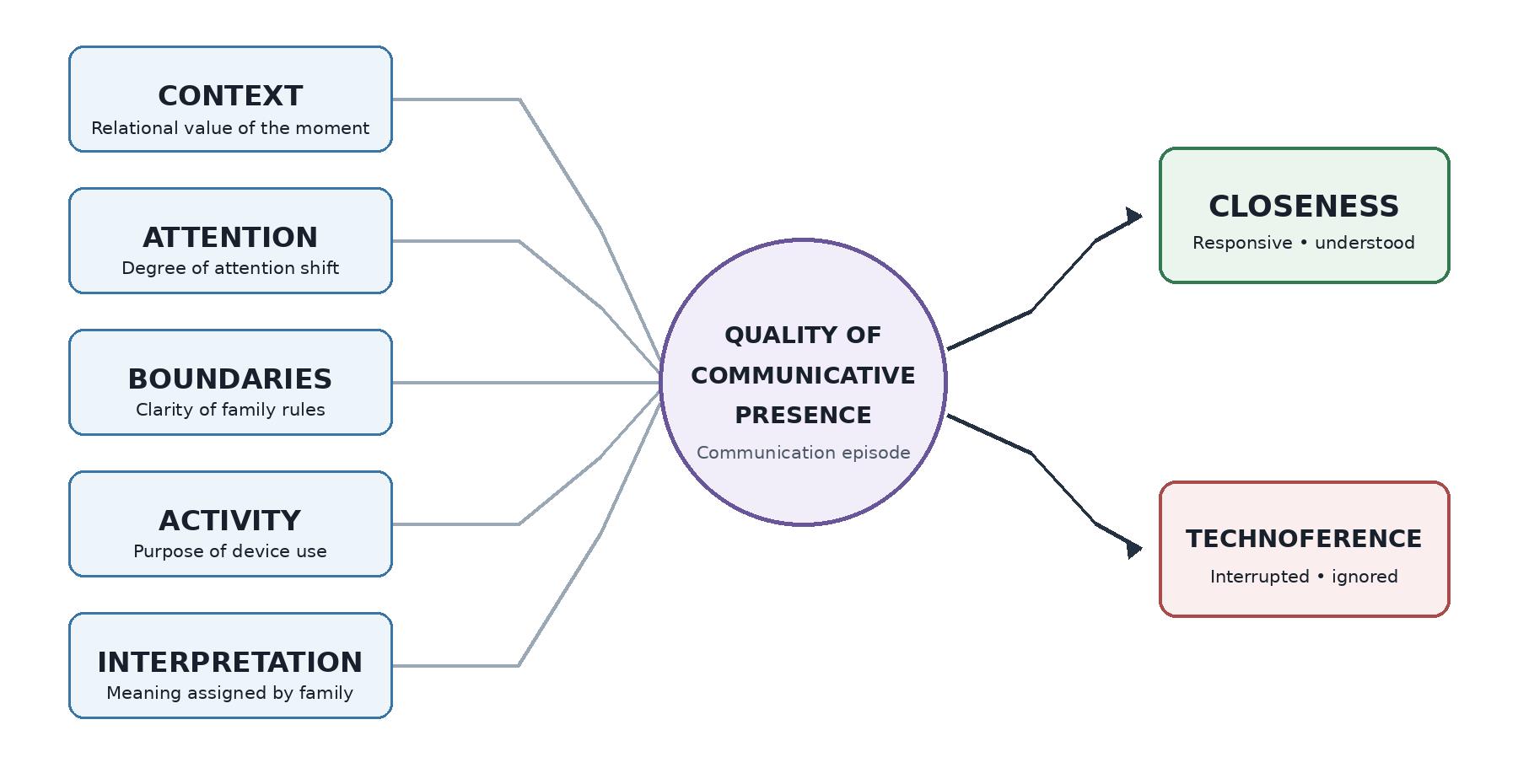
Objective: To examine how gadget use creates technoference and reshapes family communication, emphasizing the quality of attention and presence rather than screen time. Theoretical framework: Combines family communication, family systems, technology domestication, parental mediation, and attention economy theories to explain technoference and phubbing. Literature review: Prior studies link gadget use to lower responsiveness and relationship quality, but also acknowledge its benefits for coordination and support. Most research still relies on screen-time measures and cross-sectional designs. Methods: This study employed qualitative methods through a structured literature review and thematic synthesis. Searches were conducted in Scopus, Web of Science, PubMed, and Google Scholar using a combination of the terms technoference, parental phubbing, family communication, smartphone, parent–child interaction, and digital parenting. Publications were analyzed through coding of meaning units, theme clustering, cross-design comparison, and conceptual interpretation. Results: The synthesis yielded five main themes: fragmentation of attention and loss of engagement cues; decreased responsiveness and emotional validation; conflict circulation and modeling of digital behavior; the ambivalence of gadgets as both connectors and barriers; and boundary negotiation as a means of managing family communication. The findings suggest that gadget consequences are not inherent to the device or determined solely by duration. Their impact depends on the relational value of a moment, the degree of distraction, the purpose of the activity, the clarity of the rules, and the interpretations of family members. Implications: This study shifts the focus from screen time to communication quality, emphasizing participatory family rules, gadget-free routines, parental role modeling, and digital literacy. Novelty: The KABAT model (Context, Attention, Boundaries, Activities, and Interpretations) explains how gadgets shape family communication by focusing on communication episodes rather than devices, providing a framework for future longitudinal and cross-cultural research.
References
R. Silverstone and E. Hirsch, Eds., Consuming Technologies: Media and Information in Domestic Spaces. London, UK: Routledge, 1992.
M. Hartmann, “The triple articulation of ICTs: Media as technological objects, symbolic environments and individual texts,” in Domestication of Media and Technology, T. Berker, M. Hartmann, Y. Punie, and K. J. Ward, Eds. Maidenhead, UK: Open University Press, 2006, pp. 80–102.
B. T. McDaniel and S. M. Coyne, “Technoference: The interference of technology in couple relationships and implications for women’s personal and relational well-being,” Psychology of Popular Media Culture, vol. 5, no. 1, pp. 85–98, 2016, doi: https://doi.org/10.1037/ppm0000065.
B. T. McDaniel and S. M. Coyne, “Technology interference in the parenting of young children: Implications for mothers’ perceptions of coparenting,” The Social Science Journal, vol. 53, no. 4, pp. 435–443, 2016, doi: https://doi.org/10.1016/j.soscij.2016.04.010.
B. T. McDaniel, “Parent distraction with phones, reasons for use, and impacts on parenting and child outcomes: A review of the emerging research,” Human Behavior and Emerging Technologies, vol. 1, no. 2, pp. 72–80, 2019, doi: https://doi.org/10.1002/hbe2.139.
B. Knitter and M. Zemp, “Digital family life: A systematic review of the impact of parental smartphone use on parent–child interactions,” Digital Psychology, vol. 1, no. 1, pp. 29–43, 2020, doi: https://doi.org/10.24989/dp.v1i1.1809.
J. Komanchuk et al., “Impacts of parental technoference on parent–child relationships and child health and developmental outcomes: A scoping review,” Cyberpsychology, Behavior, and Social Networking, vol. 26, no. 8, pp. 579–603, 2023, doi: https://doi.org/10.1089/cyber.2022.0278.
B. T. McDaniel and J. S. Radesky, “Technoference: Longitudinal associations between parent technology use, parenting stress, and child behavior problems,” Pediatric Research, vol. 84, no. 2, pp. 210–218, 2018, doi: https://doi.org/10.1038/s41390-018-0052-6.
V. Chotpitayasunondh and K. M. Douglas, “How ‘phubbing’ becomes the norm: The antecedents and consequences of snubbing via smartphone,” Computers in Human Behavior, vol. 63, pp. 9–18, 2016, doi: https://doi.org/10.1016/j.chb.2016.05.018.
V. Chotpitayasunondh and K. M. Douglas, “The effects of ‘phubbing’ on social interaction,” Journal of Applied Social Psychology, vol. 48, no. 6, pp. 304–316, 2018, doi: https://doi.org/10.1111/jasp.12506.
A. K. Przybylski and N. Weinstein, “Can you connect with me now? How the presence of mobile communication technology influences face-to-face conversation quality,” Journal of Social and Personal Relationships, vol. 30, no. 3, pp. 237–246, 2013, doi: https://doi.org/10.1177/0265407512453827.
S. Misra, L. Cheng, J. Genevie, and M. Yuan, “The iPhone effect: The quality of in-person social interactions in the presence of mobile devices,” Environment and Behavior, vol. 48, no. 2, pp. 275–298, 2016, doi: https://doi.org/10.1177/0013916514539755.
J. S. Radesky et al., “Patterns of mobile device use by caregivers and children during meals in fast food restaurants,” Pediatrics, vol. 133, no. 4, pp. e843–e849, 2014, doi: https://doi.org/10.1542/peds.2013-3703.
J. S. Radesky et al., “Maternal mobile device use during a structured parent–child interaction task,” Academic Pediatrics, vol. 15, no. 2, pp. 238–244, 2015, doi: https://doi.org/10.1016/j.acap.2014.10.001.
C. A. Kildare and W. Middlemiss, “Impact of parents mobile device use on parent–child interaction: A literature review,” Computers in Human Behavior, vol. 75, pp. 579–593, 2017, doi: https://doi.org/10.1016/j.chb.2017.06.003.
K. Kushlev and E. W. Dunn, “Smartphones distract parents from cultivating feelings of connection when spending time with their children,” Journal of Social and Personal Relationships, vol. 36, no. 6, pp. 1619–1639, 2019, doi: https://doi.org/10.1177/0265407518769387.
Q. Xie, X. Chen, J. Zhu, and Z. He, “Parental phubbing and adolescent problematic mobile phone use: The role of parent–child relationship and self-control,” Children and Youth Services Review, vol. 116, Art. no. 105247, 2020, doi: https://doi.org/10.1016/j.childyouth.2020.105247.
L. Rainie and B. Wellman, Networked: The New Social Operating System. Cambridge, MA, USA: MIT Press, 2012.
S. M. Coyne, L. M. Padilla-Walker, A. G. Fraser, E. J. Fellows, and S. Day, “Media time = family time: Positive media use in families with adolescents,” Journal of Adolescent Research, vol. 29, no. 5, pp. 663–688, 2014, doi: https://doi.org/10.1177/0743558414538316.
L. M. Padilla-Walker, S. M. Coyne, and A. G. Fraser, “Getting a high-speed family connection: Associations between family media use and family connection,” Family Relations, vol. 61, no. 3, pp. 426–440, 2012, doi: https://doi.org/10.1111/j.1741-3729.2012.00710.x.
M. Madianou and D. Miller, Migration and New Media: Transnational Families and Polymedia. London, UK: Routledge, 2012.
R. Ling, New Tech, New Ties: How Mobile Communication Is Reshaping Social Cohesion. Cambridge, MA, USA: MIT Press, 2008.
A. F. Koerner and M. A. Fitzpatrick, “Toward a theory of family communication,” Communication Theory, vol. 12, no. 1, pp. 70–91, 2002, doi: 10.1111/j.1468- https://doi.org/2885.2002.tb00260.x.
A. F. Koerner and M. A. Fitzpatrick, “Family communication patterns theory: A social cognitive approach,” in Engaging Theories in Family Communication, D. O. Braithwaite and L. A. Baxter, Eds. Thousand Oaks, CA, USA: Sage, 2006, pp. 50–65.
P. Minuchin, “Families and individual development: Provocations from the field of family therapy,” Child Development, vol. 56, no. 2, pp. 289–302, 1985, doi: https://doi.org/10.2307/1129720.
A. R. Nathanson, “Parent and child perspectives on the presence and meaning of parental television mediation,” Journal of Broadcasting & Electronic Media, vol. 45, no. 2, pp. 201–220, 2001, doi: https://doi.org/10.1207/s15506878jobem4502_1.
P. M. Valkenburg, M. Krcmar, A. L. Peeters, and N. M. Marseille, “Developing a scale to assess three styles of television mediation: Instructive mediation, restrictive mediation, and social coviewing,” Journal of Broadcasting & Electronic Media, vol. 43, no. 1, pp. 52–66, 1999, doi: https://doi.org/10.1080/08838159909364474.
S. Livingstone and E. J. Helsper, “Parental mediation of children’s Internet use,” Journal of Broadcasting & Electronic Media, vol. 52, no. 4, pp. 581–599, 2008, doi: https://doi.org/10.1080/08838150802437396.
P. M. Valkenburg, J. T. Piotrowski, J. Hermanns, and R. de Leeuw, “Developing and validating the perceived parental media mediation scale: A self-determination perspective,” Human Communication Research, vol. 39, no. 4, pp. 445–469, 2013, doi: https://doi.org/10.1111/hcre.12010.
G. Mascheroni, C. Ponte, and A. Jorge, Eds., Digital Parenting: The Challenges for Families in the Digital Age. Göteborg, Sweden: Nordicom, 2018.
L. Clark, The Parent App: Understanding Families in the Digital Age. Oxford, UK: Oxford University Press, 2013.
M. J. Page et al., “The PRISMA 2020 statement: An updated guideline for reporting systematic reviews,” BMJ, vol. 372, Art. no. n71, 2021, doi: https://doi.org/10.1136/bmj.n71.
J. Thomas and A. Harden, “Methods for the thematic synthesis of qualitative research in systematic reviews,” BMC Medical Research Methodology, vol. 8, Art. no. 45, 2008, doi: https://doi.org/10.1186/1471-2288-8-45.
J. A. Roberts and M. E. David, “My life has become a major distraction from my cell phone: Partner phubbing and relationship satisfaction among romantic partners,” Computers in Human Behavior, vol. 54, pp. 134–141, 2016, doi: https://doi.org/10.1016/j.chb.2015.07.058.
J. A. Roberts and M. E. David, “Put down your phone and listen to me: How boss phubbing undermines the psychological conditions necessary for employee engagement,” Computers in Human Behavior, vol. 75, pp. 206–217, 2017, doi: https://doi.org/10.1016/j.chb.2017.05.021.
M. E. David and J. A. Roberts, “Phubbed and alone: Phone snubbing, social exclusion, and attachment to social media,” Journal of the Association for Consumer Research, vol. 2, no. 2, pp. 155–163, 2017, doi: https://doi.org/10.1086/690940.
W. Hong, R. D. Liu, Y. Ding, T. Oei, Y. Zhen, and S. Jiang, “Parents’ phubbing and problematic mobile phone use: The roles of the parent–child relationship and children’s self-esteem,” Cyberpsychology, Behavior, and Social Networking, vol. 22, no. 12, pp. 779–786, 2019, doi: https://doi.org/10.1089/cyber.2019.0179.
X. Xie and J. Xie, “Parental phubbing accelerates depression in late childhood and adolescence: A two-path model,” Journal of Adolescence, vol. 78, pp. 43–52, 2020, doi: https://doi.org/10.1016/j.adolescence.2019.12.004.
R. D. Liu et al., “The effect of parental phubbing on teenager’s mobile phone dependency behaviors: The mediation role of subjective norm and dependency intention,” Psychology Research and Behavior Management, vol. 12, pp. 1059–1069, 2019, doi: https://doi.org/10.2147/PRBM.S224133.
Y. Wang, H. Qiao, Z. Wang, X. Yang, and P. Yang, “The influence of perceived parental phubbing on adolescents’ problematic smartphone use: A two-wave multiple mediation model,” Addictive Behaviors, vol. 121, Art. no. 106995, 2021, doi: https://doi.org/10.1016/j.addbeh.2021.106995.
J. S. Radesky and M. Christakis, “Increased screen time: Implications for early childhood development and behavior,” Pediatric Clinics of North America, vol. 63, no. 5, pp. 827–839, 2016.
B. T. McDaniel and J. S. Radesky, “Technoference: Parent distraction with technology and associations with child behavior problems,” Child Development, vol. 89, no. 1, pp. 100–109, 2018, doi: https://doi.org/10.1111/cdev.12822.
S. Hiniker, H. Suh, S. Cao, and J. A. Kientz, “Screen time tantrums: How families manage screen media experiences for toddlers and preschoolers,” in Proc. CHI Conf. Human Factors in Computing Systems, 2016, pp. 648–660, doi: https://doi.org/10.1145/2858036.2858278.
N. Elias, D. Lemish, and G. Rovner-Lev, “Food for thought: Parent–child face-to-face communication and mobile phone use in eateries,” Journal of Family Communication, vol. 21, no. 4, pp. 272–286, 2021, doi: https://doi.org/10.1080/15267431.2021.1973458.
J. Y. Y. Yong, E. M. W. Tong, and J. C. J. Liu, “When the smartphone goes offline: A factorial survey of smartphone-mediated family communication,” Computers in Human Behavior, vol. 102, pp. 259–269, 2020.
R. A. Davis, “A cognitive-behavioral model of pathological Internet use,” Computers in Human Behavior, vol. 17, no. 2, pp. 187–195, 2001, doi: https://doi.org/10.1016/S0747-5632(00)00041-8.
S. Turkle, Alone Together: Why We Expect More from Technology and Less from Each Other. New York, NY, USA: Basic Books, 2011.
S. Turkle, Reclaiming Conversation: The Power of Talk in a Digital Age. New York, NY, USA: Penguin Press, 2015.
D. S. Blackwell, L. E. L. Gardiner, and L. Schoenebeck, “Managing expectations: Technology tensions among parents and teens,” in Proc. 19th ACM Conf. Computer-Supported Cooperative Work & Social Computing, 2016, pp. 1390–1401, doi: https://doi.org/10.1145/2818048.2819928.
R. M. Barr, “Growing up in the digital age: Early learning and family media ecology,” Current Directions in Psychological Science, vol. 28, no. 4, pp. 341–346, 2019, doi: https://doi.org/10.1177/0963721419838245.
K. L. Modecki, R. Low-Choy, K. Uink, L. Vernon, F. Correia, and M. Andrews, “What is digital parenting? A systematic review of past measurement and blueprint for the future,” Perspectives on Psychological Science, vol. 17, no. 6, pp. 1673–1691, 2022, doi: https://doi.org/10.1177/17456916211072458.
C. Y. Tan, L. A. C. Chng, and L. L. Chng, “Conceptualization, measurement, predictors, outcomes, and interventions in digital parenting: An umbrella review,” Educational Research Review, vol. 44, Art. no. 100614, 2024.
J. Zhang, C. Dong, Y. Jiang, Q. Zhang, H. Li, and Y. Li, “Parental phubbing and child social-emotional adjustment: A meta-analysis of studies conducted in China,” Psychology Research and Behavior Management, vol. 16, pp. 4267–4285, 2023, doi: https://doi.org/10.2147/PRBM.S417718.
K. Mannell, “Digital media and technology use by families with infants, toddlers, and young children: A review of the literature,” Journal of Children and Media, 2024, doi: https://doi.org/10.1080/17482798.2024.2394939.