From Silence to Courage in Language: Development of Psychological Safety Models in Arabic Language Learning in Pesantren
DOI:
https://doi.org/10.61455/sicopus.v4i03.631Keywords:
psychological safety, arabic language learning, language anxiety, education in pesantren, courageAbstract
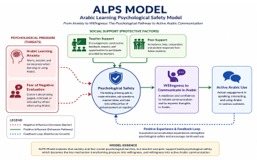
Objective: This study aims to develop the Arabic Learning Psychological Safety Model (ALPS Model) to explain the psychological mechanisms that affect the courage of students in using Arabic. The research departs from the paradox that students can have linguistic knowledge but still choose to remain silent when speaking is perceived as a social and psychological risk. Theoretical framework: The theoretical framework integrates Foreign Language Anxiety, Fear of Negative Evaluation, Psychological Safety, Teacher Support, Peer Support, and Willingness to Communicate. Literature review: Previous studies have largely described language anxiety as an individual barrier to performance, while psychological safety is more commonly used in organizational studies and general learning. The integration of the two in learning Arabic in Islamic boarding schools, especially by considering the relationship between teachers and peers, is still limited. Methods: The research uses a Research and Development (R&D) approach based on model development. Data were obtained through the exploration of the experiences of students at all levels at the Al-Anwar Pacitan Islamic Boarding School, using questionnaires, interviews, observations, expert validation, and empirical testing of constructs. Qualitative data are analyzed thematically, while quantitative data are used to test the structure and relationships between constructs in the model. Results: The results of the study show that the silence of students does not solely represent linguistic limitations, but can be a response to anxiety and fear of negative evaluation. Teacher Support and Peer Support serve as social buffers that strengthen Psychological Safety, which further encourages Willingness to Communicate and active use of the Arabic language. Implications: These findings imply the need to transform bi'ah lughawiyah from an environment that merely demands the use of Arabic to a language environment that is psychologically safe, supportive, and academically sound. Novelty: The ALPS Model offers a new contribution by placing Psychological Safety as the psychological infrastructure of Arabic language learning, while shifting the paradigm from making students speak to making students feel safe enough to speak. This model brings together linguistic, psychological, social, and pedagogical dimensions within one framework of Islamic Education.
References
S. Bakeer, Discourse Markers in Doctoral Supervision Sessions. London: Routledge, 2023. https://doi.org/10.4324/9781003184072.
N. Kassim, M. S. Sahrir, and T. B. T. Ahmad, “Malaysian non-Arabic speaking learners’ readiness in a virtual second language learning environment,” Indones. J. Appl. Linguist., vol. 13, no. 1, pp. 114–130, May 2023, https://doi.org/10.17509/ijal.v13i1.58271.
A. Ambusaidi et al., “The Prevalence and Sociodemographic Correlates of Social Anxiety Disorder: A Focused National Survey,” Chronic Stress, vol. 6, Jan. 2022, https://doi.org/10.1177/24705470221081215.
H. O. Mohammed, M. M. M. Omar, S. A. A. Elsayed, A. M. ALGamal, Y. A. N. Sallam, and N. F. Mahmoud, “Breaking the sound barrier: advancing communication abilities in cochlear implanted Egyptian children through integrating social, cognitive and linguistic abilities,” Egypt. J. Otolaryngol., vol. 42, no. 1, p. 112, Apr. 2026, https://doi.org/10.1186/s43163-026-01081-9.
T. B. Nguyen and C.-T. Dinh, “Impact of foreign language anxiety and expectancy for success on English outcomes: Mediating role of self-regulated learning among university freshmen,” Acta Psychol. (Amst)., vol. 268, p. 107308, Aug. 2026, https://doi.org/10.1016/j.actpsy.2026.107308.
P. Olalere and A. A. Adewojo, “Psychological Safety in the Algorithmic Workplace: A Conceptual Review of AI’s Impact on Learning Vulnerability and Employee Well-being,” Digit. Educ. Rev., no. 49, pp. 208–221, Jun. 2026, https://doi.org/10.1344/der.2026.49.208-221.
K. A. Al Gharibi, J. A. Snethen, M. H. Taani, C. Baldwin, and J. J. Doering, “Factors influencing psychological safety in clinical simulation: A descriptive correlational study with mediation analysis,” Clin. Simul. Nurs., vol. 114, p. 101955, May 2026, https://doi.org/10.1016/j.ecns.2026.101955.
H. Jelleli et al., “Validation of the Arabic multidimensional Facebook intensity scale and its relationships with life satisfaction, happiness, and physical activity,” Phys. Act. Nutr., vol. 29, no. 4, pp. 1–14, Dec. 2025, https://doi.org/10.20463/pan.2025.0029.
A. Begum et al., “Efficacy of Pimpinella anisum L. in Menopausal Women with Psychological Symptoms: A Randomized Controlled Study Integrated with Machine Learning Analysis,” Curr. Pharm. Des., vol. 32, May 2026, https://doi.org/10.2174/0113816128433736260209142133.
B. Klimova and A. N. P. Carvalho, “A systematic review of innovative methodologies in foreign language pedagogy in the era of artificial intelligence,” Soc. Sci. Humanit. Open, vol. 14, p. 103170, Dec. 2026, https://doi.org/10.1016/j.ssaho.2026.103170.
I. Irham, “Negotiating Emotional Entanglements: The Role of Religion and Identity in English and Arabic Medium Instruction,” Int. J. Appl. Linguist., vol. 36, no. 2, pp. 1876–1885, May 2026, https://doi.org/10.1111/ijal.70045.
B. Najdi and A. Al-Jawabreh, “Exploring the impact of active learning strategies on learning outcomes and educational experiences in undergraduate nursing education: a qualitative descriptive study,” BMC Med. Educ., vol. 26, no. 1, p. 1170, May 2026, https://doi.org/10.1186/s12909-026-09512-0.
L. You et al., “Generative Dialogue Agent Design for Research Integrity Education: Behavioral Intervention and Cognitive Training Evidence,” Digit. Technol. Res. Appl., pp. 251–273, May 2026, https://doi.org/10.54963/dtra.v5i2.2336.
H. Özen and G. Polat, Eds., Resilience, Adaptability, and Cultural Awareness Within the Educational Landscape. in Advances in Educational Marketing, Administration, and Leadership. IGI Global, 2024. https://doi.org/10.4018/979-8-3693-6040-8.
W. Bao and F. D. Yusop, “Technology-enhanced second language willingness to communicate: A systematic review and proposed framework for effective language education,” Multidisciplinary Rev., vol. 9, no. 4, p. 2026170, Sep. 2025, https://doi.org/10.31893/multirev.2026170.
T. Alsanoosy and F. Qarah, “An Arabic language benchmark and hybrid BERT–BiGRU–CapsNet model for optimism and pessimism detection,” Sci. Rep., vol. 16, no. 1, p. 20190, Apr. 2026, https://doi.org/10.1038/s41598-026-50842-2.
V. N. Rathi, V. M, and R. P. S. Vinse, “Multi-Modal Cyberbullying Detection Using Deep Learning and NLP Techniques,” in 2026 International Conference on Visual Analytics and Data Visualization (ICVADV), IEEE, Feb. 2026, pp. 1627–1633. https://doi.org/10.1109/ICVADV67766.2026.11470405.
N. A. M. Alkasirah, M. Mohamad, M. Sanmugam, and G. Ramdas, “Development of mobile application-based digital drama for Arabic language to improve students’ vocabulary,” J. Educ. Learn., vol. 20, no. 2, pp. 1240–1249, May 2026, https://doi.org/10.11591/edulearn.v20i2.23655.
K. Barkaoui, “Quality in Second Language Classroom Assessment: Controversies, Challenges, and the Need for Research on Teacher Conceptions and Practices,” Lang. Assess. Q., vol. 23, no. 1, pp. 1–23, Jan. 2026, https://doi.org/10.1080/15434303.2026.2620813.
M. E. H. Elzeky, N. Alsadaan, and N. F. M. Shahine, “Psychometric validation and measurement invariance of the Arabic version of the problem-solving inventory–20: An instrument validation study in AI-supported learning,” Nurse Educ. Pract., vol. 93, p. 104798, May 2026, https://doi.org/10.1016/j.nepr.2026.104798.
L. P. Nguyen, D. P. N. Nguyen, N. Van Tu, and Q. H. T. Ngo, “Anxiety factor affecting ESP students’ performative knowledge in learning English language,” Discov. Educ., vol. 4, no. 1, p. 560, Dec. 2025, https://doi.org/10.1007/s44217-025-00983-9.
H. Abu Ahmad and D. L. Share, “Beginning reading instruction: Syllables or phonemes? An experimental training study with Arabic-speaking preliterate preschoolers,” Dev. Psychol., vol. 61, no. 7, pp. 1325–1341, Jul. 2025, https://doi.org/10.1037/dev0001855.
M. I. Alhourani, M. Abazoglu, M. A. A. Adel, A. M. Al Mahamed, and M. M. Abouelnour, “The impact of xenophobia on foreign language learning anxiety among Turkish University students: The case of Arabic,” Res. J. Adv. Humanit., vol. 7, no. 1, Feb. 2026, https://doi.org/10.58256/xgv2c354.
Y. Demetry, P. Carlbring, and G. Andersson, “Cultural Relevance and Acceptability of Cognitive Behavioral Therapy Techniques Adapted by AI or a Human Psychologist: Experimental Study,” JMIR Form. Res., vol. 10, pp. e91056–e91056, May 2026, https://doi.org/10.2196/91056.
E. Zárate et al., “Safety and preliminary efficacy of Aurora: a pilot, non-randomized clinical trial of a culturally adapted digital cognitive behavioral therapy intervention for anxiety and depression in Mexico,” Front. Psychiatry, vol. 17, Apr. 2026, https://doi.org/10.3389/fpsyt.2026.1824079.
F. Fekih‐Romdhane et al., “The Translation and Validation of the 18‐Item Davos Assessment of Cognitive Biases Scale in Arabic,” Brain Behav., vol. 16, no. 7, Jul. 2026, https://doi.org/10.1002/brb3.71580.
R. Halabi, “The challenges for Arab lecturers in Hebrew academic institutions, and how their presence impacts the Arab students,” Int. J. Qual. Stud. Educ., vol. 38, no. 1, pp. 20–30, Jan. 2025, https://doi.org/10.1080/09518398.2024.2348791.
D. Groome and M. Eysenck, Features in Lexicography for Arabic Dialects: Multimedia Dictionary of the Syrian Dialect. London: Routledge, 2025. https://doi.org/10.4324/9781003396758.
Z. Xu and L. Ma, “A hybrid fuzzy neural model for corpus-based English language teaching,” Discov. Comput., vol. 29, no. 1, p. 39, Jan. 2026, https://doi.org/10.1007/s10791-026-09921-1.
G. P. Soriano et al., “Development and validation of the Medical Second Language Anxiety Scale for Nurses (MSLAS-N),” BMC Nurs., vol. 25, no. 1, p. 42, Dec. 2025, https://doi.org/10.1186/s12912-025-04186-3.
F. M. Suud, M. Mirawati, N. A. Akmal Binti Md Din, F. Bin Husen Ismail, A. R. Bin Zakaria, and K. S. Abdulwahid, “Linking Goal Orientation and Resilience to Academic Integrity through Behavioral Learning,” J. Ilm. Peuradeun, vol. 14, no. 2, pp. 1373–1396, May 2026, https://doi.org/10.26811/peuradeun.v14i2.2578.
M. Zingaretti and I. V. Meddegama, “‘It helps bridge gaps’: translanguaging as a pedagogy for inclusion at a community language school,” Lang. Educ., pp. 1–24, Jun. 2026, https://doi.org/10.1080/09500782.2026.2685128.
A. Dakroury, “Two Eras, One Battle: The Tale for the Right to Communicate in the Arab World,” Middle East J. Cult. Commun., vol. 18, no. 3–4, pp. 306–333, Apr. 2026, https://doi.org/10.1163/18739865-bja10006.
N. Nurjannah, A. Kasim, R. Satra, M. Yunus, and A. B. Malla, “Strategy and Implementation: The Contribution of Maharatul Kalam in Shaping the Language Environment,” Int. J. Lang. Educ., vol. 10, no. 2, p. 331, Jun. 2026, https://doi.org/10.26858/ijole.v10i2.87772.
K. Heggart, Ed., An Introduction to Civics and Citizenship Education. Singapore: Springer Nature Singapore, 2024. https://doi.org/10.1007/978-981-97-5134-1.
L. Haj, E. Saiegh-Haddad, O. Ghawi-Dakwar, and R. Schiff, “What Predicts Listening Comprehension in Standard Arabic? The Interdependence of Linguistic and Metalinguistic Skills in Spoken and Standard Arabic,” J. Speech, Lang. Hear. Res., vol. 69, no. 1, pp. 200–216, Jan. 2026, https://doi.org/10.1044/2025_JSLHR-24-00837.
M. Almayez, M. H. Al-khresheh, S. F. Alruwaili, M. N. Al-Ali, and F. S. Alenezy, “AI-driven adaptive feedback and EFL writing performance: The roles of engagement, metacognition, and epistemic agency in a cross-linguistic context,” Acta Psychol. (Amst)., vol. 268, p. 107322, Aug. 2026, https://doi.org/10.1016/j.actpsy.2026.107322.
R. Manor and T. Yair, “Education for multiculturalism and the attitudes of Arab teachers in Israel towards Hebrew literary works,” Int. J. Intercult. Relations, vol. 113, p. 102442, Jul. 2026, https://doi.org/10.1016/j.ijintrel.2026.102442.
I. Abdulnabi and R. Duwairi, “Improving Arabic Language Spell Checking Using Deep Learning Techniques,” ACM Trans. Asian Low-Resource Lang. Inf. Process., vol. 25, no. 5, pp. 1–20, May 2026, https://doi.org/10.1145/3803007.
J. A. Forte, Human Behavior in the Environment: A Justice for Vulnerable Populations Approach. London: Routledge, 2026. https://doi.org/10.4324/9781003618911.
M. I. Ali, S. Iroth, and D. P. Tatipang, “Language, Culture, and Power: An Anthropolinguistic Analysis of Lecturer–Student Interaction in Multicultural Classrooms,” Suranaree J. Soc. Sci., vol. 20, no. 1, Apr. 2026, https://doi.org/10.55766/sjss283456.
L. Bouakaz, D. Beach, and B. Zakarneh, “Arab Immigrant Families in Sweden: Integration Opportunities and Parenting Challenges in Relation to Educational Inclusion and Involvement - An Ethnographic Study,” Educ. Process Int. J., vol. 17, no. 1, 2025, https://doi.org/10.22521/edupij.2025.17.334.