An Analysis of the Implementation of the Tarjamah Method in Teaching Nahwu to Grade 8 Students at PPTQ Putri Colomadu, Academic Year 2025–2026
DOI:
https://doi.org/10.61455/sicopus.v4i02.599Keywords:
arabic language learning, implementation, mubtada’ and khabar, nahwu, tarjamah methodAbstract
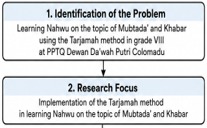
Objective: Analyze the implementation of the Tarjamah method in learning Mubtada' and Khabar in grade VIII students and its effectiveness in improving the understanding of nahwu. Theoretical framework: Based on the theory of nahwu learning, which integrates the understanding of meaning and grammatical structure through the translation method. Literature review: Departing from the problem that nahwu is considered difficult, a method is needed that makes it easier to understand concepts gradually. Method: Qualitative descriptive research with observations, interviews, and documentation analyzed using the Miles, Huberman, and Saldaña interactive model. Results: The results of the study show that the Tarjamah method is applied through the stages of reading Arabic texts, translating vocabulary, explaining nahwu rules, and providing exercises to identify mubtada' and khabar. The implementation of this method helps students understand the relationship between sentence meanings and grammatical structures, increases participation in learning, and facilitates the analysis of nahwu rules. However, the difference in students' initial abilities and limited learning time are still obstacles in its implementation. Implications: The Tarjamah method can be an effective alternative in learning nahwu in the pesantren environment. Novelty: This study shows the application of the Tarjamah method specifically to Mubtada' and Khabar materials as an approach that integrates translation with grammatical analysis to improve students' understanding.
References
A. H. Kahiha, “Methods and strategies for teaching Arabic grammar and its relationship to learners’ linguistic weakness: The third year of secondary education - a sample,” مجلة قضايا لغوية | Linguist. Issues J., vol. 4, no. 3, pp. 66–83, 2023, https://doi.org/10.61850/lij.v4i3.115.
N. Nurdin and M. Anshari, “Effective Strategies in Learning Nahwu and Sharaf: A Literature Review Perspective,” Interdiscip. Explor. Res. J., vol. 2, no. 3, pp. 1578–1590, 2024, https://doi.org/10.62976/ierj.v2i3.750.
Z. A. Hanifa and A. Sopian, “Mapping Technology, Impact, and Challenges in Nahwu Learning: A Systematic Review (2020–2025),” Aphorisme J. Arab. Lang. Lit. Educ., vol. 6, no. 1, pp. 149–163, 2025, https://doi.org/10.37680/aphorisme.v6i1.7225.
Asiah, Zamroni, and M. K. Rijal, “Problematika Pembelajaran Nahwu Dalam Meningkatkan Keterampilan Berbahasa Arab di Lembaga Pendidikan Indonesia,” Borneo J. Lang. Educ., vol. 2, no. 2, pp. 170–185, 2022, https://doi.org/10.21093/benjole.v2i2.6104.
Kementerrian Agama RI, Data Statistik Pesantren 2020. Direktorat Jenderal Pendidikan Islam, 2020.
R. T. Saadah and Z. M. Ali, “The Urgency of Sunni Tasawuf of K.H. Ahmad Sanusi in Tatar Sunda: a Study of Sirāj Al-Ażkiyā’ Fī Tarjamah Al-Azkiyā’,” J. Lekt. Keagamaan, vol. 20, no. 2, pp. 479–500, 2022, https://doi.org/10.31291/jlka.v20i2.1086.
S. L. Mawaddah, “Problematika Pembelajaran Nahwu Menggunakan Metode Klasik Arab Pegon di Era Modern,” Maharaat J. Pendidik. Bhs. Arab, vol. 4, no. 2, pp. 102–119, 2022, https://doi.org/10.18196/mht.v4i2.12976.
Susanto and S. Muhammad Samin, “Analisis Kesulitan Belajar Nahwu Pada Mahasiswa : Studi Literatur,” Perspekt. Pendidik. dan Kegur., vol. 16, no. 2, pp. 192–200, 2025, https://doi.org/10.25299/perspektif.2025.vol16(2).24908.
H. Ibnu Hajar and H. Abdul Qohar, “Pendekatan Inovatif untuk Mengatasi Tantangan Pembelajaran Nahwu dan Sharaf bagi Peserta Didik,” Ranah Res. J. Multidiscip. Res. Dev., vol. 6, no. 6, pp. 2995–3009, 2024, https://doi.org/10.38035/rrj.v6i6.1473.
F. Fitri, A. Abbas, F. Wahidah, and A. Gaffar, “Metode Pembelajaran Nahwu Sharaf di Pondok Pesantren Hidayatullah Putri Kendari,” Dirasah J. Pendidik. Islam, vol. 3, no. 1, p. 17, 2022, https://doi.org/10.31332/jpi.v3i1.3194.
Muhammad Hamdan Yuwafik and Ahmad Nuruddin, “Pendampingan Penggunaan Metode Qawaid Wa Al-Tarjamah dalam Pembelajaran Ilmu Nahwu di Pesantren Luhur Alhusna Surabaya,” Khidmatuna J. Pengabdi. Kpd. Masy., vol. 5, no. 1, pp. 99–111, 2024, https://doi.org/10.51339/khidmatuna.v5i1.2217.
I. Afriati, Z. Ratmansyah, A. Fadhil, and Y. I. Lesmana, “Grammar and Translation Methods in Arabic Language Learning: Theory and Practice,” MADINA J. Islam. Stud., vol. 2, no. 1, pp. 1–8, 2025, https://doi.org/10.62945/madina.v2i1.741.
A. Al-Jārim and M. Amīn, “An-Nahwu al-Wadhih (Juz 1). Maktabah al-Ma’arif.”
Masnun, Segaf Baharun, and Sultan Abdus Syakur, “Interactive Whiteboard as a Medium for Nahwu Learning: Bridging Technology and Arabic Grammar Education,” Int. J. Arab. Lang. Teach., vol. 7, no. 01, pp. 1–20, 2025, https://doi.org/10.32332/ijalt.v7i01.9977.
Ihwan Mahmudi, S. Alfi, and Azhar Nor, “Implementation of Student Team Achievement Divisions (STAD) Learning Methods to Improve Nahwu Learning Outcomes for Class 4 Students at KMI Darussalam Gontor Modern Islamic Boarding School for Girls,” al Mahāra J. Pendidik. Bhs. Arab, vol. 8, no. 1, pp. 27–52, 2022, https://doi.org/10.14421/almahara.2022.081-02.
I. Rifa’i and S. Ma’arif, “Application of the Deductive Method in Nahwu Learning Based on the Book of Al-Muyassar Fi Ilmi `n-Nahwi by K.H Aceng Zakariya,” Tadris Al-’Arabiyyah J. Pendidik. Bhs. Arab dan Kebahasaaraban, vol. 1, no. 2, pp. 116–133, 2023, https://doi.org/10.15575/ta.v1i2.20253.
S. K. Mu’allimah, Z. Anisah, and V. F. Ulya, “Penerapan Metode Qawaid Wa Tarjamah Pada Keterampilan Qaira’Ah Dan Kitabah Kelas V Sdi Al Hadad Kedungjambe Singgahan Tuban,” Al Ulya J. Pendidik. Islam, vol. 8, no. 2, pp. 145–155, 2023, https://doi.org/10.32665/alulya.v8i2.2248.
I. A. Bertuah and Z. Zulhaiki, “Tantangan dan peluang metode Tarjamah dalam pengajaran bahasa Arab di era teknologi digital,” Ta’limi J. Arab. Educ. Arab. Stud., vol. 5, no. 1, pp. 85–101, 2026, https://doi.org/10.53038/tlmi.v5i1.361.
S. Dlikri, A. Arini, and A. A. Al- Amin, “Implementasi Qowa’id Wa Tarjamah Dalam Pembelajaran Bahasa Arab Pada Kelas XI di Madrasah Aliyah Hasyim Asy’ari,” EL-FUSHA J. Bhs. Arab dan Pendidik., vol. 6, no. 1, pp. 88–97, 2025, https://doi.org/10.33752/el-fusha.v6i1.7910.
Z. R. Ramdhani and N. Kosim, “Efektivitas Penerapan Metode Kaidah Dan Tarjamah (Taariqah Al-Qawa’id Wa Al Terjamah) Pada Pembelajaran Bahasa Arab Di Pondok Pesantren Darul Arqam Muhammadiyah Garut,” EL-FUSHA J. Bhs. Arab dan Pendidik., vol. 6, no. 1, pp. 78–87, 2025, https://doi.org/10.33752/el-fusha.v6i1.6799.
J. Miles, M.B., Huberman, a. m., & Saldana, “Qualitative Data A Methods Sourcebook,” Etika Jurnalisme Pada Koran Kuning : Sebuah Studi Mengenai Koran Lampu Hijau, vol. 16, no. 2. Sage, pp. 39–55, 2015.
R. B. Soleh, I. M. Jannah, and A. Halim, “The Effectiveness of the Translation Method Assisted by Interactive E-Whiteboard Media on the Mastery of Nahwī Structure in Writing Skills Among Seventh-Grade Students at MTs Darul Ulum Waru Sidoarjo,” An-Nahdloh J. Educ. Islam. Stud., vol. 1, no. 2, pp. 227–252, 2025, https://doi.org/10.58788/jeis.v1i2.20.
S. M. Tageldin, “Tarjamah: Negative Translation,” PMLA, vol. 139, no. 1, pp. 163–171, 2024, https://doi.org/10.1632/S0030812924000051.
E. Suryana, U. Supriadi, M. Fikri, A. Efriani, and S. Langputeh, “Exploring Memorization Patterns in the Tahfidz and Tarjamah Qur’an Programs,” J. Pendidik. Islam, vol. 10, no. 2, pp. 375–386, 2024, https://doi.org/10.15575/jpi.v10i2.29969.
W. Nadhiroh and Wardani, “The Dynamics of Qur’anic Text and Translation in Banjar Ulema’s Works,” J. Stud. Ilmu-ilmu al-Qur’an dan Hadis, vol. 24, no. 2, pp. 205–230, 2023, https://doi.org/10.14421/qh.v24i2.4764.
U. Zaenudin, “Implementasi Metode Gramatika Tarjamah Dalam Pembelajaran Qira’Ah Dan Kitabah,” HASBUNA J. Pendidik. Islam, vol. 6, no. 1, pp. 12–23, 2025, https://doi.org/10.70143/hasbuna.v6i1.482.
F. Gunawan, M. R. Nababan, H. Syukri, and I. Burdah, “Revisiting Interpretive Translation Method: A Case Study of Muhammad Thalib’s Quranic Translation,” Jordan J. Mod. Lang. Lit., vol. 14, no. 1, pp. 111–127, 2022, https://doi.org/10.47012/jjmll.14.1.6.
A. Fidlya, M. I. N. Fadilah, and N. Mufidah, “Implementation of Reciprocal Teaching Learning Strategies for Teaching Nahwu,” Arab. J. Arab. Lang. Educ., vol. 2, no. 1, pp. 77–88, 2025, https://doi.org/10.65679/arabiyyat.v2i1.173.
A. Ulfah, Nurhidayani, and Muhammad Syukri, “Penerapan Metode Qowaid Dan Terjemah Pada Pembelajaran Bahasa Arab Di Pondok Pesantren Al Falah Puteri Banjarbaru,” An-Nafis: Jurnal Ilmiah Keislaman dan Kemasyarakatan. pp. 77–94, 2025. https://doi.org/10.62196/nfs.v4i1.81.
A. W. Ningrum and A. Hanun, “Peningkatan Prestasi Belajar Bahasa Arab dengan Metode Terjemah,” Edu J. Innov. Learn. Educ., vol. 1, no. 1, pp. 41–50, 2023, https://doi.org/10.55352/edu.v1i1.464.
Z. Cholidah and F. A. Muid, “Inovasi Pembelajaran Nahwu dalam Kurikulum Bahasa Arab Modern,” J. Pract. Learn. Educ. Dev., vol. 4, no. 3, pp. 184–189, 2024, https://doi.org/10.58737/jpled.v4i3.352.
A. Nabiilah, M. Hasanah, and F. Faisol, “Implementation of the Grammatical Translation Method in I’rob Jurumiyah Learning at Madrasah Diniyah An-Nur Batu,” Tanwir Arab. Arab. As Foreign Lang. J., vol. 4, no. 2, pp. 167–180, 2024, https://doi.org/10.31869/aflj.v4i2.5991.
U. Sukiman, G. Zainuddin, Yoyo, and S. R. Ramlan, “Arabic Neologisms in Indonesian and Malaysian Arabic Media,” Al-Jami’ah, vol. 61, no. 2, pp. 365–392, 2023, https://doi.org/10.14421/AJIS.2023.612.365-392.
K. Krisnawilujeng, A. Fatoni, and R. Sarimov, “The Relationship Between Mastery of Nahwu Sharf and The Ability to Translate Arabic Texts,” Arab. J. Arab. Stud., vol. 8, no. 2, pp. 183–192, 2023, https://doi.org/10.24865/ajas.v8i2.502.
A. Afandi, M. Fadhlan, A. Fikri, and M. H. Aziz, “Increased Understanding of Nahwu through Innovation in the Application of Direct Methods: Experimental Studies on Arabic Language Students,” Arab. J. Bhs. Arab, vol. 8, no. 1, p. 465, 2024, https://doi.org/10.29240/jba.v8i1.9434.
I. Afriati, R. S. Siregar, A. Fonna, and Z. Muna, “Effectivity of Inductive Method in Learning Nahwu-Sharaf at MIN 3 Banda Aceh City,” J. Indones. Prim. Sch., vol. 2, no. 2, pp. 1–9, 2025, https://doi.org/10.62945/jips.v2i2.738.
Sri Puspita Br Sitepu and San Putra, “Efforts To Improve Arabic Language Learning Outcomes Using Audio Visual Based Touchable Grammatical Method,” Int. J. Islam. Educ. Res. Multicult., vol. 7, no. 1, pp. 235–255, 2025, https://doi.org/10.47006/ijierm.v7i1.447.
M. Solehudin, A. H. Salsabil, and S. A. Syakur, “Scaffolding Arabic Syntax Learning: An Examination of Introductory Nahwu Materials for Novice Students,” J. Arab. Lang. Learn. Teach., vol. 4, no. 1, pp. 41–52, Feb. 2026, https://doi.org/10.23971/jallt.v4i1.408.
Ubay, Muh Jabir, M. A. Hakim, Nursyam, and Umi Kalsum, “Comparison of Arabic Learning Outcomes through the Tarjamah Method,” Tafkir Interdiscip. J. Islam. Educ., vol. 6, no. 2, pp. 486–498, 2025, https://doi.org/10.31538/tijie.v6i2.1877.
O. H. A. Alajurni, “The effect of the grammar translation method on Libyan secondary school students’ communicative competence,” Int. J. Res. Innov. Soc. Sci. (IJRISS, vol. 10, no. 26, 2026, https://doi.org/10.47772/IJRISS.2026.1026EDU0059.
M. A. Ulin Nuha, U. Ulfa, B. T. Unsi, M. S. Rosyad, and N. Musyafaah, “Implications of The Kufah Madhhab in Nahwu for Enhancing Nahwiyah Skills Among Beginners at Islamic Boarding Schools,” Al-Hikmah J. Agama dan Ilmu Pengetah., vol. 21, no. 1, pp. 134–146, 2024, https://doi.org/10.25299/al-hikmah:jaip.2024.vol21(1).16344.