Civilizational Akhlaq of Córdoba as a Model for Moral Revitalization among Indonesian Muslims
DOI:
https://doi.org/10.61455/sicopus.v4i02.596Keywords:
civilizational akhlaq, córdoba civilization, moral degradation, akhlaq revitalization, contemporary indonesian muslimsAbstract
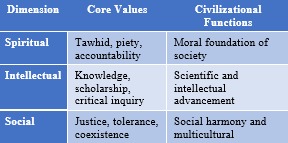
Objective: This study analyzes the concept and implementation of akhlaq within the Islamic civilization of Córdoba as a model for revitalizing religious and moral values among contemporary Indonesian Muslims, aiming to identify Córdoba's ethical foundations, examine the factors driving moral degradation, and formulate an integrative revitalization strategy. Theoretical framework: This study is grounded in the concept of Civilizational Akhlaq, which extends the classical Islamic understanding of akhlaq beyond individual virtue to encompass its role as a foundational mechanism for civilizational development, integrating three interdependent dimensions: spiritual consciousness, intellectual excellence, and social responsibility. Literature review: Existing scholarship on akhlaq has predominantly focused on individual character formation, while research on Córdoba has concentrated on political history and scientific achievements. Studies on moral degradation in Indonesia have generally employed sociological approaches without integrating lessons from classical Islamic civilizations, revealing a gap that this study seeks to address. Method: This study employed a qualitative historical-comparative library research design. Data were collected through a systematic literature review using keyword searches across Scopus, Google Scholar, and other academic databases, selected through purposive sampling based on relevance and scholarly credibility. Data were analyzed using descriptive-analytical and thematic analysis techniques. Results: The findings reveal that Córdoba's civilizational success was built upon three interconnected pillars: spiritual, intellectual, and social dimensions forming an inclusive ethical system. Contemporary Indonesian Muslims face five major drivers of moral degradation, namely digital religious fragmentation, selective tolerance, religious literalism, moral privatization, and information overload. A revitalization framework consisting of epistemological reconstruction, institutional revitalization, technological integration, and cultural contextualization is proposed to address these challenges. Implications: The Civilizational Akhlaq framework has significant implications for educational institutions, religious organizations, and policymakers in Indonesia, providing a foundation for strengthening ethical leadership, social cohesion, and religious moderation within Indonesia's pluralistic society while enhancing global competitiveness through integration of spiritual values with technological innovation. Novelty: This study introduces Civilizational Akhlaq as a theoretical bridge between Islamic ethical thought and civilizational studies, demonstrating akhlaq's role as a civilizational force shaping institutions, governance systems, and intercultural relations, offering an integrative model connecting Córdoba's historical experience with contemporary moral challenges in Indonesia.
References
M. T. S, M. Muslimah, and A. Riadi, “The Concept of Multicultural Education in Al-Qur’an Surah Al-Hujurat Verse 11-13,” SYAMIL J. Pendidik. Agama Islam (Journal Islam. Educ., vol. 8, no. 2, pp. 119–133, Nov. 2020, https://doi.org/10.21093/sy.v8i2.2558.
F. Rohman, “Eksistensi Pluralisme di Indonesia: Menyikapi Pro-Kontra Pluralisme Agama dalam Perspektif Islam,” Model. J. Progr. Stud. PGMI, vol. 9, no. 2, pp. 248–259, Jun. 2022, https://doi.org/10.69896/modeling.v9i2.1242.
M. Martalia, A. Ashadi, and S. Susilawati, “Wacana Moderasi Beragama Kementerian Agama: Analisis Wacana Kritis Norman Fairclough,” J. Sosiol. Agama Indones., vol. 5, no. 1, pp. 88–106, Mar. 2024, https://doi.org/10.22373/jsai.v5i1.4312.
P. Mahy, M. Winarnita, and N. Herriman, “Influencing the influencers: Regulating the morality of online conduct in Indonesia,” Policy & Internet, vol. 14, no. 3, pp. 574–596, Sep. 2022, https://doi.org/10.1002/poi3.321.
F. Mahzumi, A. Aminuddin, H. Mahfudh, and M. Mujibuddin SM, “Cyber-Islamic Moderation In Indonesia: Digital Activism of Islami.co and IBTimes.id and Its Implications for Young Muslims,” MIQOT J. Ilmu-ilmu Keislam, vol. 49, no. 1, p. 22, May 2025, https://doi.org/10.30821/miqot.v49i1.1290.
L. Romli, F. Noor, M. K. D. Sweinstani, R. I. Hanafi, A. S. Sudrajat, and A. F. Bastian, “Azyumardi Azra on Islamic fundamentalism and wasathiyah: insights into contemporary Islamic thought in Indonesia,” Cogent Arts Humanit., vol. 12, no. 1, p. 2571754, 2025, https://doi.org/10.1080/23311983.2025.2571754.
M. Sinurat, “The Development of Public Finance Curriculum at Institute of Home Affairs Governance (IPDN) in the Ministry of Home Affairs: A Scoping Literature Review,” J. Ecohumanism, vol. 4, no. 1, pp. 196–207, 2025, https://doi.org/10.62754/joe.v4i1.4566.
A. Wahab Syakhrani, S. Rasyidiyah Khalidiyah Amuntai, E. Maulida Sekolah Tinggi Ilmu Tarbiyyah Assunniyyah, and I. Laila Sekolah Tinggi Ilmu Tarbiyyah Assunniyyah, “Perkembangan Pemikiran Dalam Akhlak Islam,” Cross-border, vol. 6, no. 1, pp. 52–60, 2023.
Suaidi Suaidi, “Akhlak Sebagai Perisai Di Tengah Perubahan Gaya Hidup Modern,” Mutiara J. Penelit. dan Karya Ilm., vol. 1, no. 4, pp. 105–116, Aug. 2023, https://doi.org/10.59059/mutiara.v1i4.336.
Addin Mustaqim and M. Yunus Abu Bakar, “Ilmu Akhlaq sebagai Pengembangan Keilmuan dalam Perspektif Filsafat Ilmu,” J. Budi Pekerti Agama Islam, vol. 3, no. 2, pp. 122–140, Feb. 2025, https://doi.org/10.61132/jbpai.v3i2.1032.
B. Afwadzi et al., “Penguatan Nilai-Nilai Moderasi Beragama Melalui Program Kultum dalam Kegiatan Bulan Ramadhan di MAN 1 Lamongan,” Bima Abdi J. Pengabdi. Masy., vol. 4, no. 2, pp. 9–18, Jun. 2024, https://doi.org/10.53299/bajpm.v4i2.401.
M. H. Zainal Abidin, A. W. Surtahman, M. F. P. Rameli, and M. K. Johari, “The Concept of Moral Education for University Students: A Study of al-Buzaidi’s Book al-Adab al-Mardhiyyah,” Millah J. Relig. Stud., pp. 779–802, Aug. 2025, https://doi.org/10.20885/millah.vol24.iss2.ar7.
M. Hasanah, “The Modern Islamic Education Thinking (Isma’il Raji Al-Faruqi (1921-1986 Ad) And Syed Muhammad Naquif Al-Attas (1931)),” J. Tarb. J. Ilm. Kependidikan, vol. 6, no. 1, May 2017, https://doi.org/10.18592/tarbiyah.v6i1.1302.
A. Azura, A. Maulidya, D. Amalia Prastika, K. Insani Gusti, R. Julia Putri, and T. Kurniawan, “Etika Keilmuan Islam: Integrasi Nilai Aksiologis dan Maqashid,” Tadhkirah J. Terap. Huk. Islam dan Kaji. Filsafat Syariah, vol. 2, no. November, pp. 17–28, 2025.
Febrian Afriadi and Hoktaviandri, “Analisis Pengaruh Peradaban Islam di Andalusia Terhadap Kebangkitan Ilmu Pengetahuan di Eropa,” J. QOSIM J. Pendidik. Sos. Hum., vol. 2, no. 2, pp. 129–138, Nov. 2024, https://doi.org/10.61104/jq.v2i2.444.
I. F. Revanti, A. A. Amelia, and W. Mahfud, “Sejarah dan Jejak Peradaban Islam di Andalusia,” vol. 8, no. 2, pp. 131–151, 2026, https://doi.org/10.37905/jhcj.v8i2.38314.
K. Tran and T. Nguyen, “Preliminary research on the social attitudes toward the AI’s involved in Christian education in Vietnam: Promoting AI technology for religious education,” Religions, vol. 12, no. 3, pp. 1–20, 2021, https://doi.org/10.3390/rel12030208.
N. N. V. Jiménez, J. E. O. Montes, and C. V. Álvarez, “Predictors of community empowerment against dengue in Córdoba, Colombia,” J. Heal. Popul. Nutr., vol. 45, no. 1, 2026, https://doi.org/10.1186/s41043-025-01156-y.
M. Gamba, “E-commerce and residential density: A geospatial analysis of demand in Córdoba (Argentina),” Estoa, vol. 15, no. 30, 2026, https://doi.org/10.18537/est.v015.n030.a06.
L. Castaño-Prieto, A. Menor-Campos, L. Ortega-Pérez, and V. Navajas-Romero, “When memories generate loyalty: the perceived quality of Córdoba’s Courtyards Festival and its impact on visitors’ experiences and satisfaction,” Humanit. Soc. Sci. Commun., vol. 13, no. 1, 2026, https://doi.org/10.1057/s41599-025-06415-1.
D. Bartosch, “On the Actuality of Integrative Intellect-Mystical Asceticism as Self-Realization in View of Nicolaus de Cusa, Ibn Sīnā, and Others,” Religions, vol. 15, no. 7, 2024, https://doi.org/10.3390/rel15070819.
A. Ghoni and E. Roza, “Cordoba Menjadi Saksi Masa Kejayaan Peradaban Islam,” Tajdid J. Pemikir. Keislam. Dan Kemanus, vol. 8, no. 2, pp. 59–71, Nov. 2024, https://doi.org/10.52266/tadjid.v8i2.3101.
Z. A. Bilfaqih, “Tauhid Sebagai Basis Pembentukan Etika Pendidikan Islam Yang Berwawasan Peradaban,” J. Pendidik. Islam, vol. 8, no. 1, pp. 216–227, 2019, https://doi.org/10.38073/jpi.v8i1.109.
H. Saleh, “Landasan Filosofis Pendidikan Islam (Peran Tauhid dalam Konsep Pendidikan Islam Ismail Raji al-Faruqi),” Fakta J. Pendidik. Agama Islam, vol. 3, no. 1, p. 29, Jan. 2023, https://doi.org/10.28944/fakta.v3i1.1243.
Abd Hannan and Ach Fatayillah Mursyidi, “Social Media and the Fragmentation of Religious Authority among Muslims in Contemporary Indonesia,” Digit. Muslim Rev., vol. 1, no. 2, pp. 84–104, Nov. 2023, https://doi.org/10.32678/dmr.v1i2.10.
N. M. Yuliani, “Relasi Agama dan Media Digital Transformasi Otoritas Keagamaan di Era Komunikasi Virtual,” J. Penelit. Agama Hindu, vol. 10, no. 1, pp. 104–116, 2026, https://doi.org/10.37329/jpah.v10i1.4942.
R. K. Sealana, “The Convenience Factor in Education and Learning,” J. Educ. Soc. Res., vol. 15, no. 5, pp. 1–31, 2025, https://doi.org/10.36941/jesr-2025-0157.
S. H. Wahid, “Exploring the intersection of Islam and digital technology: A bibliometric analysis,” Soc. Sci. Humanit. Open, vol. 10, 2024, https://doi.org/10.1016/j.ssaho.2024.101085.
A. Salim, I. Suyuti, M. Gafarurrozi, L. Badriah, and N. M. S. A. B. N. Abdullah, “Transformation of State Religious School Competence: An Analysis of the 1975 Joint Ministerial Decree and Its Implications in Indonesia,” J. Pendidik. Agama Islam, vol. 21, no. 2, pp. 442–460, 2024, https://doi.org/10.14421/jpai.v21i2.9481.
N. Aedi and R. L. Gorni, “Lecturer–Learner Leadership And Its Impact On Student Learning Behavior In Islamic Higher Education,” J. Pendidik. Islam, vol. 11, no. 2, pp. 307–318, 2025, https://doi.org/10.15575/jpi.v11i2.50285.
A. Mahfud, B. Prasetiya, and S. A. Santoso, “Peran Pondok Pesantren Dalam Pembentukan Karakter Religius Anak Di Desa Mranggonlawang,” J. Pendidik. Islam, vol. 8, no. 2, pp. 19–28, Sep. 2022, https://doi.org/10.37286/ojs.v8i2.155.
A. H. bin A. Salam and N. S. S. M. Hussin, “Islamization Of Education In Malaysia,” Kanz Philos. A J. Islam. Philos. Mysticism, vol. 11, no. 1, pp. 69–88, Jun. 2025, https://doi.org/10.20871/kpjipm.v11i1.396.
J. King, C. Uleanya, and M. N. Parvathy, “A hybrid ethical leadership model for township schools: Integrating classical, contemporary, and African leadership perspectives,” Perspect. Educ., vol. 43, no. 4, pp. 4–24, 2025, https://doi.org/10.38140/pie.v43i4.9479.
Hugh Kennedy, Muslim Spain and Portugal: A Political History of al-Andalus. 1996.
Richard Fletcher, Moorish Spain. 2006.
M. R. Menocal, “Culture in the Time of Tolerance. Al-Andalus as a Model of Our Time,” no. 2000, 2000.
Y. Amri, Y. Febriandi, and P. Da-Oh, “Religious Moderation Unveiled: The Intersection of Textual and Contextual Approaches to Understanding Indonesian Muslims,” MIQOT J. Ilmu-ilmu Keislam, vol. 48, no. 1, Jun. 2024, https://doi.org/10.30821/miqot.v48i1.1207.
M. A. F. (Corresponding Author), A. Faishol, A. A. Rifa’i, Y. Triana, and R. Ibrahim, “Religious Moderation in the Context of Integration between Religion and Local Culture in Indonesia,” J. Al-Tamaddun, vol. 19, no. 1, pp. 47–59, Jun. 2024, https://doi.org/10.22452/JAT.vol19no1.4.
M. Rahman and A. Aliman, “Model Analysis of Religious Character Education in State-owned Islamic School,” J. Educ. Manag. Leadership, vol. 1, no. 1, pp. 14–21, 2020, https://doi.org/10.33369/jeml.1.1.14-21.
A. Rohman, G. Meraj, A. Isna, M. M. Taruna, A. Rachmadhani, and N. E. Atmanto, “Challenges in Islamic Education Curriculum Development: A Comparative Study of Indonesia, Pakistan, and India,” Int. J. Learn. Teach. Educ. Res., vol. 23, no. 6, pp. 504–523, 2024, https://doi.org/10.26803/ijlter.23.6.23.
N. C. Mutammimah, Sofiyah Sofiyah, and Agus Suprayogi, “Budaya Pesantren sebagai Penjaga Moral Bangsa,” J. Yudistira Publ. Ris. Ilmu Pendidik. dan Bhs., vol. 4, no. 1, pp. 242–253, Jan. 2026, https://doi.org/10.61132/yudistira.v4i1.2678.
H. Ainissyifa, Y. M. Nasrullah, and N. Fatonah, “Empowering Educational Autonomy To Implement Kurikulum Merdeka In Madrasah,” J. Pendidik. Islam, vol. 10, no. 1, pp. 25–40, 2024, https://doi.org/10.15575/jpi.v10i1.35133.
Abdul Aziz and Tri Huda Munawar, “Pendidikan Islam Andalusia: Sebuah Kajian Sosial-Historis Pendidikan Islam Masa Kejayaan Andalusia,” JOIES J. Islam. Educ. Stud., vol. 2, no. 1, 2017, https://doi.org/10.15642/joies.2017.2.1.103-120.