Internalizing Maja Labo Dahu Values to Strengthen Students’ Ethical Use of Mobile Phones at SMAN 1 Bima City
DOI:
https://doi.org/10.61455/sicopus.v4i02.581Keywords:
maja labo dahu, digital ethics, cellphone use, character education, local wisdomAbstract
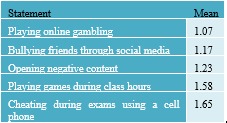
Objective: This study aims to analyze the internalization of Maja Labo Dahu values as an effort to strengthen students’ ethics in using mobile phones at SMAN 1 Bima City. Theoretical framework: This study is grounded in character education theory, local wisdom theory, and digital ethics theory. Literature review: Previous studies highlight the importance of integrating local cultural values into character education to address moral challenges arising from technological advancement. Method: This study employed a descriptive quantitative approach involving 83 students from grades X and XI at SMAN 1 Bima City. Data were collected through a questionnaire consisting of 55 statements covering students’ understanding of Maja Labo Dahu values, ethics in mobile phone use, the utilization of mobile phones for learning, discipline in mobile phone use, and behavior on social media. The collected data were analyzed using descriptive statistical techniques to determine the level of students’ ethical behavior and the extent of value internalization. Results: The findings reveal that the overall average score was 3.76, categorized as good. Students demonstrated a high level of understanding of digital ethics (4.55), awareness of positive mobile phone use (4.55), utilization of mobile phones as learning resources (4.54), compliance with school regulations (4.41), and self-control in mobile phone use (4.08). In contrast, negative behaviors related to mobile phone use, including online gambling, cyberbullying, accessing inappropriate content, playing games during lessons, and cheating through mobile phones, were found to be in the low category (1.07–2.47). These findings indicate that the values of Maja and Dahu serve as effective moral controls that encourage students to use mobile phones responsibly, ethically, and in accordance with social and religious norms. Implications: The study emphasizes the importance of integrating local wisdom into character education programs as a strategy to foster ethical digital behavior among students. Schools can utilize Maja Labo Dahu values as a cultural and moral foundation for promoting responsible technology use and preventing digital misconduct. Novelty: The novelty of this study lies in demonstrating how the internalization of Maja Labo Dahu values strengthens students’ digital ethics in mobile phone use, offering a local wisdom-based character education model for the digital era.
References
M. Akour and M. Alenezi, “Higher Education Future in the Era of Digital Transformation,” Education Sciences, vol. 12, no. 11. p. 784, 2022. doi: https://doi.org/10.3390/educsci12110784.
C. Wang, X. Chen, T. Yu, Y. Liu, and Y. Jing, “Education reform and change driven by digital technology: a bibliometric study from a global perspective,” Humanit. Soc. Sci. Commun., vol. 11, no. 1, p. 256, 2024, doi: https://doi.org/10.1057/s41599-024-02717-y.
T. D. Anggraeni, A. T. Lidyasari, and A. Herwanto, “Impact of Digital Media on Character Development and Social Skills Among Primary School Students at Sekolah Indonesia Jeddah,” Al-Ishlah J. Pendidik., vol. 17, no. 1, pp. 832–841, 2025, doi: https://doi.org/10.35445/alishlah.v17i1.6031.
M. Huda and A. Hashim, “Towards professional and ethical balance: insights into application strategy on media literacy education,” Kybernetes, vol. 51, no. 3, pp. 1280–1300, Jun. 2021, doi: https://doi.org/10.1108/K-07-2017-0252.
T. Lickona, “Character Education The Cultivation of Virtue,” in Instructional-design Theories and Models, London: Routledge, 1999, p. 22.
R. Ruslin and H. Gusfa, “The Rationalization of Maja Labo Dahu Values in the Action of Bimas Young Political Actors,” vol. 343, no. Icas, pp. 501–505, 2019, doi: https://doi.org/10.2991/icas-19.2019.103.
Amrin, Muthoifin, S. Shobron, and H. R. Putra, “Islamic Values in the Peta Kapanca Tradition at the Mbojo Community tribe’s Marriage in West Nusa Tenggara, Indonesia,” Cakrawala J. Stud. Islam, vol. 15, no. 2, pp. 93–104, 2020, doi: https://doi.org/10.31603/cakrawala.3405.
Sanura Jaya and Rozniza Zaharudin, “Emerging Trends in STEM Education: Envisioning Future Learning Spaces and Interaction Technology Tools Framework using the Fuzzy Delphi Method (FDM),” Malaysian Int. J. Res. Teach. Educ., vol. Vol.3, no. December, pp. 45–56, 2022.
Z. R. Hinduan, A. Anggraeni, and M. I. Agia, “Generation Z in Indonesia: The Self-Driven Digital,” The New Generation Z in Asia: Dynamics, Differences, Digitalisation. Emerald Publishing Limited, p. 0, Oct. 23, 2020. doi: https://doi.org/10.1108/978-1-80043-220-820201012.
S. B. Alavi, “The Making of an Authentic Leader’s Internalized Moral Perspective: The Role of Internalized Ethical Philosophies in the Development of Authentic Leaders’ Moral Identity,” J. Bus. Ethics, vol. 190, no. 1, pp. 77–92, 2024, doi: https://doi.org/10.1007/s10551-023-05442-9.
A. Rijal, A. Kosasih, and E. S. Nurdin, “Thomas Lickona and Yusuf Qardhawi: Creating Value for Character Education Through Narrative,” in Proceedings of the International Conference on Language, Education, and Social Science (ICLESS 2022), Atlantis Press, 2022, pp. 15–24. doi: https://doi.org/10.2991/978-2-494069-15-2_3.
N. P. D. S. Dartini, A. Syahputra, L. Zahara, A. Wijaksono, and M. Gombo, “Integrating Local Wisdom Values into Educational Management: A Literature Review on Character Development Aspects,” Indones. J. Educ. Inq., vol. 2, no. 1, pp. 42–51, 2025, [Online]. Available: https://ejournal2.undiksha.ac.id/index.php/IJEI/article/view/5100
Amrin, A. Priyono, Supriyanto, and Nurrahmania, “Analysis of Local Wisdom in Bima Community Marriage ( Study of Socio- Cultural Values ),” Leg. Br., vol. 11, no. 4, pp. 2418–2425, 2022, doi: https://doi.org/10.35335/legal.xx.xx.
Amrin, M. D. Fajri, E. Salim, and Amirullah, “Teka Ra Ne’e: The Integration of Islamic Values and Local Culture in Strengthening Community-Based Economic Development and Customary Law in Bima,” J. Penelit., vol. 22, no. 1, pp. 13–26, 2025, doi: https://doi.org/10.28918/jupe.v22i1.9583.
A. A. Odebode and O. T. Ogunbayo, “The potential of digital-based technology in improving organizational performance,” J. Manag. Dev., vol. 44, no. 1, pp. 96–106, 2025, doi: https://doi.org/10.1108/JMD-04-2024-0145.
Y. Kaya, “The Potential of Artificial Intelligence as the Learning Ecosystem of the Future in Adult Religious Education TT - Yetişkin Din Eğitiminde Geleceğin Öğrenme Ekosistemi Olarak Yapay Zekanın Potansiyeli,” Eskişehir Osmangazi Üniversitesi İlahiyat Fakültesi Derg., vol. 12, no. Din ve Yapay Zeka, pp. 127–156, 2025, doi: https://doi.org/10.51702/esoguifd.1607220.
A. Shobron and M. Rosyadi, Imron, “Islamic Education Values in the Tradition of Peta Kapanca of Mbojo Community Tribe in West Nusa Tenggara,” Int. J. Adv. Sci. Technol., vol. 29, no. 5, pp. 6802–6812, 2020.
Sugiyono, Metode Penelitian Pendidikan (Pendekatan Kuantitatif, Kualitatif, dan R&D). Bandung: Alfabeta, 2017.
Priyono, Metode Penelitian Kuantitatif, Edisi Revi. Sidoarjo, 2008.
J. W. Creswell and J. D. Creswell, Research Design: Qualitative, Quantitative, and Mixed Methods Approaches. California: Sage publications, 2017.
S. Hermawan and Amirullah, Metode Penelitian Bisnis: Pendekatan Kuantitatif & kualitatif. 2016.
I. Hermawan, Metodologi Penelitian Pendidikan (Kualitatif, Kuantitatif dan Mixed Method). Ciputat: Hidayatul Quran, 2019.
Amrin, M. D. Fajri, Ri. Agus, and Sugiyarto, “Strengthening Islamic Law of Financial Literacy Through Integrating Local Wisdom in West Nusa Tenggara Communities,” Addin, vol. 19, no. 2, pp. 291–326, 2025, doi: http://dx.doi.org/10.21043/addin.v19i2.31902.
M. Kurniansyah, M. Latif, and A. Thalib, “Islam , Local Culture , and the Motto Maja Labo Dahu in Bima : a Foucauldian Critical Discourse Analysis of Power and Institutionalization,” J. Penelit., vol. 23, no. 1, pp. 1–13, 2026, doi: https://doi.org/10.28918/df6zhy82.
A. M. Idrus, H. Hasan, M. J. Asti, N. T. Taudiyah, and P. Halim, “Philosophy of Tashrī‘ Review on Internalization Maja Labo Dahu in The Legal System of The Sultanate of Bima,” Al-Daulah J. Huk. dan Perundangan Islam, vol. 12, no. 1, pp. 108–128, 2022, doi: https://doi.org/10.15642/ad.2022.12.1.108-128.
Fahrurizki, Historiografi Bima. Yogyakarta: Ruas Media, 2019.
S. M. R. Salahuddin, Aksara Bima: Peradaban Lokal yang Sempat Hilang,. Mataram: Alam tara Institute, 2013.
I. Fathurrochman, “Online Evaluation System in the Pandemic Disruption in Madrasah: Opportunities and Challenges Based on Qualitative Report,” J. Iqra’ Kaji. Ilmu Pendidik., vol. 6, no. 2, pp. 184–197, 2021, [Online]. Available: https://journal.iaimnumetrolampung.ac.id/index.php/ji/article/view/983
Allan J. Henderson, The E-Learning Question and Answer Book. New York: Amacon, 2003. [Online]. Available: http://dx.doi.org/10.1016/j.cirp.2016.06.001
Maisyanah, A. Rahman, N. Kholis, M. Y. A. Bakar, and A. A. Al Hasan, “Living Qur’an Approach to Improve Critical Thinking Skills in Islamic Religious Education Learning,” Al-Hayat J. Islam. Educ., vol. 8, no. 4, pp. 1383–1398, 2024, doi: https://doi.org/10.35723/ajie.v8i4.7.
S. I. Syed Shaharuddin et al., “A Review on the Malaysian and Indonesian Batik Production, Challenges, and Innovations in the 21st Century,” Sage Open, vol. 11, no. 3, p. 21582440211040130, 2021, doi: https://doi.org/10.1177/21582440211040128.
M. Juraschek, L. Büth, N. Martin, S. Pulst, S. Thiede, and C. Herrmann, “Event-based education and innovation in Learning Factories - Concept and evaluation from Hackathon to GameJam,” Procedia Manuf., vol. 45, no. 2019, pp. 43–48, 2020, doi: https://doi.org/10.1016/j.promfg.2020.04.057.
J. König, D. J. Jäger-Biela, and N. Glutsch, “Adapting to online teaching during COVID-19 school closure: teacher education and teacher competence effects among early career teachers in Germany,” Eur. J. Teach. Educ., vol. 43, no. 4, pp. 608–622, 2020, doi: https://doi.org/10.1080/02619768.2020.1809650.
M. H. Musolin et al., “Developing Personalised Islamic Learning in Digital Age: Pedagogical and Technological Integration for Open Learning Resources (OLR),” in Proceedings of Ninth International Congress on Information and Communication Technology, X.-S. Yang, S. Sherratt, N. Dey, and A. Joshi, Eds., Singapore: Springer Nature Singapore, 2024, pp. 11–25.
D. Kurniawan and A. Yusuf, “Building an inclusive digital pedagogy framework through professional learning communities,” J. Educ. Technol. Innov., vol. 5, no. 1, pp. 44–56, 2023, doi: https://doi.org/10.31764/jeti.v5i1.217.
F. Muharom, A. Nugroho, and H. R. Putra P., “Self-directed Use of Digital Devices for Out-of-class English Learning,” Int. J. Educ. Math. Sci. Technol., vol. 10, no. 1, pp. 257–271, 2021, doi: https://doi.org/10.46328/ijemst.2245.
R. Susanto and E. Prasetyo, “Enhancing TVET digital competence through adaptive learning models in Indonesian polytechnics,” J. Educ. Technol. Innov., vol. 4, no. 2, pp. 101–112, 2022.
Syafieh, “Islamic Renewal Project: Ḥassan Ḥanafī and Indonesian Intellectual Muslims,” J. Islam. Thought Muslim Cult., vol. 2, no. 2, pp. 115–133, 2020,
D. Radovanović et al., “Digital literacy key performance indicators for sustainable development,” Soc. Incl., vol. 8, no. 2, pp. 151–167, 2020, doi: https://doi.org/10.17645/si.v8i2.2587.
L. Xia, S. Baghaie, and S. Mohammad Sajadi, “The digital economy: Challenges and opportunities in the new era of technology and electronic communications,” Ain Shams Eng. J., vol. 15, no. 2, p. 102411, 2024, doi: https://doi.org/10.1016/j.asej.2023.102411.