Work Discipline and Work Environment in an Effort to Improve the Performance of Civil Servants in Indramayu Regency
DOI:
https://doi.org/10.61455/sicopus.v4i02.548Keywords:
work discipline, employee performance, work environment, human resource management, productivityAbstract
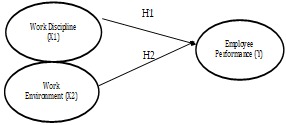
Objective: This study aims to analyze the influence of work discipline and work environment on improving the performance of civil servants in Indramayu Regency, considering that employee performance is a key factor in achieving effective governance and public service quality. Theoretical framework: This research is grounded in human resource management theory, which emphasizes that employee performance is influenced by behavioral factors, such as discipline, and environmental factors, such as workplace conditions. Literature review: Previous studies indicate inconsistent findings regarding the effect of work discipline on performance, while other studies confirm the positive role of the work environment in enhancing productivity. Methods: This study employs a quantitative approach with an associative design, involving a sample of 100 civil servants selected through simple random sampling from a population of 9,807 employees, using questionnaires with a Likert scale, and analyzed through multiple linear regression using SPSS. Results: The findings reveal that both work discipline and work environment have a positive and significant effect on employee performance, with work discipline having a more dominant influence, and the model explaining 75.9% of performance variation (Adjusted R² = 0.759). Implications: These results imply that strengthening discipline and creating a conducive work environment are essential strategies for improving employee productivity and organizational effectiveness. Novelty: The novelty of this study lies in its integrative and contextual approach in examining both variables simultaneously within the local government setting of Indramayu Regency, providing empirical evidence that contributes to the development of human resource management studies in the public sector.
References
K. P. Wenas and M. A. D. Ikhram, “Pengaruh Disiplin Kerja Dan Lingkungan Kerja Terhadap Kinerja Pegawai,” J. Kewirausahaan dan Inov., vol. 2, no. 3, pp. 902–916, 2023, https://doi.org/10.21776/jki.2023.02.3.23.
K. S. Nasution, D. S. Chandra, and P. Parlindungan, “Pengaruh Motivasi Non-Financial Dan Disiplin Kerja Terhadap Kinerja Pegawai,” Bursa J. Ekon. dan Bisnis, vol. 4, no. 1, pp. 1–11, 2025, https://doi.org/10.59086/jeb.v4i1.588.
I. S. Iriqat and S. M. Awawda, “Assessing Factors Affecting Palestinian Employees’ Turnover Intention: A Cross-Sectional Analysis,” Dirasat Hum. Soc. Sci., vol. 53, no. 2, 2026, https://doi.org/10.35516/Hum.2026.7617.
A. Ismail et al., “Development of COVID-19 Health-Risk Assessment and Self-Evaluation (CHaSe): a health screening system for university students and staff during the movement control order (MCO),” Netw. Model. Anal. Heal. Informatics Bioinforma., vol. 11, no. 1, 2022, https://doi.org/10.1007/s13721-022-00357-3.
M. I. Nasution and N. Priangkatara, “Work Discipline and Work Motivation on Employee Performance,” Int. J. Econ. Soc. Sci. Entrep. Technol., vol. 1, no. 1, pp. 50–64, 2022, https://doi.org/10.55983/ijeset.v1i1.27.
R. D. Parashakti, M. Fahlevi, M. Ekhsan, and A. Hadinata, “The Influence of Work Environment and Competence on Motivation and Its Impact on Employee Performance in the Health Sector,” in Proceedings of the 3rd Asia Pacific International Conference of Management and Business Science (AICMBS 2019), Paris, France: Atlantis Press, 2020. https://doi.org/10.2991/aebmr.k.200410.040.
B. Armando Vegatus, I. K. I. Swadesi, and I. N. Sudarmada, “Pelatihan Ladder Drill terhadap Kecepatan dan Kelincahan pada Pemain Sepak Bola,” J. Ilmu Keolahragaan Undiksha, vol. 11, no. 3, pp. 224–229, 2023, https://doi.org/10.23887/jiku.v11i3.66919.
John Zysman and Alexander, “The Effect Of Work Discipline On Employee Performance With Incentives As Intervening Variables (Case Study of Medical Doctor and Nurses in California District),” MEDALION J. Med. Res. Nursing, Heal. Midwife Particip., vol. 1, no. 4, pp. 147–155, 2020, https://doi.org/10.59733/medalion.v1i4.60.
H. N. Janah, L. P. Herawati, and L. H. Sulistiyowati, “The Influence Of Transformational Leadership, Intrinsic Motivation, and Work Discipline On Employee Performance,” IJEBD (International J. Entrep. Bus. Dev., vol. 7, no. 2, pp. 293–303, 2024, https://doi.org/10.29138/ijebd.v7i2.2697.
E. Ariyanti, E. S. Wardani, and Jaenudin, “The Influence of Work Discipline and Work Environment on Employee Performance,” International Journal of Management and Economics, vol. 3, no. 2. pp. 16–24, 2024. https://doi.org/10.56127/ijme.v3i2.1285.
H. Lestari, D. Komardi, and E. Elnura, “Effect of Compensation, Motivation and Organizational Commitment on Employee Performance,” Int. J. Inf. Syst. Innov. Manag., vol. 1, no. 1, pp. 46–56, 2023, https://doi.org/10.55583/ijisim.v1i1.603.
S. M. Taggart, O. Girard, G. J. Landers, U. K. H. Ecker, and K. E. Wallman, “Comparing thermal strain in outdoor maintenance and indoor service workers in the mining industry during summer,” PLoS One, vol. 18, no. 10 October, 2023, https://doi.org/10.1371/journal.pone.0292436.
S. E. Vaughan, D. P. Misra, J. Gohar, S. Hyer, M. Price, and C. Giurgescu, “The associations of objective and perceived neighborhood disadvantage with stress among pregnant black women,” Public Health Nurs., vol. 40, no. 3, pp. 372–381, 2023, https://doi.org/10.1111/phn.13177.
C. E. Hall, S. K. Brooks, N. Greenberg, and D. Weston, “UK Government COVID-19 Response Employees’ Perceptions of Working from Home: Content Analysis of Open-Ended Survey Questions,” J. Occup. Environ. Med., vol. 66, no. 12, pp. e661–e667, 2024, https://doi.org/10.1097/JOM.0000000000003234.
F. C. Omeke, C. I. Okeke, M. O. Ede, and J. O. Oneli, “Coaching impact on work-family conflict and occupational stress among educational administrators in primary schools,” Med. (United States), vol. 102, no. 10, p. E33185, 2023, https://doi.org/10.1097/MD.0000000000033185.
E. K. Dzantor, M. Kweku, E. S. K. Morhe, and S. Z. Bugri, “Prioritizing Workplace Health Promotion Policy to Address High Blood Pressure and Obesity in a Public University in the Northern Region of Ghana,” Inq. (United States), vol. 60, 2023, https://doi.org/10.1177/00469580231218627.
S. Syachrani, Fitriansyah, S. T. Sapulete, and R. Sucianti, “Manajemen Sumber Daya Manusia Manajemen Sumber Daya Manusia,” Ed. Revisi Jakarta Bumi Aksara, no. 1, p. 391, 2023, https://doi.org/10.31219/osf.io/x3j64.
D. T. Handayani and Hasanah, “The Influence of Work Discipline and Work Environment on Employee Performance in the General Affairs Division of the Regional Secretariat of Tangerang City,” Int. J. Sci. Soc., vol. 6, no. 4, pp. 136–148, 2024, https://doi.org/10.54783/ijsoc.v6i4.1309.
P. N. P. A. Wisesa, P. Kepramareni, and I. W. Widnyana, “The Effect of Work Discipline and Communication on Work Motivation and Performance of Agricultural Officers of Denpasar City, Indonesia,” Eur. J. Bus. Manag. Res., vol. 7, no. 6, pp. 120–126, 2022, https://doi.org/10.24018/ejbmr.2022.7.6.1625.
Maizar, Indra Nara Persada, and Septa Diana Nabella, “The Influence of Compensation, Training, Competence, and Work Discipline on Employee Performance Pt. Luas Retail Indonesia,” Int. J. Accounting, Manag. Econ. Soc. Sci., vol. 1, no. 4, pp. 291–303, 2023, https://doi.org/10.61990/ijamesc.v1i4.37.
Idris, K. R. Adi, B. E. Soetjipto, and A. S. Supriyanto, “The mediating role of job satisfaction on compensation, work environment, and employee performance: Evidence from Indonesia,” Entrep. Sustain. Issues, vol. 8, no. 2, pp. 735–750, 2020, https://doi.org/10.9770/jesi.2020.8.2(44).
H. Tian, “Analysis of the Cardiopulmonary Endurance Response of Women To Aerobic Exercise,” Rev. Bras. Med. do Esporte, vol. 28, no. 1, pp. 10–13, 2022, https://doi.org/10.1590/1517-8692202228012021_0447.
I. Sriadmitum, Sudarno, and Nyoto, “Leadership Style, Work Environment, and Compensation on Job Satisfaction and Teacher Performance,” J. Appl. Bus. Technol., vol. 4, no. 1, pp. 79–92, 2023, https://doi.org/10.35145/jabt.v4i1.122.
L. A. B. Camacho, V. C. Matos, L. L. Juvanhol, M. de J. M. da Fonseca, and E. Faerstein, “Health, social, behavioral, and labor correlates of quality of life in a well population: a contribution to construct validity of the WHOQOL-BREF,” Cad. Saude Publica, vol. 41, no. 11, 2025, https://doi.org/0.1590/0102-311XEN043325.
J. Byambasuren and C. Vadhanasindhu, “A multidimensional analysis of the determinants of job performance: A case study of civil servants in Mongolia,” Int. J. Public Policy Adm. Res., vol. 12, no. 1, pp. 30–47, 2025, https://doi.org/10.18488/74.v12i1.4154.
Y. Andika, A. Sovia, Z. Zulsantoni, and D. Dakhyar, “The Influence of Service and Work Discipline on Employee Performance,” Strat. Bus. Rev., vol. 2, no. 1, pp. 37–46, 2024, https://doi.org/10.59631/sbr.v2i1.203.
Lily, P. Ginting, P. Lumbanraja, and E. Siahaan, “The antecedent of work motivation and the effect on the performance of civil servants with job satisfaction as moderating variable (A study of civil servants on West Coast, North Sumatra - Indonesia),” Int. J. Econ. Res., vol. 14, no. 8, pp. 161–176, 2017, https://www.scopus.com/pages/publications/85026358206?origin=resultslist
S. Malik, “The discipline of state civil apparatuses in the scope of regional work units in South Buru Regency,” Int. J. Sci. Technol. Res., vol. 9, no. 1, pp. 763–767, 2020, [Online]. Available: https://www.scopus.com/pages/publications/85078732726?origin=resultslist
H. S. Anggara, “The implementation of fingerprint policy to discipline civil servants in the Faculty of Social and Political UIN Sunan Gunung Djati Bandung,” Soc. Sci., vol. 11, no. 15, pp. 3702–3706, 2016, https://doi.org/10.3923/sscience.2016.3702.3706.
Y. W. Saputri, N. Qomariah, and T. Herlambang, “Effect of work compensation, supervision, and discipline on work performance,” Int. J. Sci. Technol. Res., vol. 9, no. 1, pp. 2597–2601, 2020, https://www.scopus.com/pages/publications/85078829959?origin=resultslist
M. Kadarisman, “The influence of compensation, development, and supervision towards the performance of civil servants in Depok City government, Indonesia,” Cogent Psychol., vol. 6, no. 1, 2019, https://doi.org/10.1080/23311908.2019.1620402.
Yuliandi and R. Tahir, “Work discipline, competence, empowerment, job satisfaction, and employee performance,” Int. J. Recent Technol. Eng., vol. 8, no. 3, pp. 7209–7215, 2019, https://doi.org/10.35940/ijrte.C6221.098319.
S. Riyanto and J. H. Prasetyo, “Factors affecting civil servant performance in Indonesia,” Int. J. Entrep., vol. 25, no. 5, 2021, [Online]. Available: https://www.scopus.com/pages/publications/85108623066?origin=resultslist
S. Oktafien, “Factors that influence the performance of employees (Study in PNSD in the regional government of Bandung city),” J. Adv. Res. Dyn. Control Syst., vol. 11, no. 7 Special Issue, pp. 664–670, 2019, [Online]. Available: https://www.scopus.com/pages/publications/85071151918?origin=resultslist
D. C. de A. M. Bernardino, U. B. Otero, I. T. Pimenta, L. Giatti, R. H. Griep, and M. de J. M. da Fonseca, “Occupational, socioeconomic factors and cancer mortality in participants of the Longitudinal Study of Adult Health (ELSA-Brazil): a multiple correspondence analysis,” Rev. Bras. Epidemiol., vol. 28, 2025, https://doi.org/10.1590/1980-549720250022.
M. Mulyadi, “Penelitian Kuantitatif Dan Kualitatif Serta Pemikiran Dasar Menggabungkannya,” J. Stud. Komun. dan Media, vol. 15, no. 1, p. 128, 2013, https://doi.org/10.31445/jskm.2011.150106.
A. A. Mekarisce, “Teknik Pemeriksaan Keabsahan Data pada Penelitian Kualitatif di Bidang Kesehatan Masyarakat,” JJurnal Ilm. Kesehat. Masy. Media Komun. Komunitas Kesehat. Masy., vol. 12, no. 3, pp. 145–151, 2020, https://doi.org/10.52022/jikm.v12i3.102.
R. Surayya, “Pendekatan Kualitatif Dalam Penelitian Kesehatan,” AVERROUS J. Kedokt. dan Kesehat. Malikussaleh, vol. 1, no. 2, p. 75, 2018, https://doi.org/10.29103/averrous.v1i2.415.
S. Porter, “Swedish politicians’ perspective on civil servants’ collaboration, financial resources, and contextual knowledge in eldercare: A qualitative study,” Nord. Soc. Work Res., vol. 14, no. 4, pp. 517–531, 2024, https://doi.org/10.1080/2156857X.2022.2130405.
E. Janus, R. C. Téllez, K. Filar-Mierzwa, P. Aleksander-Szymanowicz, and A. Bac, “Psychosocial and Health Effects of the COVID-19 Pandemic Experienced by Staff Employed in Social Welfare Facilities in Poland and Spain,” Int. J. Environ. Res. Public Health, vol. 20, no. 4, 2023, https://doi.org/10.3390/ijerph20043336.
M. R. de S. Camões, A. de O. Gomes, B. Rizardi, and J. Lemos, “The work engagement cycles of federal civil servants,” Rev. Adm. Publica, vol. 57, no. 4, 2023, https://doi.org/10.1590/0034-761220230061x.
J. Liu and H. Zhang, “Epidemiological Investigation and Risk Factor Analysis of Acute Hemorrhagic Conjunctivitis in Huangshi Port District, Huangshi City,” Comput. Math. Methods Med., vol. 2022, 2022, https://doi.org/10.1155/2022/3009589.
B. I. Chigbu, W. Chinyamurindi, and C. S. Marange, “Influence of organisational climate on public service employee physical health,” Heal. SA Gesondheid, vol. 29, 2024, https://doi.org/10.4102/hsag.v29i0.2244.
L. He et al., “Effects of Serving as a State Functionary on Self-Rated Health: Empirical Evidence From China,” Front. Public Heal., vol. 10, 2022, https://doi.org/10.3389/fpubh.2022.757036.