Women’s Agency in the Practice of Ampa Sabae: An Analysis of Islamic Law and Social Reality in Bima
DOI:
https://doi.org/10.61455/sicopus.v4i02.544Keywords:
women's agency, ampa sabae, islamic law, marriage, local wisdomAbstract
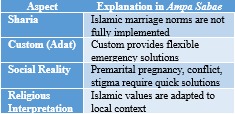
Objective: This study aims to analyze the practice of ampa sabae in the Mbojo Bima community from the perspectives of Islamic law and social reality, with a particular emphasis on women’s agency as the primary actors in responding to social issues such as premarital pregnancy and male irresponsibility. Theoretical framework: This study is grounded in socio-legal theory, Islamic legal theory, and agency theory, emphasizing the interaction between custom, sharia, and social realities, as well as the framework of maqāṣid al-sharīʿah, particularly ḥifẓ al-nasl (protection of lineage). Literature review: This study reviews key discussions on Islamic marriage law, women’s agency in socio-religious contexts, the relationship between ʿurf (custom) and Islamic law, the concept of fiqh al-ḍarūrah, and the role of local practices in shaping Islamic legal implementation. Method: This study employs a qualitative approach with a case study design. Data were collected through in-depth interviews, observation, and documentation involving perpetrators, community leaders, and religious leaders in Bima Regency. Data analysis was conducted through data reduction, data presentation, and inductive conclusion drawing. Results: The findings reveal that the practice of ampa sabae is a multidimensional phenomenon reflecting the dialectic between custom, sharia, and social reality. From an agency perspective, women are positioned as active actors who initiate marriage, determine partners, and demand responsibility from men. From an Islamic legal perspective, this practice is ambivalent: normatively inconsistent with ideal marriage procedures, yet it can be understood within the framework of fiqh al-ḍarūrah and public interest (maṣlaḥah) as an effort to preserve lineage (ḥifẓ al-nasl). Implications: This study highlights the need for a contextual and responsive approach to Islamic law and emphasizes the importance of the role of ulama and policymakers in ensuring that local practices align with principles of justice, consent, and public interest. Novelty: This study offers a comprehensive analysis through the integration of women’s agency perspectives with a socio-legal and maqāṣid al-sharīʿah approach, positioning women as active subjects in local religious practices.
References
Amrin, A. Priyono, Supriyanto, and Nurrahmania, “Analysis of Local Wisdom in Bima Community Marriage ( Study of Socio- Cultural Values ),” Leg. Br., vol. 11, no. 4, pp. 2418–2425, 2022, https://doi.org/10.35335/legal.xx.xx.
A. Amrin, M. Fitriyah, A. Hamid, and E. Amalia, “Peta Kapanca As the Existence of Islamic Marriage in Bima Indonesia,” in Proceedings of the 5th International Graduate Conference in Islam and Interdisciplinary Studies, 2023. https://doi.org/10.4108/eai.19-10-2022.2333027.
A. I. I. Yono, Amrin, “Alignment of Local Wisdom Values with Islamic Law in the Tradition of the Peta Kapanca Ceremony,” Hayula Indones. J. Multidiscip. Islam. Stud., vol. 6, no. 1, pp. 59–80, 2022, https://doi.org/10.21009/hayula.006.02.02.
S. T. Hoque, “Rethinking Marriage: Blurring the ‘Legal’ and the ‘Social,’” Law Soc. Inq., vol. 51, no. 1, pp. 142–179, 2026, https://doi.org/10.1017/lsi.2025.10068.
C. M. Becker, B. Mirkasimov, and S. Steiner, “Forced Marriage and Birth Outcomes,” Demography, vol. 54, no. 4, pp. 1401–1423, 2017, https://doi.org/10.1007/s13524-017-0591-1.
E. Miedema, W. Koster, N. Pouw, P. Meyer, and A. Sotirova, “The Struggle for Public Recognition: Understanding Early Marriage through the Lens of Honour and Shame in Six Countries in South Asia and West Africa,” Prog. Dev. Stud., vol. 20, no. 4, pp. 328–346, 2020, https://doi.org/10.1177/1464993420977790.
K. Lee-Koo and E. Gordon, “Conceptualizing Conflict-Related Child and Early Marriage as Insecurity: At the Intersection of Gender and Age,” J. Glob. Secur. Stud., vol. 7, no. 4, p. ogac022, 2022, https://doi.org/10.1093/jogss/ogac022.
Amrin, Muthoifin, S. Shobron, and H. R. Putra P, “Islamic Values of the Peta Kapanca Tradition at the Mbojo Tribe’s Marriage, West Nusa Tenggara, Indonesia,” Cakrawala J. Stud. Islam, vol. 15, no. 2, pp. 93–104, 2020, https://doi.org/10.31603/cakrawala.3405.
A. Sofyan, “Tradisi Ampa Sabae (Perkawinan Sepihak) dalam Pandangan Masyarakat Bima dan Dampaknya terhadap Rumah Tangga Pengantin,” Al-Ittihad J. Pemikir. Dan Huk. Islam, vol. 11, no. 1, pp. 175–190, 2025, https://doi.org/10.61817/ittihad.v11i1.297.
Elpipit and A. F. Safitri, “Tradisi Ampa Sabae dalam Proses Perkawinan Masyarakat Muslim di Desa Nipa Kecamatan Ambalawi Kabupaten Bima ( Perspektif Sosiologi Hukum ),” Asya-Syari’ah J. Huk. Islam, vol. 7, no. 1, 2021, https://doi.org/10.36835/assyariah.v7i1.385.
Amrin, Sugiyarto, and Su’ud, “Boho Oi Mbaru Traditions In Community Wedding Culture Mbojo Tribe in Dompu District NTB: Review The Perspective Of Islamic Law,” Al-Insyiroh J. Stud. Keislam, vol. 10, no. 1, pp. 110–133, 2024, https://doi.org/10.35309/alinsyiroh.v10i1.249.
N. Nahdhiyah, R. Ayu Damayanti, and N. Nirwana, “The Study of Accounting Practices in The Uang Panai Tradition (Ethnographic Studies on Traditional Marriages in West Sulawesi),” Devot. J. Res. Community Serv., vol. 3, no. 8, pp. 757–763, 2022, https://doi.org/10.36418/dev.v3i08.178.
N. Sahar, “Feminist Exegesis and Muslim Women ’ s Agency : A Critical Analysis of Fatima Mernissi and Saba Mahmood ’ s Perspectives for Contemporary Times,” Middle East J. Islam. Stud. Cult., vol. 8652, pp. 172–184, 2025, https://doi.org/10.36348/mejisc.2025.v05i02.007.
I. Chatterjee, J. Kunwar, and F. den Hond, “Anthony Giddens and structuration theory,” in Management, Organizations and Contemporary Social Theory, New York: Routledge, 2019, p. 20, https://doi.org/10.4324/9780429279591-4.
A. Wardatun, “Ampa co’i ndai: Local Understanding of Kafa’a in Marriage among Eastern Indonesian Muslims,” Al-Jami’ah, vol. 54, no. 2, pp. 311–336, 2016, https://doi.org/10.14421/ajis.2016.542.311-336.
Ash-Syatibi, Al-Muwafaqat fi Usul al-Shariah Terjemahan oleh Ibrahim Musa dalam buku “Maqasid alShariah as Philosophy of Islamic Law: A Systems Approach”. International Institute of Islamic Thought. 2006.
Tim Redaksi Nuansa Aulia, Kompilasi Hukum Islam dilengkapi dengan UU Nomor 1 tahun 1974 tentang Perkawinan. Bandung: Nuasa Aulia, 2012.
C. Geertz, “Religion as a cultural system,” Anthropol. approaches to study Relig., pp. 1–16, 2013.
K. Lystra, “Clifford Geertz and the Concept of Culture,” Prospects, vol. 8, pp. 31–47, 1983, https://doi.org/10.1017/S0361233300003690.
E. Ehrlich, Fundamental Principles of The Sociology of Law. Walter L. Moll trans, 1936.
D. Tan, “Revisiting Pound ’ s Law in Action and Ehrlich ’ s Living Law to Find the ‘ Gap ’: A Compilation of Lecture Notes,” J. Judic. Rev., vol. 24, no. 2, pp. 225–238, 2022, https://doi.org/10.37253/jjr.v24i2.7220.
P. Connolly, Approaches to the study of Religion. London: The Continuum International Publishing Group, 2006.
R. Banakar and M. Travers, Theory and Method in Socio-Legal Research. Bloomsbury Publishing, 2025.
Sugiyono, Metode Penelitian Kuantitatif, Kualitatif dan R&D. Bandung: CV. Alfabeta, 2018.
M. Tzanakis, “Bourdieu ’ s Social Reproduction Thesis and The Role of Cultural Capital in Educational Attainment : A Critical Review of Key Empirical Studies,” Educate, vol. 11, no. 1, pp. 76–90, 2011.
S. Davies and J. Rizk, “The Three Generations of Cultural Capital Research: A Narrative Review,” Rev. Educ. Res., vol. 88, no. 3, pp. 331–365, 2017, https://doi.org/10.3102/0034654317748423.
M. D. Wojciechowska, “The role of public libraries in the development of social capital in local communities – a theoretical study,” Libr. Manag., vol. 42, no. 3, pp. 184–196, Jan. 2021, https://doi.org/10.1108/LM-10-2020-0139.
N. Islam and A. Jirattikorn, “Navigating structural constraints: women’s agency in engineering studies and teaching in Bangladesh,” High. Educ., vol. 88, no. 4, pp. 1445–1461, 2024, https://doi.org/10.1007/s10734-023-01177-8.
A. F. Safitri, “The Ampa Sabae Tradition in the Marriage Process of the Muslim Community in Nipa Village, Ambalawi District, Bima Regency (Legal Sociology Perspective),” Ash-Syari’ah J. Islam. Law, vol. 7, no. 1, pp. 53–74, 2021, https://doi.org/10.55210/assyariah.v7i1.385.
Yunus, Amrin, Sugiyarto, and Supriyanto, “Rimpu Culture and the Existence of Bima Women: An Overview of Gender Perspectives,” Insa. J. Islam Humanit., vol. 8, no. 2, pp. 159-170., 2024, https://doi.org/10.15408/insaniyat.v8i2.31094.
S. Applin, J.-M. Simpson, and A. Curtis, “Men Have Gender and Women Are People: A Structural Approach to Gender and Violence,” Violence Against Women, vol. 29, no. 5, pp. 1097–1118, 2023, https://doi.org/10.1177/10778012221104844.
M. G. Farias, M. C. Biermann, L. F. de Melo Maia, and G. de Oliveira Meneses, “Structural Patriarchy and Male Dominance Hierarchies,” in Encyclopedia of Domestic Violence, T. K. Shackelford, Ed., Cham: Springer International Publishing, 2023, pp. 1–14. https://doi.org/10.1007/978-3-030-85493-5_2152-1.
E. Durkheim, Introduction to Sociological Theory: Theorists, Concepts, and their Applicability to the Twenty-First Century. Hoboken: Wiley Blackwell Publication, 2020.
A. Andalib, S. S. Mortazavi, R. Ahmadian, and M. Talachian, “Usefulness of Emile Durkheim’s Social Solidarity Approach on Improving the Ritual Functions of Urban Spaces (case Study: Zeynabieh and Hosseinie Azam Axis till Imamzadeh Seyed Ebrahim of Zanjan City),” Sustain. city, vol. 7, no. 1, pp. 117–133, 2024.
Noor Sanauddin, “Walby’s Theory of Patriarchy: A Critical Review in the Context of Pakistan,” Soc. Sci. Rev. Arch., vol. 3, no. 2, pp. 950–959, 2025, https://doi.org/10.70670/sra.v3i2.685.
Z. Bauman and M. Haugaard, “Liquid modernity and power: A dialogue with Zygmunt Bauman 1,” J. Power, vol. 1, no. 2, pp. 111–130, Aug. 2008, https://doi.org/10.1080/17540290802227536.
R. K. Merton, “Opportunity Structure: The Emergence, Diffusion, and Differentiation of a Sociological Concept, 1930s–1950s,” in The Legacy of Anomie Theory, New York: Routledge, 1999, p. 76.
W. Zuhaily, al-Fikihu al-Islami wa Adillatuhu. Beirut: Dar al-Fikr, 2004.
A. H. Ghozali, Ihya Ulumuddin, 2nd ed. 2005.
Departemen Agama RI, AL-JUMANATUL ‘ALI Al-Qur’an dan Terjemahannya. Bandung: CV. Penerbit J-ART, 2014.
A. N. Rohim, “Dharurah and the Realization of Maqashid Sharia: Analysis of the Implementation of Islamic Legal Maxims on Emergency,” Nurani J. Kaji. syari’ah dan Masy., vol. 22, no. 1, pp. 63–80, Jul. 2022, https://doi.org/10.19109/nurani.v22i1.11449.
A. Suganda and M. A. Siregar, “The Meaning and Development of State Emergency Laws Based on Constitution in the Indonesian Legal System,” in Proceedings of the 2nd International Conference of Law, Government and Social Justice (ICOLGAS 2020), Atlantis Press, 2020, pp. 544–553. https://doi.org/10.2991/assehr.k.201209.336.
Amrin & Amirullah, “Contemporary Legal Istimbat: Study on the Theory of Changes in Fatwa According to Yusuf Qardhawi,” Mizan J. Islam. LawJournal Islam. Law Stud., vol. 6, no. 1, pp. 89–108, 2022, https://doi.org/10.32507/mizan.v6i1.1244.
H. Kader, “Human well-being, morality and the economy: an Islamic perspective,” Islam. Econ. Stud., vol. 28, no. 2, pp. 102–123, Aug. 2021, https://doi.org/10.1108/IES-07-2020-0026.
M. Sudarno Shobron, Amrin, Imron Rosyadi, “Islamic Education Values in the Tradition of Peta Kapanca of Mbojo Community Tribe in West Nusa Tenggara Department of Islamic Law Universitas Muhammadiyah Surakarta Indonesia,” Int. J. Adv. Sci. Technol., vol. 29, no. 5, pp. 6802–6812, 2020.
A. A. An-Na’im, Islamic Family Law in a Changing World: A Global Source Book. London: Zed Books, 2002.
Y. Al-Qaradawi, FiFiqh al-Aqalliyyat al-Muslima –Hayat al-Muslimin Wasat al-Mujtama‘at al-Ukhra. Cairo: Dar al-Shuruq, 2001.
R. Pound, An Introduction to The Philosophy of Law. New Haven and London: Yale University Press, 1954.
S. Estomihi FP Simatupang, Teori Hukum Roscoe Pound (Social Engineering). 2021.
M. Weber, Bureaucracy." Social Theory Re-wired. London: Routledge, 2023, https://doi.org/10.4324/9781003320609-33.
J. Auda, Maqasid Al-shariah as Philosophy of Islamic Law: A Systems Approach. International Institute of Islamic Thought, 2008, https://doi.org/10.2307/j.ctvkc67tg.
S. Capodivacca and G. Giacomini, “Discipline and Power in the Digital Age. Critical Reflections from Foucault’s Thought,” Foucault Stud., vol. 251, no. 36, pp. 227–251, 2024, https://doi.org/10.22439/fs.i36.7215.
N. J. Coulson, A history of Islamic law. New York: Routledge, 2017, https://doi.org/10.4324/9781315083506.
F. Rahman, Islam & Modernity: Transformation of an Intellectual Tradition. London: University of Chicago Press, 2017.
I. bin M. Al-Shatibi, al-Muwafaqat. ttp: Dar Ibn ‘Affa, 1997.