Teachers as Strategic Agents in Multicultural Education at Vocational High Schools: An Analysis of Practice at SMKN 1 Talamau
DOI:
https://doi.org/10.61455/sicopus.v4i02.526Keywords:
role of exemplary teachers, facilitators, innovators, evaluators, multicultural educationAbstract
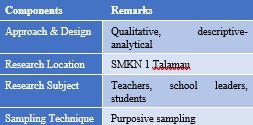
Objective: Analyze the strategic role of teachers in the implementation of multicultural education in vocational schools with a focus on SMKN 1 Talamau. The study highlights the role of teachers in the formation of the inclusive character and social competence of students. The results are directed at the formulation of contextual recommendations for the role of teachers. Theoretical framework: This research is based on the concept of multicultural education that emphasizes the management of diversity in learning. Teachers are positioned as strategic actors in building critical cultural awareness. Multicultural education is understood as part of the formation of character and work readiness of vocational school students. Literature review: The study of multicultural education is still dominated by the context of general and urban education. Studies on the role of teachers in vocational schools and regional schools are still limited. In addition, the role of teachers is generally studied descriptively and not yet strategically. Methods: This study uses a qualitative approach with an analytical descriptive design. Data were collected through in-depth interviews, participatory observations, and documentation studies at SMKN 1 Talamau. Data analysis is carried out thematically by ensuring validity through triangulation. Results: The results of the study show that the role of teachers as role models, facilitators, innovators, mediators, and reflective evaluators is the main pillar of multicultural education. Effective implementation occurs when multicultural values are integrated into the curriculum, learning, and school culture. This role contributes to strengthening students' inclusive character and social competence. Implications: The development of multicultural education in vocational schools requires the support of school policies, teacher competency improvement, and government regulations. The sustainability of implementation depends on cross-stakeholder collaboration. The sustainability of implementation depends on cross-stakeholder collaboration. Novelty: The novelty of this research lies in the analysis of the strategic and multidimensional role of teachers in the context of regional vocational schools. This study integrates multicultural education with vocational education as well as the needs of the world of work through contextual and adaptive conceptual models.
References
D. S. S. Redjeki et al., “The nexus of Nusantara archipelagic cultural values in pupil management and its activities on social harmony through national identity revitalization,” Front. Educ., vol. 10, 2025, https://doi.org/10.3389/feduc.2025.1524105.
Y. Güleç, M. Schwarzenthal, and T. Aral, “How Do Preservice Teachers Make Sense of Educational Inequalities? Exploring Critical Consciousness Through Mixed Methods,” J. Community Psychol., vol. 54, no. 1, 2026, https://doi.org/10.1002/jcop.70070.
P. D. Hatmono, L. A. Sutimin, M. Akhyar, and Djono, “Effectiveness of Value Clarification Technique (VCT) Based Teaching Materials on High School Students’ Understanding of Multiculturalism: Mixed Method Approach,” Educ. Process Int. J., vol. 15, 2025, https://doi.org/10.22521/edupij.2025.15.157.
V. Hakoon, P. Tanunchaibutra, and A. Kuroda, “Training early childhood teachers integrating project approach with multicultural education in the classroom,” J. Educ. Learn., vol. 19, no. 4, pp. 1776–1785, 2025, https://doi.org/10.11591/edulearn.v19i4.23032.
A. Abu-Gweder, “Dialogic Learning: Developing Teaching and Meaningful Learning Skills in Hebrew as a Second Language among Arab Bedouin Students in the Community-Academy Classroom Program,” Int. J. Learn. Teach. Educ. Res., vol. 24, no. 7, pp. 798–812, 2025, https://doi.org/10.26803/ijlter.24.7.39.
Z. Demirci-Ünal and G. Öztürk, “Is Need-Based Action Possible for Each Child?: Preschool Teachers’ Differentiated Instruction Within Multicultural Classrooms,” Early Child. Educ. J., vol. 53, no. 7, pp. 2699–2718, 2025, https://doi.org/10.1007/s10643-024-01753-2.
H. Hu, T. Vanwing, J. Cai, I. Placklé, Y. Wang, and W. Jacquet, “The impact of perceived school climate and socio-demographic factors on immigrant students’ engagement in China,” Cogent Educ., vol. 12, no. 1, 2025, https://doi.org/10.1080/2331186X.2025.2514343.
A. I. Benediktsson and V. Tavares, “Family-school cooperation in multicultural schools: a missing piece in teacher education in Norway,” Pedagog. Cult. Soc., vol. 33, no. 4, pp. 1261–1276, 2025, https://doi.org/10.1080/14681366.2024.2356595.
J. S. Sukardi, F. Hanum, and A. Efianingrum, “Multicultural education patterns in promoting tolerance among high school students,” Cakrawala Pendidik., vol. 44, no. 3, pp. 701–713, 2025, https://doi.org/10.21831/cp.v44i3.84362.
E. Ospankulova, S. Maxutov, R. Lathrop, L. Anuarova, and N. Balta, “Science students’ attitudes, learning, critical thinking and engagement in project-based learning,” Cogent Educ., vol. 12, no. 1, 2025, https://doi.org/10.1080/2331186X.2024.2445358.
N. Bayat, B. Karataş, G. Şekercioğlu, B. Yüksel, and Y. Özkara, “Determining the Psychometric Properties of the Scale for Preschool Teachers’ Perceptions of Their Competence in Language Teaching to Immigrant Children,” SAGE Open, vol. 15, no. 4, 2025, https://doi.org/10.1177/21582440251381150.
A. Abakirov, B. Aushakhmanova, N. Asipova, A. Raimkulova, and S. Tkacheva, “Integrating multicultural and learner-centred approaches into continuous technological education: Insights from higher education in Central Asia,” Soc. Sci. Humanit. Open, vol. 12, 2025, https://doi.org/10.1016/j.ssaho.2025.101975.
M. D. G. Allo, R. La’biran, N. Taula’bi’, and E. T. Sudarsi, “Empirical Evidence of Multicultural Learning Model Effectiveness in Improving Student Learning and Cultural Cohesion in Isolated Toraja Communities,” Archit. Image Stud., vol. 6, no. 3, pp. 1300–1308, 2025, https://doi.org/10.62754/ais.v6i3.442.
H. Dunham and O. A. Oti, “Culturally Sustaining Literacy Practices: What’s Possible in the Elementary Classroom,” Read. Teach., vol. 79, no. 1, 2025, https://doi.org/10.1002/trtr.70008.
S. Chen and K. Yie Wong, “Teachers’ multicultural personality, attitude, and practices in multicultural music education: Training and support as moderators,” Soc. Behav. Pers., vol. 53, no. 8, 2025, https://doi.org/10.2224/sbp.14573.
M. Mašát, “Implementation of Shoah themes into teaching at the first level of primary schools,” Cogent Educ., vol. 12, no. 1, 2025, https://doi.org/10.1080/2331186X.2025.2493003.
Sugiyanto, A. Arif, A. Hidayat, and S. Prihadi, “Cultural knowledge deficiency: a root cause of communication challenges among school-aged youths in Surakarta, Indonesia,” Cogent Educ., vol. 12, no. 1, 2025, https://doi.org/10.1080/2331186X.2025.2544408.
J. Seo, “South Korean early childhood educators’ perceptions of North Korean defectors and unification education,” J. Childhood Educ. Soc., vol. 6, no. 1, pp. 1–20, 2025, https://doi.org/10.37291/2717638X.202561444.
Abdurrohman, I. M. Pageh, I. W. Mudana, and I. K. Margi, “The Role of the Hidden Curriculum in Fostering Tolerance: A Case Study of Public High Schools in Mataram City,” Educ. Process Int. J., vol. 15, 2025, https://doi.org/10.22521/edupij.2025.15.160.
Mukhlis, M. Iqbal, M. Safitri, and Hasniyati, “Challenges in Implementing Sharia-Based Education: Balancing Regional Autonomy and Children’s Rights in Aceh,” Khazanah Huk., vol. 7, no. 1, pp. 105–120, 2025, https://doi.org/10.15575/kh.v7i1.41012.
A. Sholikhah, “Statistik Deskriptif Dalam Penelitian Kualitatif,” KOMUNIKA J. Dakwah dan Komun., vol. 10, no. 2, pp. 342–362, 2016, https://doi.org/10.24090/komunika.v10i2.953.
A. Prayogi, “Pendekatan Kualitatif dalam Ilmu Sejarah: Sebuah Telaah Konseptual,” Hist. Madania J. Ilmu Sej., vol. 5, no. 2, pp. 240–254, 2021, https://doi.org/10.15575/hm.v5i2.15050.
M. Mulyadi, “Penelitian Kuantitatif Dan Kualitatif Serta Pemikiran Dasar Menggabungkannya,” J. Stud. Komun. dan Media, vol. 15, no. 1, p. 128, 2013, https://doi.org/10.31445/jskm.2011.150106.
A. A. Mekarisce, “Teknik Pemeriksaan Keabsahan Data pada Penelitian Kualitatif di Bidang Kesehatan Masyarakat,” JJurnal Ilm. Kesehat. Masy. Media Komun. Komunitas Kesehat. Masy., vol. 12, no. 3, pp. 145–151, 2020, https://doi.org/10.52022/jikm.v12i3.102.
G. Katsira, A. Koulouris, D. Kouis, and E. Vraimaki, “Integrating information literacy in multicultural education: the ‘Pyxida’ example,” J. Inf. Lit., vol. 19, no. 1, pp. 83–91, 2025, https://doi.org/10.11645/19.1.702.
R. R. Gordon, “Reframing the Cultivation Metaphor in Education by Reflecting on CLIL Professional Development Through a Forest Gardening Lens,” Chinese J. Appl. Linguist, vol. 48, no. 1, pp. 90–108, 2025, https://doi.org/10.1515/CJAL-2025-0106.
M. Mareye, “Reframing International Mindedness: A Critical Review of its Role in International Education,” J. Int. Students, vol. 15, no. 9, pp. 27–46, 2025, https://doi.org/10.32674/8fw0rv70.
S. C. Vita, “The problematisation of ethnic and cultural diversity in physical education teacher education (PETE): an analysis of PETE course syllabi from Norway, Aotearoa/New Zealand and Canada,” Sport. Educ. Soc., vol. 30, no. 1, pp. 73–87, 2025, https://doi.org/10.1080/13573322.2023.2284804.
C. Mattsson and R. Säljö, “‘You see, it is the skin’—responses to racism by young immigrant refugees in rural municipalities in Sweden with historical extreme right-wing and nationalist roots,” Cogent Educ., vol. 12, no. 1, 2025, https://doi.org/10.1080/2331186X.2025.2471641.
H. Fattali and Å. W. Smith, “Learning from the outsiders-within: wearing the niqab in Swedish teacher profession and training,” Race Ethn. Educ., vol. 28, no. 6, pp. 1044–1058, 2025, https://doi.org/10.1080/13613324.2023.2183515.
Z. J. H. Aung, M. M. Barnes, S. Y. Yip, and E. Saito, “Creating equity for ethnically, linguistically, and religiously diverse students in school settings in the Myanmar public schools,” Pedagog. Cult. Soc., vol. 33, no. 2, pp. 523–540, 2025, https://doi.org/10.1080/14681366.2023.2246139.
B. Oppedal, S. Türken, W. A. Ali, and H. A. Adem, “‘We got to know each other better and talked more about stuff we usually do not talk about.’ A qualitative study of the acceptability of the Norwegian version of the Identity Project,” Front. Educ., vol. 10, 2025, https://doi.org/10.3389/feduc.2025.1579150.
M. T. Yani, Tamsil, R. R. N. Setyowati, B. Jatmiko, and A. A. Ridlwan, “Transformation of local wisdom values to build elementary and secondary school students’ characters: a case study in Serang Regency, Banten Province, Indonesia,” Cogent Educ., vol. 12, no. 1, 2025, https://doi.org/10.1080/2331186X.2025.2532225.
B. Jamil, M. M. R. Shaoan, S. Irfan, M. Arif, M. U. Okafor, and Y. Zeyuan, “Cross-Cultural Competence in Pre-Service Teacher Education Towards Global Awareness: A Study in a Pakistani Context,” J. Teach. Learn., vol. 19, no. 3, pp. 189–215, 2025, https://doi.org/10.22329/jtl.v19i5.9397.
M. Asrori et al., “Islamic educational and cultural values in Indonesian puppetry art: a systematic literature review,” Cogent Educ., vol. 12, no. 1, 2025, https://doi.org/10.1080/2331186X.2025.2490445.
L. Jimenez, S. Groves, C. Cole, E. Holtz, and C. Worley, “A mixed-methods approach to understanding pre-service teachers’ perceived cultural competency development,” Cogent Educ., vol. 12, no. 1, 2025, https://doi.org/10.1080/2331186X.2025.2556619.
M. Abraha, “Analyzing the gender representation status of Ethiopian primary school textbooks and teachers’ insight,” Cogent Educ., vol. 12, no. 1, 2025, https://doi.org/10.1080/2331186X.2025.2474301.
A. Afifuddin, M. Amri, A. Latif, R. Rosmini, and S. Z. Bin Tahir, “Negotiating multicultural values within centralized education systems: a case study of Indonesia,” Front. Educ., vol. 10, 2025, https://doi.org/10.3389/feduc.2025.1620685.
M. Dooly and J. Llompart Esbert, “‘I have felt happiness’. A detailed look at co-teacher development for plurilingual and inclusive teaching and learning,” Int. J. Biling. Educ. Biling., vol. 28, no. 10, pp. 1272–1292, 2025, https://doi.org/10.1080/13670050.2025.2529549.
Y. Wu and J. Othman, “Translanguaging strategies in EMI: insights from foreign teachers in China,” Cogent Educ., vol. 12, no. 1, 2025, https://doi.org/10.1080/2331186X.2025.2525653.
J. Żammit, “Navigating the stormy seas of inclusion: Educator insights on refugee children in Maltese classrooms through ecological and multicultural lenses,” Soc. Sci. Humanit. Open, vol. 12, 2025, https://doi.org/10.1016/j.ssaho.2025.101711.