The Dimensions of Multicultural Education and Character Education in Forming Students Who Think Critically and Tolerantly
DOI:
https://doi.org/10.61455/sicopus.v2i03.524Keywords:
multicultural education, character education, critical thinking, tolerance, diversity and social justiceAbstract
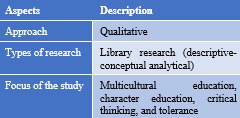
Objective: This article aims to analyze the dimensions of multicultural education and character education as well as the integrative contribution of both in forming critically thinking and tolerant students. The study focuses on the role of education in responding to the challenges of diversity in multicultural societies. Theoretical framework: The theoretical framework of this research rests on the theory of multicultural education and character education. Multicultural education emphasizes recognition of diversity and social justice, while character education focuses on internalizing moral values. The integration of the two is the basis for the formation of critical thinking and student tolerance. Literature review: The literature shows that multicultural education contributes to the strengthening of attitudes of tolerance, while character education shapes moral values and social behavior. However, studies that integrate both approaches in shaping critical thinking and tolerance are still limited. This is the basis for the development of this study. Methods: This study uses a qualitative approach with a literature study method. Data was obtained from books, national and international journals, and education policy documents. Data analysis is carried out through content analysis to examine and synthesize relevant concepts. Results: The results of the study show that multicultural education fosters students' critical awareness through an understanding of diversity and social justice. Character education reinforces the values of tolerance, empathy, and moral responsibility. The integration of the two forms of holistic learning. Implications: The findings of this study make a theoretical contribution to the development of the study of multicultural and character education. Practically, the results of the research can be a reference for educators in designing learning that fosters critical thinking and student tolerance. Novelty: The novelty of this article lies in the integration of multicultural education and character education in a single conceptual framework. This study places critical thinking and tolerance as simultaneous outcomes of holistic education in the context of a multicultural society.
References
M. A. H. Putra, E. Malihah, E. Wiyanarti, and W. Darmawan, “Religious Values in Hijaz Yamani Poetry: Integration of Spiritual Responsibility in Character Education,” Karsa, vol. 33, no. 1, pp. 33–65, 2025, https://doi.org/10.19105/karsa.v33i1.18745.
D. Susanto, A. Budiningsih, Sujarwo, Sugiyamin, N. Heri, and T. A. Sandy, “Reclaiming cultural roots through the among system: A bibliometric analysis of local wisdom integration in global educational discourse in the last decade,” Multidiscip. Rev., vol. 9, no. 6, 2026, https://doi.org/10.31893/multirev.2026283.
R. Rejokirono, D. Supriadi, M. Maryono, and H. Nurwindah, “Management of early childhood leadership character education through Leadership Soul for Kids program,” Acta Sci. - Educ., vol. 47, no. 1, 2025, https://doi.org/10.4025/actascieduc.v47i1.71157.
E. Kusumawardani, Sugito, P. Y. Fauziah, B. Pamungkas, and H. Tanimoto, “Character Formation through Undokai: Exploring the Educational Values of Japanese Practices for Indonesian Students,” Int. J. Learn. Teach. Educ. Res., vol. 24, no. 11, pp. 526–539, 2025, https://doi.org/10.26803/ijlter.24.11.25.
H. K. Nasron, “The Implementation and Evaluation of Islamic Values Integration in Local Content Subjects in Bengkulu’s Senior High Schools,” J. Cult. Anal. Soc. Chang., vol. 10, no. 3, pp. 792–800, 2025, https://doi.org/10.64753/jcasc.v10i3.2492.
N. Nizariah, S. Suhendrayatna, M. Aulia, and S. Sulastri, “Fostering Character Education through Community-Based Socialpreneurship Initiatives among High School Students in Banda Aceh,” Aptisi Trans. Technopreneursh, vol. 7, no. 3, pp. 890–903, 2025, https://doi.org/10.34306/att.v7i3.694.
N. B. Kotten, E. Beda, F. Korosando, M. Nande, S. Arafat, and L. Suryani, “Culturally Embedded Character Education: Teacher Identity and Institutional Transformation in Eastern Indonesia,” Int. J. Learn. Teach. Educ. Res., vol. 24, no. 11, pp. 711–725, 2025, https://doi.org/10.26803/ijlter.24.11.33.
Y. Sofiani, M. H. Fachrurozi, and L. Armiyati, “Reactualization of Sundanese Local Hero Figure’s Values to Foster Student Character in History Education,” Paramita, vol. 35, no. 2, pp. 357–370, 2025, https://doi.org/10.15294/paramita.v35i2.23800.
M. Muassomah, S. E. Yaacob, K. Khairiah, P. R. Yurisa, and D. Demina, “Participatory-Based Character Education: Indonesian School Children’S Experiences,” J. Ilm. Peuradeun, vol. 13, no. 3, pp. 1615–1642, 2025, https://doi.org/10.26811/peuradeun.v13i3.1969.
N. P. E. Merliana, I. M. O. Widyantara, N. M. A. E. D. Wirastuti, K. O. Saputra, and D. B. Setyohadi, “Gamification Project-Based E-learning in Character Education: A Study in Senior High School,” JOIV Int. J. Informatics Vis., vol. 9, no. 5, p. 2240, 2025, https://doi.org/10.62527/joiv.9.5.4033.
T. Usman, Bahraeni, and Nurhilaliyah, “Exploring Islamic-Oriented Cooperative Learning through Faith-Driven Collaboration among University Students in Islamic Education Courses,” Int. J. Learn. Teach. Educ. Res., vol. 24, no. 9, pp. 922–939, 2025, https://doi.org/10.26803/ijlter.24.9.44.
B. Cahyanto, A. M. Wibowo, A. Arifuddin, D. K. Dewi, E. R. Salamah, and A. G. Don, “Innovation of Brand Building and Character Development in Islamic School: A Transformation Based on School Core Values,” Munaddhomah, vol. 6, no. 3, pp. 465–481, 2025, https://doi.org/10.31538/munaddhomah.v6i3.1784.
R. Ambarini, I. Yuliasri, Widhiyanto, T. Yuniawan, and Sukarno, “Empowering Multicultural Curriculum Integration through Microteaching: An Experiential and Stakeholder-Informed Approach,” New Educ. Rev., vol. 81, no. 3, pp. 167–181, 2025, https://doi.org/10.15804/tner.2025.81.3.11.
Firmansyah, M. A. Minan, N. Z. Adriansyah, A. F. Almas, I. Riyadi, and T. T. Prabowo, “Construction of Islamic Education Based on Islamic Boarding Schools: A Case Study at Al-Manar Muhammadiyah Modern Islamic Boarding School in South Sumatra,” J. Pendidik. Agama Islam, vol. 22, no. 1, pp. 195–214, 2025, https://doi.org/10.14421/jpai.v22i1.11044.
I. Safitri et al., “Character Education in Indonesia: Do Integrated Islamic Schools Outperform Public Schools?” J. Educ. Cult. Soc., vol. 16, no. 1, pp. 251–270, 2025, https://doi.org/10.15503/jecs2025.2.251.271.
A. Sholikhah, “Statistik Deskriptif Dalam Penelitian Kualitatif,” KOMUNIKA J. Dakwah dan Komun., vol. 10, no. 2, pp. 342–362, 2016, https://doi.org/10.24090/komunika.v10i2.953.
T. Karyono, B. Isa, and J. Masunah, “Stimulation of drawing expression to strengthen character learning,” Cakrawala Pendidik., vol. 44, no. 2, pp. 286–298, 2025, https://doi.org/10.21831/cp.v44i2.76617.
A. Prayogi, “Pendekatan Kualitatif dalam Ilmu Sejarah: Sebuah Telaah Konseptual,” Hist. Madania J. Ilmu Sej., vol. 5, no. 2, pp. 240–254, 2021, https://doi.org/10.15575/hm.v5i2.15050.
A. Yani, I. Afrianto, M. Syukran, W. O. N. Noviyanti Rachman, and Z. Muhamad, “Adolescent Behavior in Implementing Clean and Healthy Living Practices through Local Wisdom-Based Character Education: A Cross-Sectional Study,” J. Public Heal. Pharm., vol. 5, no. 1, pp. 54–63, 2025, https://doi.org/10.56338/jphp.v5i1.6141.
W. Sanderse, “Blurring the lines between imitation and emulation in moral development,” Theory Res. Educ., vol. 23, no. 1, pp. 43–60, 2025, https://doi.org/10.1177/14778785241304317.
W. Yuliani, “Metode Penelitian Deskriptif Kualitatif Dalam Perspektif Bimbingan Dan Konseling,” QUANTA J. Kaji. Bimbing. dan Konseling dalam Pendidik., vol. 2, no. 2, pp. 1–10, 2018, https://doi.org/10.22460/q.v2i1p21-30.642.
Tamjidnor, Suriagiri, Surawardi, Samdani, F. Amal, and Khuzaini, “Transformation of Hadith Teaching as an Effort to Revitalize Islamic Science in Pesantren,” Nazhruna J. Pendidik. Islam, vol. 8, no. 1, pp. 123–138, 2025, https://doi.org/10.31538/nzh.v8i1.9.
D. Mucinskas, S. Clark, L. Barendsen, and H. Gardner, “An increase in educator expectations of student character growth during participation in a community of practice,” Front. Educ., vol. 10, 2025, https://doi.org/10.3389/feduc.2025.1466295.
Imran, I. Ramadhan, Daniel, and Suriyanisa, “Efforts to Strengthen Nationalist Character Education through Education and Community Empowerment Institutions in the Indonesia-Malaysia Borderlands,” J. Ecohumanism, vol. 4, no. 1, pp. 4411–4423, 2025, https://doi.org/10.62754/joe.v4i1.6322.
Y. C. Lu, “The compatibility of character education and citizenship education in Aristotelian approaches to moral development,” J. Moral Educ., vol. 54, no. 4, pp. 710–724, 2025, https://doi.org/10.1080/03057240.2024.2354746.
P. Aprilia, M. F. Ijudin, A. Manda, and D. Adela, “Utilization of Emotional Artificial Intelligence (EAI) in Art Learning to Improve Character Education of Elementary School Students,” Eng. Proc., vol. 107, no. 1, p. 135, 2025, https://doi.org/10.3390/engproc2025107135.
M. T. Yani, Tamsil, R. R. N. Setyowati, B. Jatmiko, and A. A. Ridlwan, “Transformation of local wisdom values to build elementary and secondary school students’ characters: a case study in Serang Regency, Banten Province, Indonesia,” Cogent Educ., vol. 12, no. 1, 2025, https://doi.org/10.1080/2331186X.2025.2532225.
S. Choi, X. Mao, and S. Park, “Promoting school belonging for immigrant students: the interplay of inclusive school climate and multicultural education,” Sch. Eff. Sch. Improv., vol. 36, no. 4, pp. 522–542, 2025, https://doi.org/10.1080/09243453.2025.2492012.
A. Abakirov, B. Aushakhmanova, N. Asipova, A. Raimkulova, and S. Tkacheva, “Integrating multicultural and learner-centred approaches into continuous technological education: Insights from higher education in Central Asia,” Soc. Sci. Humanit. Open, vol. 12, 2025, https://doi.org/10.1016/j.ssaho.2025.101975.
B. Panmei, “Generative AI in Multicultural Classrooms: A Narrative Inquiry into International Students’ Experiences,” Int. J. Multicult. Educ., vol. 27, no. 2, pp. 1–21, 2025, https://doi.org/10.18251/ijme.v27i2.5165.
A. I. Benediktsson and V. Tavares, “Family-school cooperation in multicultural schools: a missing piece in teacher education in Norway,” Pedagog. Cult. Soc., vol. 33, no. 4, pp. 1261–1276, 2025, https://doi.org/10.1080/14681366.2024.2356595.
A. I. Benediktsson, “Sustaining the ethos of togetherness in multicultural schools in Denmark: student teachers’ reflections and experiences,” Scand. J. Educ. Res., vol. 69, no. 5, pp. 930–944, 2025, https://doi.org/10.1080/00313831.2024.2360921.
A. Prasetyarini, S. Anif, Harsono, S. Narimo, and M. S. Nugroho, “Peer collaboration in P5: students’ perspective of project-based learning in multicultural school setting,” Int. J. Innov. Learn., vol. 37, no. 1, pp. 104–119, 2025, https://doi.org/10.1504/IJIL.2025.143003.
M. Muhajir, U. Kultsum, M. M. Choiri, S. Mustonah, H. Kulkarni, and A. Karim, “Integrating Multicultural Values To Foster Tolerance and Inclusivity in Islamic Religious Education,” J. Pendidik. Islam, vol. 11, no. 1, pp. 17–32, 2025, https://doi.org/10.15575/jpi.v11i1.44607.
M. Asrori et al., “Islamic educational and cultural values in Indonesian puppetry art: a systematic literature review,” Cogent Educ., vol. 12, no. 1, 2025, https://doi.org/10.1080/2331186X.2025.2490445.
G. Katsira, A. Koulouris, D. Kouis, and E. Vraimaki, “Integrating information literacy in multicultural education: the ‘Pyxida’ example,” J. Inf. Lit., vol. 19, no. 1, pp. 83–91, 2025, https://doi.org/10.11645/19.1.702.
R. Raihani, G. Issabekova, T. Maulana, and G. Abdrakhman, “Multicultural Education in Indonesia’S ‘Merdeka’ Curriculum,” J. Educ. Cult. Soc., vol. 16, no. 1, pp. 413–432, 2025, https://doi.org/10.15503/jecs2025.2.413.432.
K. Nisa, E. Syafitri, and A. Simanungkalit, “Integrating Culturally Responsive Teaching and TPACK Frameworks in the Design and Validation of Indonesian Language Learning Tools for Multicultural Schools,” Int. J. Learn. Teach. Educ. Res., vol. 24, no. 12, pp. 268–294, 2025, https://doi.org/10.26803/ijlter.24.12.12.
L. Nantsou, Z. Karanikola, and N. Palaiologou, “Building Resilience: The Critical Role of Multicultural Education to Cope with the Psychological Trauma of Migrant and Refugee Youth,” Behav. Sci. (Basel), vol. 15, no. 7, 2025, https://doi.org/10.3390/bs15070916.
M. Mareye, “Reframing International Mindedness: A Critical Review of its Role in International Education,” J. Int. Students, vol. 15, no. 9, pp. 27–46, 2025, https://doi.org/10.32674/8fw0rv70.
F. Kılavuz and F. Karakuş, “Development of awareness of tolerance and mathematical reasoning skills through action research in multicultural mathematics education,” Int. Electron. J. Math. Educ. , vol. 20, no. 3, 2025, https://doi.org/10.29333/iejme/16574.