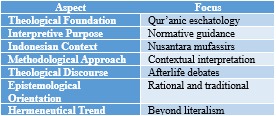
Interpreting Qur’anic Eschatology: Perspectives of Indonesian (Nusantara) Mufassirs
DOI:
https://doi.org/10.61455/sicopus.v4i01.505Keywords:
indonesian mufassirs, nusantara, eschatology, tafsir of the qur'an, hereafterAbstract
Objective: This study aims to understand how Indonesian mufassirs interpret eschatological verses in the Qur'an, specifically regarding life after death, the apocalypse, and resurrection, and how these interpretations influence morality and behavior in the Indonesian context. Theoretical framework: The study is grounded in eschatology, focusing on the Islamic concepts of the afterlife and resurrection. It explores how different mufassirs interpret these themes and how their views affect Muslim beliefs and practices. Literature review: The literature review examines prior studies on Islamic eschatology and tafsir, highlighting the diversity of mufassir interpretations on eschatological verses. It also discusses the role of cultural and theological contexts in shaping these interpretations, with a focus on Indonesian perspectives. Methods: This research uses library research, analyzing books, tafsir texts, and related articles to compare the views of Indonesian mufassirs on eschatological themes, identifying key differences in their interpretations. Results: The study finds differing views among Indonesian mufassirs, such as Agus Mustofa’s belief that the afterlife is not eternal, and KH. Taufiqul Hakim’s affirmation of bodily resurrection reflects varied interpretations within the Indonesian context. Implications: The findings suggest the need for a more contextual approach in interpreting eschatological verses to avoid narrow or rigid readings and promote a deeper understanding of Islamic teachings in Indonesia. Novelty: This study offers a fresh perspective on Indonesian mufassirs’ views on eschatology, contributing new insights into Qur'anic interpretation within the Indonesian Islamic community.
References
T. Morcom, “Agape and the Antichrist: Soteriological and Eschatological Masculinities in the Homilies of Wulfstan,” English Stud., vol. 105, no. 5, pp. 703–717, 2024, https://doi.org/10.1080/0013838X.2024.2391179.
F. R. Susanti and S. Hayani, “pemikiran filosof Ibnu Rusyd tentang eskatologi,” J. Ilm. Ilmu Ushuluddin, vol. 20, no. 1, p. 15, 2021, https://doi.org/10.18592/jiiu.v20i1.3448.
Y. Uchaev, “Katechontic Temporality and Political Form: Towards Double Representation33,” Russ. Sociol. Rev., vol. 23, no. 3, pp. 146–176, 2024, https://doi.org/10.17323/1728-192x-2024-3-146-176.
R. D. Putri and A. Wasik, “Gaya Hidup Minimalis Sebagai Pengamalan Ilmu Eskatologi Dalam Mengingat Hari Akhir Dan Akhirat,” Abrahamic Relig. J. Stud. Agama-Agama, vol. 2, no. 2, p. 148, 2022, https://doi.org/10.22373/arj.v2i2.13402.
G. D. Formenton, J. R. S. Duran, and M. L. Fernandes, “The Ontology of Sponsality in Karol Wojtyła’s Thought : The Relationship to Which We Are Called,” Verbum Vitae, vol. 42, no. 4, pp. 807–826, 2024, https://doi.org/10.31743/vv.17191.
I. Arabi, “Makna Ruhani Dalam Ritual Dan Eskatologi Islam Menurut Al-Alusi,” Tarb. Islam. J. Ilm. Pendidik. Agama Islam, vol. 13, no. 1, pp. 15–28, 2023, https://doi.org/10.18592/jtipai.v13i1.9966.
T. Litvin, “Historical Narrative and the Symbolism of Numbers in Late Antiquity,” Platonic Investig., vol. 20, no. 1, pp. 180–199, 2024, https://doi.org/10.25985/PI.20.1.07.
A. Hadiyanto and U. Khumairoh, “Makna Simbolik Ayat-Ayat tentang Kiamat dan Kebangkitan dalam Al-Qur’an,” Hayula Indones. J. Multidiscip. Islam. Stud., vol. 2, no. 2, pp. 187–212, 2018, https://doi.org/10.21009/hayula.002.2.06.
G. E. Dames, “Towards an eco-practical theology: An eschatological horizon of true hope,” HTS Teol. Stud. / Theol. Stud., vol. 80, no. 1, 2024, https://doi.org/10.4102/hts.v80i1.9768.
E. Yulaeliah, “The End of Time: Representations of Natural and Social Phenomena through Kacapi Kawih Composition,” Resital, vol. 24, no. 1, pp. 22–35, 2023, https://doi.org/10.24821/resital.v24i1.8028.
S. Mitralexis, “A Parallax View on Eastern Orthodox Aesthetics: From the Ethos of Liturgical Art to Dionysis Savvopoulos’ Aesthetic Eschatology,” Religions, vol. 16, no. 10, 2025, https://doi.org/10.3390/rel16101227.
D. W. Larsen, “A Canonical Interpretation of Paul’s Eulogy in Ephesians 1:3–14, with Implications for Resurrection and New Creation,” Religions, vol. 16, no. 9, 2025, https://doi.org/10.3390/rel16091115.
M. Parchem, “The Apocalyptic Character of the Testament of Moses,” Biblic. Ann., vol. 14, no. 3, pp. 461–480, 2024, https://doi.org/10.31743/ba.15527.
K. Ang, “A Treatise in Disguise: Eschatological Themes in Aquinas’s Commentary on the Parables of Matthew’s Gospel,” Religions, vol. 16, no. 8, 2025, https://doi.org/10.3390/rel16081023.
C. P. Ukeachusim, “Understanding COVID-19 birth-pangs’ theological responses and the promised Parousia of Jesus,” Verbum Eccles., vol. 45, no. 1, 2024, https://doi.org/10.4102/ve.v45i1.2834.
S. Lefsrud, “Holy Desire or Wholly Hubris? Deification in the Theology of Hans Urs von Balthasar,” Religions, vol. 16, no. 7, 2025, https://doi.org/10.3390/rel16070826.
D. Susanto, Risnita, and M. S. Jailani, “Teknik Pemeriksaan Keabsahan Data Dalam Penelitian Ilmiah,” J. QOSIM J. Pendidikan, Sos. Hum., vol. 1, no. 1, pp. 53–61, 2023, https://doi.org/10.61104/jq.v1i1.60.
H. Zukriadi, Sulaiman, U., “Aneka Macam Penelitian,” SAMBARA J. Pengabdi. Kpd. Masy., vol. 1, no. 1, pp. 36–46, 2023, https://doi.org/10.58540/sambarapkm.v1i1.157.
E. C. Ekeke and E. O. Ekpenyong, “A comparative study of eschatology in Christianity and African traditional religion,” Verbum Eccles., vol. 45, no. 1, 2024, https://doi.org/10.4102/ve.v45i1.2958.
M. Baghos, “Eusebius of Caesarea’s Representations of Christ, Constantine, and Rome: An ‘Eschatology of Replacement,’” Religions, vol. 16, no. 6, 2025, https://doi.org/10.3390/rel16060744.
A. Hollingsworth, “Eschatology, the Elimination of Evil, and the Ontology of Time,” TheoLogica, vol. 8, no. 1, pp. 1–19, 2024, https://doi.org/10.14428/thl.v8i1.74563.
M. S. Kgatle and J. Chigorimbo, “Towards Holistic Healing: A Pentecostal Ecotheological Perspective,” Religions, vol. 15, no. 12, 2024, https://doi.org/10.3390/rel15121479.
N. Turcan, “‘The Hidden Present’: Time and Eschatology in Jean-Yves Lacoste,” Religions, vol. 15, no. 9, 2024, https://doi.org/10.3390/rel15091067.
A. B. Davis, “Horizons of Hope: Disability, Eschatology, and the Work of the Holy Spirit,” J. Disabil. Relig., vol. 28, no. 3, pp. 356–378, 2024, https://doi.org/10.1080/23312521.2023.2301605.
M. J. P. Tan, “Loss in Light of the Last Things: Christianity, Eschatology, and Grief in Inside Out,” Religions, vol. 15, no. 8, 2024, https://doi.org/10.3390/rel15080897.
C. V. O. Witvliet et al., “Transcendent accountability: construct and measurement of a virtue that connects religion, spirituality, and positive psychology,” J. Posit. Psychol., vol. 19, no. 2, pp. 243–256, 2024, https://doi.org/10.1080/17439760.2023.2170824.
M. Rakhno, “Pre-Christian Eschatological Motifs in the Ukrainian Dumas and Spiritual Verses and Their Germanic Parallels,” Religions, vol. 15, no. 7, 2024, https://doi.org/10.3390/rel15070846.
D. Conway, “Eschatological Technophobia: Cinematic Anticipations of the Singularity,” Religions, vol. 15, no. 2, 2024, https://doi.org/10.3390/rel15020172.
X. Hu, “Eschatology in Preaching on the Eve of the French Wars of Religion: The Case of François Le Picart,” Religions, vol. 16, no. 12, 2025, https://doi.org/10.3390/rel16121500.
N. L. Sæten, “Between Inevitability and Hindsight: End-Times and the Loss of Agency in the Anthropocene,” Polit. Stud., 2025, https://doi.org/10.1177/00323217241310964.
O. G. Africa, “Azania between history and eschatology: Bonganjalo Goba’s Africanist theology,” Verbum Eccles., vol. 46, no. 1, 2025, https://doi.org/10.4102/ve.v46i1.3458.
I. Mikeshin, “‘If they have persecuted me, they will also persecute you’: the eschatological tranquillity of Jehovah’s Witnesses persecuted in Russia,” Relig. State Soc., vol. 53, no. 5, pp. 463–481, 2025, https://doi.org/10.1080/09637494.2025.2552519.
R. Törzsök, “Strange intimacy: Spirituality and intersubjective relations in Orwell’s 1984,” Brno Stud. English, vol. 50, no. 2, pp. 207–227, 2025, https://doi.org/10.5817/BSE2024-2-10.
C. Caldeira, “‘The Future is Ancestral’: Towards the Eschatology of Ancestry from the Ecodomy of Quilombola Ways of Life,” Perspect. Teol., vol. 57, no. 1, 2025, https://doi.org/10.20911/21768757v57n1e05812/2025.
K. Mokoena, “Transcendence in African spirituality and the techno-utopia,” Pract. Theol., vol. 18, no. 2, pp. 139–151, 2025, https://doi.org/10.1080/1756073X.2025.2477336.
J. A. Gilcher, “Journey to the Kingdom: The Three-Fold Compositional Arc of Book II of the Psalter,” Perichoresis, vol. 22, no. 4, pp. 48–74, 2024, https://doi.org/10.2478/perc-2024-0027.
M. J. Schunemann, “On the metanoia of eschatological injustice: powerful is the giving-up of power: a theological and ethnographic case study of The Southwark Mysteries and Crossbones Graveyard’s in-casts,” Lit. Theol., vol. 38, no. 4, pp. 313–332, 2024, https://doi.org/10.1093/litthe/fraf010.
H. Spelman, “‘If one knows what is to come’: Ethics, audience and eschatology in Pindar’s Olympian 2,” J. Hell. Stud., vol. 144, pp. 48–64, 2024, https://doi.org/10.1017/S0075426924000168.
S. Tranter, “Eschatological naturalism and ecological responsibility: Troubling some assumptions,” Scottish J. Theol., vol. 77, no. 3, pp. 245–259, 2024, https://doi.org/10.1017/S0036930624000310.
S. L. Young, “Ethnic Ethics: Paul’s Eschatological Myth of Jewish Sin,” New Testament. Stud., vol. 70, no. 2, pp. 235–248, 2024, https://doi.org/10.1017/S0028688523000462.
H. Schulz, “Thankfulness: Kierkegaard’s First-Person Approach to the Problem of Evil,” Philosophies, vol. 9, no. 2, 2024, https://doi.org/10.3390/philosophies9020032.
P. Ambros, “Human and Christian Recreation of the Way of Life for the Post-Covid 19 Era,” Caritas Verit., vol. 14, no. 2, pp. 43–55, 2024, https://doi.org/10.32725/cetv.2024.019.