Development Model of the Batik Harmoni SMI Cluster in North Sumatera: Post-COVID-19 Strategies and Solutions
DOI:
https://doi.org/10.61455/sicopus.v4i01.498Keywords:
msme, cluster of batik, priority solutions and strategy, pandemic covid-19, anpAbstract
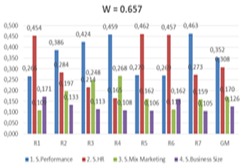
Objective: This study aims to develop a cluster development model for Batik Harmoni MSMEs in North Sumatra using the Analytic Network Process (ANP) to identify priority solutions and strategies in the post-COVID-19 era. Theoretical Framework: This study is based on the theory of MSME cluster development, performance-based competitiveness, and crisis resilience theory, considering the interdependence between internal capabilities and external environmental factors. Literature Review: Criteria and Performance of Micro, Small, and Medium Enterprises (MSME), The Relationship between MSME Clusters and Business Performance, The Source of Working Capital, The Relationship between HR and Business Performance, The Connection Between Marketing Mix and Business Performance. Method: A mixed qualitative-quantitative approach was used through focus group discussions, in-depth interviews, and paired comparison questionnaires involving seven expert participants, with data processed using Super Decisions software and analyzed through priority weighting and Kendall's concordance coefficient. Results: The findings indicate that internal solutions are the highest priority, led by performance, followed by human resources, marketing mix, and business size, with total sales and profit margin as key performance indicators, training as the top human resource solution, product as the dominant marketing mix element, and working capital as the main business size factor. Externally, the economic environment during COVID-19, working capital, and government support, particularly technological assistance, were the most influential factors. Implications: The results suggest that post-pandemic MSME cluster development should prioritize strengthening internal performance supported by technology-based policies and institutional support. Novelty: This study offers an integrated ANP-based development model that systematically links the internal and external determinants of the resilience and competitiveness of batik MSME clusters in developing countries.
References
N. Akagawa, “Batik as a creative industry: Political, social and economic use of intangible heritage,” in Safeguarding Intangible Heritage, New York: Routledge, 2018, p. 20.
R. Febriani, L. Knippenberg, and N. Aarts, “The making of a national icon: Narratives of batik in Indonesia,” Cogent Arts Humanit., vol. 10, no. 1, p. 2254042, Dec. 2023, doi: https://doi.org/10.1080/23311983.2023.2254042.
E. Sugiarto, M. I. Syarif, K. B. Mulyono, A. N. bin Othman, and M. Krisnawati, “How is ethnopedagogy-based education implemented? (A case study on the heritage of batik in Indonesia),” Cogent Educ., vol. 12, no. 1, p. 2466245, 2025, doi: https://doi.org/10.1080/2331186X.2025.2466245.
S. Rismantojo, V. Sirivesmas, E. Joneurairatana, and W. A. Natalia, “Transforming the Batik Tiga Negeri (Three-Countries Batik) in Pleats to Represent Indonesia, Malaysia, and Thailand’s Batik Heritage by Applying the ATUMICS Method TT -,” Arch. Des. Res., vol. 37, no. 4, pp. 65–96, 2024, doi: https://doi.org/10.15187/adr.2024.08.37.4.65.
A. Octavia, H. Heriberta, and Y. Sriayudha, “A Study Of Jambi Batik Artisans In Innovation And Strategic Decision-Making To Influence The Development And Resilience Of The Jambi Batik Industry,” J. Ilm. Ilmu Terap., vol. 8, no. 2, pp. 760–772, 2024, doi: https://doi.org/10.22437/jiituj.v8i2.38037.
W. Wesnina, M. Prabawati, and M. Noerharyono, “Integrating traditional and contemporary in digital techniques: the analysis of Indonesian batik motifs evolution,” Cogent Arts Humanit., vol. 12, no. 1, p. 2474845, 2025, doi: https://doi.org/10.1080/23311983.2025.2474845.
S. I. Syed Shaharuddin et al., “A Review on the Malaysian and Indonesian Batik Production, Challenges, and Innovations in the 21st Century,” Sage Open, vol. 11, no. 3, p. 21582440211040130, 2021, doi: https://doi.org/10.1177/21582440211040128.
A. A. Gunawan, J. Bloemer, A. C. R. van Riel, and C. Essers, “Institutional Barriers and Facilitators of Sustainability for Indonesian Batik SMEs: A Policy Agenda,” Sustainability, vol. 14, no. 14. p. 8772, 2022. doi: https://doi.org/10.3390/su14148772.
N. C. Nawi, A. Al Mamun, R. R. Daud, and N. A. Nasir, “Strategic Orientations and Absorptive Capacity on Economic and Environmental Sustainability: A Study among the Batik Small and Medium Enterprises in Malaysia,” Sustainability, vol. 12, no. 21. p. 8957, 2020. doi: https://doi.org/10.3390/su12218957.
N. Luh, W. Sayang, N. M. Suci, N. Made, A. Dewantini, and N. K. Sinarwati, “SMEs Business Survival Model During the COVID-19 Pandemic : A Case Study of Handicraft SMEs in Bali Province,” JIA (Jurnal Ilm. Akuntansi), vol. 9, no. 1, pp. 67–81, 2024, doi: https://doi.org/10.23887/jia.v9i1.58292.
P. Blaga, “The Importance of Human Resources in the Continuous Improvement of the Production Quality,” Procedia Manuf., vol. 46, pp. 287–293, 2020, doi: https://doi.org/10.1016/j.promfg.2020.03.042.
S. Khemraj, “Enhancing Competitive Advantage through Learning Capabilities and Innovative Human Resource Management,” Intersecta Minds J., vol. 2, no. 1, pp. 26–41, 2023, [Online]. Available: https://so13.tci-thaijo.org/index.php/IMJ/article/view/581
L. J. Gutierrez-Gutierrez, V. Barrales-Molina, and H. Kaynak, “The role of human resource-related quality management practices in new product development: A dynamic capability perspective,” Int. J. Oper. Prod. Manag., vol. 38, no. 1, pp. 43–66, 2018, doi: https://doi.org/10.1108/IJOPM-07-2016-0387.
L. M. Grobar, “Policies to promote employment and preserve cultural heritage in the handicraft sector,” Int. J. Cult. Policy, vol. 25, no. 4, pp. 515–527, 2019, doi: https://doi.org/10.1080/10286632.2017.1330887.
G. Wuryandari, “The Prospects of Indonesia–China Relations,” in Six Decades of Indonesia-China Relations: An Indonesian Perspective, L. Christin Sinaga, Ed., Singapore: Springer Nature Singapore, 2018, pp. 79–93. doi: https://doi.org/10.1007/978-981-10-8084-5_6.
T. Tambunan, “Success Factors for the Development of Micro, Small, and Medium Industrial Clusters in Indonesia,” J. Asian Dev. Stud., vol. 12, no. 1, pp. 7–25, 2023, doi: https://doi.org/10.62345/jads.2023.12.1.1.
H. Ç. Bal and Ç. Erkan, “Industry 4.0 and Competitiveness,” Procedia Comput. Sci., vol. 158, pp. 625–631, 2019, doi: https://doi.org/10.1016/j.procs.2019.09.096.
J. Nagy, J. Oláh, E. Erdei, D. Máté, and J. Popp, “The Role and Impact of Industry 4.0 and the Internet of Things on the Business Strategy of the Value Chain-The Case of Hungary,” Sustainability, vol. 10, no. 10. p. 3491, 2018. doi: https://doi.org/10.3390/su10103491.
H. D. Yahaya and G. Nadarajah, “Determining key factors influencing SMEs’ performance: A systematic literature review and experts’ verification,” Cogent Bus. Manag., vol. 10, no. 3, p. 2251195, 2023, doi: https://doi.org/10.1080/23311975.2023.2251195.
R. Prasanna, J. Jayasundara, S. K. Naradda Gamage, E. M. S. Ekanayake, P. S. K. Rajapakshe, and G. Abeyrathne, “Sustainability of SMEs in the Competition: A Systemic Review on Technological Challenges and SME Performance,” Journal of Open Innovation: Technology, Market, and Complexity, vol. 5, no. 4, p. 100, 2019. doi: https://doi.org/10.3390/joitmc5040100.
D. B. Audretsch and M. Belitski, “Knowledge complexity and firm performance: evidence from the European SMEs,” J. Knowl. Manag., vol. 25, no. 4, pp. 693–713, 2021, doi: https://doi.org/10.1108/JKM-03-2020-0178.
B. Owalla, C. Gherhes, T. Vorley, and C. Brooks, “Mapping SME productivity research: a systematic review of empirical evidence and future research agenda,” Small Bus. Econ., vol. 58, no. 3, pp. 1285–1307, 2022, doi: https://doi.org/10.1007/s11187-021-00450-3.
B. Surya, F. Menne, H. Sabhan, S. Suriani, H. Abubakar, and M. Idris, “Economic Growth, Increasing Productivity of SMEs, and Open Innovation,” Journal of Open Innovation: Technology, Market, and Complexity, vol. 7, no. 1, p. 20, 2021. doi: https://doi.org/10.3390/joitmc7010020.
Y. Temouri, V. Pereira, G. W. Muschert, V. Ramiah, and M. Babula, “How does cluster location and intellectual capital impact entrepreneurial success within high-growth firms?” J. Intellect. Cap., vol. 22, no. 1, pp. 171–189, 2020, doi: https://doi.org/10.1108/JIC-02-2020-0066.
J. Wilson, E. Wise, and M. Smith, “Evidencing the benefits of cluster policies: towards a generalised framework of effects,” Policy Sci., vol. 55, no. 2, pp. 369–391, 2022, doi: https://doi.org/10.1007/s11077-022-09460-8.
A.-L. Vernay, B. D’Ippolito, and J. Pinkse, “Can the government create a vibrant cluster? Understanding the impact of cluster policy on the development of a cluster,” Entrep. Reg. Dev., vol. 30, no. 7–8, pp. 901–919, 2018, doi: https://doi.org/10.1080/08985626.2018.1501611.
A. A. M. M. Fitriyah, “Response Of Micro, Small And Medium Enterprises (Umkm) Fast Food To The Obligation Of Halal Certification In Bima Town, Indonesia,” Yurisprudentia J. Huk. Ekon., vol. 9, no. 1, pp. 1–23, 2023.
I. Koeswahyono, D. P. Maharani, and A. Liemanto, “Legal breakthrough of the Indonesian job creation law for ease, protection, and empowerment of MSMEs during the COVID-19 pandemic,” Cogent Soc. Sci., vol. 8, no. 1, p. 2084895, 2022, doi: https://doi.org/10.1080/23311886.2022.2084895.
K. Koesrianti and J. Tanega, “A Review of the Indonesian Regulatory Policy on MSMEs and Cooperatives for Boosting Economic Potential towards the Industrial Revolution 4.0 Koesrianti Koesrianti *, Joseph Tanega **,” Padjadjaran J. Ilmu Huk., vol. 11, no. 3, pp. 434–458, 2024, doi: https://doi.org/10.22304/pjih.v11n3.a6.
M. Bhamra and K. Kishore, “Strategies for Cluster Branding in MSMEs Clusters: A Grounded Theory Approach,” Glob. Bus. Rev., p. 09721509221124166, 2022, doi: https://doi.org/10.1177/09721509221124166.
B. Guo, Y. Feng, J. Lin, and X. Wang, “New energy demonstration city and urban pollutant emissions: An analysis based on a spatial difference-in-differences model,” Int. Rev. Econ. Financ., vol. 91, pp. 287–298, 2024, doi: https://doi.org/10.1016/j.iref.2024.01.048.
L. Jiang, Y. Lai, R. Guo, X. Li, W. Hong, and X. Tang, “Measuring the impact of government intervention on the spatial variation of market-oriented urban redevelopment activities in Shenzhen, China,” Cities, vol. 147, p. 104834, 2024, doi: https://doi.org/10.1016/j.cities.2024.104834.
O. Defilania, A. Gunadi, N. Rohaya, and M. Khutub, “Legal Pluralism and Maqāṣid Al-Sharīʿah in Regulating Cooperative Finance under Indonesia’s Financial Services Authority,” Az-Zarqa’ J. Huk. Bisnis Islam, vol. 17, no. 1, pp. 1–21, 2025, doi: https://doi.org/10.14421/az-zarqa.v17.i1.4344.
R. Nopsuwan, C. Rodgunphai, and S. Pornsuksawat, “Integrated Marketing Communication for Sustainable Tourism in Thailand: A Structural Equation Model of Tourist Behavioral Responses,” Connex. J. Humanit. Soc. Sci., vol. 14, no. 1, pp. 98–114, 2025, [Online]. Available: https://so05.tci-thaijo.org/index.php/MFUconnexion/article/view/279597
Amrin, M. D. Fajri, Ri. Agus, and Sugiyarto, “Strengthening Islamic Law of Financial Literacy Through Integrating Local Wisdom in West Nusa Tenggara Communities,” Addin, vol. 19, no. 2, pp. 291–326, 2025, doi: http://dx.doi.org/10.21043/addin.v19i2.31902.
R. Agus, Nurlinda, and E. S. Barus, “Optimising Productive Zakat Financing: A Strategic Framework For Strengthening Microenterprises in Indonesia,” Int. J. Econ. Financ. Stud., vol. 17, no. 3, pp. 130–146, 2025, doi: https://doi.org/10.34109/ijefs.202517307.
M. Allaymoun et al., “A Case Study of the Employment Strategy and Its Impact on the Performance of the Future Educational Academy During the Covid 19 Pandemic,” in From Industry 4.0 to Industry 5.0: Mapping the Transitions, A. Hamdan, A. Harraf, A. Buallay, P. Arora, and H. Alsabatin, Eds., Cham: Springer Nature Switzerland, 2023, pp. 855–865. doi: https://doi.org/10.1007/978-3-031-28314-7_73.
I. Demirkan, R. Srinivasan, and A. Nand, “Innovation in SMEs: the role of employee training in German SMEs,” J. Small Bus. Enterp. Dev., vol. 29, no. 3, pp. 421–440, 2021, doi: https://doi.org/10.1108/JSBED-07-2020-0246.
D. V. Le, H. T. T. Le, T. T. Pham, and L. Van Vo, “Innovation and SMEs performance: evidence from Vietnam,” Appl. Econ. Anal., vol. 31, no. 92, pp. 90–108, 2023, doi: https://doi.org/10.1108/AEA-04-2022-0121.
G. Pu, M. Qamruzzaman, A. M. Mehta, F. N. Naqvi, and S. Karim, “Innovative Finance, Technological Adaptation and SMEs Sustainability: The Mediating Role of Government Support during COVID-19 Pandemic,” Sustainability, vol. 13, no. 16. p. 9218, 2021. doi: https://doi.org/10.3390/su13169218.
M. Najib, A. A. Abdul Rahman, and F. Fahma, “Business Survival of Small and Medium-Sized Restaurants through a Crisis: The Role of Government Support and Innovation,” Sustainability, vol. 13, no. 19. p. 10535, 2021. doi: https://doi.org/10.3390/su131910535.
H. Jeong, K. Shin, S. Kim, and E. Kim, “What Types of Government Support on Food SMEs Improve Innovation Performance?” Sustainability, vol. 13, no. 16. p. 9461, 2021. doi: https://doi.org/10.3390/su13169461.
I. Otache and O. U. E. Usang, “Innovation capability and SME performance in times of economic crisis: does government support moderate?” African J. Econ. Manag. Stud., vol. 13, no. 1, pp. 76–88, 2021, doi: https://doi.org/10.1108/AJEMS-08-2021-0362.
E.-M. Vătămănescu, A. Mitan, A. G. Andrei, and A. M. Ghigiu, “Linking coopetition benefits and innovative performance within small and medium-sized enterprises networks: a strategic approach on knowledge sharing and direct collaboration,” Kybernetes, vol. 51, no. 7, pp. 2193–2214, 2021, doi: https://doi.org/10.1108/K-11-2020-0731.
M. Holubčík, J. Soviar, and V. Lendel, “Through Synergy in Cooperation towards Sustainable Business Strategy Management,” Sustainability, vol. 15, no. 1, p. 525, 2023. doi: https://doi.org/10.3390/su15010525.
S. Luongo, F. Sepe, and G. Del Gaudio, “Regional innovation systems in tourism: The role of collaboration and competition,” J. Open Innov. Technol. Mark. Complex, vol. 9, no. 4, p. 100148, 2023, doi: https://doi.org/10.1016/j.joitmc.2023.100148.
Z. Zhang, Q. Z. Id, and C. Li, “Do network synergies facilitate the realization of M & A motivation ?: From the perspective of network node degree and strength change,” PLoS One, vol. 18, no. 4, pp. 1–21, 2023, doi: https://doi.org/10.1371/journal.pone.0284204.
Sugiyono, Metode Penelitian Kuantitatif, Kualitatif dan R&D. Bandung: CV. Alfabeta, 2018.
J. W. Creswell and J. D. Creswell, Research Design: Qualitative, Quantitative, and Mixed Methods Approaches. California: Sage Publications, 2017.
S. Arikunto, Prosedur: Penelitian Suatu Pendekatan Praktik. Jakarta: PT. Rineka Cipta, 2013.
L. J. Moleong, Metodologi Penelitian Kualitatif. In Metodologi Penelitian Kualitatif, 36th ed. Bandung: PT Remaja Rosdakarya, 2017.