The Peculiarities of the Mention of Mosquitoes in the Qur'an from the Perspective of Tafsir Al-Azhar
DOI:
https://doi.org/10.61455/sicopus.v3i03.484Keywords:
mosquito, amtsal or parable, tafsir al-azhar, surah al-baqarah, hamkaAbstract
Objective: This study aims to analyze the mention of mosquitoes in QS. Al-Baqarah verse 26 through Tafsir Al-Azhar by Buya Hamka, and explores the relevance of the symbolism to modern scientific knowledge. Theoretical framework: This study combines two approaches: classical interpretations, especially the Al-Azhar Interpretation, which interprets mosquitoes as a symbol of Allah's greatness, and scientific approaches that highlight biology, ecology, and the role of mosquitoes in public health. Literature review: The literature review includes Al-Azhar's interpretation of symbolism in the Qur'an as well as scientific literature on the biology and ecological role of mosquitoes, including their impact on health as a vector of disease. Method: Qualitative method is used with a literature study approach. Data were obtained from the analysis of the text of the Qur'an, Tafsir Al-Azhar, and related scientific literature. Results: The study found that Hamka views mosquitoes as a symbol of God's greatness and as a medium of spiritual education. Scientifically, mosquitoes have complex biological structures and play an important role in ecosystems and public health. Implications: This research connects revelation and science, enriching understanding of the role of God's creation, both from a spiritual and scientific perspective, and providing moral lessons about humility. Novelty: This research integrates the interpretation of the Qur'an with modern science, demonstrates the relevance between religious symbolism and scientific phenomena, and opens up new insights into understanding the relationship between revelation and human knowledge.
References
M. Zaini, “Alam Semesta Menurut Al-Qur’an,” vol. 3, no. 1, pp. 30–46, 2018, https://doi.org/10.22373/tafse.v2i1.8073.
U. Al Azhar, “Analisis Penggunaan Amtsal ( Perumpamaan ) dalam Al-Quran : Kajian Sosiolinguistik Arab,” vol. 3, 2025, https://doi.org/10.61132/morfologi.v3i2.1464.
M. Ipa et al., “Urban-rural disparities in self-reported dengue infection: A comprehensive analysis of the 2023 Indonesian health survey,” Glob. Transitions, vol. 8, no. 1, pp. 10–21, 2026, https://doi.org/10.1016/j.glt.2025.08.003.
Y. Zha and W. Jiang, “Threshold dynamics of a dengue fever model with seasonality and multiple patches,” Discret. Contin. Dyn. Syst. - B, vol. 0, no. 0, pp. 0–0, 2025, https://doi.org/10.3934/dcdsb.2025175.
M. A. Hardinagoro, A. Sulthoni, E. Wirastho, S. Tinggi, I. A.- Qur, and J. Tengah, “Tadabbur Alam in the Qur ’ an ( A Study of the Interpretation of Verses on Nature Contemplation in Tafsir Al-Azhar ) Tadabbur Alam dalam Al- Qur ’ an ( Studi Penafsiran Ayat-ayat Tadabbur Alam dalam Tafsir Al-Azhar ),” vol. 1, no. 1, pp. 1–18, 2024, https://doi.org/10.58438/bunyanalulum.v1i1.235.
J. Bouyer, “studi fisiologi sistem reproduksi nyamuk: menunjukkan kompleksitas struktur internal dan mekanisme reproduksi nyamuk dari berbagai genus,” Trends Parasitol., vol. 36, no. 4, pp. 325–336, 2020, https://doi.org/10.1016/j.pt.2020.01.004.
J. Yu, C. Ju, Y. Wang, K. Wang, and H. Zhu, “Existence and Stability of Sawtooth Periodic Solutions in a State-Dependent Switching System,” Discret. Contin. Dyn. Syst. Ser. A, vol. 49, pp. 381–402, 2026, https://doi.org/10.3934/dcds.2025173.
E. K. Too et al., “A pseudokinase pPK4 is required for efficient red blood cell invasion and exflagellation center formation in Plasmodium yoelii,” Parasitol. Int., vol. 111, 2026, https://doi.org/10.1016/j.parint.2025.103187.
B. Pant et al., “Could malaria mosquitoes be controlled by periodic releases of transgenic mosquitocidal Metarhizium pingshaense fungus? A mathematical modeling approach,” Appl. Math. Model., vol. 152, 2026, https://doi.org/10.1016/j.apm.2025.116540.
G. Sun, A. Mai, and Y. Liu, “Mosquito Control Models Based on Wolbachia or Sterile Insect Techniques,” Discret. Contin. Dyn. Syst. - Ser. B, vol. 33, pp. 464–489, 2026, https://doi.org/10.3934/dcdsb.2025160.
X. Chen and P. Moraga, “Dengue forecasting and outbreak detection in Brazil using LSTM: integrating human mobility and climate factors,” Infect. Dis. Model, vol. 11, no. 1, pp. 338–354, 2026, https://doi.org/10.1016/j.idm.2025.11.002.
Z. Yue, Y. Zhang, and X. Ji, “Modelling, analysis and optimal control of Zika virus transmission dynamics based on sterile insect technique,” Infect. Dis. Model, vol. 11, no. 1, pp. 47–71, 2026, https://doi.org/10.1016/j.idm.2025.08.005.
A. K. Asselin, J. Engelstädter, and K. N. Johnson, “Dynamics of virus infection in a Wolbachia-infected host,” Virology, vol. 615, 2026, https://doi.org/10.1016/j.virol.2025.110759.
R. Mahendran et al., “Wildfire smoke and dengue burden in Brazil: Evidence from a nationwide study,” Environ. Pollut., vol. 390, 2026, https://doi.org/10.1016/j.envpol.2025.127505.
S. Chang, Y. Yan, C. Li, and Y. Geng, “Enhanced photoresponse in WSe2/MoS2 heterobilayers optoelectronic device via programmable local nanostrain engineering,” Int. J. Extrem. Manuf., vol. 8, no. 1, 2026, https://doi.org/10.1088/2631-7990/ae15c8.
J. Asy-syukriyyah and A. A. Salim, “Jurnal Asy-Syukriyyah,” vol. 23, pp. 203–216, 2022, https://doi.org/10.36769/asy.v23i2.235.
A. P. Amaral, A. Borkent, V. A. Baranov, C. Haug, and J. T. Haug, “First fossil mosquito larva in 99-million-year-old amber with a modern type of morphology sheds light on the evolutionary history of mosquitoes (Diptera: Culicidae),” Gondwana Res., vol. 150, pp. 154–162, 2026, https://doi.org/10.1016/j.gr.2025.09.011.
C. L. Swab, B. W. Alto, G. Kluiters, F. H. Cornine, and S. R. Telford, “Age structure of cohorts of mosquitoes from the field using shortwave infrared spectroscopy before and after ULV adulticide treatment,” Parasites and Vectors, vol. 18, no. 1, 2025, https://doi.org/10.1186/s13071-025-06873-1.
J. S. Barr, S. R. Saksena, A. Callahan-Muller, E. Simpson, and J. F. Hillyer, “When a mosquito ingests blood, the phagocytic activity of hemocytes increases with warmer environmental temperature and aging,” J. Invertebr. Pathol., vol. 214, 2026, https://doi.org/10.1016/j.jip.2025.108459.
H. Tinde, W. O. Sawadogo, P. O. F. Ouedraogo, and A. Kiemtore, “Mathematical modeling of the 2023 dengue outbreak in the Centre Region of Burkina Faso: Parameter estimation and assessment of control strategies,” Math. Biosci. Eng., vol. 23, no. 1, pp. 40–75, 2026, https://doi.org/10.3934/mbe.2026003.
D. S. Widyawati and M. R. Duhita, “Entomological Assessment of Mosquito Diversity and Density in Negara District, Bali: Implications for Vector-Borne Disease Surveillance,” HAYATI J. Biosci., vol. 33, no. 1, pp. 256–263, 2026, https://doi.org/10.4308/hjb.33.1.256-263.
A. Barlow and B. Adams, “Household scale Wolbachia release strategies for effective dengue control,” Ecol. Modell, vol. 511, 2026, https://doi.org/10.1016/j.ecolmodel.2025.111384.
P. A. A. Dan and A.-I. J. Â. Z. A.- Ilm, “Interpretasi Term Ba’ûdhatan Famâ Fauqahâ Perspektif Al-Tafsîr Al-Tarbawî Dan Al-I’jâz Al-‘Ilmî,” vol. 4, no. 02, 2024, https://doi.org/10.62359/tafakkur.v4i2.245.
A. Alviyah, “Metode Penafsiran Buya Hamka Dalam Tafsir Al-Azhar,” vol. 15, no. 1, pp. 25–35, 2016, https://doi.org/10.18592/jiiu.v15i1.1063.
L. Hernández-Pelegrín, “The evolutionary history of insect-associated xinmoviruses,” Mol. Phylogenet. Evol., vol. 214, 2026, https://doi.org/10.1016/j.ympev.2025.108453.
Z. Y. Siew et al., “Treeshrews as a potential reservoir: First detection of dengue virus serotype 2 in Malaysian treeshrew faeces,” J. Virol. Methods, vol. 339, 2026, https://doi.org/10.1016/j.jviromet.2025.115256.
Y. Zhang et al., “First isolation and full-length genome analysis of a new RNA virus, Wenzhou sobemo-like virus 4 from Culex tritaeniorhynchus,” Virulence, vol. 16, no. 1, 2025, https://doi.org/10.1080/21505594.2025.2539210.
A. J. Mackay et al., “Infection and host-feeding patterns of West Nile virus vectors vary by urban greenspace composition,” Sci. Total Environ., vol. 1009, 2025, https://doi.org/10.1016/j.scitotenv.2025.181098.
B. López-Gutiérrez et al., “Evaluation of Plasmodium falciparum PSSP17 essentiality in human-to-mosquito transmission and its prospective candidacy as a biomarker,” iScience, vol. 28, no. 12, 2025, https://doi.org/10.1016/j.isci.2025.113919.
L. Mathiarasan et al., “Diversity and spatiotemporal distribution of mosquitoes (Diptera: Culicidae) with emphasis on disease vectors across agroecological areas of Kerala, India,” Sci. Rep., vol. 15, no. 1, 2025, https://doi.org/10.1038/s41598-025-16357-y.
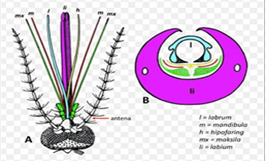
M. Wheelwright, C. R. Whittle, and O. Riabinina, “Struktur proboscis: bundle stylets terdiri atas enam elemen: dua maxillae, dua mandibles, satu labrum, dan satu hypopharynx dibungkus labium,” Cell Tissue Res., pp. 75–90, 2021, https://doi.org/10.1007/s00441-020-03407-2.
B. M. L. Ventura et al., “ Evaluation of Antiviral Activity of N -N-Phenyl-2-Phenoxyacetamides Derived from Carvacrol against Mayaro Virus: In Vitro Analyses and In Silico Insights,” ACS Omega, vol. 10, no. 47, pp. 57085–57096, 2025, https://doi.org/10.1021/acsomega.5c05194.
E. Bilgo et al., “Transmission of transgenic mosquito-killing fungi during copulation,” Sci. Rep., vol. 15, no. 1, 2025, https://doi.org/10.1038/s41598-024-83242-5.
D. Anvari et al., “Scalable and cost-effective methods for xenomonitoring of P. falciparum and antimalarial drug resistance validated with laboratory and wild-caught mosquitoes,” Sci. Rep., vol. 15, no. 1, 2025, https://doi.org/10.1038/s41598-025-20554-0.
K. D. Mosquera and O. Terenius, “Indicator bacteria taxa reveal breeding site origins of Aedes aegypti mosquitoes,” BMC Res. Notes, vol. 18, no. 1, 2025, https://doi.org/10.1186/s13104-025-07482-y.
A. Rukmana et al., “Bioekologi Nyamuk Culex ( Diptera : Culicidae ) di Kecamatan Jebus Kabupaten Bangka Barat Bioecology Culex Mosquito ( Diptera : Culicidae ) in Jebus District West Bangka Regency Maret-April 2017 di Kecamatan Jebus , Perikanan dan Biologi , Universitas Ban,” vol. 07, no. 1, pp. 15–22, 2022, https://doi.org/10.33019/ekotonia.v7i1.3139.
O. V. Goldman et al., “A single-nucleus transcriptomic atlas of the adult Aedes aegypti mosquito,” Cell, vol. 188, no. 25, pp. 7267-7290.e26, 2025, https://doi.org/ 10.1016/j.cell.2025.10.008.
D. Will-Dryden, W. Mwambu, T. Nordstrom, and R. Gruber, “Delivering sleep: Bed kit distributions to children living in poverty in Tanzania,” Sleep Med. X, vol. 10, 2025, https://doi.org/10.1016/j.sleepx.2025.100155.
V. Lukyanchikova, I. I. Brusentsov, D. A. Karagodin, M. V. Sharakhova, and I. V. Sharakhov, “Protocol for Hi-C-based identification of chromosomal inversions in mosquitoes,” STAR Protoc., vol. 6, no. 4, 2025, https://doi.org/10.1016/j.xpro.2025.104087.
A. Suppermpool, C. Trivedi, G. T. Powell, and M. Andrés, “Protocol for multiplex whole-mount RNA fluorescence in situ hybridization combined with immunohistochemistry in the mosquito brain,” STAR Protoc., vol. 6, no. 4, 2025, https://doi.org/10.1016/j.xpro.2025.104109.
M. B. Bonica, G. A. Marti, S. Goenaga, A. Balsalobre, and M. V. Micieli, “Protocol for experimental infections with viruses in mosquitoes using a glass artificial feeder,” STAR Protoc., vol. 6, no. 4, 2025, https://doi.org/10.1016/j.xpro.2025.104117.