The Phenomenon of Normalization of Zina and Its Relevance to Ashrat al-Sa'ah: Analysis of al-Hajj verses 1-2
DOI:
https://doi.org/10.61455/sicopus.v4i01.483Keywords:
phenomenon, zina normalization, apocalypse, moral decline, qur’anic perspectiveAbstract
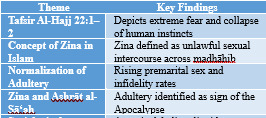
Objective: The phenomenon of increasing promiscuous sexual behavior in today's society shows a significant shift in moral values. The purpose of this study is to examine the correlation between this phenomenon and the commemoration of the Apocalypse in Surah Al-Hajj 1-2 and the saheeh hadiths related to Asyrat al-Sa'ah. Theoretical framework: This research refers to the approach of the study of Surah Al-Hajj verses 1-2, its correlation with the Punishment at the time of the Apocalypse. Literature review: Classical and Contemporary Interpretations combined with theories of social deviance. Method: This study uses a qualitative method with a literature approach, in the form of thematic interpretation and hadith studies, where the main source is Al-Hajj verses 1-2, and the secondary source is classical and contemporary tafsir books, as well as journals about Zina with semantic analysis. Results: The results of the study show that there is a correlation between punishment and the Apocalypse (great), where the great apocalypse contains the greatest and most devastating set of punishments that have occurred since humans lived, and the thing that most affects the occurrence of punishment is acts that deviate from the rules of Allah SWT. Implications: This study highlights the importance of being aware of the rampant practice of adultery among the community as a form of caution for the coming of the Punishment and the Apocalypse. Novelty: This study offers a new perspective by linking the psychology of fear in Surah Al-Hajj 1-2 as a direct response to the normalization of adultery in the digital age, a correlation rarely discussed in contemporary sekaological literature.
References
M. R. Perez, “Rape under Islamic Law: The Confusing Classification of Zina and Limitations in Getting Justice,” Int. J. Relig. Spiritual. Soc., vol. 15, no. 1, pp. 43–56, 2025, https://doi.org/10.18848/2154-8633/CGP/v15i01/43-56.
M. Iskandar, M. Nurdin, A. J. Prang, and I. Qodir, “Extrajudicial Trend in Sharia Law Enforcement: Customary Justice or Vigilantism?” Petita J. Kaji. Ilmu Huk. Dan Syariah, vol. 9, no. 2, pp. 624–640, 2024, https://doi.org/10.22373/petita.v9i2.422.
J. Lee and Y. Choi, “Decriminalization of adultery likely changed women’s views on divorce following spousal infidelity in South Korea,” Demogr. Res., vol. 52, pp. 111–124, 2025, https://doi.org/10.4054/DemRes.2025.52.4.
M. Syah, N. Marhayati, Habiburrahman, and A. Yasmin, “The Interaction and Acculturation of Islamic Law and Rejang Customary Law in Rejang Lebong Regency,” Al-Istinbath J. Huk. Islam, vol. 9, no. 2, pp. 679–698, 2024, https://doi.org/10.29240/jhi.v9i2.9052.
S. Maimunah, Rusdianingseh, M. Shodiq, A. H. Setiawan, N. M. Hatmanti, and R. K. Afiyah, “Effectiveness of knowledge of the prohibition of Zina in Islam towards pre-marriage sex students at Nurul Huda Islamic Boarding School Surabaya,” Bali Med. J., vol. 12, no. 3, pp. 2805–2807, 2023, https://doi.org/10.15562/bmj.v12i3.4353.
S. Bachri, M. A. A. Samuri, N. Moosa, B. N. Duran, and Ramadhita, “The Criminalization of Polyamory Perspective Islamic Penal Law and Indonesian New Penal Code,” Al-Istinbath J. Huk. Islam, vol. 8, no. 2, pp. 406–440, 2023, https://doi.org/10.29240/jhi.v8i2.7221.
S. Herlambang, “Muhammad Shahrur’s millennial interpretation of women’s issues,” F1000Research, vol. 12, p. 39, 2023, https://doi.org/10.12688/f1000research.125653.3.
T. Fardiansyah, Z. Yunizar, and Maryana, “Implementation of Support Vector Machine Method with TF-IDF for Sentiment Analysis of the Al-Zaytun Islamic Boarding School Controversy,” Int. J. Eng. Sci. Inf. Technol., vol. 5, no. 3, pp. 58–65, 2025, https://doi.org/10.52088/ijesty.v5i3.883.
S. Korbatieh, “Evidence Rules in Sharia and the Impact of Modern Technology and DNA Testing,” Aust. J. Islam. Stud., vol. 5, no. 3, pp. 4–29, 2020, https://doi.org/10.55831/ajis.v5i3.303.
M. Wijayati, “Family Law Reform In Tunisia (Reading the Rules of Polygamy in The Tunisian Code of Personal Status 1957),” J. Ilm. Mizani, vol. 8, no. 1, pp. 133–143, 2021, https://doi.org/10.29300/mzn.v8i1.2757.
N. Nikmatullah, “The Controversy of the Hadith Interpretation of Early Marriage among Muslim Communities,” Int. J. Relig. Spiritual. Soc., vol. 14, no. 3, pp. 45–69, 2023, https://doi.org/10.18848/2154-8633/CGP/v14i03/45-69.
I. Jauhari et al., “The Qur’an and Islamic Legal Perspectives on Child Protection,” Pharos J. Theol., vol. 104, no. 4, 2023, https://doi.org/10.46222/pharosjot.104.417.
M. I. Usman, M. Yusuf, A. Yahya, Adwani, and A. Gayo, “Adultery Offenses in Indonesia’s New Penal Code: Examining the Influence of Islamic and Customary Law,” Juris J. Ilm. Syariah, vol. 24, no. 1, pp. 73–84, 2025, https://doi.org/10.31958/juris.v24i1.13208.
I. Ermolin, L. Svolkinas, and P. Suvorkov, “Poaching, Fictive Kin Relationships, Adultery: Cultural Models of Socialization in the Disadvantaged Neighborhoods of the Lower Volga,” Russ. Sociol. Rev., vol. 24, no. 1, pp. 300–331, 2025, https://doi.org/10.17323/1728-192X-2025-1-300-331.
C. Fortier, “Religious and non-religious issues of medically assisted reproduction in France: Sexuality, incest and descent,” Reprod. Biomed. Soc. Online, vol. 11, pp. 73–81, 2020, https://doi.org/10.1016/j.rbms.2020.10.002.
Mujtahid, A. Sodiqin, and M. N. Ichwan, “Social Labeling, Power, and Deviancy Amplification: Community Stigmatization of Migrant Residents in Adultery Cases in Banda Aceh,” J. Islam. Law, vol. 6, no. 2, pp. 265–285, 2025, https://doi.org/10.24260/jil.v6i2.3754.
W. I. Maratu, “Religious Barriers to Transformative Masculinity and Femininities: Church discipline on pregnant adolescent girls in the Evangelical Lutheran Church of Tanzania,” Pharos J. Theol., vol. 106, no. SpecialIssue-2, pp. 1–11, 2025, https://doi.org/10.46222/pharosjot.106.2020.
W. Naro, A. Syatar, M. M. Amiruddin, I. Haq, A. Abubakar, and C. Risal, “Shariah assessment toward the prosecution of cybercrime in Indonesia,” Int. J. Criminol. Sociol., vol. 9, pp. 572–586, 2020, https://doi.org/10.6000/1929-4409.2020.09.56.
D. Johanyak, “Shifting religious identities and sharia in Othello,” Religions, vol. 10, no. 10, 2019, https://doi.org/10.3390/rel10100587.
M. S. Lemraski, K. Kalantari, and I. Goldoozian, “Murder License for Murder in the March; Reiterated in 2013 Approved Islamic Penal Code Regarding Mahdur al-Damm (Deserving Death),” Ahkam J. Ilmu Syariah, vol. 19, no. 2, pp. 349–372, 2019, https://doi.org/10.15408/ajis.v19i2.10810.
C. N. A. Ayoub, “Augustine and the injustice of the law and legal forms regarding the rape of women,” Rev. Filos. Aurora, vol. 37, 2025, https://doi.org/10.1590/2965-1557.037.E202531344.
R. Surayya, “Pendekatan Kualitatif Dalam Penelitian Kesehatan,” AVERROUS J. Kedokt. dan Kesehat. Malikussaleh, vol. 1, no. 2, p. 75, 2018, https://doi.org/10.29103/averrous.v1i2.415.
L. Giltrow-Shaw, “‘A trouble to the whole house’: The Frankford’s Plague-Time Home in Thomas Heywood’s A Woman Killed with Kindness,” Renaiss. Stud., vol. 39, no. 3, pp. 419–439, 2025, https://doi.org/10.1111/rest.12947.
K. Sugimoto and B. K. Muflih, “Concept of Halal Matchmaking and Dating Services for Muslim Marriage: Halal Criteria From Fatwa Perspective,” J. Fatwa Manag. Res., vol. 30, no. 2, pp. 80–101, 2025, https://doi.org/10.33102/jfatwa.vol30no2.662.
A. Azni, M. Hafis, A. A. Zakariah, A. Harmanto, M. Miftahuddin, and M. Ihsan, “Pseudo-Maṣlaḥah and Epistemological Failure in Marriage Dispensation At Indonesian Religious Courts,” J. Ilm. Peuradeun, vol. 13, no. 2, pp. 1399–1420, 2025, https://doi.org/10.26811/peuradeun.v13i2.2047.
J. E. McKay et al., “Tolerating tigers: Gaining local and spiritual perspectives on human-tiger interactions in Sumatra through rural community interviews,” PLoS One, vol. 13, no. 11, 2018, https://doi.org/10.1371/journal.pone.0201447.
O. Chetto et al., “Unveiling New Insights Into Faba Bean Sensitivity and Genetic Responses to the Mutagen Agent EMS (Ethyl Methanesulfonate),” Int. J. Agron., vol. 2025, no. 1, 2025, https://doi.org/10.1155/ioa/2738022.
M. S. Molloy, “White, Female Adultery across the Color Line in North Carolina during Slavery and Reconstruction, c. 1800–1870,” J. Fam. Hist., vol. 50, no. 2, pp. 186–212, 2025, https://doi.org/10.1177/03631990241291860.
I. Nur, “Islamic Law on Gender Based Sexual Violence,” Ahkam J. Ilmu Syariah, vol. 13, no. 1, pp. 57–64, 2013, https://doi.org/10.15408/ajis.v13i1.951.
G. Bzdyrak and P. Kubisiak, “The Permanence and Indissolubility of Marriage Against the Background of Deuteronomy 24:1,” Religions, vol. 16, no. 3, 2025, https://doi.org/10.3390/rel16030292.
A. Schulz, “Public, Poor, and Promiscuous? Defining the Prostitute in Sixteenth-Century Zurich,” Religions, vol. 16, no. 2, 2025, https://doi.org/10.3390/rel16020245.
N. Muhammad, M. M. Mushtaq Ahmed, Abdullah, F. Omer, and N. H. Shah, “Honor killing in Pakistan: An Islamic perspective,” Asian Soc. Sci., vol.. 8, no. 10, pp. 180–185, 2012, https://doi.org/10.5539/ass.v8n10p180.
M. Windzio, T. Hirsch, and D. Baier, “Cultural Frames of Deviance. Muslim Religiousness and Adolescents’ Attitudes Toward Violent Control of Female Behavior,” Deviant Behav., vol. 46, no. 3, pp. 312–332, 2025, https://doi.org/10.1080/01639625.2024.2341947.
O. O. Ilesanmi, “Sexual offences in a Muslim world: A socio-ethical reflection on Zamfara State (Nigeria) v. Bariya I. Mugazu,” Int. J. Hum. Rights, vol. 14, no. 2, pp. 215–232, 2010, https://doi.org/10.1080/13642980802542704.
A. Ghandour, “Deconstructing Traditional Muslim Sexual Morality: Approaches to a New Understanding of Legal and Illegal Sex in Muslim Theology Based on the Principle of Sexual Autonomy,” Religions, vol. 16, no. 9, 2025, https://doi.org/10.3390/rel16091208.
N. I. Qariati, L. A. Salim, and D. Indriani, “Mapping Research on Premarital Sexuality in Indonesia: A Bibliometric Review of the Literature Over Two Decades,” J. Ecohumanism, vol. 4, no. 1, pp. 977–989, 2025, https://doi.org/10.62754/joe.v4i1.5903.
Sukataman, Idlofi, A. N. R. Santono, and U. Chamdan, “Maqāṣid al-Sharī‘ah and the Prohibition of Incest in Indonesian Legislation: An Analysis of the Protection of Lineage and Public Morals,” Al-Manahij J. Kaji. Huk. Islam, vol. 19, no. 2, pp. 205–226, 2025, https://doi.org/10.24090/mnh.v19i2.14989.
N. A. Alzoubi, M. O. Almwajeh, A. F. Al-Badarneh, and H. M. Talafha, “Dissenting Female Voices: A Comparative Reading of Nathaniel Hawthorne’s The Scarlet Letter and Fadia Faqir’s My Name Is Salma,” J. Lang. Teach. Res., vol. 16, no. 1, pp. 190–196, 2025, https://doi.org/10.17507/jltr.1601.20.
J. L. Meza-Rueda, S. J. Víctor Martínez Morales, and M. A. Alvarado-Navarrete, “Theology of Justice and Gender Violence: A Contribution from Contextual Reading about ‘The Levite’s Concubine’ and ‘The Woman Accused of Adultery,’” Cuest. Teol., vol. 52, no. 118, 2025, https://doi.org/10.18566/cueteo.v52n118.a08.
U. Langen and F. Stjernfelt, “Introducing freedom of the press in Denmark-Norway 1770–1773 The birth of modern debate in Denmark-Norway,” Opera Hist., vol. 26, no. 1, pp. 76–97, 2025, https://doi.org/10.32725/oph.2025.003.
D. Azhari, Asmuni, and K. Nasution, “Reassessing Tajdid al-Nikah: Maqasid al-Shariah and Legal Status of Illegitimate Children in Central Lombok,” Justicia Islam, vol. 22, no. 1, pp. 1–24, 2025, https://doi.org/10.21154/justicia.v22i1.7343.