The Silent Decline of Indonesian Education: A Critical Analysis of the Psychological Dissonance Impact of Adapting Western Education Models
DOI:
https://doi.org/10.61455/sicopus.v4i01.459Keywords:
educational psychology, authoritative discipline, self-determination theory, cultural dissonance, educational policyAbstract
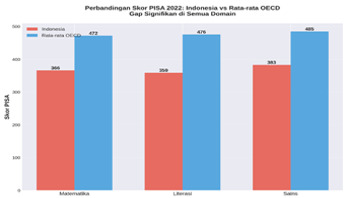
Objective: Indonesian education faces a paradox with the adoption of Western educational models like child-centered learning and positive psychology, aimed at enhancing student well-being. However, data reveal declining PISA scores and increasing classroom management issues. This study analyzes the cultural-psychological dissonance caused by the misalignment of these models with Indonesia’s collectivist, hierarchical culture. Theoretical framework: The study integrates Self-Determination Theory (SDT), Baumrind's authoritative discipline model, Bandura’s Social Cognitive Theory, and Hofstede’s cultural dimensions to understand why Western models fail in the Indonesian context, particularly in terms of discipline, motivation, and teacher authority. Literature review: Previous research shows a drop in PISA scores and difficulties in teacher-student interactions due to soft discipline policies. These findings highlight the failure to align Western educational reforms with Indonesian cultural values, leading to confusion, disengagement, and a weakening of teacher authority. Methods: This study uses systematic library research, analyzing empirical studies from 2015 to 2025, employing qualitative content analysis to uncover the underlying psychological and cultural causes of the educational crisis. Results: The shift to permissive education policies has weakened discipline and teacher authority, eroding student motivation. The failure to account for cultural context has exacerbated these issues, with students losing respect for authority figures. Implications: The study advocates for an Authoritative-Restorative model that combines structure with empathy, aligned with Indonesian values, to restore discipline, motivation, and respect in classrooms. Novelty: This paper proposes the Authoritative-Restorative model as a culturally relevant solution to Indonesia’s educational challenges.
References
A. Alishahi Tabriz, H. Dabbagh, and H. G. Koenig, “Medical Ethics in Qiṣāṣ (Eye-for-an-Eye) Punishment: An Islamic View; an Examination of Acid Throwing,” J. Relig. Health, vol. 55, no. 4, pp. 1426–1432, 2016, https://doi.org/10.1007/s10943-015-0120-8.
I. Canfijn and K. Fatah-Black, “The Power of Procedure Punishment of Slaves and the Administration of Justice in Suriname, 1669-1869,” J. Glob. Slavery, vol. 7, no. 1, pp. 19–47, 2022, https://doi.org/10.1163/2405836X-00701004.
F. Ghodrati, “Legal-Jurisprudential Protection of Women in Cases of Spousal Unauthorized Psychological-Verbal Domestic Violence, A Narrative Review Study,” Curr. Womens. Health Rev., vol. 20, no. 3, pp. 124–131, 2024, https://doi.org/10.2174/1573404820666230505110916.
C. L. Erickson, Spanked: How Hitting Our Children Is Harming Ourselves. Augsburg University, United States: Oxford University Press, 2022. https://doi.org/10.1093/oso/9780197518236.001.0001.
F. Orhan, “The Husband’s Nushūz in Islamic Family Law,” Mutefekkir, vol. 11, no. 21, pp. 83–108, 2024, https://doi.org/10.30523/mutefekkir.1501827.
J. D. McLennan, T. O. Afifi, H. L. MacMillan, and V. Warriyar K.V., “Is religious affiliation associated with parent disciplinary behavior in Suriname and Guyana?” Child Abuse. Negl., vol. 155, 2024, https://doi.org/10.1016/j.chiabu.2024.106960.
Z. Ardiansyah, Waston., Mahmudulhassan., Daud and M. Salleh., Norsaleha Mohd., AN, Andri Nirwana., “Tracing Trends in Quran Memorization and Cognitive Learning: A Bibliometric Analysis from the Scopus Database,” Pakistan J. Life Soc. Sci., vol. 22, no. 2, pp. 1493–1509, 2024, https://doi.org/10.57239/PJLSS-2024-22.2.00105.
M. Abuzar, S. Uddin, and A. Khondoker, “Exploring the Dynamics of Student Motivation and Behavior : A Qualitative Analysis of Influencing Factors and Effective Interventions,” Solo Univers. J. Islam. Educ. Multicult., vol. 2, no. 3, pp. 195–206, 2024, https://doi.org/10.61455/sujiem.v2i03.202.
M. Waston, Yusuf Olawale Owa-Onire Uthman, Mahmudulhassan, “Ian G. Barbour’s Thoughts on Science and Religion,” J. World Thinkers, vol. 1, no. 1, pp. 1–16, 2024.
M. Abuzar and A. Nirwana, “Night Work Culture in Professional and Sharia Perspectives,” Solo Int. Collab. Publ. Soc. Sci. Humanit., vol. 2, no. 3, pp. 268–281, 2024, https://doi.org/10.61455/sicopus.v2i03.198.
M. Van Damme and D. Jacobs, “UNESCO’s intangible cultural heritage and its polarising nature: A case study on Aalst Carnival,” Int. J. Intang. Herit., vol. 17, pp. 115–122, 2022.
N. A. Abdul Aziz, N. F. Mohd Ariffin, N. A. Ismail, and A. Alias, “Community Participation in the Importance of Living Heritage Conservation and Its Relationships with the Community-Based Education Model towards Creating a Sustainable Community in Melaka UNESCO World Heritage Site,” Sustain., vol. 15, no. 3, 2023, https://doi.org/10.3390/su15031935.
E. V McLean, “Looking for advice: The politics of consulting services procurement in the World Bank,” World Dev., vol. 161, 2023, https://doi.org/10.1016/j.worlddev.2022.106117.
N. Versal and A. Sholoiko, “Green bonds of supranational financial institutions: On the road to sustainable development,” in Investment Management and Financial Innovations, Taras Shevchenko National University of Kyiv, Ukraine: LLC CPC Business Perspectives, 2022, pp. 91–105. https://doi.org/10.21511/imfi.19(1).2022.07.
A. M. Veneman, “UNICEF report on state of the world children 2007: the double advantage of gender equality,” Assist. Inferm. Ric., vol. 26, no. 1, pp. 46–50, 2007.
B. Jones, “UNICEF activities in the field of population in Africa,” Afr. Popul. Newsl., vol. 23, pp. 1–3, 1976.
A. Marzano, “F. Lessa, The Condor Trials. Transnational Repression and Human Rights in South America, New Haven (CT), Yale University Press, 2022.” Riv. Ital. di Stor. Internazionale, vol. 5, no. 2, pp. 439–444, 2022, https://doi.org/10.30461/106169.
V. M. C. Tze, J. C.-H. Li, and L. M. Daniels, “Similarities and differences in social and emotional profiles among students in Canada, USA, China, and Singapore: PISA 2015,” Res. Pap. Educ., vol. 37, no. 4, pp. 558–583, Jul. 2022, https://doi.org/10.1080/02671522.2020.1864760.
L. Pellizzoni, “Nature or technics? Sars-CoV-2, new materialisms and critique of the Anthropocene,” Sociol. Urbana e Rural, no. 127, pp. 94–106, 2022, https://doi.org/10.3280/SUR2022-127008.
V. Mele, “The Metropolization of Social Life,” in Marx, Engels, and Marxisms, Political Science, University of Pisa, Pisa, Italy: Palgrave Macmillan, 2022, pp. 173–214. https://doi.org/10.1007/978-3-031-18184-9_6.
C. Dell’ Aversano, “Intersubjective Anticipation: Accountability, Anticipation, and Conversation as a Zero-Sum Game or, the (Real) Pleasures of a Pluralistic Society,” J. Constr. Psychol., vol. 35, no. 1, pp. 96–105, 2022, https://doi.org/10.1080/10720537.2020.1720196.
R. P. Dewitt and J. F. Petras, “Political economy of international debt: The dynamics of financial capital,” in Debt and the Less Developed Countries, State University of New York, Binghamton, United States: Taylor and Francis, 2019, pp. 191–215. https://doi.org/10.4324/9780429044892-12.
A. S. Greenberg, “Manifest destiny’s hangover: Congress confronts territorial expansion and martial masculinity in the 1850s,” in Congress and the Crisis of the 1850s, Penn State University, United States: Ohio University Press, 2012, pp. 97–119.
D. S. Karp et al., “Forest bolsters bird abundance, pest control and coffee yield,” Ecol. Lett., vol. 16, no. 11, pp. 1339–1347, 2013, https://doi.org/10.1111/ele.12173.
M. Abuzar and E. Purwandari, “Self-Esteem Matters: Examining its Impact on Academic Achievement in the Context of Gender and Age Diversity in Higher Education,” Indones. J. Soc. Res., vol. 6, no. 2, p. 156, Aug. 2024, https://doi.org/10.30997/ijsr.v6i2.473.
M. Abuzar, Mahmudulhassan, and L. Nuryanti, “The Role Of Online Social Network Sites And Social Integration In Mitigating Homesickness Among International Students,” Pakistan J. Educ. Res., vol. 7, no. 3, pp. 95–112, 2024, https://doi.org/10.52337/pjer.v7i3.1151.
M. Abuzar and H. S. Mansoor, “Exploring The Role Of Hijab In Fostering Personal Security And Positive Body Image: A Cross-Cultural Analysis Of Indonesian And Pakistani Women’s Perspectives,” J. Indones. Islam, vol. 18, no. 1, p. 206, Jun. 2024, https://doi.org/10.15642/JIIS.2024.18.1.206-224.
S. García-Alvarado, M. G. Arreguín, and J. A. Ruiz-Escalante, “Mexican-American preschoolers as co-creators of zones of proximal development during retellings of culturally relevant stories: A participatory study,” J. Early Child. Lit., vol. 22, no. 2, pp. 232–253, 2022, https://doi.org/10.1177/1468798420930339.
B. de Souza, “Regular schools as a straitjacket for zone of proximal development: A Vygotskian perspective of Malawian inclusive secondary education,” Perspect. Educ., vol. 41, no. 4, pp. 50–64, 2023, https://doi.org/10.38140/pie.v41i4.6880.
Z. Rahman and U. A. Yunusa, “A Bibliometric Analysis of Islamic Law and Philosophy : Global Trends, Key Participants, and Developing Themes,” Demak Univers. J. Islam Sharia, vol. 3, no. 2, pp. 333–350, 2025, https://doi.org/10.61455/deujis.v3i02.419.
J. Khanom, “The Role of Islamic Religious Education in Raising Public Health Awareness in Villages,” vol. 1, no. 1, pp. 1–14, 2025, https://doi.org/10.61455/wijce.v1i01.449.
“Correction to: Human rights in Palestine: from self-determination to governance (Australian Journal of Human Rights, 2023), 29, 3, (492-510), 10.1080/1323238X.2023.2291210),” Aust. J. Hum. Rights, vol. 29, no. 3, p. iii, 2023, https://doi.org/10.1080/1323238X.2023.2320174.
D. E. Martínez, “The theory of democracy and the relationship between human rights and popular sovereignty,” Alpha, vol. 2019, no. 48, pp. 139–150, 2019, https://doi.org/10.32735/S0718-2201201900048622.
F. R. Tesón, The theory of self-determination. Florida State University College of Law, United States: Cambridge University Press, 2016. https://doi.org/10.1017/CBO9781316340639.
X. Hu and J. Hu, “A classification analysis of the high and low levels of global competence of secondary students: Insights from 25 countries/regions,” Sustain., vol. 13, no. 19, 2021, https://doi.org/10.3390/su131911053.
A. Schleicher, “Can competencies assessed by PISA be considered the fundamental school knowledge 15-year-olds should possess?” J. Educ. Chang, vol. 8, no. 4, pp. 349–357, 2007, https://doi.org/10.1007/s10833-007-9042-x.
S. Ngabaza and T. Shefer, “Sexuality education in South African schools: deconstructing the dominant response to young people’s sexualities in contemporary schooling contexts,” Sex Educ., vol. 19, no. 4, pp. 422–435, 2019, https://doi.org/10.1080/14681811.2019.1602033.
T. Dadeh, G. O. Hutasoit, and M. R. Alfarisi, “The Impact of School Climate on Emotion Regulation in Indonesian Students : Evidence from PISA 2022,” J. An Nafs, pp. 27–45, 2025, https://doi.org/10.33367/psi.v10i1.7170.
F. J. P. Soares and L. F. P. B. Santos, “Competencies for Considering Cultural Diversity in Primary Care and Nursing Education,” in Lecture Notes in Networks and Systems, C. A.P., M. A., F. F., C. K., and B. G., Eds., Universidade Federal de Alagoas, Maceió, Brazil: Springer Science and Business Media Deutschland GmbH, 2023, pp. 281–300. https://doi.org/10.1007/978-3-031-31346-2_18.
B. V Mandarić, G. Barudžija, and D. Barić, “Intercultural Competencies and Lifelong Learning of Teachers in the Republic of Croatia,” Bogosl. Vestn., vol. 83, no. 2, pp. 479–498, 2023, https://doi.org/10.34291/BV2023/02/Mandaric.
H. Park, “Financial behavior among young adult consumers: the influence of self-determination and financial psychology,” Young Consum., vol. 22, no. 4, pp. 597–613, 2021, https://doi.org/10.1108/YC-12-2020-1263.
L. Jin, T. Jowsey, and M. Yin, “Medical students’ perceptions of prosocial behaviors: a grounded theory study in China,” BMC Med. Educ., vol. 24, no. 1, 2024, https://doi.org/10.1186/s12909-024-05335-z.
Mahmudulhassan, W. Waston, A. Nirwana, S. Amini, M. M. A. Sholeh, and M. Muthoifin, “A moral-based curriculum to improve civilization and human resource development in Bangladesh,” Multidiscip. Rev., vol. 7, no. 8, 2024, https://doi.org/10.31893/multirev.2024137.
M. Mahmudulhassan, W. Waston, and A. Nirwana AN, “The Rights and Status of Widows in Islam: A Study from the Perspective of Multicultural Islamic Education in the Context of Bangladesh,” Multicult. Islam. Educ. Rev., vol. 1, no. 1, pp. 01–14, Sep. 2023, https://doi.org/10.23917/mier.v1i1.2674.
G. Yuan, Q. Ye, and Y. Sun, “Financial innovation, information screening and industries’ green innovation — Industry-level evidence from the OECD,” Technol. Forecast. Soc. Change, vol. 171, 2021, https://doi.org/10.1016/j.techfore.2021.120998.
M. Appiah, M. Li, J. Taden, S. Ashraf, A. K. Tiwari, and P. B. Laari, “Enhancing natural resource rents through industrialization, technological innovation, and foreign capital in the OECD countries: Does financial development matter?” Resour. Policy, vol. 89, 2024, https://doi.org/10.1016/j.resourpol.2023.104520.
J. Khanom, M. T. Islam, and Mahmudulhassan, “Women’s Rights in Islamic Culture: A Bibliometric Analysis of Trends, Influential Authors, and Institutional Contributions (1969–2023),” Solo Univers. J. Islam. Educ. Multicult., vol. 3, no. 01, pp. 27–42, Dec. 2024, https://doi.org/10.61455/sujiem.v3i01.232.
K. F. Maulinda, L. W. Purnama, M. A. Marelyno, S. Sa, and F. Hidayat, “Maktabah Reviews,” Maktab. Rev.., vol. 1, no. 1, pp. 99–118, 2024, https://doi.org/10.61455/mr.v1i01.128 Transactions.
A. N. Andri Nirwana, Mahmudulhassan, M. Ali, Muthoifin, Waston, and A. R. B. S. Senathirajah, “The Intersection of Quranic Studies and Modern Technology: A Bibliometric Analysis of Academic Publications from 2000 to 2024,” Qubahan Acad. J., vol. 4, no. 4, pp. 178–190, 2024, https://doi.org/10.48161/qaj.v4n4a981.
S. N. Georgiou, K. Fousiani, M. Michaelides, and P. Stavrinides, “Cultural value orientation and authoritarian parenting as parameters of bullying and victimization at school,” Int. J. Psychol., vol. 48, no. 1, pp. 69–78, 2013, https://doi.org/10.1080/00207594.2012.754104.
I. Yilmaz and F. Yang, “Digital authoritarianism, religion and future of democracy,” in Digital Authoritarianism and its Religious Legitimization: The Cases of Turkey, Indonesia, Malaysia, Pakistan, and India, Alfred Deakin Institute, Deakin University, Burwood, Victoria, Australia: Springer Nature, 2023, pp. 151–166. https://doi.org/10.1007/978-981-99-3600-7_7.
H.-D. Huynh-Tran et al., “The relationships among intrinsic religiosity, premarital sexual permissiveness and attitudes towards abortion among believers,” Multidiscip. Sci. J., vol. 6, no. 9, 2024, https://doi.org/10.31893/multiscience.2024157.
H. Hu, M. Zhou, and Y. Liu, “Maximally permissive distributed control of large-scale automated manufacturing systems modeled with Petri nets,” in IEEE International Conference on Automation Science and Engineering, School of Electro-mechanical Engineering, Xidian University, Xi’an, Shaanxi 710071, China, 2013, pp. 1145–1150. https://doi.org/10.1109/CoASE.2013.6654040.
B. Mustakim, N. Hasan, and Z. Lessy, “Popular Islamist Authoritative Parenting: A Contest of Identity in Islamic Education for Early Childhood,” J. Pendidik. Agama Islam, vol. 19, no. 2, pp. 179–192, 2022, https://doi.org/10.14421/jpai.2022.192-01.
Mahmudulhassan, A. Nirwana, and K. Saif Uddin Ahmed, “Exploring the Contributions of Prof. Dr. Syed Ali Ashraf to the Islamization of Knowledge in Bangladesh: A Comprehensive Analysis,” J. World Thinkers, vol. 1, no. 1, pp. 91–98, 2024.
E. S. Utaminingsih, F. R. Wuriningsih, and M. A. Puspita, “Leveraging interactive e-learning platforms to enhance problem-solving ability in science learning : A pathway to achieving SDG 4 for quality education,” Borobudur Int. Symp. Humanit. Soc. Sci., vol. 1, pp. 1–19, 2025, https://doi.org/10.31603/bised.176.
Z. A. Hossein and M. Mahmudulhassan, “Legal Disruption and Sharia Arbitration: Navigating Change, Measuring Impact, and Fostering Innovation,” Indones. J. Islam. Econ. Law, vol. 1, no. 1, pp. 39–49, 2023, https://doi.org/10.23917/ijoel.v1i1.3436.
Y. Taoka, K. Kagohashi, and C. Mougenot, “A cross-cultural study of co-design: the impact of power distance on group dynamics in Japan,” CoDesign, vol. 17, no. 1, pp. 22–49, 2021, https://doi.org/10.1080/15710882.2018.1546321.
A. Kaur, “Peace, violence & social distance: Ethnography of an elite school in India,” Cogent Educ., vol. 10, no. 1, 2023, https://doi.org/10.1080/2331186X.2022.2158674.
M. A. M. Khalil, “The Impact Of The Parameter Individualism — Collectivism On The Formation Of Behavioral Characteristics In People Of Various National Cultures,” Concept Philos. Relig. Cult., vol. 8, no. 1, pp. 71–90, 2024, https://doi.org/10.24833/2541-8831-2024-1-29-71-90.
J. B. Ang and P. G. Fredriksson, “Culture, legal heritage and the regulation of labor,” J. Comp. Econ., vol. 46, no. 2, pp. 616–633, 2018, https://doi.org/10.1016/j.jce.2017.11.007.
S. C. Carr, I. McWha, M. Maclachlan, and A. Furnham, “International-local remuneration differences across six countries: Do they undermine poverty reduction work?” Int. J. Psychol., vol. 45, no. 5, pp. 321–340, 2010, https://doi.org/10.1080/00207594.2010.491990.
A. Rakhmat, “Islamic Ecotheology: Understanding the Concept of Khalifah and the Ethical Responsibility of the Environment,” Acad. J. Islam. Princ. Philos., vol. 3, no. 1, pp. 1–24, 2022, https://doi.org/10.22515/ajipp.v3i1.5104.
N. Saudah et al., “Communication, Information, and Education on Self-Awareness about Marriage Age Maturation among Adolescent Girls,” Kemas, vol. 18, no. 3, pp. 325–333, 2023, https://doi.org/10.15294/kemas.v18i3.36740.
A. Iran-Nejad, “Active and Dynamic Self-Regulation of Learning Processes,” Rev. Educ. Res., vol. 60, no. 4, pp. 573–602, 1990, https://doi.org/10.3102/00346543060004573.
L. Listiana and A. S. Hamdani, “Enhancing self-regulation skills through group investigation integrated with think, talk, write,” Int. J. Instr., vol. 13, no. 1, pp. 915–930, 2020, https://doi.org/10.29333/iji.2020.13159a.
J. E. Szalados, “Regulation of provider practice: State oversight, licensing, credentialing, peer review, and the National Practitioner Data Bank,” in The Medical-Legal Aspects of Acute Care Medicine: A Resource for Clinicians, Administrators, and Risk Managers, Surgical and Neurocritical Care Units, Rochester Regional Health System, Rochester General Hospital, Rochester, NY, United States: Springer, 2021, pp. 137–169. https://doi.org/10.1007/978-3-030-68570-6_6.
A. Gråstén, S. Yli-Piipari, M. Huhtiniemi, K. Salin, H. Hakonen, and T. Jaakkola, “A one-year follow-up of basic psychological need satisfactions in physical education and associated in-class and total physical activity,” Eur. Phys. Educ. Rev., vol. 27, no. 3, pp. 436–454, 2021, https://doi.org/10.1177/1356336X20957356.
A. A. Syaukani, D. W. Y. Kusuma, L. A. Khuddus, E. Sudarmanto, and A. H. M. Hashim, “Investigating students’ understanding and cultural competence towards traditional sporting games using ANOVA statistic in higher education: A case study,” J. Phys. Educ. Sport, vol. 23, no. 12, pp. 3461–3467, 2023, https://doi.org/10.7752/jpes.2023.12397.
T. A. Ojo and S. O. Oloruntoba, “Global Governance of Finance and African Relations with the World,” in The Palgrave Handbook of Africa and the Changing Global Order, Department of Politics and International Relations, University of Johannesburg, Johannesburg, South Africa: Springer International Publishing, 2021, pp. 441–463. https://doi.org/10.1007/978-3-030-77481-3_21.
B. Espina-Jerez, L. Romera-Álvarez, M. de Dios-Aguado, A. Cunha-Oliveira, J. Siles-Gonzalez, and S. Gómez-Cantarino, “Wet Nurse or Milk Bank? Evolution in the Model of Human Lactation: New Challenges for the Islamic Population,” Int. J. Environ. Res. Public Health, vol. 19, no. 15, 2022, https://doi.org/10.3390/ijerph19159742.
M. Mahmudulhassan, M. Abuzar, S. U. A. Khondoker, and J. Khanom, “The Integration of Islamic Epistemology in Ethical and Multicultural Education: Pedagogical Strategies and Challenges,” Multicult. Islam. Educ. Rev., vol. 2, no. 2, Feb. 2025, https://doi.org/10.23917/mier.v2i2.7612.
N. Nuha et al., “The Existence of Education as a Rehabilitation, Preventive, Curative, and Moral Development Strategy in Madrasah,” Solo Univers. J. Islam. Educ. Multicult., vol. 2, no. 01, pp. 01–18, Mar. 2024, https://doi.org/10.61455/sujiem.v2i01.99.
A. Wahid, D. P. Erdina, and M. Mahmudulhassan, “Study of the Practice of Reading Surah Al-Isra Verses 79-82 At Duha Time At Hidayatul Islamiyah Pesantren,” QiST J. Quran Tafseer Stud., vol. 1, no. 3, pp. 290–306, 2022, https://doi.org/10.23917/qist.v1i3.2766.
I. Afiyah and M. Mahmudulhassan, “Professional Zakat as a Catalyst for Welfare: Strategic Mapping for Sustainable Economic Growth in Semarang,” Demak Univers. J. Islam Sharia, vol. 2, no. 03, pp. 199–210, Apr. 2024, https://doi.org/10.61455/deujis.v2i03.129.
S. Alizadeh, M. B. A. Talib, R. Abdullah, and M. Mansor, “Relationship between parenting style and children’s behavior problems,” Asian Soc. Sci., vol. 7, no. 12, pp. 195–200, 2011, https://doi.org/10.5539/ass.v7n12p195.
A. R. Saidek, J. Rahmadoni, and E. Pramudya, “Islamic Parenting Education: Parenting Realizing The Golden Character of Alpha Generation,” J. Soc. Work Sci. Educ., vol. 3, no. 3, pp. 303–311, 2022, https://doi.org/10.52690/jswse.v3i3.406.
D. Sartono, M. Mahmudulhassan, I. Najmi, S. Amin, and M. Bensar, “Silver as Nishab Zakat to Improve Community Welfare in the Modern Era,” Demak Univers. J. Islam Sharia, vol. 1, no. 02, pp. 83–91, Oct. 2023, https://doi.org/10.61455/deujis.v1i02.24.
I. Afiyah, V. Ghafurjonovich Macsudov, M. Mahmudulhassan, and M. Muthoifin, “Impact Analysis of Marital Dispensation: Economic Implications and Family Welfare in Social and Legal Context,” Solo Int. Collab. Publ. Soc. Sci. Humanit., vol. 2, no. 01, pp. 25–36, Mar. 2024, https://doi.org/10.61455/sicopus.v2i01.117.
S. Rahmawati, F. Qurrota, and A. Tamami, “The Integration of Faith and National Identity : A Comprehensive Study on Islamic Patriotism and Its Theological Implications,” Solo Univers. J. Islam. Educ. Multicult., vol. 2, no. 2, pp. 83–92, 2024, https://doi.org/10.61455/sujiem.v2i02.185.
M. M. A. Sholeh, Waston, A. Nirwana, and M. Mahmudulhassan, “The Reasons of Lifelong Education for the Sustainable Development Goals (SDGs): The Islamic Epistemology Perspective,” J. Lifestyle SDGs Rev., vol. 5, no. 2, p. e02988, Nov. 2024, https://doi.org/10.47172/2965-730X.SDGsReview.v5.n02.pe02988.