Civil-Military Relations in Maiduguri Metropolis, Borno State: A Pathway to Good Governance
DOI:
https://doi.org/10.61455/sicopus.v4i01.450Keywords:
civil-military relations, community engagement, good governance, security, peace-buildingAbstract
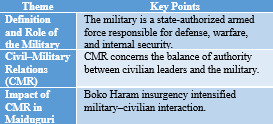
Objective: The objective of the study is to examine the civil-military relations in Maiduguri Metropolis of Borno State, Nigeria, particularly amidst the ongoing insurgency, and to identify ways in which effective civil-military relations can enhance state legitimacy, service delivery, community participation, and overall security and development. Theoretical framework: Focuses on governance, state legitimacy, and the importance of trust, coordination, and community engagement in civil-military relations. Literature review: Explores existing studies on civil-military relations in conflict zones, emphasizing challenges like trust deficits and the role of transparency and accountability. Methods: The study uses a qualitative methodology, analyzing existing literature, reports, and data on civil-military relations in Maiduguri. This likely includes interviews, case studies, and secondary data analysis to identify key themes and challenges within the civil-military context. Results: The findings reveal that effective civil-military relations contribute to improved governance, enhanced security, stability, and development in Maiduguri. Key factors for positive relations include community engagement, transparency, and accountability, which foster trust and cooperation between the military and civilians. Implications: Improved civil-military relations can enhance governance and stability in conflict zones like Maiduguri, promoting peace and development. Novelty: Focuses on Maiduguri’s specific context and offers practical recommendations for improving civil-military relations in conflict-affected regions.
References
S. P. Huntington, “The Soldier and the State,” The Soldier and the State. Harvard University, MA, 2019. https://doi.org/10.2307/j.ctvjf9wx3.
A. Ikelegbe, “Engendering civil society: Oil, women groups and resource conflicts in the Niger Delta region of Nigeria,” J. Mod. Afr. Stud., vol. 43, no. 2, pp. 241–270, 2005, https://doi.org/10.1017/S0022278X05000820.
J. Burk, “Theories of democratic civil-military relations,” Armed Forces Soc., vol. 29, no. 1, 2002, https://doi.org/10.1177/0095327X0202900102.
A. E. Egbujiobi, “Sustainable Development and Internal Security in Nigeria: The Role of Civil-Military Relations,” Rev. Educ. Adm.. Law, vol. 8, no. 1, pp. 163–177, 2025, https://doi.org/10.47067/real.v8i1.413.
R. A. Brooks, “Integrating the civil-military relations subfield,” Annu. Rev. Polit. Sci., vol. 22, no. 1, pp. 379–398, 2019, https://doi.org/10.1146/annurev-polisci-060518-025407.
D. Pion-Berlin and D. Dudley, “Civil-Military Relations: What Is the State of the Field,” in Handbook of Military Sciences, eds., Ed., Springer, 2020, pp. 1–22. https://doi.org/10.1007/978-3-030-02866-4_37-1.
T. Tagarev and P. Fluri, “From Civil-Military Relations to Resilience: The Fifth Wave of Strengthening Democracy through Research and Education,” Connections, vol. 24, no. 1, pp. 73–90, 2025, https://doi.org/10.11610/Connections.24.1.06.
A. E. Fernandez-Osorio and C. Acevedo-Navas, “The Privatisation of Security in Colombia: Redefining the Concepts of War and Armed Conflict in the 21St Century,” Anal. Polit., vol. 38, no. 110, pp. 163–188, 2025, https://doi.org/10.15446/anpol.v38n110.122259.
T. Feilen, “When Violence Becomes Visible: The Bundeswehr’s Struggle for Legitimacy in Afghanistan,” Polit. Gov.., vol. 13, 2025, https://doi.org/10.17645/pag.10066.
Q. Cai, “Comparative Analysis of Democratic Systems in Cambodia, Laos, and Thailand,” J. Ecohumanism, vol. 3, no. 4, pp. 3000–3011, 2024, https://doi.org/10.62754/joe.v3i4.3816.
H. Taş, “Populism and civil–military relations,” Democratization, vol. 31, no. 1, pp. 70–89, 2024, https://doi.org/10.1080/13510347.2023.2255976.
N. Dietrich, K. Eck, and C. Ruffa, “How governance shaped military responses to the COVID-19 pandemic,” Eur. Polit. Sci. Rev., vol. 15, no. 4, pp. 628–640, 2023, https://doi.org/10.1017/S1755773923000024.
H. R. Ezzat, “Palimpsests of civicness: Spontaneity and the Egyptian Uprising/Cairo 2011,” J. Civ. Soc., vol. 18, no. 2, pp. 239–261, 2022, https://doi.org/10.1080/17448689.2022.2125416.
R. Q. Ahmed and M. Tamoor, “State formation and the postcolonial decay in Pakistan,” Asian J. Soc. Sci., vol. 49, no. 1, pp. 9–15, 2021, https://doi.org/10.1016/j.ajss.2020.10.002.
S. S. Gajić and D. Pavlović, “State Capture, Hybrid Regimes, and Security Sector Reform,” J. Reg. Secur., vol. 16, no. 2, pp. 89–126, 2021, https://doi.org/10.5937/jrs0-34622.
M. R. DeVore, “Strategic satisficing: Civil-military relations and French intervention in Africa,” Eur. J. Int. Secur., vol. 4, no. 2, pp. 163–189, 2019, https://doi.org/10.1017/eis.2019.1.
E. J. Zürcher, “Young Turk Governance in the Ottoman Empire during the First World War,” Middle East. Stud., vol. 55, no. 6, pp. 897–913, 2019, https://doi.org/10.1080/00263206.2019.1590820.
E. L. Hillman, “Outing the Costs of Civil Deference to the Military,” J. Homosex., vol. 60, no. 2–3, pp. 312–326, 2013, https://doi.org/10.1080/00918369.2013.744675.
U. Cizre, “Problems of democratic governance of civil-military relations in Turkey and the European Union enlargement zone,” Eur. J. Polit. Res., vol. 43, no. 1, pp. 107–125, 2004, https://doi.org/10.1111/j.1475-6765.2004.00147.x.
A. Cottey, T. Edmunds, and A. Forster, “The Second Generation Problematic: Rethinking Democracy and Civil-Military Relations,” Armed Forces Soc., vol. 29, no. 1, pp. 31–56, 2002, https://doi.org/10.1177/0095327X0202900103.
S. Grčar, A. Sotlar, and K. Eman, “Attitudes of local population and armed forces in the Republic of Slovenia on the environmental impacts of peacetime military activities: unaddressed perspective in civil-military relations,” Discov. Sustain., vol. 6, no. 1, 2025, https://doi.org/10.1007/s43621-025-01011-4.
N. N. Snyder, “The Consequences of Declining Patriotism in the United States,” US Army War Coll. Q. Parameters, vol. 55, no. 3, pp. 17–33, 2025, https://doi.org/10.55540/0031-1723.3354.
M. Mulyadi, “Penelitian Kuantitatif Dan Kualitatif Serta Pemikiran Dasar Menggabungkannya,” J. Stud. Komun. dan Media, vol. 15, no. 1, p. 128, 2013, https://doi.org/10.31445/jskm.2011.150106.
A. O. Akinola and R. Makombe, “Rethinking the Resurgence of Military Coups in Africa,” J. Asian Afr. Stud., vol. 60, no. 5, pp. 2847–2863, 2025, https://doi.org/10.1177/00219096231224680.
M. Bayer, A. Croissant, R. Izadi, and N. Scheeder, “Multidimensional Measures of Militarization (M3): A Global Dataset,” Armed Forces Soc., vol. 51, no. 3, pp. 815–839, 2025, https://doi.org/10.1177/0095327X231215295.
H. Shin and S. H. Sheen, “The Evolution of China’s Assured Retaliation: An Analysis Focusing on the Development of China’s Strategic Nuclear Submarines,” Korean J. Int. Stud., vol. 23, no. 1, pp. 61–98, 2025, https://doi.org/10.14731/kjis.2025.04.23.1.61.
L. Terhorst, “Theorising Military Innovation’s Emergence and Effectiveness Across Innovation Timelines,” Eur. Rev. Int. Stud., vol. 11, no. 3, pp. 415–438, 2024, https://doi.org/10.1163/21967415-11030005.
R. Asghar, “Nuclear weapons and interstate conflict behavior: The moderating influence of civil–military relations,” Confl. Manag. Peace Sci., vol. 42, no. 2, pp. 190–219, 2025, https://doi.org/10.1177/07388942241238649.
A. Bueno, M. Durán, and R. Martínez, “A Cultural Gap? Perceptions of the Armed Forces Held by Spanish Political, Economic and Military Elites,” Rev. Esp. Investig. Sociol., no. 189, pp. 5–22, 2025, https://doi.org/10.5477/cis/reis.189.5-22.
F. Aina, “Between ‘Victims’ and Their ‘Saviors’: Process-Based Leadership and Trust Building in Civil–Military Relations in Northern Nigeria,” Armed Forces Soc., vol. 51, no. 1, pp. 181–203, 2025, https://doi.org/10.1177/0095327X231187581.
G. Smułek and A. Ejupi, “Local perceptions and socio-economic impacts of foreign peacekeeping forces in post-conflict Kosovo,” Hrvat. Geogr. Glas., vol. 87, no. 1, pp. 43–57, 2025, https://doi.org/10.21861/HGG.2024.87.01.02.
B. C. Krick, J. B. Petkun, and M. R. Revkin, “Civilian Harm and Military Legitimacy: Evidence from the Battle of Mosul,” Int. Organ, vol. 79, no. 2, pp. 332–357, 2025, https://doi.org/10.1017/S0020818325000098.
D. Morgan-Owen, A. Fox, and H. Bennett, “A haunting past: British defence, historical narratives, and the politics of presentism: Part of the special issue entitled Stories of world politics: between history and fiction,” Cambridge Rev. Int. Aff., vol. 37, no. 4, pp. 520–545, 2024, https://doi.org/10.1080/09557571.2023.2273375.
M. W. Bauer, G. Lotta, and F. de Holanda Schmidt, “Bureaucratic militarization as a mode of democratic backsliding: lessons from Brazil,” Democratization, vol. 32, no. 3, pp. 595–613, 2025, https://doi.org/10.1080/13510347.2024.2382355.
G. E. Yıldırım, “The Coup, the Pandemic, and Turkey’s Civilian Control over the Military,” Middle East Policy, vol. 31, no. 4, pp. 140–150, 2024, https://doi.org/10.1111/mepo.12773.
L. Remiro, A. Calatrava, A. Bueno, and R. Martinez, “Political culture and defence policy: a model of five-subtypes to explain the Spanish defence political culture,” Eur. Polit. Soc., vol. 25, no. 5, pp. 827–848, 2024, https://doi.org/10.1080/23745118.2024.2324888.
L. Klymanska, M. Malachivska-Danchak, M. Klimanska, and I. Haletska, “Civilian Attitudes Toward the Military Through the Prism of Personal Experience in Wartime Ukraine,” J. Educ. Cult. Soc., vol. 15, no. 2, pp. 43–65, 2024, https://doi.org/10.15503/jecs2024.2.43.65.
R. H. Phillips, “Nasty wars and needy veterans? How cognitive polyphasia may explain conceptualizations of the U.S. Iraq and Afghanistan veterans as victims and heroes,” Front. Sociol., vol. 9, 2024, https://doi.org/10.3389/fsoc.2024.1442649.
A. B. Gunawan, “Explaining civilian control of militarisation in Indonesia: The case of military law amendment,” J. Ilmu Sos. Dan Ilmu Polit., vol. 28, no. 1, pp. 35–54, 2024, https://doi.org/10.22146/jsp.96894.
C. Lavallée and B. O. Martins, “Reframing Civil–Military Relations in the EU: Insights From the Drone Strategy 2.0,” J. Common Mark. Stud., vol. 62, no. 2, pp. 619–625, 2024, https://doi.org/10.1111/jcms.13546.
P. Dixon, “‘A Grand Strategic Error’: the British military elite’s role in the invasion of Iraq,” Br. Polit., vol. 19, no. 1, pp. 84–105, 2024, https://doi.org/10.1057/s41293-023-00250-1.