Intra-Institutional Ziswaf Management at Al-Barokah Islamic Boarding School: A Fiqh Muamalah Review
DOI:
https://doi.org/10.61455/sicopus.v4i01.436Keywords:
ziswaf, islamic boarding school, contemporary, management, empowermentAbstract
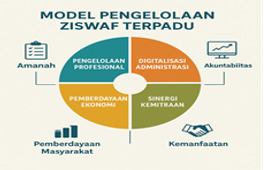
Objective: This study aims to analyse the contemporary management model of zakat, infaq, sedekah, and waqf (ZISWAF) in the Al-Barokah Islamic boarding school in Simalungun, North Sumatra, from the perspective of muamalah jurisprudence. Theoretical framework: This study is based on the muamalah jurisprudence framework, especially the concept of ownership (al-milkiyyah), trust, benefit (maslahah), and justice ('adl) in the management of social funds. These principles are linked to modern institutional management theory that emphasises accountability, transparency, and efficiency. The integration of classical Islamic legal norms with contemporary management practices is the basis for assessing the effectiveness of the ZISWAF management model in the Islamic boarding school environment. Literature review: The literature review includes Islamic Muamalah Fiqh from an Economic perspective in Islam, Contemporary ZISWAF Management, and Islamic Boarding Schools in the Reality of Sharia Economic Implementation. Methods: This study uses a qualitative approach with a case study method. Data were obtained through interviews with the management of the Al-Barokah Islamic boarding school, documentation of the institution's financial reports, and observations of ZISWAF management practices. Data analysis was carried out through the stages of data condensation, data presentation, and conclusion, using muamalah jurisprudence as an interpretative framework. Results: The study indicates that the ZISWAF management model at the Al-Barokah Islamic boarding school applies a hybrid system that combines fundraising based on traditional religious values with modern institutional management practices. The integration of digital recording systems, participatory decision-making, and empowerment-based fund distribution reflects the application of muamalah fiqh principles in the contemporary context. This model has succeeded in increasing financial transparency, educational independence, and the social welfare of the community around the Islamic boarding school. Implications: These findings indicate that Islamic boarding schools have the potential to become strategic centres of Islamic social finance by institutionalising accountable ZISWAF management in accordance with sharia principles. Novelty: This study introduces the Integrated ZISWAF Management Model (IZMM), which combines the principles of muamalah fiqh with modern management for the sustainable management of Islamic boarding school social funds.
References
M. Fauzi, “Islamic Boarding Schools As Means Of Regeneration In The Development Of Da’wah,” IJSS Ilomata Int. J. Soc. Sci., vol. 1, no. 3, pp. 149–157, 2020, https://doi.org/10.52728/ijss.v1i3.123.
Badrun, “Enhancing Islamic Education : The Role of Management in Islamic Boarding Schools,” Al-Ishlah J. Pendidik., vol. 16, no. 2, pp. 2772–2780, 2024, https://doi.org/10.35445/alishlah.v16i2.5153.
A. Supriyanto, “Concepts and Paradigms of Islamic Education in Indonesian Islamic Boarding Schools (Study at Al-Mukmin Ngruki Islamic Boarding School) 1),” Int. J. Humanit. Educ. Soc. Sci., vol. 2, no. 2, pp. 454–468, 2022, https://doi.org/10.55227/ijhess.v2i2.257.
A. A. R. Supriyanto, Amrin, “Islamic Education Paradigm ( A Case Study at Islamic Boarding School of Al-Muayyad Surakarta ),” Akad. J. Pemikir. Islam, vol. 27, no. 1, pp. 31–46, 2022, https://doi.org/10.32332/akademika.v27i1.4562.
M. Zuhirsyan, “Urgensi Pengembangan Regulasi Pengelolaan Ziswaf Lembaga Pendidikan Pesantren,” J. Huk. KAIDAH Media Komun. Dan Inf. Huk. dan Masy., vol. 22, no. 2, pp. 327–240, 2023, https://doi.org/10.30743/jhk.v22i2.6496.
Sucyani and Amrin, “Development of Sharia Economic Law in Indonesia ( Positivation of Zakat Law ),” Leg. Br., vol. 11, no. 2, pp. 1335–1344, 2022.
I. Mustofa, Fiqih Muamalah Kontemporer. Jakarta: RajaGrafindo Persada, 2016.
Mustofa dan Abdul Wahid, Hukum Islam Kontemporer. Jakarta: Sinar Gratika, 2009.
Departemen Agama RI, AL-JUMANATUL ‘ALI Al-Qur’an dan Terjemahannya. Bandung: CV. Penerbit J-ART, 2014.
K. H. A. Yafie, Menggagas Fikih Sosial. Bandung: Mizan, 1995.
Y. Mafiah and T. W. Hidayati, “The Significance of Al-Ghazali’s Maslahah Concept to the Development of Usul Fiqh and Islamic Law,” AN NUR J. Stud. Islam, vol. 15, no. 1, pp. 34–48, 2023, https://doi.org/10.37252/annur.v15i1.444.
W. M. Uhili and W. Al-Zuhayli, Al-Fiqh al-Islami wa-Adillatuh. Damascus: Dar Al-Fikr Al-Mouaser, 1989.
A. Sarif and R. Ahmad, “Maslahat (Benefits) in Fiqh Awlāwiyāt: A Comparison between Yūsuf al-Qarādhawī’s View and Abdus Salam Alī al-Karbulī’s,” Al-’Adalah, vol. 21, no. 1, pp. 1–24, 2024, https://doi.org/10.21111/tsaqafah.v13i2.1183.
M. M. Al-Qosimi, A. Amrin, and D. Saepudin, “Wakf Of Money In Sharia Economic Law Perspective: Study of Human Resource Management in Indonesian Waqf Savings Dompet Dhuafa,” Profetika J. Stud. Islam, vol. 23, no. 2, pp. 249–264, 2022, https://doi.org/10.23917/profetika.v23i2.19659.
Amrin, Ade Irmah Imamah, Nurrahmania, and A. Priyono, “Implementation of Professional Zakat of State Civil Apparatus in Indonesia from an Islamic Law Perspective,” Profetika J. Stud. Islam, vol. 24, no. 01, pp. 22–32, 2023, https://doi.org/10.23917/profetika.v24i01.709.
J. W. Cresswell, Educational Research : Planning, Conducting, and Evaluating Quantitative and Qualitative Research, 4th ed., vol. 4, no. 1. M.A: Pearson, 2012.
Sugiyono, Metode Penelitian Kuantitatif, Kualitatif dan R&D. Bandung: CV. Alfabeta, 2018.
L. J. Moleong, Metode Penelitian Kualitatif. Edisi Revisi. Bandung: Bandung: PT. Remaja Rosdakarya, 2014.
Ishom Talimah, Manhaj Fikih Yusuf al-Qaradhawi. Jakarta: Pustaka Al-Kautsar, 2001.
Y. Qardhawi, Fiqh al Zakah. Cairo: Maktabah Wahabah, 1994.
M. S. Antonio, Bank Islam: Dari Teori ke Praktik. Jakarta: Gema Insani, 2001.
Amrin & Amirullah, “Contemporary Legal Istimbat: Study on the Theory of Changes in Fatwa According to Yusuf Qardhawi,” Mizan J. Islam. LawJournal Islam. Law Stud., vol. 6, no. 1, pp. 89–108, 2022, https://doi.org/10.32507/mizan.v6i1.1244.
M. A. Mannan, Ekonomi Islam Teori dan Praktek (dasar dasar ekonomi Islam). Jakarta: Intermasa, 1992.
N. Nurlinda, “The Integration of Islamic Spiritual Values and Economics in Al-Ghazali’s Perspective for Community Development,” Nusant. J. Law Stud., vol. 3, no. 1, pp. 23–37, 2024.
Imam Ghazali, Al-Mustasfa min al-Usul, Jilid II. Cairo: Amiriyah, 1442.
H. K. Anheier, Nonprofit Organisations Theory, Management, Policy. London: Routledge, 2014. https://doi.org/10.4324/9781315851044.
M. U. Chapra, The Future of Economics: An Islamic Perspective. Leicester: Kube Publishing, 2016.
Umar Chapra, What is Islamic Economics? No. 9 in the IDB Prize Winner Lesture Series. Jeddah: IRTI/ITB, 1996.
T. M. Jones, A. C. Wicks, and R. E. Freeman, “Stakeholder Theory: The state of the Art,” Blackwell Guid. to Bus. Ethics, pp. 17–37, 2017, https://doi.org/10.1002/9781405164771.ch1.
J. M. R. Edward Freeman, “A Stakeholder Approach to Strategic Management,” Blackwell Handb. Strateg. Manag., pp. 183–201, 2005, https://doi.org/10.1111/b.9780631218616.2006.00007.x.
A. I. Khaldun, Muqaddimah al-‘Allamah Ibn Khaldun. Beirut: Dar al Fikr, 998.
M. N. Siddiqi, Banking without Interest. Leicester: Islamic Foundation (originally published in Urdu), 1983.
J. Rawls, A Theory of Justice. London: Oxford University, 1973.
A. Sen, Development as Freedom. Oxford: Oxford University Press, 1999.
P. F. Drucker, Post-Capitalist Society. London: Routledge, 2012, https://doi.org/10.4324/9780080938257.
M. D. Wojciechowska, “The role of public libraries in the development of social capital in local communities – a theoretical study,” Libr. Manag., vol. 42, no. 3, pp. 184–196, Jan. 2021, https://doi.org/10.1108/LM-10-2020-0139.
Ash-Syatibi, Al-Muwafaqat fi Usul al-Shariah Terjemahan oleh Ibrahim Musa dalam buku “Maqasid alShariah as Philosophy of Islamic Law: A Systems Approach”. International Institute of Islamic Thought. 2006.
H. Mintzberg, Crafting Strategy. London: Routledge, 2007.
M. K. Lewis, “Accentuating the positive: governance of Islamic investment funds,” J. Islam. Account. Bus. Res., vol. 1, no. 1, pp. 42–59, Apr. 2010, https://doi.org/10.1108/17590811011033406.
M. Kahf, “The Performance of the Institution of Zakah in Theory and Practice,” in International conference on Islamic economics towards the 21st Century, Kuala Lumpur, 1999.
Courneya, M. C., Kerry S., and R. E. Rhodes, “Effects of different measurement scales on the variability and predictive validity of the ‘two-component’ model of the theory of planned behaviour in the exercise domain,” Psychol. Heal., vol. 21, no. 5, pp. 557–570, 2006, https://doi.org/10.1080/14768320500422857.
I. Taimiyah, Majmu’ah al-Fatawa. Beirut: Darul Fikr, 1980.
R. Chambers, Ideas for Development. London: Routledge, 2023. https://doi.org/10.4324/9781849771665.
G. S. Becker, J. J. Elias, and Kevin M. Murphy, The Economic Approach: Unpublished Writings of Gary S. Becker. New York: University of Chicago Press, 2023, https://doi.org/10.7208/chicago/9780226827216.001.0001.
A. Sen, “Development as Freedom: an Indian perspective,” Indian J. Ind. Relat., pp. 157–169, 2006.
M. Sud, C. V. VanSandt, and A. M. Baugous, “Social Entrepreneurship: The Role of Institutions,” J. Bus. Ethics, vol. 85, no. 1, pp. 201–216, 2009, https://doi.org/10.1007/s10551-008-9939-1.