The Discourse of Tahrif al-Qur’an in Indonesian Syiah Communities: A Study on IJABI and ABI Perspectives
DOI:
https://doi.org/10.61455/sicopus.v3i03.430Keywords:
tahrif al-qur’an, syiah in indonesia, ijabi, abi, theological discourseAbstract
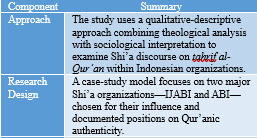
Objective: The purpose of this study is to explain the theological attitude of the Indonesian Syiah community, especially the Indonesian Ahlul Bait Jamaah Association (IJABI) and the Indonesian Ahlul Bait (ABI), towards the doctrine of tahrif al-Qur'an and analyze how their interpretation affects the public perception of Syiah in Indonesia. Theoretical framework: This study uses a theological-sociological framework by combining doctrinal analysis and sociological perspectives of religion. This approach is used to understand the relationship between beliefs, identity, and community dynamics in the context of Indonesian Syiah. Literature review: This study examines the historical debate on tahrif in the Syiah scholarly tradition, ranging from the classical view that indicates textual changes to contemporary perspectives that expressly reject the idea. In addition, this study also reviews various studies on Syiah in Indonesia that have so far focused on issues of identity politics, sectarian conflicts, and minority rights. Thus, this study is here to fill the study gap related to the sensitive issue of tahrif al-Qur'an in the context of Indonesia. Results: The results of the study show that both IJABI and ABI reject the doctrine of tahrif al-Qur'an and affirm the authenticity of the current Qur'anic text, so that they are within the Sunni consensus line. Nevertheless, differences arise in the way they articulate and communicate those views. IJABI emphasizes a dialogical and moderatory approach to reduce public suspicion, while ABI emphasizes a more formal theological defense based on Syiah Imamiyah orthodoxy. Implications: This study shows that the Syiah community in Indonesia consciously positions itself within the framework of Islamic unity to dismiss accusations of heterodoxy. This attitude contributes to reducing sectarian tensions and strengthening inter-religious harmony in Indonesia. Novelty: The novelty of this research lies in a comparative analysis that focuses on the doctrinal discourse of tahrif al-Qur'an in the two main Syiah organizations in Indonesia. This study shows how minority groups seek to negotiate theological legitimacy in the context of Indonesia's majority Sunni society.
References
M. K. Amal, “Anti-Syiah mass mobilization in Indonesia’s democracy: Godly alliance, militant groups and the politics of exclusion,” Indones. J. Islam Muslim Soc., vol. 10, no. 1, pp. 25–48, 2020, https://doi.org/10.18326/ijims.v10i1.25-48
M. Mukhlis, R. D. Jackson-Ortiz, M. Jufri, E. Garunja, and P. A. Aidonojie, “Rejection of Former Syiah Community in Sampang Perspective on Human Rights Law: Discourse of Religious Rights and Freedom in Indonesia,” Lex Sci. Law Rev., vol. 7, no. 2, pp. 959–994, 2023, https://doi.org/10.15294/lesrev.v7i2.72156.
A. Akbar and B. Isakhan, “The Islamic State, Syiah religious clerics and the mobilisation of Syiah militias in Iraq and Syria,” Contemp. Polit., vol. 29, no. 5, pp. 535–552, 2023, https://doi.org/10.1080/13569775.2023.2196875.
N. Fahrizi and M. Zubir, “Historitas Dan Otentisitas Al-Qur’an (Studi Komparatif Antara Arthur Jeffery Dengan Manna’ Al-Qathan),” QiST J. Quran Tafseer Stud., vol. 1, no. 2, pp. 183–222, 2022, https://doi.org/10.23917/qist.v1i2.1113.
F. N. R. Hakim, “Re-understanding tolerance through intrareligious dialogue: The discourse of anti-shi’ism in Indonesia,” Ulumuna, vol. 25, no. 2, pp. 350–372, 2021, https://doi.org/10.20414/ujis.v25i2.449.
A. Tahiiev, “Minority within a Minority: Syiah Community in Ukraine,” Int. J. Islam. Thought, vol. 19, no. 1, pp. 14–20, 2021, https://doi.org/10.24035/IJIT.19.2021.191.
H. Anwar, “Tahrif Dalam Al-Qur’an (Studi Analitis tentang Perubahan yang Bersifat Lafdzy dan Ma`nawy),” MISYKAT J. Ilmu-ilmu Al-Quran, Hadist, Syari’ah dan Tarb., vol. 1, no. 1, p. 49, 2016, https://doi.org/10.33511/misykat.v1n1.49.
K. H. Isa, “Sunni literary responses to the spread of Syiah ideology in northern Nigeria,” Stud. African Lang. Cult., vol. 2018, no. 52, pp. 113–130, 2018, https://doi.org/10.32690/SALC52.5.
A. Suryana, “Discrepancy in state practices: The cases of violence against Ahmadiyah and Shi’a minority communities during the presidency of Susilo Bambang Yudhoyono,” Al-Jami’ah, vol. 55, no. 1, pp. 71–104, 2017, https://doi.org/10.14421/ajis.2017.551.71-104.
M. A. Leichtman, “Migration, war, and the making of a transnational Lebanese Syiah community in Senegal,” Int. J. Middle East Stud., vol. 42, no. 2, pp. 269–290, 2010, https://doi.org/10.1017/S002074381000005X.
M. Nailul Authar As Syaukani A, K. Kerwanto, and Z. Husin Lubis, “Penghormatan terhadap Keturunan Ahlulbait Nabi Muhammad Saw dalam Perspektif Al-Qur’an : Analisis dengan Pendekatan Gerakan Ganda Fazlur Rahman,” Blantika Multidiscip. J., vol. 2, no. 11, pp. 437–455, 2024, https://doi.org/10.57096/blantika.v2i11.237.
A. Tahiiev, “Prospects for Higher Syiah Religious Education in Post-Soviet Countries,” Religions, vol. 14, no. 7, 2023, https://doi.org/10.3390/rel14070822.
Kholaf Al Muntadar and Abdul Azis, “Al-Qur’an Di Mata Ahlul Bait: Studi Pemikiran Hasyim al-Mousawi dalam Buku Al-Qur’an fi Madrasati Ahlil bait,” J. Stud. Qur’an dan Tafsir, vol. 1, no. 2, pp. 178–205, 2022, https://doi.org/10.59005/jsqt.v1i2.233.
W. Sugiyarto, “Pertumbuhan Syi’Ah Dan Relasinya Dengan Non Syi’Ah Di Kota Medan Sumatra Utara,” Harmoni, vol. 17, no. 2, pp. 272–289, 2018, https://doi.org/10.32488/harmoni.v17i2.294.
E. Tzfadya, “Modern Syiah Islamic and Jewish Political Theosophy: An Elective Affinity?,” Religions, vol. 14, no. 2, 2023, https://doi.org/10.3390/rel14020176.
H. Zukriadi, Sulaiman, U., “Aneka Macam Penelitian,” SAMBARA J. Pengabdi. Kpd. Masy., vol. 1, no. 1, pp. 36–46, 2023, https://doi.org/10.58540/sambarapkm.v1i1.157.
W. Yuliani, “Metode Penelitian Deskriptif Kualitatif Dalam Perspektif Bimbingan Dan Konseling,” QUANTA J. Kaji. Bimbing. dan Konseling dalam Pendidik., vol. 2, no. 2, pp. 1–10, 2018, https://doi.org/10.22460/q.v2i1p21-30.642.
M. Mulyadi, “Penelitian Kuantitatif Dan Kualitatif Serta Pemikiran Dasar Menggabungkannya,” J. Stud. Komun. dan Media, vol. 15, no. 1, p. 128, 2013, https://doi.org/10.31445/jskm.2011.150106.
A. Prayogi, “Pendekatan Kualitatif dalam Ilmu Sejarah: Sebuah Telaah Konseptual,” Hist. Madania J. Ilmu Sej., vol. 5, no. 2, pp. 240–254, 2021, https://doi.org/10.15575/hm.v5i2.15050.
A. Sholikhah, “Statistik Deskriptif Dalam Penelitian Kualitatif,” KOMUNIKA J. Dakwah dan Komun., vol. 10, no. 2, pp. 342–362, 2016, https://doi.org/10.24090/komunika.v10i2.953.
A. Alma`arif, “Kesadaran Hermeneutik Dalam Membaca Teks: Model Ijtihad Umar Ibn Al-Khattab,” Al-A’raf : Jurnal Pemikiran Islam dan Filsafat, vol. 13, no. 2. p. 191, 2016. https://doi.org/10.22515/ajpif.v13i2.304.
K. S. Masooda Banu, “Shaping Global Islamic Discourses,” Shaping Global Islamic Discourses. 2015. https://doi.org/10.3366/edinburgh/9780748696857.001.0001.
M. N. K. Setiawan, “Book Review: Syi‘ah dan Wacana Perubahan Mushaf al-Quran, Tahrif al-Qur’an,” Al-Jami’ah J. Islam. Stud., vol. 43, no. 1, p. 241, 2005, https://doi.org/10.14421/ajis.2005.431.241-254.
M. -, “Ideologisasi Mazhab Syiah Di Balik Periodisasi Sejarah Tafsir Al-Qur’an,” Empirisma, vol. 24, no. 1, 2015, https://doi.org/10.30762/empirisma.v24i1.4.
M. Rusdi, V. A. Sebayang, S. Kholil, and A. M. Syam, “Islam and the Ethics of War: Deconstructing Jihad through the Principle of Humanism in Theological Discourses,” Pharos J. Theol., vol. 105, no. 5, 2024, https://doi.org/10.46222/pharosjot.105.57.
J. Bin Yusuf and H. S. Shah, “Eternity of the Word of God: Exploring a Common Theme in Judeo-Christian and Muslim Theological Discourse,” J. Islam. Thought Civiliz., vol. 13, no. 2, pp. 335–353, 2023, https://doi.org/10.32350/jitc.132.22.
M. F. M. Yusoff and M. Y. Ismail, “Sunni Ḥadīth and Continuous Commentaries on the Eschatological Mahdī: A Literary Analysis,” Religions, vol. 14, no. 4, 2023, https://doi.org/10.3390/rel14040499.
U. M. Noor, “MaqĀm maḤmŪd polemic and the denunciation of anthropomorphism in Sunni Islam,” Afkar, vol. 23, no. 1, pp. 1–48, 2021, https://doi.org/10.22452/afkar.vol23no1.1.
N. V. Ivkina and O. S. Chikrizova, “The ‘Syiah factor’ in Nigeria’s Public and Political Life (1994–2020): Domestic and International Dimensions,” Vestn. Sankt-Peterburgskogo Univ. Vostokovedenie i Afrikanistika, vol. 14, no. 3, pp. 524–540, 2022, https://doi.org/10.21638/spbu13.2022.309.
M. Eslami and C. Kaunert, “Forward Defence, Hamas-Hezbollah War With Israel and Iran’s Path to Nuclear Bombs,” Glob. Policy, vol. 16, no. 2, pp. 299–305, 2025, https://doi.org/10.1111/1758-5899.70011.
M. Lupașcu, “A Study of 3D Graphic in Culture,” Anastasis, vol. 9, no. 1, pp. 131–138, 2022, https://doi.org/10.35218/armca.2022.1.08.
E. Hassanzadeh and H. Hazratı, “The Kojajani Family and Iran’s Political Developments (13-16Th Century),” Turk Kult. ve Haci Bektas Veli - Arastirma Derg., no. 103, pp. 171–185, 2022, https://doi.org/10.34189/hbv.103.008.
N. T. Boms and H. Aboubakr, “Pan Arabism 2.0? The Struggle for a New Paradigm in the Middle East,” Religions, vol. 13, no. 1, 2022, https://doi.org/10.3390/rel13010028.
R. A. Cohen and G. Hitman, “Iran and Saudi Arabia Civilian-Theo-Zation clash: Reformulating regional strategies following the Arab spring,” Trames, vol. 25, no. 2, pp. 257–275, 2021, https://doi.org/10.3176/tr.2021.2.06.
M. Samari and R. Rezalou, “Study and classification of tombstones of the Safavid period (Ardabil City),” Anastasis, vol. 7, no. 1, pp. 77–92, 2020, https://doi.org/10.35218/ARMCA.2020.1.04.
H. Özel and F. Çiftçi, “Shīism Reflections in the Poetry of Ibn Hāni’ al-Andalusī,” Cumhur. Ilah. Derg., vol. 24, no. 3, pp. 1381–1406, 2020, https://doi.org/10.18505/cuid.776563.
C. Kara, “Yahyâ b. Zeyd İsyanı ve Horasan’daki Etkileri,” Cumhur. Ilah. Derg., vol. 24, no. 2, pp. 765–787, 2020, https://doi.org/10.18505/cuid.787925.
A. Ostovar, “Iran, its clients, and the future of the Middle East: The limits of religion,” Int. Aff., vol. 94, no. 6, pp. 1237–1255, 2018, https://doi.org/10.1093/ia/iiy185.
M. C. Inhorn, D. Birenbaum-Carmeli, S. Tremayne, and Z. B. Gürtin, “Assisted reproduction and Middle East kinship: a regional and religious comparison,” Reprod. Biomed. Soc. Online, vol. 4, pp. 41–51, 2017, https://doi.org/10.1016/j.rbms.2017.06.003.
J. L. Esposito, “Islam and political violence,” Religions, vol. 6, no. 3, pp. 1067–1081, 2015, https://doi.org/10.3390/rel6031067.
H. Latief, “The identity of Syiah sympathizers in contemporary Indonesia,” J. Indones. Islam, vol. 2, no. 2, pp. 300–335, 2008, https://doi.org/10.15642/jiis.2008.2.2.300-335.