Strategy for Collaborative Governance in Developing Huyula MSMEs toward Sustainable Economic Growth in Lembah Hijau
DOI:
https://doi.org/10.61455/sicopus.v3i03.427Keywords:
msme development, collaborative governance, sustainable economy, human resources, lembah hijau villageAbstract
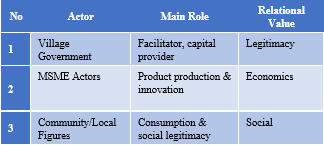
Objective: This study aims to analyze the development strategy of Huyula Micro, Small, and Medium Enterprises (MSMEs) based on collaborative governance to achieve a sustainable economy in Lembah Hijau Village, Bone Bolango Regency. Theoretical framework: The study is grounded on three main concepts: business development strategy, collaborative governance, and sustainable economy. Business strategy emphasizes innovation, managerial capacity, and digitalization; collaborative governance highlights multi-stakeholder collaboration; while sustainable economy integrates economic, and social. Literature review: Previous studies reveal that MSMEs are vital contributors to Indonesia’s economy, accounting for more than 60% of GDP and absorbing 97% of the workforce. However, they face challenges such as limited resources, weak managerial capacity, inadequate institutional infrastructure, and poor digital adoption. Methods: This research applies a descriptive qualitative approach, conducted over six months (June–October 2025). Data were collected through observation, semi-structured interviews with seven purposively selected informants (village government, community leaders, four MSME actors, and youth representatives), and focus group discussions (FGD). Results: The findings indicate that Huyula MSMEs remain at the start-up stage, constrained by managerial, marketing, and innovation limitations. Collaborative governance proved crucial, involving the village government as facilitator, MSME actors as innovators, local leaders as social legitimators, youth as digital promoters, and the private sectors as financing and distribution partners. The collaborative model strengthens human resource capacity, builds collective institutions, and integrates digital technology to expand market access. Implications: The study implies that collaborative governance fosters inclusive and sustainable economic practices, aligning with Sustainable Development Goals (SDGs) 8 (Decent Work and Economic Growth) and 12 (Responsible Consumption and Production). Novelty: This research contributes by formulating an ideal model of MSME development based on collaborative governance at the village level, integrating managerial empowerment, institutional strengthening, and digitalization.
References
Kementerian Koordinator Bidang Perekonomian And R. Indonesia, “UMKM Menjadi Pilar Penting dalam Perekonomian Indonesia.”
D. Umkm, P. Era, and R. Industri, “Collaborative Governance Dalam Pengembangan Digitalisasi Umkm Pada Era Revolusi Industri 4.0 Di Wilayah Bangka Belitung,” vol. 3, pp. 247–254, 2022, https://doi.org/10.55314/tsg.v3i3.317.
J. Of, C. Development, and D. Management, “Collaborative Governance dalam Pengembangan Usaha Mikro Kecil Menengah ( UMKM ) di Kecamatan Kedungbanteng Kabupaten Banyumas,” vol. 7, no. 1, pp. 77–95, 2025, https://doi.org/10.37680/jcd.v7i1.6821.
“Selamat hari UMKM Nasional,” Badan Pusat Statistik, 2024.
S. Alhadar, S. Latare, Y. Antu, A. Latif, Y. Sahi, and T. Gobel, “Partisipasi Pemuda Dalam Pembangunan Desa : ( Transformasi Wisata Berbasis Kearifan Lokal Dalam Meningkatkan Umkm Di Desa Lembah Hijau ) Participation Of Youth In The Development Of Villages : ( Tourism Transformation Based on Local Wisdom in Increasing MSMEs in Lembah Hijau Village ),” vol. 3, no. 2, 2022, https://doi.org/10.35311/jmpm.v3i2.89.
T. A. Lubis, A. Nur, B. Utama, N. Sari, M. Ningsih, and K. Daerah, “Transformasi Umkm Jambi : Strategi Memanfaatkan,” vol. 13, no. 01, pp. 296–303, 2024, https://doi.org/10.22437/jmk.v13i01.31962.
M. Fachruddin, M. Nur, and H. Basri, “Jurnal Pendidikan dan Konseling,” vol. 4, pp. 6437–6445, 2022.
K. Adi, S. Wijaya, I. P. D. Yudartha, N. P. Anik, and U. Udayana, “Collaborative Governance dalam Pemberdayaan UMKM Melalui Pemanfaatan Potensi Alam Menuju Sustainable Tourism di Desa Wisata Taro Kabupaten Gianyar,” vol. 5636, no. 3, pp. 475–487, 2024, https://doi.org/10.37478/abdika.v4i3.4057.
D. I. Kota and B. Aceh, “Jurnal Ilmiah Mahasiswa FISIP USK Volume 8, No 4, November 2023 http://www.jim.usk.ac.id/Fisip,” vol. 8, no. 4, pp. 1–12, 2023.
J. Ilmiah and E. Islam, “Paradigma Ekonomi Berkelanjutan di Negara Berkembang Dalam Perspektif Islam,” vol. 10, no. 01, pp. 1009–1016, 2024, https://doi.org/10.29040/jiei.v10i1.12794.
N. Agustus, J. Raya, B. Sumedang, K. Jatinangor, K. Sumedang, and J. Barat, “Strategi Bisnis sebagai Dasar Keunggulan Kompetitif Bagi Usaha Mikro di Kota Bandung : Peran Model Inovasi Nabilah Zulkhairi Putri,” vol. 2, no. 3, 2024, https://doi.org/10.59603/masman.v2i3.494.
M. Kusuma and W. Gunawan, “Pengaruh Strategi Bisnis Terhadap Kinerja Umkm Yang Dimediasi Oleh Teknologi Digital,” vol. 7, 2023, https://doi.org/10.35308/jbkan.v7i2.8052.
H. Wang, B. Ran, and H. Wang, “Network governance and collaborative governance : a thematic analysis on their similarities, differences, and entanglements,” Public Manag. Rev., vol. 25, no. 6, pp. 1187–1211, 2023, https://doi.org/10.1080/14719037.2021.2011389.
L. Rahmawaty, N. S. Mulyani, T. Faturrahman, and N. Rahmawati, “Collaborative Governance Strategy In Developing Micro, Small And Medium Enterprises ( Msmes ) Using The Pentahelix System Collaborative Governance Strategy In Developing Micro, Small And Medium Enterprises ( Msmes ) Using The Pentahelix”.
Yohanes Apriadi, Alfi Haris Wanto, Asti Amelia Novita, “Faktor-Faktor Yang Mempengaruhi Kondisi Awal Collaborative Governance Dalam Pemetaan Wilayah Adat Di Kabupaten Sorong Selatan Yohanes”, P. Studi, M. Ilmu, A. Publik, F. I. Administrasi, and U. Brawijaya, vol. 6, no. 7, pp. 360–367.
R. McNaught, “The application of collaborative governance in local level climate and disaster resilient development – A global review,” Environ. Sci. Policy, vol. 151, no. December 2022, p. 103627, 2024, https://doi.org/10.1016/j.envsci.2023.103627.
C. Ansell and J. Torfing, “Co-creation: The new kid on the block in public governance,” Policy Polit., vol. 49, no. 2, pp. 211–230, 2021, https://doi.org/10.1332/030557321X16115951196045.
A. Kementerian, D. Daerah, and T. Email, “Strategi Pengembangan Ekonomi Berkelanjutan di Desa : Mendorong Pemberdayaan Komunitas dan Kemandirian Ekonomi Lokal,” vol. 3, pp. 2175–2183, 2023.
N. Suchek and M. Franco, “Inter-organisational Cooperation Oriented Towards Sustainability Involving SMEs : a Systematic Literature Review,” J. Knowl. Econ., pp. 1952–1972, 2024, https://doi.org/10.1007/s13132-023-01196-x.
F. Adibah and D. Novita, “Majalah Ekonomi _ ISSN No. 1411-9501 _Vol. XXIV No. 1_Juli 2019 Faroh Adibah & Dina Novita,” no. 1411, pp. 69–83, 2019.
S. Kurnia, M. I. Alamsyahbana, R. Chartady, S. V. Arifin, and M. I. Sesaria, “Circular Solutions for Decent Work and Economic Growth: Lessons from Sustainable Development Goals (SDG) 8: Solusi Sirkuler untuk Pekerjaan yang Layak dan Pertumbuhan Ekonomi: Pelajaran dari Sustainable Development Goals (SDG) Nomor 8,” Acad. Open, vol. 8, no. 1 SE-Business and Economics,. 2023, https://doi.org/10.21070/acopen.8.2023.6657.
imam Machali, Metode Penelitian Kualitatif Panduan Praktis Merencanakan, melaksanakan, dan analisis dalam penelitian kuantitatif. Yogyakarta: Fakultas Ilmu Tarbiyah dan Keguruan Universitas Islam Negeri (UIN) Sunan Kalijaga Yogyakarta, 2021.
S. P. Rahayu et al., “Peran Smart Fisheries Village Dalam Meningkatkan Ekonomi Lokal Melalui Wisata Edukasi Dan Kuliner :,” vol. 11, pp. 915–924, 2025, https://doi.org/10.25157/moderat.v11i3.5442.
S. Haryoko, Bahartiar, and F. Arwadi, Analisis Data Penelitian Kualitatif (Konsep, Teknik, & Prosedur Analisis). Makassar: Badan Penerbit Universitas Negeri Makassar, 2020.
A. D. Putro, E. R. Cahyadi, and E. Anggraini, “The Influence Of Digital Transformation On The Performance Of Culinary Smes In Bogor District Using The Technology Organization Environment ( Toe ) Model,” vol. 11, no. 2, pp. 344–354, 2025, https://doi.org/10.17358/ijbe.11.2.344.
F. Faiz, V. Le, and E. K. Masli, “Determinants of digital technology adoption in innovative SMEs,” J. Innov. Knowl., vol. 9, no. 4, p. 100610, 2024, https://doi.org/10.1016/j.jik.2024.100610.
S. J. M. Grootjans, M. M. N. Stijnen, M. E. A. L. Kroese, D. Ruwaard, and M. W. J. Jansen, “Collaborative governance at the start of an integrated community approach: a case study.” BMC Public Health, vol. 22, no. 1, p. 1013, May 2022, https://doi.org/10.1186/s12889-022-13354-y.
I. Murwenie, E. Kartiko, and A. Avrianto, “Digital Empowerment of MSMEs : Implications of Digital Loans on Business Sustainability Through Selective Credit Schemes,” vol. 13, no. 1, pp. 51–67, 2025, https://doi.org/10.26905/jmdk.v13i1.15691.
H. B. Ginting and S. Rijal, “Assessing The Role Of Environmental Innovation, Credit Access, And Governance In Shaping The Financial Sustainability Of Indonesian MSMEs,” vol. 7, no. 4, pp. 10834–10852, 2024, https://doi.org/10.31539/costing.v7i4.9655.
A. Haris, A. Suryono, A. Said, and M. Rozikin, “Collaborative Governance In Local Economic Development : The Case In East Java, Indonesia,” pp. 1–16, 2024, doi: https://doi.org/10.55908/sdgs.v12i1.2501 a.
J. Laksmanawati and A. Yuniawan, “Women and the Digitalization Strategies of Micro, Small, and Medium Enterprises in the New Normal Era,” vol. 4, no. 1, pp. 55–64, 2021, https://doi.org/10.9744/ijbs.4.1.55-64.
N. Khatik, R. E. Wibowo, and A. Santosa, “The Influence of Financial Institutions, Government, and Digital Technology in the MSME,” vol. 16, no. 1, pp. 1–14, 2023, https://doi.org/10.15408/akt.v16i1.30263.
Z. Zakaria and K. Y. Chin, “SMEs Fintech Financing : Does Board Governance Matter ?” vol. 26, no. 2, pp. 185–207, 2024, https://doi.org/10.22146/gamaijb.66123.
Z. Acs, D. Audretsch, and E. Lehmann, “The knowledge spillover theory of entrepreneurship,” Small Bus. Econ., vol. 41, no. 4, pp. 757–774, 2013, https://doi.org/10.1007/s11187-013-9505-9.
A. Martins, M. C. Branco, and P. N. Melo, “Sustainability in Small and Medium-Sized Enterprises : A Systematic Literature Review and Future Research Agenda,” pp. 1–26, 2022, https://doi.org/10.3390/su14116493.
D. Jimenez and I. B. Franco, “A Review of Corporate Purpose : An Approach to Actioning the Sustainable Development Goals ( SDGs ),” 2021, https://doi.org/10.3390/su13073899.
M. S. Shabbir and F. Batool, “Social Entrepreneurship for Community Development : The Role of Social Capital in Establishing Sustainable Enterprises Social Entrepreneurship for Community Development : The Role of Social Capital in Establishing Sustainable,” J. Soc. Entrep., vol. 0, no. 0, pp. 1–26, 2025, https://doi.org/10.1080/19420676.2025.2492060.
S. Avelar, T. Borges-Tiago, A. Almeida, and F. Tiago, “Confluence of sustainable entrepreneurship, innovation, and digitalization in SMEs,” J. Bus. Res., vol. 170, p. 114346, 2024, https://doi.org/10.1016/j.jbusres.2023.114346.
N. A. Nazibudin, S. A. M. Sabri, and L. A. Manaf, “Aligning with sustainable development goals (SDG) 12: A systematic review of food waste generation in Malaysia,” Clean. Waste Syst., vol. 10, p. 100205, 2025, https://doi.org/10.1016/j.clwas.2025.100205.
R. Raman, H. H. Lathabai, and P. Nedungadi, “Sustainable development goal 12 and its synergies with other SDGs: identification of key research contributions and policy insights,” Discov. Sustain., vol. 5, no. 1, p. 150, 2024, https://doi.org/10.1007/s43621-024-00289-0.
P. Q. Huy and V. K. Phuc, “Changing times : do the critical success factors boosting green transition of SMEs remain unchanged ?” J. Innov. Entrep., vol. 6, 2025, https://doi.org/10.1186/s13731-024-00449-6.
T. T. T. Ninh and T. T. Hue, “Sustainable entrepreneurial ecosystems: what are the main schools of thought and topical trends?” Discov. Sustain., vol. 6, no. 1, p. 115, 2025, https://doi.org/10.1007/s43621-025-00931-5.