Strategies for Fostering Students' Morals through Kultum Dzuhur at SMA Muhammadiyah Darul Arqom Karanganyar
DOI:
https://doi.org/10.61455/sicopus.v3i02.322Keywords:
moral education, kultum dzuhur, islamic religious education, character development, teaching strategiesAbstract
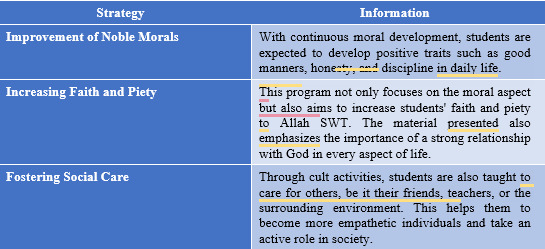
Objective: This study aims to describe and analyze the strategies of Islamic Religious Education teachers in fostering students' morals through the cult of Dzuhur Prayer and evaluate the role of the cult in improving the morality of students at SMA Muhammadiyah Darul Arqom Karanganyar for the 2024/2025 academic year. Theoretical framework: This research is based on the theory of character education and moral development in Islam, which emphasizes the importance of examples, habituation, and spiritual approaches in shaping students' personalities and behaviors. Literature review: The literature review includes a study of the methods of moral development in Islamic education, the role of cults in non-formal learning, and the importance of spiritual approaches in shaping the character of students. Methods: This study uses a qualitative approach with data collection techniques through observation, interviews, and documentation. Data analysis was carried out using data reduction techniques, inductive approaches, and conclusion drawing and verification. Results: The results of the study show that teachers apply strategies in the form of contextual material delivery, examples, and moral habituation in daily life. Kultum is effective in increasing moral awareness and improving students' attitudes in the school environment. Implications: This study emphasizes the importance of cult as a medium for strategic moral development in Islamic education, as well as encouraging the strengthening of spiritual approaches in shaping students' character as a whole. Novelty: The uniqueness of this research lies in its focus on the cult of Dhuhr Prayer as a systematic approach to the moral development of students in secondary school, which has not been discussed in depth in contemporary Islamic education studies.
References
M. N. L. Mahamid, “The Management of Islamic Philanthropic Institutions Using a Total Quality Management Approach: a Case in Magelang,” Profetika J. Stud. Islam, vol. 24, no. 01, pp. 57–63, 2023, https://doi.org/10.23917/profetika.v24i01.1571.
S. A. Adha, “Pembinaan Akhlak Siswa Siswi Melalui Kegiatan Kultum Jumat Di SD Negeri 008 Samarinda ULU,” J. Ilmu Pendidik. dan Teknol., vol. 6, no. 2, 2024.
M. Fatimah, M. Mustofa, Rizkiy Pratama Putra, M. M. Abu Zinah, and M. Masuwd, “Optimization of the Principal’s Role As a Supervisor To Improve the Performance of Teachers in Surakarta,” Profetika J. Stud. Islam, vol. 24, no. 02, pp. 207–216, 2023, https://doi.org/10.23917/profetika.v24i02.1986.
A. Ardianto, “Efektivitas Kuliah Tujuh Menit Setelah Sholat Dzuhur Sebagai Pembinaan Akhlak Siswa di Sekolah Menengah Kejuruan Negeri 7 Pekanbaru.” 2019.
M. A. Aziz, Ilmu Dakwah: Edisi Revisi. Prenada Media, 2019.
A. R. Choidab, A. Mudakir, A. S. Mubarok, A. Ramadayanto, and B. Supriadi, Interaksi Agama dan Budaya di Masyarakat. Interaksi Agama dan Budaya di Masyarakat, 2020.
I. Ismail, H. Hasanuddin, and A. Chandra, “The Influence of Thinking Styles and Learning Styles on Student Learning Achievement,” AL-ISHLAH J. Pendidik., vol. 15, no. 1, pp. 193–202, 2023, https://doi.org/10.35445/alishlah.v15i1.2896.
S. Elhayat, “Filsafat Akhlak Persfektif Ibnu Miskawaih,” Taushiah J. Hukum, Pendidik. Dan Kemasyarakatan, vol. 9, no. 2, pp. 49–58, 2019, https://doi.org/10.30743/taushiah.v9i2.2223.
T. Sanyoto, N. Fadli, R. Irfan Rosyadi, and M. Muthoifin, “Implementation of Tawhid-Based Integral Education to Improve and Strengthen Hidayatullah Basic Education,” Solo Univers. J. Islam. Educ. Multicult., vol. 1, no. 01, pp. 30–41, 2023, https://doi.org/10.61455/sujiem.v1i01.31.
A. A. Fauzi et al., Pemanfaatan Teknologi Informasi di Berbagai Sektor Pada Masa Society 5.0. PT. Sonpedia Publishing Indonesia, 2023.
S. A. F. Lingga, A. Mustaqim, M. Al Farabi, and A. Darlis, “Tauhid Education in the Qur’an,” Solo Univers. J. Islam. Educ. Multicult., vol. 1, no. 01, pp. 10–19, 2023, https://doi.org/10.61455/sujiem.v1i01.3.
Sugiyono, “Metode Penelitian Pendidikan Pendekatan Kuantitatif, Kualitatif dan R&D.” Alfabeta, Bandung, p. 407, 2010.
A. S. Hamdi and E. Bahruddin, Metode Penelitian Kuantitatif Aplikasi Dalam Pendidikan. Deepublish, 2015.
A. Majid, Analisis Data Penelitian Kualitatif. Penerbit Aksara Timur, 2017.
U. Nugroho, Metodologi penelitian kuantitatif pendidikan jasmani. Penerbit CV. Sarnu Untung, 2018.
A. Anggito and J. Setiawan, Metodologi Penelitian Kualitatif. CV Jejak (Jejak Publisher, 2018.
S. Habibah, “Akhlak Dan Etika Dalam Islam,” J. Pesona Dasar, vol. 1, no. 4, pp. 73 – 87, 2015.
H. Hasma, “Keterampilan dasar guru untuk menciptakan suasana belajar yang menyenangkan,” Didakt. J. Pendidik. Dan Ilmu Pengetah., vol. 17, no. 1, 2017.
S. Hawa, S. Syarifah, and M. Muhamad, “Pembinaan Akhlak Peserta Didik Melalui Kegiatan Kultum (Kuliah Tujuh Menit) di SD Negeri 17 Pangkalpinang,” Sustain. J. Kaji. Mutu Pendidik., vol. 4, no. 2, pp. 75–90, 2021, https://doi.org/10.32923/kjmp.v4i2.2162.
H. Hendri, “Upaya Guru dalam Membina Akhlak Siswa di MTs PGAI Padang,” Murabby J. Pendidik. Islam, vol. 1, no. 2, pp. 176–184, 2018, https://doi.org/10.15548/mrb.v1i2.320.
M. Huda, “Urgensi Keteladanan Pelatih Dalam Pembentukan Akhlak Anggota Persaudaraan Setia Hati Terate Di Komisariat Iain Ponorogo.” 2020.
N. M. Iskandar, S. Vera, and A. S. Raharusun, “Konsep Akhlak dalam Perspektif Hadis Nabi Menggunakan Metode Tematik,” in Gunung Djati Conference Series, 2022, pp. 294–303.
Y. Kurniawan and A. Sudrajat, “Peran teman sebaya dalam pembentukan karakter siswa MTs (Madrasah Tsanawiyah,” SOCIA J. Ilmu-Ilmu Sos., vol. 14, no. 2, 2017, https://doi.org/10.21831/socia.v14i2.17641.
M. Maryati, “Pembinaan Akhlak Siswa Melalui Kuliah Tujuh Menit (Studi Kasus Di SMPN 04 Ponorogo.” 2018.
B. Muhammad Rusmin, “Konsep Dan Tujuan Pendidikan Islam,” J. UIN Alaudin Makasar, vol. 6, no. 1, p. 78, 2017, https://doi.org/10.24252/ip.v6i1.4390.
H. Mustofa, F. W. Nurita, F. Al Mutamaddinah, and Y. Ichsan, “Pendidikan Aqidah Akhlak dalam Perspektif KH Ahmad Dahlan dan KH,” Hasyim Asy’ari. J. Pendidik. Tambusai, vol. 6, no. 2, pp. 12937–12944, 2022.
M. Ngadhimah, “Kontribusi Nilai Ikhlas dalam Pendidikan Akhlak Jama’ah Salawat Wahidiyyah,” Al-Izzah J. Hasil-Hasil Penelit., vol. 12, no. 1, pp. 74–93, 2017.
W. S. Ovan, “Peran Guru Pendidikan Agama Islam Dalam Membina Akhlak Siswa Di Sman 16 Bandar Lampung.” 2021.
M. I. Pamungkas, Akhlak Muslim Modern: Membangun Karakter Generasi Muda. Marja, 2023.
N. I. Pratiwi, “Penggunaan media video call dalam teknologi komunikasi,” J. Ilm. Din. Sos., vol. 1, no. 2, pp. 202–224, 2017.
A. Rahman, “Pendidikan Agama Islam dan Pendidikan Islam-Tinjauan Epistemologi dan Isi-Materi,” J. Eksis, vol. 8, no. 1, pp. 2053–2059, 2012.
Z. Yusuf, “Pola Pembinaan Keagamaan Pada Lembaga kesejahteraan Sosial Anak (LKSA) Studi Kasus di LKSA Aisyiyah Kota Batu,” Joiem (Journal Islam. Educ. Manag., vol. 3, no. 2, pp. 93–104, 2022, https://doi.org/10.30762/joiem.v3i2.465.
F. Riyadi, “Urgensi Manajemen dalam Bisnis Islam,” BISNIS J. Bisnis Dan Manaj. Islam, vol. 3, no. 1, pp. 65–84, 2016, https://doi.org/10.21043/bisnis.v3i1.1472.
F. Wulan, “Pemanfaatan Kultum dalam Pembinaan Akhlak Siswa diSMPN 1 Indrapuri.” 2017.
M. Rizky and P. Supriyoso, “Tinjauan Strategi Segmenting Targeting dan Positioning dari PT Trakindo Utama dalam Memasarkan Produknya,” J. Pendidik. Tambusai, vol. 7, no. 1, pp. 2024–2035, 2023.
S. Tambak, “Metode ceramah: Konsep dan aplikasi dalam pembelajaran Pendidikan Agama Islam,” J. Tarb., vol. 21, no. 2, 2014.
M. A. Saeroji and M. D. Ariyanto, “Implementasi Pendidikan Karakter Siswa Melalui Kegiatan Keagamaan di Sekolah Menengah Pertama Muhammadiyah 5 Kecamatan Kerjo Kabupaten Karanganyar Tahun Pelajaran 2017/2018.” 2018.
S. Sylviyanah, “Pembinaan Akhlak Mulia Pada Sekolah Dasar,” J. Tarbawi, vol. 1, no. 3, p. 191, 2012.
M. Silmi and Y. Kusmarni, “Menumbuhkan karakter rasa ingin tahu siswa dalam pembelajaran sejarah melalui media puzzle,” Factum J. Sej. Dan Pendidik. Sej., vol. 6, no. 2, 2017, https://doi.org/10.17509/factum.v6i2.9980.
K. Simarmata, R. Elindra, and E. Y. Siregar, “Analisis Penggunaan Media Pembelajaran Power Point Dalam Pembelajaran Daring Pada Masa Pandemi Covid-19,” J. Mathedu (Mathematic Educ. J., vol. 4, no. 2, pp. 224–230, 2021, https://doi.org/10.37081/mathedu.v4i2.2684.