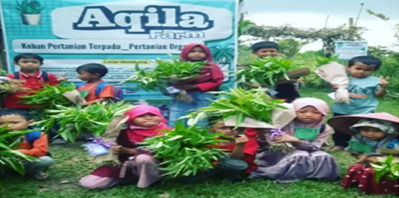
Implementation of Green-Based Learning in Effort to Realize Green Economy at Alam Elementary School Aqila Wonosari Klaten
DOI:
https://doi.org/10.61455/sicopus.v3i02.297Keywords:
green-based learning, green economy, environmental education, sustainable development, elementary school educationAbstract
Objective: This study aims to determine the implementation of Green-Based Learning to realize a Green Economy at SD Alam Aqila Wonosari Klaten for the 2024/2025 school year, as well as identify its supporting and inhibiting factors. Theoretical framework: This study uses the theoretical framework of continuing education and the Green Economy, which emphasizes the importance of environmental education from an early age. Literature review: The literature review covers environment-based education, the role of nature schools, and the concept of the Green Economy, as well as the importance of policy support and community involvement in green learning. Methods: This study uses a descriptive qualitative method with observation, interview, and documentation techniques. The validity of the data was tested by triangulation of sources and analyzed interactively. Results: The implementation of Green-Based Learning is carried out through curriculum integration, environmental projects, and community collaboration. Supporting factors: school policies, involvement of all parties, and availability of facilities. Inhibiting factors: limited resources, teacher competence, and community participation. Implications: This study emphasizes the importance of cooperation between schools, parents, and the community in supporting environmental education to realize the Green Economy from an early age. Novelty: The novelty of the research lies in contextual studies in nature schools as well as the mapping of supporting and inhibiting factors that apply to the Green-Based Learning model.
References
K. K. C. Cheung, J. J. Su, and L. Batalik, “Defining evidence-based nursing practice: An interpretative phenomenological study,” Nurse Educ. Today, vol. 144, 2025, https://doi.org/10.1016/j.nedt.2024.106400.
M. B. McCullough, M. D. Martin, and M. A. Sajady, “Implementing green walls in schools,” Front. Psychol., vol. 9, no. JUN, 2018, https://doi.org/10.3389/fpsyg.2018.00619.
M. C. Morris and P. Conroy, “Development of a simulation-based sub-module in undergraduate medical education,” Ir. J. Med. Sci., vol. 189, no. 1, pp. 389–394, 2020, https://doi.org/10.1007/s11845-019-02050-3.
M. H. Makarim, “Analysis of the Effect of Halal Supply Chain Management and Green Supply Chain,” 2019, [Online]. Available: https://revistas.ufrj.br/index.php/rce/article/download/1659/1508%0Ahttp://hipatiapress.com/hpjournals/index.php/qre/article/view/1348%5Cnhttp://www.tandfonline.com/doi/abs/10.1080/09500799708666915%5Cnhttps://mckinseyonsociety.com/downloads/reports/Educa
N. Abd. Wahab, R. Mohd Yusof, Z. Zainuddin, J. N. Shamsuddin, and S. F. N. Mohamad, “Charting future growth for Islamic finance talents in Malaysia: a bibliometric analysis on the Islamic finance domains and future research gaps,” J. Islam. Account. Bus. Res., vol. 14, no. 5, pp. 812–837, 2023, https://doi.org/10.1108/JIABR-02-2022-0045.
D. R. Bridges, R. A. Davidson, P. S. Odegard, I. V Maki, and J. Tomkowiak, “Interprofessional collaboration: Three best practice models of interprofessional education,” Med. Educ. Online, vol. 16, no. 1, 2011, https://doi.org/10.3402/meo.v16i0.6035.
L. Jacobs, “Peripheral Intravenous Catheter Insertion Competence and Confidence in Medical/Surgical Nurses,” J. Infus. Nurs., vol. 45, no. 6, pp. 306–319, 2022, https://doi.org/10.1097/NAN.0000000000000487.
R. Murtyaningsih, “Implementasi Metode Pembelajaran Everyone Is a Teacher Here Untuk Meningkatkan Prestasi Belajar Pendidikan Agama Islam Di Smk Muhammadiyah 2 Blora,” J. Ilm. Pedagog., vol. 8, pp. 140–159, 2017.
A. Nurhartanto and R. Murtyaningsih, “The Concept of Children ’ s Education in Islam Based on Surah Luqman Verses 13-15 : A Comparative Analysis of the Tafsir of Sayyid Qutb, M . Quraish Shihab, and Ibn Kathir,” Bull. Islam. Res., vol. 3, no. 2, pp. 387–396, 2025, https://doi.org/10.69526/bir.v3i2.339.
S. Anwar and S. Rosyidah, “Development Of Islamic Personality In The Digital Era With A Monotheism-Based Character Education Model,” J. Pedagog., vol. 17, no. 2, 2024.
W. Stai and M. Blora, “Studi Tokoh Novel Hafalan Shalat Delisa Karya Tere Liye,” J. Pedagog., vol. 17, no. 1, pp. 73–85, 2024.
M. N. U. Sukisno, Sholihul Anwar, “Pendidikan islam di era society 5.0 sebagai upaya pengembangan ilmu pengetahun,” in Prosiding Seminar Internasional, 2023, pp. 275–283.
K. Sholeha and W. Salsabilla, Najwa, “Moral Development Strategy In The Era Of Artifical Intelligence (AI),” in 1st International Conference On Islamic Education And Islamic Business ( ICoBEI ) Islamic Studies Faculty Universitas Islam Riau 2024, 2024, pp. 2022–2025.
Widodo, “Mengkritisi Faktor-Faktor Kegagalan,” J. Ilm. Pedagog., vol. 14, no. 1, pp. 110–125, 2019.
A. Nurhartanto, “Upaya Meningkatkan Nilai-Nilai Moderasi Beragama Di STAI Muhammadiyah Blora Melalui Penguatan Pemahaman Kaidah Kaidah Ushul Fiqih,” J. Pedagog., vol. 21, 2022, [Online]. Available: http://www.jurnal.staimuhblora.ac.id/index.php/pedagogy/article/view/140%0Ahttps://www.jurnal.staimuhblora.ac.id/index.php/pedagogy/article/download/140/127
and W. Ainiyah, “Melalui Pendidikan Agama Islam Nur Ainiyah , Nazar Husain Hadi Pranata Wibawa Abstrak A . Pendahuluan Pendidikan karakter menjadi isu penting dalam dunia pendidikan akhir-akhir ini , hal ini berkaitan dengan fenomena dekadensi moral yang terjadi ditengah,” Al-Ulum, vol. 13, no. 11, pp. 25–38, 2013.
S. W. Muh. Shodiq, Suyata, “Developing Quality Evaluation Instrument For Islamic Senior High School,” J. Penelit. Dan Eval. Pendidik., vol. 21, no. 2, pp. 1–17, 2008, https://doi.org/10.1017/CBO9781107415324.004.
I. K. Tsalikova and S. V Pakhotina, “Forming Soft Skills of University Students By Means of Academic Role-Playing Games At Foreign Language Classes,” Semant. Sch., 2013, [Online]. Available: https://www.semanticscholar.org/paper/FORMING-SOFT-SKILLS-OF-UNIVERSITY-STUDENTS-BY-MEANS-Tsalikova-Pakhotina/651fcb98f420bc7783de185d4f87f4424d59dc25
A. Triyanta, “Implementasi Kepatuhan Syariah dalam Perbankan Islam (Syariah) (Studi Perbandingan antara Malaysia dan Indonesia),” J. Huk. - UII, vol. 16, pp. 209–228, 2009, [Online]. Available: http://jurnal.uii.ac.id/index.php/IUSTUM/article/viewFile/3870/3445
W. Setyorini, A. R. Jannah, U. Wulansari, and M. Nisa, “Opportunities and challenges halal marketplace in Indonesia,” J. halal Prod. Res., vol. 4, no. 2, p. 90, 2021, https://doi.org/10.20473/jhpr.vol.4-issue.2.90-97.
Y. K. Dwivedi et al., “‘So what if ChatGPT wrote it?’ Multidisciplinary perspectives on opportunities, challenges and implications of generative conversational AI for research, practice, and policy,” Int. J. Inf. Manage., vol. 71, 2023, https://doi.org/10.1016/j.ijinfomgt.2023.102642.
M. L. N. Cawilan, J. M. L. Bermudez, N. B. Cabute, J. S. Pabulayan, J. K. A. D. Rufino, and E. F. Acoba, “Pet Attachment and Empathy of Filipino Pet Owners: The Moderating Role of Age,” N. Am. J. Psychol., vol. 26, no. 3, pp. 653 – 668, 2024.
A. Yunus, “Implementasi Pendidikan Karakter dalam Proses Pembelajaran di Sekolah Dasar Islam Terpadu Al-Madinah Kebumen Tahun 2014,” Profetika J. Stud. Islam, vol. 16, no. 48, pp. 181–193, 2014.
A. N. W. Samsul Hidayat, “Konsep Pendidikan Islam Ibnu Khaldun Relevansinya Terhadap Pendidikan Nasional,” Profetika J. Stud. Islam, vol. 16, no. 1, pp. 93–102, 2015.
N. Salam, “Pemikiran Pendidikan Islam Prof. Moch. Sholeh Y. a. Ichrom Tentang Sekolah Dasar Muhammadiyah Program Khusus Surakarta,” Profetika J. Stud. Islam, no. 1, pp. 71–80, 2019, https://doi.org/10.23917/profetika.v0i0.8950.
F. Zannah, “Integrasi Nilai-Nilai Pendidikan Karakter Berbasis Al Qur’an,” Tunas J. Pendidik. Guru Sekol. Dasar, vol. 5, no. 2, pp. 1–8, 2020, https://doi.org/10.33084/tunas.v5i2.1233.
M. Muthoifin, I. Rosyadi, and H. Prasetyo, “The phenomenon of the rise of online transactions: A case study Tokopedia.com and Bukalapak.com sharia perspective,” Multidiscip. Rev., vol. 7, no. 8, p. 2024133, May 2024, https://doi.org/10.31893/multirev.2024133.
E. D. Felix, J. D. Sharkey, J. G. Green, M. J. Furlong, and D. Tanigawa, “Getting precise and pragmatic about the assessment of bullying: The development of the California Bullying Victimization Scale,” Aggress. Behav., vol. 37, no. 3, pp. 234–247, 2011, https://doi.org/10.1002/ab.20389.
Y.-F. Wang and C.-C. Teng, “A transformative sustainability learning model for inculcating passion for learning about green food and beverage in hospitality college students,” J. Teach. Travel Tour., vol. 19, no. 4, pp. 302–325, 2019, https://doi.org/10.1080/15313220.2019.1592060.
Rina Murtyaningsih, “Implementasi Manajemen Pendidikan Dalam Mengembangkan Lembaga Pendidikan Islam,” J. Ilm. Peda, vol. 15, no. 1, pp. 1–6, 2023, https://doi.org/10.32832/tawazun.v15i1.7111.
S. Anwar, “Sekularisme Dan Studi Islam (Anwar),” J. Ilm. Pedagog., vol. 14, no. 1, p. 81, 2019, [Online]. Available: https://scholar.googleusercontent.com/scholar?q=cache:nhDldQsPwV4J:scholar.google.com/+sekulerisme&hl=id&as_sdt=0,5
R. Murtyaningsih, “Manajemen Kurikulum Pendidikan Islam Di Masa Pandemi,” J. Ilm. Pedagog., vol. 17, no. November 2021, https://doi.org/10.20414/jpk.v17i1.3464.
S. Sholihul Anwar, “Tinjauan Konsep Prulalis Dan Multikulutral Dalam Pendidikan Agama Islam,” J. Pedagog., vol. 17, no. April, pp. 118–127, 2024.
A. Nurhartanto, “Metode Penafsiran Dalam Ushul Fiqih Kontemporer: Kajian Terhadap Pendekatan Literal Dan Kontekstual,” J. Pedagog., vol. 16, no. 1, pp. 55–66, 2023.
S. Anwar, “Pembelajaran Studi Islam Dalam Konsepsi Literasi Digital di Era Disruptif,” J. Ilm. Pedagog., vol. 16, no. 1, pp. 157–178, 2021, [Online]. Available: http://www.jurnal.staimuhblora.ac.id/index.php/pedagogy/article/view/92%0Ahttp://www.jurnal.staimuhblora.ac.id/index.php/pedagogy/article/download/92/84
C. Green, “Consequences of neoliberal traits in curriculum design; English influences and the implementation of moral education in schools in the United Arab Emirates,” Glob. Soc. Educ., 2021, https://doi.org/10.1080/14767724.2021.1993150.
. Sulastiningsih and S. U. Wikaningtyas, “Green Entrepreneurship Motivation Model,” Acad. J. Interdiscip. Stud., vol. 12, no. 2, p. 262, 2023, https://doi.org/10.36941/ajis-2023-0047.
F. Stickle and J. D. Onedera, “Teaching gerontology in counselor education,” Educ. Gerontol., vol. 32, no. 4, pp. 247–259, 2006, https://doi.org/10.1080/03601270500493974.
Rochman Natawidjaja, “Peranan Guru dalam Bimbingan,” J. Ilm. Pedagog., vol. 12, p. 6, 1989.
Widodo, “Objek Kajian dan Urgensi Mempelajari Sejarah dan Peradaban Islam,” J. Pedagog., vol. 10, no. 3, pp. 7–11, 2017, [Online]. Available: http://jurnal.staimuhblora.ac.id/index.php/pedagogy/article/view/62
Rina Murtyaningsih, “Kontribusi Etos Kerja Islami Terhadap Kinerja Dosen,” J. Ilm. Pedagog., vol. 16, no. 1, p. 187, 2021, http://jurnal.radenfatah.ac.id/index.php/El-idare/article/view/675/60