Strategies for Cultivating Religious Character in Marginal and Minority Schools: A Case Study at Senior High Schools in the Kupang Archipelago
DOI:
https://doi.org/10.61455/sicopus.v2i03.292Keywords:
religious character, moral education, minority schools, kupang, character developmentAbstract
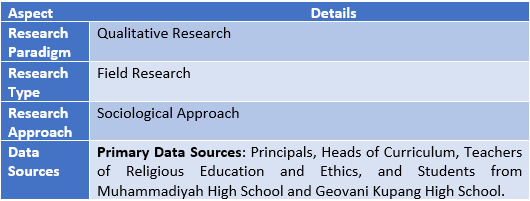
Objective: This research aims to explore the strategies for cultivating religious character in marginal and minority school contexts, focusing on Senior High Schools in the Kupang Archipelago, namely Muhammadiyah Kupang High School and Geovani Kupang High School. The study is motivated by growing concerns about declining moral values among students, where education appears overly focused on academics and detached from students’ personal development. Theoretical framework: The theoretical framework draws from character education theory, especially Lickona’s dimensions of moral knowing, moral feeling, and moral action, integrated with local values such as religious teachings, Pancasila, and Indonesian cultural heritage. Literature review: Literature on character education in marginalized and religiously diverse settings was reviewed, highlighting both the challenges and potential strategies that can be adapted to local sociocultural dynamics. Method: Using a qualitative field research approach, data were collected through interviews, observations, and documentation at both institutions. Data analysis was conducted through the stages of data reduction, data display, and conclusion drawing. Results: The findings reveal that Muhammadiyah Kupang High School emphasizes habituation, direct teaching, exemplary role models, motivational efforts, and the enforcement of school regulations. Meanwhile, Geovani Kupang High School applies teaching, modelling, setting moral priorities, practising selected priorities, and reflective activities. Both schools foster cognitive (moral knowing) and affective (moral loving) aspects of character but differ in developing the psychomotor aspect (moral action), which is only evident in Muhammadiyah High School. Implications: The behavioral impact observed includes more active, cheerful, and cooperative students at Muhammadiyah High School, where inclusive values and shared responsibilities are emphasized. In contrast, students at Geovani High School appear more disciplined and neat, but some show lower engagement and joy, possibly due to their minority status and stricter school norms. Novelty: The novelty of this research lies in its comparative analysis of religious character education in minority and marginal settings, contributing new insights to the discourse on inclusive and adaptive moral education strategies.
References
A. Yunus, “Implementasi Pendidikan Karakter dalam Proses Pembelajaran di Sekolah Dasar Islam Terpadu Al-Madinah Kebumen Tahun 2014,” Profetika J. Stud. Islam, vol. 16, no. 48, pp. 181–193, 2014.
S. Suidat, A. Husaini, D. Saefuddin, and E. Mujahidin, “Civic Education At Muhammadiyah Higher Education: Development Study of Hand Book of Menuju Kehidupan Yang Demokratis Dan Berkeadaban,” Profetika J. Stud. Islam, vol. 18, no. 1, pp. 1–17, 2017, https://doi.org/10.23917/profetika.v18i1.6296.
Diah Ayu Saraswati et al., “Analisis Kegiatan P5 di SMA Negeri 4 Kota Tangerang sebagai Penerapan Pembelajaran Terdiferensiasi pada Kurikulum Merdeka,” J. Pendidik. Mipa, vol. 12, no. 2, pp. 185–191, 2022, https://doi.org/10.37630/jpm.v12i2.578.
M. A. Cholidian, “Learning Motivation In Project Based Learning Model Of X Grade Student In Islamic Religious Education Learning In State Senior High School 7 Malang Thesis,” 2018. https://doi.org/10.1017/CBO9781107415324.004.
S. Satrio, “Redesain Bahan Ajar Untuk Meningkatkan Keterampilan Berbicara Bahasa Arab Bagi Peserta Didik Madrasah Aliyah Negeri,” Profetika J. Stud. Islam, vol. 22, no. 1, pp. 123–133, 2021, https://doi.org/10.23917/profetika.v22i1.14771.
R. Ramli, “Peran Guru Pendidikan Agama Islam Dalam Menanamkan Nilai Cinta Lingkungan Kepada Peserta Didik,” Profetika J. Stud. Islam, vol. 22, no. 1, pp. 80–90, 2021, https://doi.org/10.23917/profetika.v22i1.14767.
M. B. Muvid, M. Miftahuuddin, and M. Abdullah, “Pendidikan Islam Kontemporer Perspektif Hasan Langgulung Dan Zakiah Darajat,” Zawiyah J. Pemikir. Islam, vol. 6, no. 1, pp. 115–137, 2020, https://doi.org/10.31332/zjpi.v6i1.1703.
“Adeng Muchtar Ghazali State Islamic University ( UIN ) Sunan Gunung Djati Bandung Jl . A . H . Nasution No 105 Bandung, West Java-Indonesia Keywords : Pluralism, 7DV PXK, Inclusive Islamic Education Recently, an emerging phenomenon,” no. 105.
H. C. A. Kistoro, Zamroni, E. Istiyono, E. Latipah, and N. M. Burhan, “Islamic Character Education: Mapping and Networking Data Using Bibliometric Analysis,” J. Pendidik. Agama Islam, vol. 20, no. 2, pp. 195–214, 2023, https://doi.org/10.14421/jpai.v20i2.8027.
K. Risman and A. Asman, “The Pattern of Islamic Character Education of the Muhammadiyah Student Association (Imm) and Its Implementation in Formal Education,” Profetika J. Stud. Islam, vol. 23, no. 2, pp. 197–203, 2022, https://doi.org/10.23917/profetika.v23i2.19646.
S. S. Marwah, M. Syafe’i, and E. Sumarna, “Relevansi Konsep Pendidikan Menurut Ki Hadjar Dewantara Dengan Pendidikan Islam,” TARBAWY Indones. J. Islam. Educ., vol. 5, no. 1, p. 14, 2018, https://doi.org/10.17509/t.v5i1.13336.
I. W. Saputro, “Penanaman Pendidikan Karakter di Lembaga Pendidikan Non-Formal (Studi Kasus di Homeschooling Group Khairu Ummah, Bantul),” At-Ta’dib, vol. 12, no. 1, p. 19, 2017, https://doi.org/10.21111/at-tadib.v12i1.882.
A. W. Murti, “Implementasi the Hidden Curriculum Dalam Menumbuhkan Karakter Islami,” Profetika J. Stud. Islam, vol. 19, no. 1, pp. 13–19, 2019, https://doi.org/10.23917/profetika.v19i1.7749.
A. I. Asa, “Pendidikan Karakter Menurut Ki Hadjar Dewantara Dan Driyarkara,” J. Pendidik. Karakter, vol. 9, no. 2, pp. 245–258, 2019, https://doi.org/10.21831/jpk.v9i2.25361.
M. M. N. Muthoifin, “Outsourcing System because of Islamic Law : Study on Employees at Universitas Muhammadiyah Surakarta,” in Proceedings of the International Conference on Engineering, Technology and Social Science (ICONETOS 2020), Atlantis Press, 2021, https://doi.org/10.2991/assehr.k.210421.015.
S. Trihariyanto, E. Supriyanto, M. Muthoifin, and Z. ’Uyun, “Strategi Pembelajaran Inovatif Pendidikan Agama Islam Dengan Media Powerpoint Dalam Meningkatkan Mutu Pendidikan Di Sdit Muhammadiyah Sinar Fajar Cawas Dan Sd Muhammadiyah Pk Bayat,” Profetika J. Stud. Islam, vol. 21, no. 1, pp. 109–120, 2020, https://doi.org/10.23917/profetika.v21i1.11653.
A. Umi Markhamah Zahra Ayyusufi and A. Anshori, “Evaluation of the Cipp Model on the Tahfidz Program in Islamic Boarding Schools,” J. Pendidik. Islam, vol. 5, no. 2, pp. 466–484, 2022, https://doi.org/10.31538/nzh.v5i2.2230.
A. Amrin, K. Khairusoalihin, and M. Muthoifin, “Tax Modernization in Indonesia: Study of Abu Yusuf’s Thinking on Taxation in the Book of Al-Kharaj,” Profetika J. Stud. Islam, vol. 23, no. 1, pp. 30–42, 2021, https://doi.org/10.23917/profetika.v23i1.16792.
M. Apriantoro, A. Suryaningsih, and M. Muthoifin, “Bibliometric Analysis of Research Development of Economic Dispute Settlement,” in EUDL European Union Digital Library, 2023. https://doi.org/10.4108/eai.19-10-2022.2329068.
M. Adi Haironi, “Implementasi Metode Taḥfīẓul Qur’an ‘Sabaq, Sabqi, Manzil’ Di Marhalah Mutawasithah Dan Tsanawiyah Putri Pondok Pesantren Imam Bukhari Tahun Pelajaran 2010-2014,” UMS, 2016.
T. Sanyoto, N. Fadli, R. Irfan Rosyadi, and M. Muthoifin, “Implementation of Tawhid-Based Integral Education to Improve and Strengthen Hidayatullah Basic Education,” Solo Univers. J. Islam. Educ. Multicult., vol. 1, no. 01, pp. 30–41, 2023, https://doi.org/10.61455/sujiem.v1i01.31.
D. Astuti, E. Supriyanto, and M. Muthoifin, “Model Penjaminan Mutu Ketercapaian Kompetensi Dasar Dalam Sistem Pembelajaran Online Pada Situasi Work From Home (Wfh),” Profetika J. Stud. Islam, vol. 21, no. 1, pp. 129–139, 2020, https://doi.org/10.23917/profetika.v21i1.11655.
A. H. Muthoifin, Didin Saefuddin, “Pemikiran Pendidikan Ki Hadjar Dewantara Dalam Perspektif Pendidikan Islam,” Ta’dibuna J. Pendidik. Islam, vol. 2, no. 2, pp. 155–200, 2013, https://doi.org/10.32832/tadibuna.v2i2.562.
M. Muthoifin and F. Fahrurozi, “Nilai-Nilai Pendidikan Tauhid Dalam Kisah Ashabul Ukhdud Surat Al-Buruj Perspektif Ibn Katsir Dan Hamka,” Profetika J. Stud. Islam, vol. 19, no. 2, pp. 163–174, 2018, https://doi.org/10.23917/profetika.v19i2.8123.
S. Anwar et al., “Development of the concept of Islamic education to build and improve the personality of school-age children,” Multidiscip. Rev., vol. 7, no. 8, p. 2024139, May 2024, https://doi.org/10.31893/multirev.2024139.
W. Waston, S. Amini, and M. Arifin, “A moral-based curriculum to improve civilization and human resource development in Bangladesh,” Multidiscip. Rev., 2024.
N. Muthoifin, “Kontekstualisasi Makna Zakat: Studi Kritis Kosep Sabilillah Menurut Masdar Farid Mas’udi,” in The 3rd University Research Colloquium 2016, 2016, pp. 185–191.
M. Muhamad Subhi Apriantoro, “The Epistemology of Ushul Fiqh Al-Ghazali in His Book Al-Mustashfa Min Ushuf Fiqh,” Profetika J. Stud. Islam, vol. 22, no. 2, pp. 229–236, 2021, https://doi.org/10.23917/profetika.v22i2.16668.
S. Shobron, M. Nur, and R. Maksum, “Humanist Education the Dayak of Kalimantan Indonesia Islamic Perspective,” Solo Univers. J. Islam. Educ. Multicult., vol. 1, no. 1, pp. 17–25, 2023, https://doi.org/10.61455/sujiem.v1i01.27.
S. N. Asia and M. S. Apriantoro, “Analysis of Islamic Economic Law on Fishing Pool Business in Indonesia,” Demak Univers. J. Islam Sharia, vol. 1, no. 1, pp. 1–11, 2023, https://doi.org/10.61455/deujis.v1i01.7.
Z. Ardiansyah., Waston., Mahmudulhassan., Daud and M. Salleh., Norsaleha Mohd., AN, Andri Nirwana., “Tracing Trends in Quran Memorization and Cognitive Learning: A Bibliometric Analysis from the Scopus Database,” Pakistan J. Life Soc. Sci., vol. 22, no. 2, pp. 1493–1509, 2024, https://doi.org/10.57239/PJLSS-2024-22.2.00105.
Q. Q. Yusran and A. Nirwana, “The Practice of Changing the Status of Change of Waqf Property in the Islamic Social Economic View,” J. Ecohumanism, vol. 6798, pp. 229–238, 2024, https://doi.org/10.62754/joe.v3i6.3996.
Q. Q. Yusran and I. Afiyah, “Optimizing the Potential of Zakat to Alleviate Poverty Problems and Improve Community Economy in Surakarta City,” J. Ecohumanism, vol. 6798, pp. 121–132, 2024, https://doi.org/10.62754/joe.v3i3.3394.
A. A. Moh. Abdul Kholiq Hasan, Muthoifin, “Metode Pembelajaran Tahfīżul Qur’Ᾱn Di Madrasah Ibtida’iyah Tahfīżul Qur’Ᾱn Al-Ma’shum Surakarta Dan Isy Karima Karangayar Jawa Tengan,” Profetika J. Stud. I Slam, vol. 20, no. 2, pp. 168–178, 2019.
M. A. K. Hasan, “The Component Characteristics of A Favorite Teacher In The Era of Industrial Revolution 4.0 (Study in verses 129 and 151 of Surah al-Baqarah),” Profetika J. Stud. Islam, vol. 23, no. 1, pp. 52–66, 2021, https://doi.org/10.23917/profetika.v23i1.16794
N. Yahya, A. Nirwana, G. Giyoto, and S. D. Raharjo, “The Cases Of Student Burnout At Independent Doktor,” Profetika J. Stud. Islam, vol. 23, no. 2, 2022, https://doi.org/10.23917/profetika.v23i2.19643.
F. Rachmadhani, “Atsar al-Audho’ al-Ijtimaiyyah fi Fahmi al-Sunnah al-Nabawiyyah wa Istinbathi al-Ahkam al-Syar’iyyah,” Profetika J. Stud. Islam, vol. 21, no. 1, 2020.
R. Rudiyanto, “Pandangan Keuangan Publik Abu Yusuf Dan Implementasinya Di Indonesia,” Profetika J. Stud. Islam, vol. 22, no. 1, pp. 134–140, 2021, https://doi.org/10.23917/profetika.v22i1.14772.
Q. D. H. dan M. A. K. Hasan, “Kiai Abdurrochim ( Kajian Pemakaian Rasm Dan,” Profetika, J. Stud. Islam, vol. 21, pp. 59–61, 2020.
S. Anwar, K. G. Permatasari, S. Nur, M. Munawar, and M. N. Shabrina, “History of Muhammadiyah in Blora Mustika City : Development and Challenges,” Pakistan J. Life Soc. Sci., vol. 22, pp. 812–821, 2024, https://doi.org/10.57239/PJLSS-2024-22.2.0059.
A. Nurrohim, A. H. Setiawan, and A. A. Sweta, “The Concept of Islamic Moderation in Indonesia : A Comparative Study in Tafsir An-Nur and Tafsir of the Ministry of Religious Affairs ( MORA ),” Int. J. Relig., vol. 3538, no. 10, pp. 2110–2125, 2024, https://doi.org/10.61707/5b1e9h02.
Muthoifin et al., “Profit-Sharing Practices To Increase Profits and Development of Indonesian Sharia Banking,” Rev. Gest. Soc. e Ambient., vol. 18, no. 6, pp. 1–17, 2024, https://doi.org/10.24857/rgsa.v18n6-005.
H. Huzaery, B. Sumardjoko, T. Kasturi, and A. Nirwana, “Enhancing Parent-Teacher Collaboration in Tahfidzul Qur ’ a Learning : Roles, Challenges, and Strategies,” Int. J. Relig., vol. 3538, no. 10, pp. 3850–3874, 2024, https://doi.org/10.61707/jxn48760.
N. Y. Muthoifin, I. R. Isman, and M. Ishmah Afiyah, “Fostering The Ummah ’ S Economy Through The Stock-investment System : The Views Of The Mui For Sustainable Development Goals (SDGs),” J. Lifestyle SDGs Rev., vol. 4, pp. 1–19, 2024, https://doi.org/10.47172/2965-730X.SDGsReview.v4.n00.pe01685.
A. N. Suwarsono, Bambang Setiadji, Musa Asy’arie, Waston, Muthoifin, “The Future Of The Civilization Of The Ummah Is Reviewed From The Sociology Of Education For The Sustainable Development Goals ( SDG ’ S ),” J. Lifestyle SDGs Rev., vol. 4, pp. 1–19, 2024, https://doi.org/10.47172/2965-730X.SDGsReview.v4.n00.pe01688.
M. Sri Mega Indah Umi Zulfiani and I. Rosyadi, “Corporate Social Responsibility (CSR) Practices Of Shariaconsumer Cooperatives For Sustainable Development Goals (SDGs) Ethical Perspective,” J. Lifestyle SDGs Rev., vol. 4, pp. 1–20, 2024, https://doi.org/10.47172/2965-730X.SDGsReview.v4.n00.pe01752.
T. G. Ginting, “Forming a Solid Foundation : The Role of Early Childhood Education in Character Development,” Solo Univers. J. Islam. Educ. Multicult., vol. 2, no. 1, pp. 71–82, 2024.
A. A. Jabbar, M. Achour, M. B. Alauddin, T. Al Mutawakkil, I. Afiyah, and J. H. Srifyan, “The Existence of Multicultural-Universal Education Values in Pesantren,” Solo Univers. J. Islam. Educ. Multicult., vol. 1, no. 3, pp. 221–234, 2024.
H. Lebdaoui, Y. Chetioui, and T. Harkat, “Propensity towards Islamic banking among non-users: a mixed-methods analysis,” J. Financ. Serv. Mark., vol. 29, no. 1, pp. 45–66, 2024, https://doi.org/10.1057/s41264-022-00178-5.
M. Ari Kurniawati, “Effective Qur ’ an Learning Strategies to Strengthen Children s Memorization with Zahrawain Method,” Solo Univers. J. Islam. Educ. Multicult., vol. 2, no. 1, pp. 37–48, 2024.
N. Tattaqillah, M. Z. Lillah, B. Ali, and M. Sule, “The Existence of Education as a Rehabilitation, Preventive, Curative, and Moral Development Strategy in Madrasah,” Solo Univers. J. Islam. Educ. Multicult., vol. 2, no. 1, pp. 1–18, 2024.
S. Begum, “Artificial Intelligence in Multicultural Islamic Education : Opportunities, Challenges, and Ethical Considerations,” Solo Univers. J. Islam. Educ. Multicult., vol. 2, no. 1, pp. 19–26, 2024.
M. Abuzar, L. Yafi, I. Afiyah, and I. Amelia, “Strategy and Implementation of Islamic Personality Development through the Internalization of Religious Values at Madrasah Aliyah Dakka, Bangladesh,” Solo Univers. J. Islam. Educ. Multicult., vol. 2, no. 2, pp. 167–180, 2024.
M. Abuzar, “Developing Religious Identity : Assessing the Effects of Aliya Madrasahs on Muslim Students in Bangladesh,” Solo Univers. J. Islam. Educ. Multicult., vol. 2, no. 1, pp. 49–60, 2024.
I. Yaumil, F. Bansu, N. S. B. Elmanaya, M. Gamal, I. Elbasiouny, and S. Shobron, “Religious Values and Multiculturalism in the Sayyang Pattu ’ du Tradition in West Sulawesi Indonesia,” Solo Univers. J. Islam. Educ. Multicult., vol. 1, no. 2, pp. 104–117, 2023.
M. Iqbal et al., “Jasadiyah Education in Modern Pesantren with Multicultural and Democratic Style,” Solo Univers. J. Islam. Educ. Multicult., vol. 1, no. 3, pp. 235–252, 2023.
S. U. A. K. Mahmudulhassan, Waston, Muthoifin, “Understanding the Essence of Islamic Education : Investigating Meaning, Essence, and Knowledge Sources,” Solo Univers. J. Islam. Educ. Multicult., vol. 2, no. 1, pp. 27–36, 2024.
D. R. Munir and A. Aquil, “The Influence of the Qiyas Method on the Students’ Ability to Understand the Book of Alfiyah Ibnu Malik at Islamic Boarding School,” Solo Univers. J. Islam. Educ. Multicult., vol. 1, no. 02, pp. 96–103, 2023.