Marketing Strategy of Fruit Traders in Attracting Consumer Buying Interest: A Study of Honesty and Consistency
DOI:
https://doi.org/10.61455/sicopus.v3i02.288Keywords:
marketing, honesty, consumer behavior, islamic business ethics, trade practicesAbstract
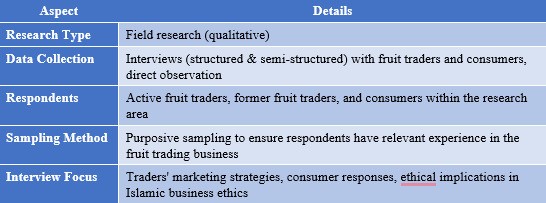
Objective: Marketing strategies play a crucial role in influencing consumer behavior, and one of the commonly employed techniques is the use of marketing gimmicks. This study aims to analyze the impact of marketing gimmicks on consumer buying interest while examining the values of honesty and consistency in their application from the perspective of Sharia business principles. Theoretical framework: The theoretical framework of this research is based on Islamic business ethics, particularly the principles of honesty (shidq) and consistency (istiqamah) in trade. Literature review: The literature review explores various studies on marketing strategies, consumer behavior, and ethical considerations in business, particularly within the framework of Islamic economics. Methods: This study employs a qualitative field research method. Data collection was conducted through direct interviews with fruit traders and their customers to obtain firsthand insights into marketing gimmicks used in the marketplace. The analysis utilizes an interpretative approach to understand the alignment of these gimmicks with Islamic business ethics. Results: The findings indicate that many fruit traders implement marketing gimmicks that can sometimes mislead consumers, particularly in price determination and product presentation. While these gimmicks effectively attract consumer interest, they often lack transparency, leading to misunderstandings about the actual value of the products. The study highlights that such practices contradict the fundamental Sharia business principles of honesty and consistency, which emphasize truthful representation and ethical sales practices. Implications: The implications of this research suggest the need for increased awareness and education among traders regarding ethical marketing strategies that align with Islamic values. Policymakers and business associations could also play a role in promoting fair trade practices that uphold integrity in business transactions. Novelty: The novelty of this research lies in its integration of Islamic business ethics with modern marketing strategies.
References
S. Razavi and L. Turquet, Progress of the world’s women 2015–2016: Transforming economies, realizing rights, vol. 16, no. 1. 2016. https://doi.org/10.1177/1468018115624314.
M. S. Apriantoro, Yasir Hasanridhlo, Widhi Indira Laksmi, Leny Agustin, and M. Z. Husain, “A Barter System for Used Palm Oil Traders: Islamic Law Perspective,” Demak Univers. J. Islam Sharia, vol. 1, no. 01, pp. 57–66, 2023, https://doi.org/10.61455/deujis.v1i01.34.
A. Haris, A. Umi, and M. Zahra, Proceedings of the 1st International Seminar on Sharia, Law and Muslim Society (ISSLAMS 2022), vol. 1, no. 81. Atlantis Press SARL, 2022. https://doi.org/10.2991/978-2-494069-81-7.
H. J. Kim and B. Hudayana, “What Makes Islamic Microfinance Islamic? A Case of Indonesia’s Bayt al-Māl wa al-Tamwīl,” Stud. Islam., vol. 29, no. 1, pp. 31–54, 2022, https://doi.org/10.36712/sdi.v29i1.17862.
E. Willya, A. B. B. Maronrong, and S. Mokodenseho, “The Enforcement of MUI Fatwa Number 1 of 2003 concerning Copyright for Merchants Selling Pirated VCD and DVD in Manado City,” Al-Ahkam, vol. 31, no. 2, pp. 183–202, 2021, https://doi.org/10.21580/ahkam.2021.31.2.8638.
Hamzah, “Pendayagunaan Zakat Pada Budan Amil Zakat Nasional Dalam Meningkatkan Kesejahteraan Umat,” 2009, [Online]. Available: http://repository.uinjkt.ac.id/dspace/bitstream/123456789/39386/1/HAMZAH - SPS.pdf
V. G. Demirci, “Practices of ethnography and mixed quantitative data analysis methods in experiential marketing,” in Handbook of Research on Interdisciplinary Reflections of Contemporary Experiential Marketing Practices, Aksaray University, Turkey: IGI Global, 2022, pp. 101–120. https://doi.org/10.4018/978-1-6684-4380-4.ch006.
L. O. Nazaruddin, B. Gyenge, M. Fekete-Farkas, and Z. Lakner, “The Future Direction of Halal Food Additive and Ingredient Research in Economics and Business: A Bibliometric Analysis,” Sustain., vol. 15, no. 7, 2023, https://doi.org/10.3390/su15075680.
M. H. Salleh, “The Integrated Islamic Education ,” Singapore Islam. Educ. Syst. SIES Semin., pp. 1–13, 2009.
K. M. Haradhan, “The First Industrial Revolution: Creation of a New Global Human Era,” J. Soc. Sci. Humanit., vol. 5, no. 4, pp. 377–387, 2019.
C. N. Castel-Branco, N. Massingue, and C. Muianga, “Questions on productive development in Mozambique,” no. May 2017, pp. 1–410, 2015,
G. H. Rassool, “Re-Examining the Anatomy of Islamic Psychotherapy and Counselling: Envisioned and Enacted Practices,” Islam. Guid. Couns. J., vol. 4, no. 2, pp. 132–144, 2021, https://doi.org/10.25217/igcj.v4i2.1840.
É. N. de M. Frazen, E. C. O. Menezes, R. C. Dos Santos, and R. A. Rosa, “The Economy and the Environment in Debate: Limits and Potential for a New Scenario for Sustainable Development and Objectives,” J. Lifestyle SDG’S Rev., vol. 4, pp. 1–16, 2024, https://doi.org/10.37497/2965-730X.SDGsReview.v4.n00.pe01596.
R. O. Tumanggor, “The Conversion of Religion in Psychological Perspective,” pp. 836–844, 2016.
M. Burley, “SāṃKhya,” Hist. Indian Philos., pp. 131–140, 2017, https://doi.org/10.4324/9781315666792.
B. B. Hering and H. Feith, The Decline of Constitutional Democracy in Indonesia. 2007. https://doi.org/10.2307/40198726.
Y. M. Nugraha, “Analisis Potensi Promosi Pariwisata Halal Melalui E-Marketing Di Kepulauan Riau,” J. Penelit. Dan Karya Ilm. Lemb. Penelit. Univ. Trisakti, vol. 3, no. 2, pp. 63–68, 2018, https://doi.org/10.25105/pdk.v3i2.2990.
M. P. Van Phung and A. P. D. L. N. D. Khoi, “Solutions To Enhancing Tourism Services On Phu Quoc Island, Vietnam,” in Proceeding International Conference On Tourism, Technology and Business Management (ICTTBM), 2018, 2018.
A. Day, Religion and the individual: Belief, practice, identity. 2016. https://doi.org/10.4324/9781315604848.
M. Lister, J. Dovey, S. Giddings, K. Kelly, and I. Grant, Women & media: a critical introduction, vol. 44, no. 04. 2006. https://doi.org/10.5860/CHOICE.44-1949.
K. K. Isoldi and J. D. Burrowes, Counseling approaches. 2014. https://doi.org/10.1007/978-1-62703-685-6_26.
D. Hafidhuddin, “Peran Strategis Organisasi Zakat Dalam Menguatkan Zakat Di Dunia,” Al-Infaq J. Ekon. Islam, vol. 2, no. 1, pp. 1–4, 2019, [Online]. Available: http://www.jurnalfai-uikabogor.org/index.php/alinfaq/article/view/361/256
A. Safithri, Kawakib, and H. A. Shiddiqi, “Implementasi Nilai-Nilai Moderasi dan Toleransi Antar Umat Beragama dalam Menciptakan Kerukunan Masyarakat di Kota Pontianak Kalimantan Barat,” Al Fuadiy, vol. 4, no. 1, pp. 13–26, 2022, https://doi.org/10.55606/af.v4i1.7.
COMCEC, “Muslim Friendly Tourism: Developing and Marketing MFT Products and Services In the OIC Member Countries,” in Standing Committee for Economic and Commercial Cooperation of the Organization of Islamic Cooperation (COMCEC), Tur: For further information please contact: COMCEC Coordination Office Necatibey Caddesi, 2016, pp. 20–22.
A. Mulyadi, E. Supriyanto, M. Muthoifin, and S. Shobron, “Upaya Peningkatan Mutu Sekolah Dengan Strateg Bauran Pemasaran Untuk Kepuasan Pelanggan Pada Smp Muhammadiyah Sinar Fajar Cawas Dan Smpit Muhammadiyah an Najah Jatinom Klaten,” Profetika J. Stud. Islam, vol. 21, no. 1, pp. 121–128, 2020, https://doi.org/10.23917/profetika.v21i1.11654.
Nurrudin, “Dalam Mewujudkan Ketangguhan,” Transfpemasi Hadits-hadits Dalam Mewujudkan Ketangguhan Ekon. Pada Era Mod., vol. 01, p. 2, 2014.
M. Azizah, “Penerapan Etika Bisnis Islam Dalam Transaksi Jual Beli Daring Di Toko Online Shopee,” Fak. Syariah, Univ. Semarang, vol. 10, no. 1, pp. 83–96, 2020, https://doi.org/10.26623/humani.v10i1.1848.
H. A. Said and N. Ferdiani, “Methodology of the Qur ’ an and Its Tafsir By the Ministry,” Stud. Islam., vol. 20, no. 1, pp. 1–29, 2022, https://doi.org/10.24239/jsi.v20i1.689.
A. Jayanegara, A. Mukhtarom, and I. Marzuki, “Innovative learning methods of Islamic education subject in Indonesia: a meta-analysis,” Int. J. Eval. Res. Educ., vol. 13, no. 2, pp. 1148 – 1158, 2024, https://doi.org/10.11591/ijere.v13i2.26364.
E. Mahrus, A. Salim, I. Muttaqin, and T. Supriyatno, “Memorization and discussion methods effect on achievement and communication skills,” Int. J. Eval. Res. Educ. , vol. 13, no. 2, pp. 1123–1131, 2024, https://doi.org/10.11591/ijere.v13i2.26952.
A. M. Ahmad, A. A. Rahman, M. H. Saleh, and Z. Daud, “Diversifying Quranic revision methods using gamification-based teaching material for tahfiz education,” Int. J. Eval. Res. Educ., vol. 13, no. 2, pp. 987 – 996, 2024, https://doi.org/10.11591/ijere.v13i2.26218.
A. Topadang and A. Triyono, “Decision support system for selection of tourism in Tana Toraja using technique for order preference method by similarity to ideal solution (topsis),” IOP Conf. Ser. Mater. Sci. Eng., vol. 885, no. 1, 2020, https://doi.org/10.1088/1757-899X/885/1/012031.
I. Fauji, E. F. Fahyuni, A. Muhid, and Z. N. Fahmawati, “Implementing Child-Friendly Teaching Methods To Improve Qur’an Reading Ability,” J. Pendidik. Islam, vol. 6, no. 1, pp. 69–78, 2020, https://doi.org/10.15575/jpi.v6i1.8078.
Takiddin, “Uang Dalam Perspektif Ekonomi Islam,” SALAM J. Filsafat dan Budaya Huk., vol. 1, no. 2, 2014, https://doi.org/10.15408/sjsbs.v1i2.1539.
R. Shafarni, “Implementasi Khiyar Dalam Jual Beli Barang Secara Online ( Suatu Penelitian terhadap Para Reseller di Banda Aceh ),” UIN Ar-Raniri, Banda Aceh, 2018.
G. T. Pambekti, “Tinjauan Hukum Islam Terhadap Pelaksanaan Khiyar Pada Jual Beli Online di Indonesia,” J. Akses, vol. 12, no. 24, pp. 84–98, 2017.
Melis, “Prinsip & Batasan Konsumsi Dalam Islam,” Islam. Bank., vol. Volume 1 N, pp. 13–19, 2015.
C. Coker et al., “Perspektif Hukum Islam Tentang Jual Beli Pakaian Bekas di Pasar Perumnas Way Halim Bandar Lampung,” Transcommunication, vol. 53, no. 1, pp. 1–8, 2018, https://doi.org/10.58471/dalihannatolu.v1i02.182.
S. S. Java, “Fenomena Online Shop Di Instagram (Studi Fenomenologi Online Shop Pada Konsumen Di Instagram).” pp. 1–7, 1991.
W. Hidayat, “Analisis Hukum Islam TerhadapMalapraktik dalam Jual Beli Online,” 2019.
Yuliani, “Konsep Dan Peran Strategis Ekonomi Syariah Terhadap Isu Kemiskinan,” Iqtishadia, vol. 8, no. 1, p. 133, 2022, https://doi.org/10.35448/jequ.v12i2.17500.
C. D. Elviera, “Universitas Dharmawangsa Transformasi Perilaku Konsumen Di Masa Pra Dan Pasca Pandemi Covid 19 (Studi Kasus Pembelian Produk Shopee),” J. Bisnis Net, vol. 19, no. 2, pp. 2621–3982, 2022, https://doi.org/10.46576/bn.v5i2.2767.
A. Nissa, N. Sa’adiyah, R. Hidayat, and A. R. Anshori, “Prosiding Hukum Ekonomi Syariah Analisis Perilaku Konsumen Muslim Dalam Melakukan Jasa Gesek Tunai Melalui Shopee PayLater Pada Marketplace di Aplikasi Shopee,” Pros. Huk. Ekon. Syariah Anal. Perilaku Konsum. Muslim Dalam Melakukan Jasa Gesek Tunai Melalui Shopee PayLater Pada Marketpl. Di Apl. Shopee, vol. 7, no. 2, pp. 304–308, 2021.
M. N. U. Sukisno, Sholihul Anwar, “Pendidikan islam di era society 5.0 sebagai upaya pengembangan ilmu pengetahun,” in Prosiding Seminar Internasional, 2023, pp. 275–283.
Rina Murtyaningsih, “Kontribusi Etos Kerja Islami Terhadap Kinerja Dosen,” J. Ilm. Pedagog., vol. 16, no. 1, p. 187, 2021, [Online]. Available: http://jurnal.radenfatah.ac.id/index.php/El-idare/article/view/675/607
R. Murtyaningsih, “Manajemen Kurikulum Pendidikan Islam Di Masa Pandemi,” J. Ilm. Pedagog., vol. 17, no. November 2021, https://doi.org/10.20414/jpk.v17i1.3464.
A. Nurhartanto, “Upaya Meningkatkan Nilai-Nilai Moderasi Beragama Di STAI Muhammadiyah Blora Melalui Penguatan Pemahaman Kaidah Kaidah Ushul Fiqih,” J. Pedagog., vol. 21, 2022, [Online]. Available: http://www.jurnal.staimuhblora.ac.id/index.php/pedagogy/article/view/140%0Ahttps://www.jurnal.staimuhblora.ac.id/index.php/pedagogy/article/download/140/127
S. Anwar, “Pembelajaran Studi Islam Dalam Konsepsi Literasi Digital di Era Disruptif,” J. Ilm. Pedagog., vol. 16, no. 1, pp. 157–178, 2021, [Online]. Available: http://www.jurnal.staimuhblora.ac.id/index.php/pedagogy/article/view/92%0Ahttp://www.jurnal.staimuhblora.ac.id/index.php/pedagogy/article/download/92/84
Widodo, “Objek Kajian dan Urgensi Mempelajari Sejarah dan Peradaban Islam,” J. Pedagog., vol. 10, no. 3, pp. 7–11, 2017, [Online]. Available: http://jurnal.staimuhblora.ac.id/index.php/pedagogy/article/view/62
A. Nurhartanto, “Metode Penafsiran Dalam Ushul Fiqih Kontemporer: Kajian Terhadap Pendekatan Literal Dan Kontekstual,” J. Pedagog., vol. 16, no. 1, pp. 55–66, 2023.
K. Sholeha and W. Salsabilla, Najwa, “Moral Development Strategy In The Era Of Artifical Intelligence (AI),” in 1 st International Conference On Islamic Education And Islamic Business ( ICoBEI ) Islamic Studies Faculty Universitas Islam Riau 2024, 2024, pp. 2022–2025.
S. Anwar and S. Rosyidah, “Development Of Islamic Personality In The Digital Era With A Monotheism-Based Character Education Model,” J. Pedagog., vol. 17, no. 2, 2024.
Q. Q. Yusran and A. Nirwana, “The Practice of Changing the Status of Change of Waqf Property in the Islamic Social Economic View,” J. Ecohumanism, vol. 6798, pp. 229–238, 2024, https://doi.org/10.62754/joe.v3i6.3996.