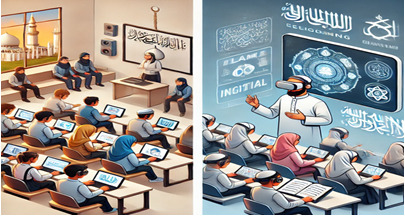
Islamic Religious Learning in the Digital Age: An Interactive Method for Generation Z
DOI:
https://doi.org/10.61455/sicopus.v2i03.222Keywords:
Islamic religious learning, generation z, interactive methods, digital era, educational technologyAbstract
This research aims to explore and develop interactive and relevant Islamic religious learning methods for Generation Z in the digital era. Generation Z has unique characteristics, such as a high tendency towards technology, a practical and visual learning style, and the need to get information instantly. Given these needs, conventional learning approaches are considered less effective in attracting their interest in exploring Islam. This study uses a qualitative research method with data collection techniques through in-depth interviews, observations, and literature studies related to digital learning methods and religious teaching. Participants in this study include students, Islamic teachers, and experts in the field of digital education. The results of the study show that technology-based interactive methods, such as learning apps, educational short videos, interactive quizzes, and discussions on social media platforms, can increase the interest and engagement of Generation Z in learning Islam. The use of digital media not only makes the learning process more interesting but also helps students understand religious concepts in a more applicable and relevant way to daily life. In addition, the application of gamification, augmented reality (AR), and virtual reality (VR) in Islamic religious learning shows great potential to enhance immersive and contextual learning experiences. The implications of this study are the need for the integration of digital technology in the Islamic religious learning curriculum, as well as training for educators so that they can use interactive methods effectively. The novelty of this study lies in a holistic approach that combines digital interactive methods with religious learning, which has not been widely applied in the context of Islamic education. This research is expected to be a reference for educators and curriculum developers in creating Islamic religious learning strategies that are more adaptive, interactive, and able to answer the unique needs and characteristics of Generation Z.
References
H. Dzaki, M. Asma, R. W. Suci, U. Sakhinah, and F. Hidayat, “Causes of Online Gambling Entangling Gen Z,” Solo Int. Collab. Publ. Soc. Sci. Humanit., vol. 2, no. 3, 2024.
A. H. Arribathi, “Peran Teknologi Informasi Dalam Pendidikan Agama Islam Untuk Menghadapi Tantangan Di Era Global Dan Generasi Z,” vol. 1, no. 1, 2021.
Y. F. Ulfah, A. E. Rochmawan, and F. Alhasbi, “Islamic Ethics Education Concept For Gen Z : Ibn Miskawayh ’ S View On Philosophy,” Profetika J. Stud. Islam, vol. 25, no. 1, pp. 211–222, 2024.
M. Miftakhuddin, “Pengembangan Model Pendidikan Agama Islam dalam Membentuk Karakter Empati pada Generasi Z,” J. Pendidik. Agama Islam, vol. 17, no. 1, pp. 1–16, 2020, https://doi.org/10.14421/jpai.2020.171-01.
B. Yusuf, “Teknologi dan Personalisasi Pembelajaran Pendidikan Islam untuk Generasi Z,” vol. 4, no. 4, pp. 277–285, 2024, https://doi.org/10.53621/jider.v4i4.344.
T. Sanyoto, N. Fadli, R. Irfan Rosyadi, and M. Muthoifin, “Implementation of Tawhid-Based Integral Education to Improve and Strengthen Hidayatullah Basic Education,” Solo Univers. J. Islam. Educ. Multicult., vol. 1, no. 01, pp. 30–41, 2023, https://doi.org/10.61455/sujiem.v1i01.31.
M. Muhamad Subhi Apriantoro, “The Epistemology of Ushul Fiqh Al-Ghazali in His Book Al-Mustashfa Min Ushuf Fiqh,” Profetika J. Stud. Islam, vol. 22, no. 2, pp. 229–236, 2021, https://doi.org/10.23917/profetika.v22i2.16668.
L. S. Jannah, N. Pratiwi, S. Bengkalis, E. Digital, E. Online, and Z. Generasi, “Pendidikan Karakter Dalam Era Digital : Tantangan Dan Peluang Dalam Membentuk Etika Online Bagi,” vol. 9, pp. 77–81, 2024.
A. Umi Markhamah Zahra Ayyusufi and A. Anshori, “Evaluation of the Cipp Model on the Tahfidz Program in Islamic Boarding Schools,” J. Pendidik. Islam, vol. 5, no. 2, pp. 466–484, 2022, https://doi.org/10.31538/nzh.v5i2.2230.
D. Astuti, E. Supriyanto, and M. M, “Model Penjaminan Mutu Ketercapaian Kompetensi Dasar Dalam Sistem Pembelajaran Online Pada Situasi Work From Home (Wfh),” Profetika J. Stud. Islam, vol. 21, no. 1, pp. 129–139, 2020, https://doi.org/10.23917/profetika.v21i1.11655.
S. Trihariyanto, E. Supriyanto, M. M, and Z. ’Uyun, “Strategi Pembelajaran Inovatif Pendidikan Agama Islam Dengan Media Powerpoint Dalam Meningkatkan Mutu Pendidikan Di Sdit Muhammadiyah Sinar Fajar Cawas Dan Sd Muhammadiyah Pk Bayat,” Profetika J. Stud. Islam, vol. 21, no. 1, pp. 109–120, 2020, https://doi.org/10.23917/profetika.v21i1.11653.
M. M and F. Fahrurozi, “Nilai-Nilai Pendidikan Tauhid Dalam Kisah Ashabul Ukhdud Surat Al-Buruj Perspektif Ibn Katsir Dan Hamka,” Profetika J. Stud. Islam, vol. 19, no. 2, pp. 163–174, 2018, https://doi.org/10.23917/profetika.v19i2.8123.
A. H. M, Didin Saefuddin, “Pemikiran Pendidikan Ki Hadjar Dewantara Dalam Perspektif Pendidikan Islam,” Ta’dibuna J. Pendidik. Islam, vol. 2, no. 2, pp. 155–200, 2013, https://doi.org/10.32832/tadibuna.v2i2.562.
A. Amrin, K. Khairusoalihin, and M. M, “Tax Modernization in Indonesia: Study of Abu Yusuf’s Thinking on Taxation in the Book of Al-Kharaj,” Profetika J. Stud. Islam, vol. 23, no. 1, pp. 30–42, 2021, https://doi.org/10.23917/profetika.v23i1.16792.
M. Nuha, “Kontekstualisasi Makna Zakat: Studi Kritis Kosep Sabilillah Menurut Masdar Farid Mas’udi,” in The 3rd University Research Colloquium 2016, 2016, pp. 185–191.
M. Apriantoro, A. Suryaningsih, and M. M, “Bibliometric Analysis of Research Development of Economic Dispute Settlement,” in EUDL European Union Digital Library, 2023. https://doi.org/10.4108/eai.19-10-2022.2329068.
M. Adi Haironi, “Implementasi Metode Taḥfīẓul Qur’an ‘Sabaq, Sabqi, Manzil’ Di Marhalah Mutawasithah Dan Tsanawiyah Putri Pondok Pesantren Imam Bukhari Tahun Pelajaran 2010-2014,” UMS, 2016.
M. M. Nugroho. M, “Outsourcing System in View of Islamic Law : Study on Employees at Universitas Muhammadiyah Surakarta,” in Proceedings of the International Conference on Engineering, Technology and Social Science (ICONETOS 2020), Atlantis Press, 2021, https://doi.org/10.2991/assehr.k.210421.015.
S. Shobron, M. Nur, and R. Maksum, “Humanist Education the Dayak of Kalimantan Indonesia Islamic Perspective,” Solo Univers. J. Islam. Educ. Multicult., vol. 1, no. 1, pp. 17–25, 2023, https://doi.org/10.61455/sujiem.v1i01.27.
S. Anwar et al., “Development of the concept of Islamic education to build and improve the personality of school-age children,” Multidiscip. Rev., vol. 7, no. 8, p. 2024139, May 2024, https://doi.org/10.31893/multirev.2024139.
S. N. Asia and M. S. Apriantoro, “Analysis of Islamic Economic Law on Fishing Pool Business in Indonesia,” Demak Univers. J. Islam Sharia, vol. 1, no. 1, pp. 1–11, 2023, https://doi.org/10.61455/deujis.v1i01.7.
W. Waston, S. Amini, and M. Arifin, “A moral-based curriculum to improve civilization and human resource development in Bangladesh,” Multidiscip. Rev., 2024.
T. A. Rafsanjani and M. A. Razaq, “Internalisasi Nilai-Nilai Keislaman Terhadap Perkembangan Anak Di Sekolah Dasar Muhammadiyah Kriyan Jepara,” Profetika J. Stud. Islam, vol. 20, no. 1, pp. 16–29, 2019, https://doi.org/10.23917/profetika.v20i1.8945.
M. A. R. Toni Ardi Rafsanjani and 1, “Educational Problems in Indonesia,” Solo Univers. J. Islam. Educ. Multicult., vol. 2, no. 2, pp. 135–144, 2024.
T. A. Rafsanjani and M. A. Rozaq, “Peran Gerakan Jama’Ah Dan Dakwah Jama’Ah Dalam Internalisasi Nilai-Nilai Islam Di Ranting Muhammadiyah Blimbingrejo,” Profetika J. Stud. Islam, vol. 23, no. 1, pp. 146–152, 2021, https://doi.org/10.23917/profetika.v23i1.16804.
E. R. Alhadjrath, P. W. Hutami, and M. A. P, “Peran Pendidikan Agama Islam dalam Membangun Karakter Generasi Z,” vol. 7, pp. 30380–30384, 2023.
T. A. Rafsanjani, M. Abdurozaq, and R. Saputro, “Multicultural Learning : Christian Students at Muhammadiyah Mayong Senior High School,” vol. 3, no. 1, pp. 1–10, 2025.
P. Anak, D. I. Sekolah, T. A. Rafsanjani, and M. A. Rozaq, “Internalisasi Nilai-Nilai Keislaman Terhadap Muhammadiyah Kriyan Jepara,” vol. 20, no. 1, pp. 16–29, 2018.
S. Elmaliyasari, N. R. Rusdiyanto, and E. Kusumastuti, “Jurnal Kependidikan Jurnal Kependidikan,” vol. 9, no. 1, pp. 7–15, 2024.
A. K. Syafeie, I. Syekh, and N. Cirebon, “Peran Kyai dalam Meningkatkan Kecerdasan Spiritual Remaja Generasi Z di Pesantren Anwarul Huda nilai-nilai agama kepada anak didik , seperti kasih sayang , keadilan , kejujuran , tanggung jawab ,” vol. 8, no. 3, pp. 138–152, 2021.
M. M and A. Y. Rhezaldi, “Community economic empowerment through mosque management to improve people’s welfare,” Multidiscip. Rev., vol. 7, no. 8, 2024, https://doi.org/10.31893/multirev.2024134.
E. B. G. Suwoko, Waston, Bambang Setiaji, M, Huda Kurnia Maulana, “Family Education To Improve The Quality Of Human Resources And Sustainable Development In Samarinda,” Rev. Gestão Soc. e Ambient., vol. 18, no. 6, pp. 1–19, 2024, https://doi.org/10.24857/rgsa.v18n6-011.
Muthoifin et al., “Profit-Sharing Practices To Increase Profits and Development of Indonesian Sharia Banking,” Rev. Gest. Soc. e Ambient., vol. 18, no. 6, pp. 1–17, 2024, https://doi.org/10.24857/rgsa.v18n6-005.
Waston et al., “Islamophobia and Communism: Perpetual Prejudice in Contemporary Indonesia,” Rev. Gestão Soc. e Ambient., vol. 18, no. 2, p. e04875, Feb. 2024, https://doi.org/10.24857/rgsa.v18n2-075.
A. A. Amtiran and A. Kriswibowo, “Kepemimpinan Agama Dan Dialog Antaragama : Strategi Pembangunan Masyarakat Multikultural Berbasis Moderasi Beragama,” vol. 8, pp. 331–348, 2024, https://doi.org/10.37329/jpah.v8i3.3165.
D. I. Kelurahan and K. Kendal, “Santo Antonio Padua Dengan Umat Islam,” 2016.
A. N. AN, . M., . M., and . W., “Bibliometric Analysis of Islamic Education and Character Development in Religious Education Practices in Indonesia,” Pakistan J. Life Soc. Sci., vol. 22, no. 2, pp. 1231–1245, 2024, https://doi.org/10.57239/PJLSS-2024-22.2.0086.
A. A. Astuti, S. A. Aryani, S. Hidayat, . W., A. N, Andri Nirwana, and . M., “Parent Practices of SMPIT Insan Mulia Surakarta in Implementing Sexual Education from An Islamic Perspective to Children in The Digital Era,” Int. J. Relig., vol. 5, no. 10, pp. 2092–2109, Jun. 2024, https://doi.org/10.61707/6msvvh24.
H. Huzaery, B. Sumardjoko, T. Kasturi, and A. Nirwana, “Enhancing Parent-Teacher Collaboration in Tahfidzul Qur ’ an Learning : Roles, Challenges, and Strategies,” Int. J. Relig., vol. 3538, no. 10, pp. 3850–3874, 2024, https://doi.org/10.61707/jxn48760.
M. Sudarno Shobron, Amrin, Imron Rosyadi, “Islamic Education Values in the Tradition of Peta Kapanca of Mbojo Community Tribe in West Nusa Tenggara,” Int. J. Adv. Sci. Technol., vol. 29, no. 5, pp. 6802–6812, 2020.
N. Hidayat, “The Implementation of Character Education Model at Islamic Boarding School of Pabelan, Magelang, Central Java,” J. Pendidik. Islam, vol. 5, no. 2, p. 431, 2016, https://doi.org/10.14421/jpi.2016.52.431-455.