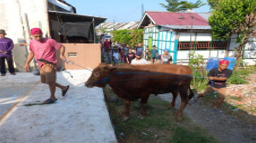
Community Empowerment through Sharia-Based Animal Slaughter and Animal Welfare Education during Eid al-Adha
DOI:
https://doi.org/10.61455/deujis.v4i01.678Keywords:
community empowerment, sacrificial animals, islamic slaughter, animal welfare, maqasid al-shariahAbstract
Objective: This article aims to develop a community empowerment model educating residents about sharia-compliant sacrificial slaughter and animal welfare during Eid al-Adha. It draws on Muthoifin’s field research in Surakarta to identify needs and inform program design in Indonesian communities. Theoretical framework: The model integrates Islamic slaughtering principles, ihsan (kindness and excellence), and animal welfare standards. Maqasid al-shariah provides the analytical foundation, particularly protection of life (hifz al-nafs), wealth and food resources (hifz al-mal), and religion (hifz al-din). Literature review: Previous research indicates that rough handling, inadequate transportation, noisy and overcrowded holding areas, and limited handler skills are associated with stress responses in cattle and goats. Conversely, gentle handling, calm holding facilities, clean, sharp equipment, and appropriate slaughter procedures can reduce animal distress. These findings underscore the need to connect ritual compliance with ethical treatment. Methods: A participatory approach is proposed, involving coordination with mosque administrators and sacrificial committees, needs assessment, instruction on slaughter jurisprudence and ihsan, animal-handling demonstrations, assistance in developing standard operating procedures, and participant evaluation. Instruments comprise pre- and post-tests, an observational checklist, and participant reflection. Results: The field research identifies risk factors and welfare-supportive practices in sacrificial animal management. However, the source material does not document implementation of this proposed program; therefore, no actual training outcomes or numerical improvements are claimed. Evaluation tables are intended for completion using implementation data. Implications: The model can guide mosque committees, slaughterers, and educators in improving knowledge, handling skills, procedural consistency, and ethical accountability while aligning sacrificial practices with maqasid-based considerations. Novelty: The article proposes an integrated, participatory educational model connecting sharia compliance, ihsan, and animal welfare, translating field-based needs into practical community training and evaluation procedures with measurable learning and practical competency indicators for committees.
References
I. A. Shahdan, J. M. Regenstein, A. S. M. Shahabuddin, and M. T. Rahman, “Developing control points for halal slaughtering of poultry,” Poult. Sci., vol. 95, no. 7, pp. 1680–1692, 2016, https://doi.org/10.3382/ps/pew092.
Muthoifin, I. Afiyah, and Nuha, “Behavioral responses of cows and goats during slaughtering for Eid Al-Adha: A field study in Surakarta,” J. Anim. Behav. Biometeorol., vol. 12, no. 4, 2024, https://doi.org/10.31893/jabb.2024034.
A. Alam, “Animal welfare studies in religious and Halal slaughter studies : A literature review,” J. Anim. Behav. Biometeorol., vol. 12, no. 3, 2024, https://doi.org/10.31893/jabb.2024019.
S. L. Adrenalin, G. W. Airlangga, and A. B. Hardian, “Analisis Distribusi Titik Pemotongan Hewan Kurban pada Idul Adha 1440H di Kota Malang, Jawa Timur, Indonesia Analysis of Slaughtering Points Distribution during Eid al-Adha 1440H in Malang City, East Java, Indonesia,” Vet. Biomed. Clin. J., vol. 2, no. 2, pp. 32–38, 2020, https://doi.org/10.21776/ub.VetBioClinJ.2020.002.02.5.
R. Khan et al., “Halal slaughtering, welfare, and empathy in farm animals: a review,” Trop. Anim. Heal. Prod., vol. 50, pp. 1733–1738, 2018, https://doi.org/10.1007/s11250-018-1644-1.
K. N. Rochmah, M. R. Saufi, M. Novitasari, F. Sugiyarto, P. Hendraswari, and M. I. Amal, “Ethics and Philosophy of Science in Herbal Medicine Technology: Opportunities and Challenges for SDGs,” Maktab. Rev. Sustain. Dev. Goals, vol. 1, no. 3, pp. 181–194, 2024.
A. A. Sarvestani, “Insights into Self-Knowledge from Islamic Teachings : A Path Towards Ethical Environmental Stewardship within the Framework of the SDGs,” Profetika J. Stud. Islam, vol. 25, no. 2, pp. 375–386, 2024, https://doi.org/10.23917/profetika.v25i02.6721.
A. Bălășescu and S.-C. Ailincăi, “The deposition of dogs (Canis Familiaris) at satu nou – valea lui voicu (Babadag Culture),” Mater. si Cercet. Arheol., vol. 16, pp. 57–85, 2020, https://doi.org/10.3406/mcarh.2020.2124.
D. Berti and A. Good, “Introduction: The judicialisation and politicisation of sacrifice,” Anim. Sacrif. Relig. Law South Asia, pp. 1–50, 2023, https://doi.org/10.4324/9781003284949-1.
S. R. Perwita, K. F. Az-zahra, F. K. Devita, and F. Hidayat, “A Critical Review of the Slaughter of Kendhit Goats to Reject Bala in the Perspective of Islamic Aqidah,” Demak Univers. J. Islam Sharia, vol. 2, no. 3, pp. 257–270, 2024, https://doi.org/10.61455/deujis.v2i03.160.
A. Alam, A. El Ashfahany, S. Aisyah, A. Ramadayanti, and M. I. Tabash, “Animal welfare studies in religious and Halal slaughter studies: A literature review,” J. Anim. Behav. Biometeorol., vol. 12, no. 3, p. 2024019, 2024, https://doi.org/10.31893/jabb.2024019.
N. Chaachouay and L. Zidane, “The importance of animals in sacrificial rituals and socio-religious occasions practised by the indigenous communities of Morocco and strategies to conserve them from extinction,” Biologia (Bratisl., vol. 79, no. 3, pp. 753–773, 2024, https://doi.org/10.1007/s11756-023-01548-7.
V. A. Barroso, J. F. N. Mederos, and P. C. Alonso, “Animals and ritual Fannal remains from sacrificial altars of El Alto de Garajonay (La Gomera, Canary Islands),” Zephyrus, vol. 76, pp. 159–179, 2015, https://doi.org/10.14201/zephyrus201576159179.
M. Sinclair et al., “International perceptions of animals and the importance of their welfare,” Front. Anim. Sci., vol. 3, 2022, https://doi.org/10.3389/fanim.2022.960379.
SPSS, “Data processed from SPSS ‘Long-term owning of animals,’” 2025.
S. M. Riazul, “Empowering Young Da ’ i through Digital Literacy Training for Promoting Islamic Moderation,” Walidem Int. J. Community Engagem., vol. 1, no. 1, 2025.
A. Alam, R. S. Nizam, and M. T. Hidayat, “The Role of Islamic Microfinance Institution in Empowering Indonesian Fishing Communities,” Univers. J. Account. Financ., vol. 9, no. 2, pp. 178–183, 2021, https://doi.org/10.13189/ujaf.2021.090205.
M. Iqbal, K. Chaghtai, A. A. Jabbar, M. Achour, and E. Geraldine, “Concept, Implementation, and Development of Productive Zakat Management for Social, Educational, and Humanitarian,” Demak Univers. J. Islam Sharia, vol. 2, no. 1, pp. 67–78, 2024, https://doi.org/10.61455/deujis.v2i01.103.
L. Yafi and T. Al Mutawakkil, “Innovating Finance: Applying the Nash Concept to Develop a Sustainable Pawn Model Aligned with the SDGs,” Maktab. Rev. Sustain. Dev. Goals, vol. 1, no. 1, pp. 1–12, 2024.
E. R. Shore, D. K. Douglas, and M. L. Riley, “What ’ s in it for the Companion Animal ? Pet Attachment and College Students ’ Behaviors Toward Pets,” J. Appl. Anim. Welf. Sci., vol. 8, no. 1, pp. 1–11, 2005, https://doi.org/10.1207/s15327604jaws0801_1.
M. S. Firman, Isman, Muhammad Ammar Al-amudi, and Prabu Arya Sembara, “Zakat Fund Management Strategy for Mustahik Welfare Maqashid Sharia Perspective,” Profetika J. Stud. Islam, vol. 24, no. 02, pp. 277–291, 2023, https://doi.org/10.23917/profetika.v24i02.2469.
M. N. Alim and A. Rohman, “2018 the Governance Type of Pondok Pesantren ’ S Business Unit and,” South East Asia Journal Contemp. Business, Econ. Law, vol. 17, no. 2, pp. 56–62, 2018.
K. A. Cobb, G. A. Brown, R. H. Hammond, and L. H. Mossop, “Alumni-based evaluation of a novel veterinary curriculum: Are Nottingham graduates prepared for clinical practice?,” Vet. Rec. Open, vol. 2, no. 2, 2015, https://doi.org/10.1136/vetreco-2015-000116.
Setiyowati, “Design/methodology/approach: This is an exploratory qualitative research, employing a thematic analysis approach. Six Muslim Wills (State) Enactments [Enakmen Wasiat Orang Islam (Negeri)] in Malaysia, Islamic Law Compilation (Kompilasi Hukum Islam) in Ind,” Croat. Int. Relations Rev., vol. 28, no. 89, pp. 136–149, 2022, https://doi.org/10.2478/CIRR-2022-0008.
H. Snyder, “Literature review as a research methodology: An overview and guidelines,” J. Bus. Res., vol. 104, pp. 333–3, https://doi.org/10.61455/sicopus.v2i01.12039, 2019, https://doi.org/10.1016/j.jbusres.2019.07.039.
K. Hamidu, A. Amsalu, and J. H. Srifyan, “Social Safety Concept : Exploring Human Values, Justice, and Sharia,” Solo Int. Colab. Publ. Soc. Sci. Humanit. Publ. Soc. Sci. Humanit., vol. 2, no. 1, pp. 61–72, 2024.
Y. Amalia, F. Ashari, I. Afiyah, M. Ali, and R. Sanjani, “Optimizing Public Policies for Stunting Prevention: A Maqashid Sharia and SDGs-Based Framework,” Maktab. Rev. Sustain. Dev. Goals, vol. 1, no. 2, pp. 119–130, 2024, https://doi.org/10.61455/sicopus.v2i01.120.
T. Widiastuti, Muryani, P. S. Sukmaningrum, S. Rusgianto, A. F. Hady, and A. Robani, “Critical Review of Social Safety Net in COVID Era Based on Maqashid Sharia Framework: Indonesia Case,” Proc. 1st UMGESHIC Int. Semin. Heal. Soc. Sci. Humanit. (UMGESHIC-ISHSSH 2020), vol. 585, no. 2016, pp. 432–440, 2021, https://doi.org/10.2991/assehr.k.211020.061.
R. P. Sari and A. C. Adi, “Sistem Penentuan Kualitas Hewan Qurban di Indonesia dengan Metode SAW,” J. Nas. Teknol. dan Sist. Inf., vol. 7, no. 2, pp. 44–51, 2021, https://doi.org/10.25077/teknosi.v7i2.2021.44-51.
Annisa Rahmi et al., “Praktik Higiene Dan Sanitasi Dalam Pemotongan Hewan Kurban Saat Wabah PMK Hygiene and Sanitation Practices in Animal Qurban,” J. Qardhul Hasan; Media Pengabdi. Kpd. Masy., vol. 8, no. 3, pp. 223–228, 2022.
W. Winanti et al., “Edukasi Tata Kelola Dan Penyembelihan Hewan Qurban Secara Syar’I Pada Kampung Tematik Drum Bujana,” Pros. Konf. Nas. Pengabdi. Kpd. Masy. dan Corp. Soc. Responsib., vol. 6, pp. 1–8, 2023, https://doi.org/10.37695/pkmcsr.v6i0.1878.
Sulaeman, R. Mahriani, and A. Nurdin, “Komunikasi Tradisi Abda ’ u pada Prosesi Hewan Qurban Adat Tulehu Maluku,” KOMUNIKA J. Dakwah dan Komun. Vol. 13, no. 2, pp. 201–218, 2019, https://doi.org/10.24090/komunika.v13i2.2067.
S. T, N. G. B. Putra, S. A. Fadhil, H. F. Ramadhito, and F. Syifa, “Perancangan Sistem Informasi Penjualan Hewan Qurban Studi Kasus Yayasan XYZ,” J. Ilmu Komput. dan Bisnis, vol. 12, no. 2, pp. 140–147, 2021, https://doi.org/10.47927/jikb.v12i2.151.
I. N. Muflikha, S. Sya’roni, A. Alqahoom, and S. Pramana, “The Investment of Sharia Shares in Indonesia Stock Exchange Representative in Sharia Law Economic Perspective,” Demak Univers. J. Islam Sharia, vol. 1, no. 01, pp. 27–36, 2023, https://doi.org/10.61455/deujis.v1i01.25.
A. A. Itsna Nur Muflikha, Sya’roni, “Investment Of Sharia Shares In Indonesia Stock Exchange Representative In Sharia Law Economic Perspective,” Demak Univers. J. Islam Sharia, vol. 01, no. 1, pp. 24–32, 2023, https://doi.org/10.61455/deujis.v1i01.25.
A. I. Ibad, “Pemanfaatan Barang Gadai (Studi Komparatif Fiqh Empat Madzhab),” Al-Ulum, vol. 3, no. 2, pp. 55–67, 2017.
A. W. Murti, “Implementasi the Hidden Curriculum Dalam Menumbuhkan Karakter Islami,” Profetika J. Stud. Islam, vol. 19, no. 1, pp. 13–19, 2019, https://doi.org/10.23917/profetika.v19i1.7749.
E. Galgut, “A Critique of the Cultural Defense of Animal Cruelty,” J. Anim. Ethics, vol. 9, no. 2, pp. 184–198, 2019, https://doi.org/10.5406/janimalethics.9.2.0184.
M. Jung, “Islamophobia through Animal Ethics in The Netherlands,” 2022, https://doi.org/10.3390/rel13100955
R. E. Otto, “J’Accuse: Animal Accusation in 2 Enoch,” J. Anim. Ethics, vol. 11, no. 1, pp. 1–10, 2021, https://doi.org/10.5406/janimalethics.11.1.0001.
M. Jung, “Religion, Animals, and Racialization: Articulating Islamophobia through Animal Ethics in The Netherlands,” Religions, vol. 13, no. 10, p. 955, 2022, https://doi.org/10.3390/rel13100955.
M. S. E. Azam and M. A. Abdullah, “Global Halal Industry: Realities and Opportunities,” Int. J. Islam. Bus. Ethics, vol. 5, no. 1, p. 47, 2020, https://doi.org/10.30659/ijibe.5.1.47-59.