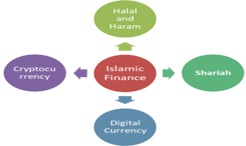
Cryptocurrency in the Framework of Islamic Finance: Evaluating Halal and Haram Dimensions
DOI:
https://doi.org/10.61455/deujis.v4i01.635Keywords:
cryptocurrency, digital currency, halal and haram, islamic finance, sharia complianceAbstract
Objective: The study examines the Sharia status of cryptocurrency by assessing its characteristics, functions, and transaction mechanisms based on fiqh al-muʿāmalāt, particularly its status as māl or thamaniyyah and its potential involvement in ribā, gharar, and maysir. Theoretical framework: The study is grounded in Islamic commercial jurisprudence, focusing on māl, thamaniyyah, ribā, gharar, maysir, and maqāṣid al-Sharīʿah as principles for evaluating cryptocurrency transactions. Literature review: The review discusses cryptocurrency, Islamic finance, contemporary fatwas, and scholarly debates concerning its classification, economic functions, potential benefits, and Sharia-related risks. Methods: The study employs a qualitative doctrinal approach based on Qur’anic principles, Sunnah, classical jurisprudence, contemporary fatwas, and recent academic literature on cryptocurrency and Islamic finance. Results: The analysis finds that cryptocurrency cannot be assigned a uniform halal or haram status solely on the basis of its technological form. Its Sharia status depends on the characteristics of the particular token, its economic function, transaction structure, and manner of use. Cryptocurrency may perform certain functions of money and facilitate lawful exchange, financial inclusion, remittances, and transparent transactions. However, high volatility, speculative trading, uncertain valuation, weak consumer protection, illicit uses, and interest-based products associated with some platforms raise substantial Sharia concerns. The findings therefore support a conditional, case-by-case approach to Sharia assessment. Implications: The findings highlight the need for case-by-case Sharia assessment and responsible governance that considers transparency, utility, transaction mechanisms, consumer protection, and the objectives of Sharia. Novelty: The study introduces a conditional approach to cryptocurrency assessment by shifting the focus from the technology itself toward token design, economic utility, transaction structure, and the presence or absence of prohibited Sharia elements.
References
A. Musgamy, R. Rappe, R. Abd. Rahman, A. A. Muslimin, and S. Nadirah, “Quality Governance and Institutional Negotiation in Indonesian Islamic Higher Education under Globalised Policy Regimes,” Int. J. Learn. Teach. Educ. Res., vol. 25, no. 3, pp. 1011–1032, 2026, https://doi.org/10.26803/ijlter.25.3.45.
H. Qiestha Khaira, A. Irawan, and M. Tamam, “Cryptocurrency in Islamic Economics: A Critical Analysis of Dogecoin’s Compliance with Sharia Principles,” Al-Risalah J. Ilmu Syariah dan Huk., vol. 25, no. 1, pp. 133–152, Feb. 2025, https://doi.org/10.24252/al-risalah.vi.55707.
I. M. Lawal, “The suitability of cryptocurrency in the structure of Islamic banking and finance,” J. Perspekt. Pembiayaan dan Pembang. Drh., vol. 6, no. 6, pp. 639–648, Jul. 2019, https://doi.org/10.22437/ppd.v6i6.6603.
M. A. G. Al Zuraib, “Cryptocurrencies and Blockchain in Islamic Jurisprudence: A Comparative Legal and Economic Study,” Int. J. Environ. Sci., vol. 11, no. 1s, pp. 659–661, Jul. 2025, https://doi.org/10.64252/ncq8cs85.
Z. Ahmad, M. N. Mokal, I. al- Amatullah, and M. N. A. Mafaz, “An Evaluation of Bitcoin From Sharia Perspective,” Rev. Appl. Manag. Soc. Sci., vol. 6, no. 2, pp. 459–480, Jun. 2023, https://doi.org/10.47067/ramss.v6i2.343.
A. Diallo and A. B. H. A. Aziz, “Cryptocurrencies and Zakat Applicability: An Analysis of the Fatwa Genre,” Sprin J. Arts, Humanit. Soc. Sci., vol. 4, no. 1, pp. 34–42, Feb. 2025, https://doi.org/10.55559/sjahss.v4i1.468.
S. N. Khan, “The legality of cryptocurrency from an Islamic perspective: a research note,” J. Islam. Account. Bus. Res., vol. 14, no. 2, pp. 289–294, Feb. 2023, https://doi.org/10.1108/JIABR-02-2022-0041.
O. P. Dahlan, “Sharia-compliant cryptocurrency: Navigating opportunities and challenges at the intersection of Islamic finance and digital innovation,” J. Islam. Econ. Insights, vol. 1, no. 1, pp. 40–46, Jan. 2025, https://doi.org/10.55942/jiei.v1i1.293.
G. A. Atiyah, N. A. Manap, A. I. Ibrahim, and A. Rahman, “Legitimacy of Smart Contracts from the Perspective of Islamic Law: A Case Study of Blockchain Transactions,” Al-Istinbath J. Huk. Islam, vol. 9, no. 1, p. 155, May 2024, https://doi.org/10.29240/jhi.v9i1.8726.
D. S. Sallom and M. S. Mufatzizah, “Analisis Hukum Crytocurrency Kajian Fikih Dan Fatwa-Fatwa Di Luar Negeri,” Ahkam J. Huk. Islam, vol. 11, no. 1, pp. 151–168, Jul. 2023, https://doi.org/10.21274/ahkam.2023.11.1.151-168.
A. Balarabe, M. F. Abdullah, and A. Rahman, “Cryptocurrency in Nigeria: a Review From Contemporary Islamic Scholars’ Perspective,” J. Syariah, vol. 32, no. 3, pp. 466–486, Dec. 2024, https://doi.org/10.22452/syariah.vol31no3.5.
E. Al-Mansouri, “Is Bitcoin Haram in Sharia? A Methodological Critique of the Prohibition Fatwa,” J. Balk. Econ. Manag., vol. 1, no. 2, pp. 83–156, Jul. 2025, https://doi.org/10.51331/bemA06.
I. Sujono, M. H. Rochman, and A. A. Mu’ala, “Crypto Currency Trading in Islam: An Attempt to Explore the Law amidst Technological Advances,” Int. J. Islam. Thought Humanit., vol. 4, no. 1, pp. 81–87, Apr. 2025, https://doi.org/10.54298/ijith.v4i1.395.
A. A. I. Izadin, R. Mohd. Yusof, and A. R. Mazlan, “The integration of Maqasid Sharia in evaluating stablecoins and traditional cryptocurrencies for Islamic portfolios diversification,” Int. J. Islam. Middle East. Financ. Manag., vol. 18, no. 3, pp. 577–597, Apr. 2025, https://doi.org/10.1108/IMEFM-08-2024-0380.
H. Desky and A. K. M. Hye, “Exploring Smart Contracts In Islamic Finance: Blockchain-Based Sharia-Compliant Transactions,” AT-TIJARAH J. Penelit. Keuang. dan Perbank. Syariah, vol. 7, no. 1, pp. 50–61, Jun. 2025, https://doi.org/10.52490/at-tijarah.v7i1.6022.
F. Z. Benali, W. M. Miftahussurur, R. A. S. Santos, and Zaenol Hasan, “The Algorithmic Fiqh: Qiyas and the Cryptocurrency Paradigm,” Indones. J. Islam. Law, vol. 8, no. 1, pp. 1–28, Jun. 2025, https://doi.org/10.35719/c3g8zb70.
H. Setiawan, “Analysis of Cryptocurrency As a New Currency With the Maqashid Sharia Approach,” KOMITMEN J. Ilm. Manaj., vol. 6, no. 1, pp. 50–61, Jan. 2025, https://doi.org/10.15575/jim.v6i1.43722.
M. M. Abdeldayem, S. H. Al Dulaimi, and F. H. Al Dulaimi, “A qualitative approach to evaluate the reconciliation of GOLDX and OneGram in Islamic finance,” Zb. Rad. Ekon. Fak. u Rijeci / Proc. Rijeka Fac. Econ., vol. 39, no. 1, pp. 113–134, 2021, https://doi.org/10.18045/zbefri.2021.1.113.
M. D. Rahmatya, M. S. A. Latif, M. H. Mahaiyadin, and M. S. S. P. M. Shith, “Islamic Sale & Purchase Principles in Decentralized Exchanges: An Evaluation of Sharia Compliance,” Ahkam J. Ilmu Syariah, vol. 25, no. 2, pp. 215–230, 2025, https://doi.org/10.15408/ajis.v25i2.41250.
N. R. Febriandika, A. N. Faizah, and H. Imaduddin, “Sentiment analysis on cryptocurrency in a Muslim-majority country: Evidence from Indonesian social media,” Invest. Manag. Financ. Innov., vol. 23, no. 2, pp. 264–275, 2026, https://doi.org/10.21511/imfi.23(2).2026.20.
A. Balarabe, M. F. Abdullah, M. H. Rahman, and M. Z. Daud, “Sharia Governance Of Cryptocurrencies: Risks, Parameters and Regulatory Solutions,” Jurisdictie J. Huk. dan Syariah, vol. 16, no. 2, pp. 452–481, 2025, https://doi.org/10.18860/j.v16i2.35817.
M. M. Taha and M. Alanezi, “Mac Coin on Bchain Mac: a Stable and Islamic Compatible Cryptocurrency Model,” Iraqi J. Sci., vol. 67, no. 6, pp. 3502–3510, 2026, https://doi.org/10.24996/ijs.2026.67.6.35.
S. K. Basarud-Din And N. S. N. Abdullah, “Can Bitcoin be used for Zakat Payment?,” Int. J. Econ. Manag., vol. 17, no. 2, pp. 273–285, 2023, https://doi.org/10.47836/ijeam.17.2.09.
N. Albalawee and A. S. Al Fahoum, “Islamic legal perspectives on digital currencies and how they apply to Jordanian legislation [version 1; peer review: 1 approved with reservations],” F1000Research, vol. 12, 2023, https://doi.org/10.12688/f1000research.128767.1.
A. K. M. Meera, “Cryptocurrencies From Islamic Perspectives: the Case of Bitcoin,” Bul. Ekon. Monet. dan Perbankan/Monetary Bank. Econ. Bull., vol. 20, no. 4, pp. 475–492, 2018, https://doi.org/10.21098/bemp.v20i4.902.
A. Nasir, K. Shaukat, K. I. Khan, I. A. Hameed, T. M. Alam, and S. Luo, “What is Core and What Future Holds for Blockchain Technologies and Cryptocurrencies: A Bibliometric Analysis,” IEEE Access, vol. 9, pp. 989–1004, 2021, https://doi.org/10.1109/ACCESS.2020.3046931.
A. Bossman, M. Gubareva, S. K. Agyei, and X. V. Vo, “Time-frequency comovements between environmental cryptocurrency sentiment and faith-based sectoral stocks,” Int. Rev. Econ. Financ., vol. 91, pp. 699–719, 2024, https://doi.org/10.1016/j.iref.2024.01.068.
M. Widjaja, Gaby, and S. A. H. Havidz, “Are gold and cryptocurrency a haven for stocks and bonds? Conventional vs Islamic markets during the COVID-19 pandemic,” Eur. J. Manag. Bus. Econ., vol. 33, no. 1, pp. 96–115, 2024, https://doi.org/10.1108/EJMBE-05-2022-0135.
M. I. Rosele et al., “The Concept of Wealth (māl) in the Sharīʿah and Its Relation to Digital Assets,” SAGE Open, vol. 12, no. 2, 2022, https://doi.org/10.1177/21582440221102424.
N. Muhammad, S. S. F. Alwi, M. Katan, N. M. H. Nasrijal, A. G. Buja, and T. G. Siang, “The Sharia Perspective on Cryptocurrency: Insights from Malaysian Scholars,” Glob. J. Al-Thaqafah, vol. 14, no. 2, pp. 58–66, 2024, https://doi.org/10.7187/GJAT122024-5.
E. Mnif and A. Jarboui, “Resilience of Islamic cryptocurrency markets to COVID-19 shocks and the Federal Reserve policy,” Asian J. Account. Res., vol. 7, no. 1, pp. 59–70, 2022, https://doi.org/10.1108/AJAR-01-2021-0004.
F. A. Hudaefi, M. Zakiy, A. Laallam, F. H. N. Athief, and M. S. Apriantoro, “Shari’Ah Analytics of Arabic Currency Terms and Implications for Cryptocurrency,” J. Islam. Monet. Econ. Financ., vol. 12, no. 1, pp. 107–132, 2026, https://doi.org/10.21098/JIMF.V12I1.3328.
M. Ajouz, A. Abdullah, and S. Kassim, “Developing a Sharīʿah-Compliant Precious Metal Backed Cryptocurrency,” J. King Abdulaziz Univ. Islam. Econ., vol. 33, no. 1, pp. 3–20, 2020, https://doi.org/10.4197/Islec.33-1.1.
M. Ajouz, A. Abdullah, and S. Kassim, “Acceptance of Sharīʿah-compliant precious metal-backed cryptocurrency as an alternative currency: An empirical validation of adoption of innovation theory,” Thunderbird Int. Bus. Rev., vol. 62, no. 2, pp. 171–181, 2020, https://doi.org/10.1002/tie.22106.
M. Hanif, “Developing a fair currency system,” ISRA Int. J. Islam. Financ., vol. 12, no. 3, pp. 325–345, 2020, https://doi.org/10.1108/IJIF-02-2019-0024.
E. H. Al-Mansouri, A. F. Aysan, and R. Nagayev, “Beyond the Buzz: A Measured Look at Bitcoin’s Viability as Money,” J. Risk Financ. Manag., vol. 18, no. 1, 2025, https://doi.org/10.3390/jrfm18010039.
B. Huda, R. A. Wicaksono, M. A. Agustianto, and Fadllan, “Assessing the Legality of Cryptocurrency Trading in Indonesia’S Commodity Market: an Analytical Study Based on Maqāṣid Al-Sharīʿah,” Syariah J. Huk. dan Pemikir., vol. 25, no. 1, pp. 67–95, 2025, https://doi.org/10.18592/sjhp.v25i1.16759.
Sanuri, M. Hilmy, N. Mubarok, I. Azizah, Y. Irama, and Hidayatulloh, “a Maslahah-Based Review of Mui’S Fatwa on Cryptocurrency: a Cognizant Human Perspective,” Syariah J. Huk. dan Pemikir., vol. 25, no. 1, pp. 43–66, 2025, https://doi.org/10.18592/sjhp.v25i1.16641.
A. Fageh and A. K. N. Iman, “Cryptocurrency as Investment in Commodity Futures Trading in Indonesia; Based on Maqāsị d al-Sharī ’ah Approach,” J. Huk. Islam, vol. 19, no. 2, pp. 175–192, 2021, https://doi.org/10.28918/jhi.v19i2.3723.
A. Yasin and A. Billah, “Blockchain-Based Digital Transaction Security System: Perspective of Imam al-Shāṭibi’s Maqāṣid al-Sharī’ah Concept,” Al-Muamalat, vol. 11, no. 2, pp. 176–198, 2024, https://doi.org/10.15575/am.v11i2.34379.
A. S. Hidayat, “Sharia and State’s Intervention: Uncertainty Cryptocurrency in Indonesia,” Ahkam J. Ilmu Syariah, vol. 23, no. 1, pp. 213–234, 2023, https://doi.org/10.15408/ajis.v23i1.31876.