The Meaning of Ahzab in the Quran: A Contextual Analysis of History and Its Application in Islamic Ethics
DOI:
https://doi.org/10.61455/deujis.v3i02.496Keywords:
ahzab, qur’anic semantics, islamic ethics, political discourse, tafsir studiesAbstract
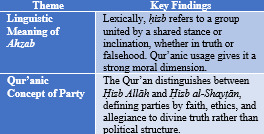
Objective: This study aims to clarify the meaning of the term Ahzab in the Qur’an and to examine its appropriate application within Islamic ethical and socio-political discourse. The research seeks to provide a precise linguistic and terminological understanding of Ahzab, while distinguishing its Qur’anic usage from contemporary political interpretations that often lead to conceptual misuse. Theoretical framework: The theoretical framework is grounded in Qur’anic semantics and classical Islamic scholarship, emphasizing contextual interpretation (siyāq and asbāb al-nuzūl) as essential tools for understanding key religious terms. Literature review: The literature review draws upon classical Qur’anic exegesis, authoritative Arabic dictionaries, and relevant contemporary studies to trace the historical, linguistic, and exegetical dimensions of Ahzab and related terms such as Hizbullah. Previous studies reveal a gap between traditional interpretations and modern political appropriations of Qur’anic terminology, which this research seeks to address. Methods: Methodologically, the study employs a qualitative inductive approach by identifying and analyzing all occurrences of the term Ahzab in the Qur’an. This approach is supported by descriptive and deductive methods, with systematic references to classical tafsir works and lexicographical sources to ensure textual accuracy and contextual consistency. Results: The findings demonstrate that Ahzab in the Qur’an consistently refers to groups or coalitions that oppose divine truth and prophetic missions, rather than neutral or legitimate political entities. Furthermore, the study confirms that Hizbullah does not denote a specific political party but signifies individuals and communities committed to faith, obedience, and moral integrity. Implications: The implications of this research highlight the ethical responsibility of interpreting Qur’anic terminology accurately, cautioning against its instrumentalization for political justification or social oppression. Novelty: The novelty of this study lies in its focused contextual and linguistic analysis of Ahzab, offering a corrective framework for contemporary discourse and contributing to a more ethical and textually grounded understanding of Qur’anic concepts.
References
Z. Tashmatov, S. L. Uulu, M. Mamazhusupova, and E. Ergeshov, “Pedagogical Technologies and Trends in the Development of Religious Education in Higher Education Institutions: Gender Aspects and Islamic Educational Tradition,” Pharos J. Theol., vol. 106, no. 3, pp. 1–14, 2025, https://doi.org/10.46222/pharosjot.106.3032.
Y. F. Rozy, “The Hermeneutics Influence On Feminist Exegesis: A Case Study On Amina Wadud,” QiST J. Quran Tafseer Stud., vol. 2, no. 3, pp. 369–381, Oct. 2023, https://doi.org/10.23917/qist.v2i3.2908.
R. M. Kadri and A. Kirin, “Strategi Guru Dalam Meningkatkan Kemampuan Siswa Dalam Membaca Dan Menghafal Al-Quran Di Sd Sabbihisma Padang Sumatra Barat,” QiST J. Quran Tafseer Stud., vol. 1, no. 2, pp. 238–247, Aug. 2022, https://doi.org/10.23917/qist.v1i2.1051.
A. Romadhona, M. S. Apriantoro, and L. M. Rasyid, “Exploring The Distinctive Features Of Indonesian Tafsir Al-Quran: A Study Of Sheikh Abdul Latif Syakur’s Ad-Da’wah Wa Al-Irsyād Ilā Sabīli Ar-Rasyād,” QiST J. Quran Tafseer Stud., vol. 3, no. 1, pp. 91–106, Dec. 2023, https://doi.org/10.23917/qist.v3i1.2912.
M. G. Makarim, H. Rahayu, and M. Mardi, “Roland Barthes’ Semiotic Analysis Of The Meaning Of Haram In The Quran,” QiST J. Quran Tafseer Stud., vol. 2, no. 3, pp. 331–346, Sep. 2023, https://doi.org/10.23917/qist.v2i3.2574.
M. M. Sule, “Response to Muslims Da’Wah Activities’ By Non-Muslims in Akwanga and Nassarawa Eggon Local Government Areas of Nasarawa State, Nigeria,” QiST J. Quran Tafseer Stud., vol. 3, no. 1, pp. 23–39, 2023, https://doi.org/10.23917/qist.v3i1.3110.
B. Ali and S. Lawal, “Mapping the Intersections: History, Religion, Culture, Governance and Economics in Taraba North Senatorial Zone, Nigeria,” Bull. Islam. Res., vol. 2, no. 4, pp. 525–556, Jul. 2024, https://doi.org/10.69526/bir.v2i4.55.
A. Nur, H. Bin Husin, Alwizar, and M. Yasir, “Qur’anic Ecotheology and the Ethics of Forest Protection in Indonesia,” J. Stud. Ilmu-ilmu al-Qur’an dan Hadis, vol. 26, no. 2, pp. 351–382, 2025, https://doi.org/10.14421/qh.v26i2.6312.
E. Cahyani M Djamil, E. Galih Rahayu, and F. Fahreza, “Thoroughly Exploring Secularism in an Islamic Perspective: History, Dynamics, and Interpretation of the Qur’an,” Bull. Islam. Res., vol. 2, no. 1, pp. 1–16, Jun. 2024, https://doi.org/10.69526/bir.v2i1.30.
A. Abalkheel, M. Sourani, and S. ElZohbi, “Phonological Orchestration and Structural Unity: The Dual Role of the Fawasil,” Forum Linguist. Stud., vol. 7, no. 3, pp. 597–610, 2025, https://doi.org/10.30564/fls.v7i3.8484.
A. Nirwana, M. D. Ariyanto, M. F. Abror, S. Akhyar, and F. bin Husen Ismail, “Semantic Analysis Of Where Is The Difference In The Meaning Of The Words Qalb And Fuād In The Qur’an?,” J. STIU Darul Hikmah, vol. 9, no. 1, pp. 12–20, Mar. 2023, https://doi.org/10.61086/jstiudh.v9i1.38.
A. Nafisa, A. Iskandar, and B. Nugraha, “Religious Moderation,” Bull. Islam. Res., vol. 1, no. 4, pp. 127–142, Jun. 2023, https://doi.org/10.69526/bir.v1i4.44.
A. N. AN, “أصول التفسير عند عبد الله بن عمر رضي الله عنهما في تفسير القرآن,” J. Ilm. Peuradeun, vol. 2, no. 2, pp. 161–190, 2014.
A. N. An, M. Y. Alfian, Saifudin, and S. Akhyar, “Implementasi Metode Tafsir Tahlili Terhadap Qs Ar-Rum Ayat 30 Tentang Fitrah Manusia dalam Tafsir Azhar untuk Membendung Embrio Paham Atheis,” J. Ilmu Al Quran dan Tafsir, vol. 6, no. 2, pp. 425–436, 2021, https://doi.org/10.30868/at.v6i02.2082.
A. Nirwana, H. Hayati, and M. Ridhwan, “The Media of Washatiyah Dakwah in Quranic Exegesis Study,” Budapest Int. Res. Critics Inst. Humanit. Soc. Sci., vol. 3, no. 2, pp. 911–922, May 2020, https://doi.org/10.33258/birci.v3i2.919.
A. N. AN and E. D. Cahyo, “Ushul Tafsir and Qawaid Tafsir Nusantara: A Review Of Nawawi Al Bantani’s Book Of Tafsir Marah Labid,” Syariati J. Stud. Al-Qur’an dan Huk., vol. 8, no. 2, pp. 153–162, Apr. 2023, https://doi.org/10.32699/syariati.v8i2.4249.
A. Nirwana AN, “Qawaid Tafsir dan Ushul Tafsir Siti Aisyah dalam Kitab Sahih Muslim,” J. Ilm. Al-Mu’ashirah, vol. 18, no. 2, 2021, https://doi.org/10.22373/jim.v18i2.11281.
A. Nirwana, I. P. Sari, S. Suharjianto, and S. Hidayat, “Kajian Kritik pada Bentuk dan Pengaruh Positif al-Dakhil dalam Tafsir Jalalain tentang Kisah Nabi Musa dan Khidir,” AL QUDS J. Stud. Alquran dan Hadis, vol. 5, no. 2, p. 717, Nov. 2021, https://doi.org/10.29240/alquds.v5i2.2774.
D. E. Wibowo, “Consumer Protection in the Digital Era: Challenges and Solutions from an Islamic Legal Perspective,” J. Ilm. Mizani, vol. 11, no. 2, pp. 473–485, 2024, https://doi.org/10.29300/mzn.v11i2.4752.
A. Nirwana, “Da’wah In The Qur’an (Thematic Tafsir),” J. At-Tibyan J. Ilmu Alqur’an dan Tafsir, vol. 4, no. 2, pp. 307–329, Dec. 2019, https://doi.org/10.32505/at-tibyan.v4i2.1350.
A. Geissinger, “Notes on the Siege’S Aftermath and Gendered Rhetoric in the Qur’an: Towards a Reconsideration of Q. 33:34,” ReOrient, vol. 9, no. 1, pp. 27–49, 2024, https://doi.org/10.13169/reorient.9.1.0027.
I. Rohman, “Different Approaches To Sunni-Shi‘I Exegetical Differences: Al-Ṭabāṭabā’Ī, Hamka, and Shihab on Ahl Al-Bayt,” Aust. J. Islam. Stud., vol. 8, no. 1, pp. 25–41, 2023, https://doi.org/10.55831/ajis.v8i1.555.
A. N. AN, D. Mustofa, and S. Akhyar, “Contextualization Review of the Interpretation of the Verses of the Fathul Qulub Book at the IMM Sukoharjo Regeneration Program,” J. Ilm. Al-Mu’ashirah Media Kaji. Al-Qur’an dan Al-Hadits Multi Perspekt., vol. 20, no. 1, pp. 146–159, 2023.
D. J. Stewart, “Ignoring the Bible in Qur’Anic Studies Scholarship of the Late Twentieth Century,” ReOrient, vol. 9, no. 1, pp. 131–169, 2024, https://doi.org/10.13169/reorient.9.1.0131.
Z. F. Haidar and A. N. AN., “Studi Kitab Kitab Tafsir Kawasan,” Underline, Underline, Klaten, p. 204, 2025.
A. N. AN, “Studi Kitab Kitab Tafsir,” Muhammadiyah University Press, Sukoharjo, p. 239, 2024. https://doi.org/978-602-361-777-7.
S. A. Frantsouzoff, “Aenigmatic Names Some Remarks on Corruption of Personal Names in Historical and Hagiographic Sources,” Scrinium, vol. 18, no. 1, pp. 420–426, 2022, https://doi.org/10.1163/18177565-BJA10065.
M. A. A. Rab, A. M. Ismail, H. Awang, M. Hoque, N. A. Aljabri, and A. A. S. Alshibli, “Alternatives for Psychological Illness Treatment and Prevention in Malaysia From the Perspective of Shariah,” Malaysian J. Syariah Law, vol. 12, no. 3, pp. 633–651, 2024, https://doi.org/10.33102/mjsl.vol12no3.927.
A. S. Adish and R. G. Mathew, “A Kashmiri Woman Stuck in Crossfire: Exploring the Impact of Militarisation on Everyday Lives in Farah Bashir’s Rumours of Spring,” Religions, vol. 15, no. 8, 2024, https://doi.org/10.3390/rel15080970.
A. Danarta, “The Implementation of Disaster Mitigation based on Qur’anic Interpretation: Muhammadiyah Case Study,” J. Stud. Ilmu-ilmu al-Qur’an dan Hadis, vol. 23, no. 1, pp. 125–144, 2022, https://doi.org/10.14421/qh.2022.2301-07.
S. Herlambang, I. Muttaqin, Rahmap, Torikoh, and B. Suratman, “New media in the Interpretation of the Qur’an: study of Quraish Shihab’s interpretation of Covid-19 on Youtube,” Cogent Arts Humanit., vol. 12, no. 1, 2025, https://doi.org/10.1080/23311983.2025.2493463.
M. S. Islam and S. Samsudin, “Interpretations of Al-amanah Among Muslim Scholars and Its Role in Establishing Peace in Society,” Soc. Change, vol. 48, no. 3, pp. 437–450, 2018, https://doi.org/10.1177/0049085718781689.
U. Rashid, “A Reflection of the Peaceful Life between Muslims and Christians in Desa Kertajaya: An Analytical Study from Qur’anic and Biblical Perspectives,” Intellect. Discourse, vol. 33, pp. 277–298, 2025, https://www.scopus.com/inward/record.uri?eid=2-s2.0-85217050826&partnerID=40&md5=d7cc45f9527939c76af543cb618ae9dd
H. Unsal, “On the revelation circumstances and general emphases of Surat al-Ahzab: An analysis within the scope of textual and non-textual context,” Ilah. Stud., vol. 7, no. 1, pp. 53–85, 2016, https://doi.org/10.12730/13091719.2016.71.140.
J. Murel, “The Readers and Annotations of the First English Quran (1649),” Huntingt. Libr. Q., vol. 87, no. 3, pp. 415–446, 2025, https://doi.org/10.1353/hlq.2024.a970062.
U. Rubin, “The seal of the prophets and the finality of prophecy: On the interpretation of the Qur’anic Surat al-Ahzab (33),” Z. Dtsch. Morgenl. Ges., vol. 164, no. 1, pp. 65–96, 2014, [https://www.scopus.com/inward/record.uri?eid=2-s2.0-84902082463&partnerID=40&md5=7d9a6f0893dc6f55fe6a70750a676f1b
A. N. AN et al., “Teori Studi Al-Qur’an,” Yayasan Penerbit Muhammad Zaini, Yayasan Penerbit Muhammad Zaini, Pidie, p. 241, 2022.
A. N. AN et al., “Metode Penelitian Tafsir,” Buginese Art, Buginese Art, Yogyakarta, p. 254, 2023. https://doi.org/978-623-5913-09-4.
F. Lukman, “Conflicting Interests in the Creation of a State-Authorised Translation: Comparing the Saudi and Indonesian Editions of Al-Qur’an dan Terjemahnya,” J. Qur’anic Stud., vol. 26, no. 1, pp. 38–62, 2024, https://doi.org/10.3366/jqs.2024.0568.
M. Browers, “Origins and architects of Yemen’s joint meeting parties,” Int. J. Middle East Stud., vol. 39, no. 4, pp. 565–586, 2007, https://doi.org/10.1017/S0020743807071085.
K. Hidayah, U. Syarifah, M. Muhammad, S. Bachri, and R. Roibin, “The Kembar Manten in Java Majapahit Wedding Traditions in Mojokerto: Perspectives on Natural Law and Anthropology of Islamic Law,” Samarah, vol. 8, no. 2, pp. 770–790, 2024, https://doi.org/10.22373/sjhk.v8i2.19611.