A Bibliometric Analysis of Islamic Law and Philosophy: Global Trends, Key Participants, and Developing Themes
DOI:
https://doi.org/10.61455/deujis.v3i02.419Keywords:
philosophy, islamic law, legal philosophy, bibliometric, ethics and human rightsAbstract
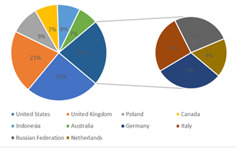
Objective: This study maps the bibliometric landscape of the study of Islamic philosophy, law, and law for the period 2019–2024 with a focus on themes, influential figures, publication trends, and the interconnectedness of philosophy of law, ethics, and human rights in global discourse. Theoretical framework: This study uses bibliometric approaches and scientific communication theory to analyze patterns of publication, collaboration, and cross-disciplinary knowledge development. Literature review: Previous studies have shown interdisciplinary trends in Islamic philosophy, law, and economics, but not many have examined the connection between the three simultaneously. Methods: Data obtained from Scopus using a Boolean search. Of the 14,632 articles, 185 were selected for analysis with Microsoft Excel, R-Studio, and VOSViewer, covering publication trends, collaborations, institutional contributions, and keyword co-occurrence. Results: Publications peaked in 2021 and then declined. Major contributors are from the US, UK, and Indonesia. The analysis shows the close linkage between ethics, philosophy, and law with a multidisciplinary character, as well as identifying key academics and institutions. Implications: A study of the post-2021 productivity decline and increased international collaboration, especially from underrepresented regions, is needed. Novelty: This research is the first comprehensive mapping that integrates Islamic philosophy, law, and law (2019–2024), affirms multidisciplinary interconnectedness, and places Indonesia as an important actor in global academic discourse.
References
A. N. AN, . M., . M., and . W., “Bibliometric Analysis of Islamic Education and Character Development in Religious Education Practices in Indonesia,” Pakistan J. Life Soc. Sci., vol. 22, no. 2, pp. 1231–1245, 2024, https://doi.org/10.57239/PJLSS-2024-22.2.0086.
A. P. Caetano, I. P. Freire, and E. B. Machado, “Student voice and participation in intercultural education,” J. New Approaches Educ. Res., vol. 9, no. 1, pp. 57–73, 2020, https://doi.org/10.7821/naer.2020.1.458.
K. E. Brush, S. M. Jones, R. Bailey, B. Nelson, N. Raisch, and E. Meland, “Social and Emotional Learning: From Conceptualization to Practical Application in a Global Context,” pp. 43–71, 2022, https://doi.org/10.1007/978-3-030-85214-6_3.
D. S. Caudill, “On realism’s own ‘hangover’ of natural law philosophy: Llewellyn Avec Dooyeweerd,” in On Philosophy in American Law, Villanova University School of Law, United States: Cambridge University Press, 2009, pp. 19–26. https://doi.org/10.1017/CBO9780511576386.004.
D. F. Maulana and A. Rozak, “Istihsan As A Finding Method Of Progressive Islamic Law In The Industrial Revolution Era 4.0,” El-Mashlahah, vol. 11, no. 2, pp. 127–145, 2021, https://doi.org/10.23971/elma.v11i2.2981.
A. Kahane, “Antigone, Antigone: Lacan and the Structure of the Law,” in Interrogating Antigone in Postmodern Philosophy and Criticism, Humanities and Arts Research Centre, Royal Holloway, University of London, United Kingdom: Oxford University Press, 2010. https://doi.org/10.1093/acprof:oso/9780199559213.003.0009.
M. Mahmudulhassan, S. Begum, S. U. Ahmed Khondoker, A. E. Conti Morales, M. Muthoifin, and W. Mahir Muttaqin, “Tracing the Roots of Socio-Cultural Factors in Legal and Religious Thought: Historical and Contemporary Perspectives,” Solo Int. Collab. Publ. Soc. Sci. Humanit., vol. 2, no. 02, pp. 85–94, Mar. 2024, https://doi.org/10.61455/sicopus.v2i02.122.
Mahmudulhassan, S. Rahmawati, F. Qurrota, and A. Tamami, “The Integration of Faith and National Identity : A Comprehensive Study on Islamic Patriotism and Its Theological Implications,” Solo Univers. J. Islam. Educ. Multicult., vol. 2, no. 2, pp. 83–92, 2024, https://doi.org/10.61455/sujiem.v2i02.158.
N. Ünlü, “Islamic Headscarves: The Other-Religion Effect and Religious Literacy at the European Court of Human Rights,” Islam Christ. Relations, vol. 34, no. 4, pp. 381–401, 2023, https://doi.org/10.1080/09596410.2023.2275423.
A. M. Alkhan, “The Maqāid al-Sharīah and Islamic Finance Debate: The Underlying Philosophy and Perspectives of Sharīah Scholars,” Arab Law Q., vol. 37, no. 1–2, pp. 80–110, 2021, https://doi.org/10.1163/15730255-BJA10075.
M. Amberi, “Efforts to Prevent Child Marriage Based on Philosophy of Islamic Law and Indonesian Positive Law,” Samarah, vol. 7, no. 1, pp. 239–260, 2023, https://doi.org/10.22373/sjhk.v7i1.12404.
Muthoifin et al., “An Interfaith Perspective on Multicultural Education for Sustainable Development Goals (SDGS),” J. Lifestyle SDGs Rev., vol. 4, no. 3, p. e01720, Sep. 2024, https://doi.org/10.47172/2965-730X.SDGsReview.v4.n03.pe01720.
M. Abuzar, Mahmudulhassan, and L. Nuryanti, “The Role Of Online Social Network Sites And Social Integration In Mitigating Homesickness Among International Students,” Pakistan J. Educ. Res., vol. 7, no. 3, pp. 95–112, 2024, https://doi.org/10.52337/pjer.v7i3.1151.
A. L. Tun, “Deconstructing and Reinforcing Gender Norms and Cultural Taboos in Myanmar’s Spring Revolution,” J. Burma Stud., vol. 27, no. 1, pp. 29–63, 2023, https://doi.org/10.1353/JBS.2023.0001.
F. Ganda, “The interplay between technological innovation, financial development, energy consumption, and natural resource rents in the BRICS economies: Evidence from GMM panel VAR,” Energy Strateg. Rev., vol. 51, 2024, https://doi.org/10.1016/j.esr.2023.101267.
M. Hatina, “Ivan Aguéli’s Humanist Vision: Islam, Sufism, and Universalism,” in Anarchist, Artist, Sufi: The Politics, Painting, and Esotericism of Ivan Aguéli, Department of Islamic and Middle Eastern Studies, Hebrew University of Jerusalem, Israel: Bloomsbury Publishing Plc., 2021, pp. 139–150. https://www.scopus.com/inward/record.uri?eid=2-s2.0-85118456521&partnerID=40&md5=ca604fb727cdc8fe78a70665ca246e99
A. N. An et al., “Examining Religious Coexistence: Perspectives from the Quran and Hadith in the Context of Bangladesh,” Int. J. Relig., vol. 5, no. 10, pp. 718–731, 2024, https://doi.org/10.61707/yyd0mm12.
S. J. Ioannides, I. Hess, C. Lamberton, B. Luisi, and L. Gupta, “Engaging with culturally and linguistically diverse communities during a COVID-19 outbreak: a NSW Health interagency public health campaign,” Public Health. Res. Pract., vol. 33, no. 3, 2023, https://doi.org/10.17061/phrp32342215.
S. Karim, M. Raza Rabbani, M. Rashid, and Z. Anwer, “COVID-19 Challenges and the Role of Islamic Fintech,” in FinTech in Islamic Financial Institutions: Scope, Challenges, and Implications in Islamic Finance, Nottingham University Business School, Semenyih, Malaysia: Springer International Publishing, 2022, pp. 341–356. https://doi.org/10.1007/978-3-031-14941-2_16.
Mahmudulhassan, Muthoifin, and S. Begum, “Artificial Intelligence in Multicultural Islamic Education : Opportunities, Challenges, and Ethical Considerations,” Solo Univers. J. Islam. Educ. Multicult., vol. 2, no. 1, pp. 19–26, 2024, https://doi.org/10.61455/sujiem.v2i01.114.
F. Gordon and D. Newman, “Introduction: Law and social justice,” Lead. Work. Law Soc. Justice, pp. 1–6, 2021, https://doi.org/10.4324/9780429287572-1.
M. Zembylas, “The therapisation of social justice as an emotional regime: implications for critical education,” J. Prof. Cap. Community, vol. 1, no. 4, pp. 286–301, 2016, https://doi.org/10.1108/JPCC-05-2016-0015.
J. M. Saavedra and A. M. López, “Building bridges between global justice and transformative education,” Izquierdas, no. 51, 2022, https://www.scopus.com/inward/record.uri?eid=2-s2.0-85127209893&partnerID=40&md5=4ae8c74511ca8fd55dd8451c4451aea5
E. Gonzales, Exhibitions for social justice. Taylor and Francis, 2019. https://doi.org/10.4324/9781315232812.
M. Mahmudulhassan and M. Abuzar, “Harmony in the Family: Indicators of Marriage Success in Cultural and Religious Foundations in Bangladesh,” Demak Univers. J. Islam Sharia, vol. 2, no. 03, pp. 221–230, May 2024, https://doi.org/10.61455/deujis.v2i03.136.
J. Du, J. Cao, and J. Xue, “Exploration of the Ideological and Political Elements of Artificial Intelligence Courses under the Background of Three Comprehensive Education,” Wirel. Commun. Mob. Comput., vol. 2023, 2023, https://doi.org/10.1155/2023/2427039.
M. S. Abubakari, W. Shafik, and A. F. Hidayatullah, “Evaluating the Potential of Artificial Intelligence in Islamic Religious Education,” in AI-Enhanced Teaching Methods, Sultan Hassanal Bolkiah Institute of Education, Universiti Brunei Darussalam, Brunei Darussalam: IGI Global, 2024, pp. 216–239. https://doi.org/10.4018/979-8-3693-2728-9.ch010.
A. J. Wójcik-Czerniawska, “The Role of Artificial Intelligence in Modern Finance and Sustainable Marketing,” in Handbook of Research on Achieving Sustainable Development Goals With Sustainable Marketing, SGH Warsaw School of Economics, Poland: IGI Global, 2023, pp. 355–371. https://doi.org/10.4018/978-1-6684-8681-8.ch019.
N. Donthu, S. Kumar, D. Mukherjee, N. Pandey, and W. M. Lim, “How to conduct a bibliometric analysis: An overview and guidelines,” J. Bus. Res., vol. 133, no. May, pp. 285–296, 2021, https://doi.org/10.1016/j.jbusres.2021.04.070.
Mahmudulhassan, W. Waston, A. Nirwana, S. Amini, M. M. A. Sholeh, and M. Muthoifin, “A moral-based curriculum to improve civilization and human resource development in Bangladesh,” Multidiscip. Rev., vol. 7, no. 8, 2024, https://doi.org/10.31893/multirev.2024137.
Ardiansyah et al., “Tracing Trends in Quran Memorization and Cognitive Learning: A Bibliometric Analysis from the Scopus Database,” Pakistan J. Life Soc. Sci., vol. 22, no. 2, pp. 1493–1509, 2024, https://doi.org/10.57239/PJLSS-2024-22.2.00105.
A. N. AN, Mahmudulhassan, Muthoifin, Waston, and S. Hidayat, “Research Trends In Quranic And Biblical Studies: A Bibliometric Analysis Of Islamic And Christian Scholarship (2019-2024),” Rev. Iberoam. Psicol. DEL Ejerc. Y EL Deport., vol. 19, no. 4148, pp. 343–349, 2024.
H. Y. Bhatti, M. M. Galan-Ladero, and C. Galera-Casquet, “Cause-related marketing: a systematic review of the literature,” Int. Rev. Public Nonprofit Mark., vol. 20, no. 1, pp. 25–64, 2023, https://doi.org/10.1007/s12208-021-00326-y.
Sukisno, Waston, A. Nirwana, Mahmudulhassan, and M. Muthoifin, “Parenting problems in the digital age and their solution development in the frame of value education,” Multidiscip. Rev., vol. 7, no. 8, p. 2024163, Apr. 2024, https://doi.org/10.31893/multirev.2024163.
A. N. A.N., M. Mahmudulhassan, F. D. Marshal, M. Muthoifin, and N. Fadli, “Human rights and social justice in Quranic contexts: a global trend,” Leg. J. Ilm. Huk., vol. 32, no. 2, pp. 453–471, Sep. 2024, https://doi.org/10.22219/ljih.v32i2.35088.
S. J. Costello, The Alchemy of Addiction: Carl Jung, the Enneagram, and Contemplative Wisdom Traditions. St Gerard’s School, Castleknock College, University College Dublin, Ireland: Taylor and Francis, 2024. https://doi.org/10.4324/9781003422570.
M. R. Fadli, “Digital Pedagogy Philosophy: Building Critical Awareness of The Role of Technology in Education,” J. Filsafat, vol. 34, no. 2, p. 307, Sep. 2024, https://doi.org/10.22146/jf.93321.
C. Tomlins, “A Poetics for Spatial Justice: Gaston Bachelard, Walter Benjamin, and the Return to Historical Materialism,” Law Lit., vol. 32, no. 3, pp. 319–353, 2020, https://doi.org/10.1080/1535685X.2020.1725315.
J. De Roover and S. Rao, Cultures Differ Differently: Selected Essays of S.N. Balagangadhara. Department of Comparative Science of Cultures, Ghent University, Belgium: Taylor and Francis, 2021. https://doi.org/10.4324/9781003229445.
D. D. Pyzikov, “Cultural and Historical Context of the Mythmaking of H.P. Lovecraft,” Religiovedenie, vol. 2019, no. 1, pp. 137–142, 2019, https://doi.org/10.22250/2072-8662.2019.1.137-142.
M. Kumar, “The Idea of Justice in Gandhian Philosophy,” in Relevance of Duties in the Contemporary World: With Special Emphasis on Gandhian Thought, Himachal Pradesh National Law University, Shimla, India: Springer Nature, 2023, pp. 21–39. https://doi.org/10.1007/978-981-19-1836-0_2.
T. Smejkalová, “Legal Concepts as Social Representations,” Int. J. Semiot. Law, vol. 37, no. 1, pp. 165–188, 2024, https://doi.org/10.1007/s11196-023-10066-3.
R. Ford, “Humor, Law, and Jurisprudence: on deleuze’s political philosophy,” Angelaki - J. Theor. Humanit., vol. 21, no. 3, pp. 89–102, 2016, https://doi.org/10.1080/0969725X.2016.1205263.
A. Barua et al., “The MTP 2020 Amendment Bill: anti-rights subjectivity,” Sex. Reprod. Heal. Matters, vol. 28, no. 1, 2020, https://doi.org/10.1080/26410397.2020.1795447.
G. Grieco, “A legal theory for the nation state. Pasquale Stanislao Mancini, Hegelianism and Piedmontese liberalism after 1848,” J. Mod. Ital. Stud., vol. 24, no. 2, pp. 266–292, 2019, https://doi.org/10.1080/1354571X.2019.1573022.
H. F. Zarkasyi, H. Shalahuddin, H. Armayanto, and M. F. Hamat, “The Impact of Postmodernism on the Thought of Indonesian Muslim Intellectuals (IMIs),” J. Islam. Thought Civiliz., vol. 13, no. 2, pp. 30–47, 2023, https://doi.org/10.32350/jitc.132.03.
I. Levytska, A. Klymchuk, N. Biletska, and L. Bilogor, “Public Expenditures Of Ukraine: Problems And Prospects For Their Solution,” Financ. Credit Act. Probl. Theory Pract., vol. 3, no. 50, pp. 52–62, 2023, https://doi.org/10.55643/fcaptp.3.50.2023.4047.
V. Ortynskyi, V. Shamrayeva, I. Zeman, I. Lisna, and O. Valetska, “Philosophy of ‘Soft Law’ As A Universal Regulator Of International Relations Management,” Wisdom, vol. 20, no. 4, pp. 95–103, 2021, https://doi.org/10.24234/wisdom.v20i4.501.
I. Shcherbai, S. Slyvka, O. Chornobai, O. Kolych, and O. Levytska, “Philosophical And Anthropological Analysis Of The Semiotics Of The Economic And Legal System,” Wisdom, vol. 2, no. 1, pp. 140–149, 2022, https://doi.org/10.24234/wisdom.v2i1.780.
O. Bogucki, “The Derivational Theory of Legal Interpretation in Polish Legal Theory,” Int. J. Semiot. Law, vol. 33, no. 3, pp. 617–636, 2020, https://doi.org/10.1007/s11196-019-09628-1.
S. Slyvka, T. Harasymiv, O. Levytska, M. Kolyba, and S. Panchenko, “Development Of Ideas Of Philosophy Of Law In The Ancient East,” Wisdom, vol. 20, no. 4, pp. 209–216, 2021, https://doi.org/10.24234/wisdom.v20i4.502.
V. Ortynskyi, T. Harasymiv, I. Lychenko, H. J. M. Shakhatreh, and N. Pavliuk, “Characteristic Of Features Of The Philosophical And Legal Paradigm Of Control In The Context Of The Philosophy Of Law,” Wisdom, vol. 22, no. 2, pp. 244–252, 2022, https://doi.org/10.24234/wisdom.v22i2.715.
A. Karácsony, “Heidegger on Hegel’s Concept of State,” J. Eur. Hist. Law, vol. 13, no. 2, pp. 138–142, 2022, [Online]. Available: https://www.scopus.com/inward/record.uri?eid=2-s2.0-85142875276&partnerID=40&md5=fb62d456aedc869367f5be52946cef74
Y. Kaldybekov, Z. Abdildin, O. Kabul, and T. Tumashbay, “Problem of Power in Michel Foucault’s Philosophy,” Integr. Psychol. Behav. Sci., vol. 58, no. 2, pp. 420–432, 2024, https://doi.org/10.1007/s12124-023-09804-w.
R. Zhang, “Cooperation Mechanism of Financial Support for Marine Economic Development,” J. Coast. Res., vol. 107, no. sp1, pp. 210–214, 2020, https://doi.org/10.2112/JCR-SI107-053.1.
S. Shapin and S. Schaffer, Leviathan and the air-pump: Hobbes, Boyle, and the experimental life. Harvard University, United States: Princeton University Press, 2011. https://www.scopus.com/inward/record.uri?eid=2-s2.0-80054250776&partnerID=40&md5=9fd47acaa0506aa830776d26e85633f3
M. Y. Wong, “Emotion as a language of universal dialogue,” Dialogue and Universalism, vol. 29, no. 3, pp. 41–56, 2019, https://doi.org/10.5840/du201929336.
J. Helbing, D. Draschkow, and M. L.-H. Võ, “Search superiority: Goal-directed attentional allocation creates more reliable incidental identity and location memory than explicit encoding in naturalistic virtual environments,” Cognition, vol. 196, 2020, https://doi.org/10.1016/j.cognition.2019.104147.
R. Durrett, Probability: Theory and Examples. Mathematics Department, Duke University, United States: Cambridge University Press, 2019. https://doi.org/10.1017/9781108591034.
L. Krasnoff, “Constructing Practical Justification Can the Categorical Imperative Justify Desire-based Actions?” in Kant on Practical Justification: Interpretive Essays, College of Charleston, United States: Oxford University Press, 2013. https://doi.org/10.1093/acprof:oso/9780195395686.003.0005.
J. Ladyman, “Ontological, Epistemological, and Methodological Positions,” in General Philosophy of Science: Focal Issues, Department of Philosophy, University of Bristol, Bristol BS8, 1TB, 9 Woodland Road, United Kingdom: Elsevier, 2007, pp. 303–376. https://doi.org/10.1016/B978-044451548-3/50008-2.
J. Donhauser, “Informative ecological models without ecological forces,” Synthese, vol. 197, no. 6, pp. 2721–2743, 2020, https://doi.org/10.1007/s11229-018-1859-8.
V. I. Trukhachev and M. Dzhikiya, “Development of environmental economy and management in the age of AI based on green finance,” Front. Environ. Sci., vol. 10, 2023, https://doi.org/10.3389/fenvs.2022.1087034.
J. Hedström, E. Olivius, and K. Soe, “Women in Myanmar: Change and Continuity,” in Myanmar Politics, Economy and Society: Second Edition, Swedish Defence University, Sweden: Taylor and Francis, 2023, pp. 220–236. https://doi.org/10.4324/9781003386063-18.
M. Mahmudulhassan, M. Abuzar, S. U. A. Khondoker, and J. Khanom, “The Integration of Islamic Epistemology in Ethical and Multicultural Education: Pedagogical Strategies and Challenges,” Multicult. Islam. Educ. Rev., vol. 2, no. 2, Feb. 2025, https://doi.org/10.23917/mier.v2i2.7612.
Z. A. Hossein and M. Mahmudulhassan, “Legal Disruption and Sharia Arbitration: Navigating Change, Measuring Impact, and Fostering Innovation,” Indones. J. Islam. Econ. Law, vol. 1, no. 1, pp. 39–49, 2023, https://doi.org/10.23917/ijoel.v1i1.3436.
A. N. Andri Nirwana, Mahmudulhassan, M. Ali, Muthoifin, Waston, and A. R. B. S. Senathirajah, “The Intersection of Quranic Studies and Modern Technology: A Bibliometric Analysis of Academic Publications from 2000 to 2024,” Qubahan Acad. J., vol. 4, no. 4, pp. 178–190, 2024, https://doi.org/10.48161/qaj.v4n4a981.
M. M. A. Sholeh, Waston, A. Nirwana, and M. Mahmudulhassan, “The Reasons of Lifelong Education for the Sustainable Development Goals (SDGs): The Islamic Epistemology Perspective,” J. Lifestyle SDGs Rev., vol. 5, no. 2, p. e02988, Nov. 2024, https://doi.org/10.47172/2965-730X.SDGsReview.v5.n02.pe02988.
A. Wahid, D. P. Erdina, and M. Mahmudulhassan, “Study Of The Practice of Reading Surah Al-Isra Verses 79-82 at Duha Time at Hidayatul Islamiyah Pesantren,” QiST J. Quran Tafseer Stud., vol. 1, no. 3, pp. 290–306, Dec. 2022, https://doi.org/10.23917/qist.v1i3.2766.
I. Afiyah and M. Mahmudulhassan, “Professional Zakat as a Catalyst for Welfare: Strategic Mapping for Sustainable Economic Growth in Semarang,” Demak Univers. J. Islam Sharia, vol. 2, no. 03, pp. 199–210, Apr. 2024, https://doi.org/10.61455/deujis.v2i03.129.
Mahmudulhassan, A. Nirwana, and K. Saif Uddin Ahmed, “Exploring the Contributions of Prof. Dr. Syed Ali Ashraf to the Islamization of Knowledge in Bangladesh: A Comprehensive Analysis,” J. World Thinkers, vol. 1, no. 1, pp. 91–98, 2024, https://doi.org/10.61455/jwt.v1i02.80.
M. Waston, Yusuf Olawale Owa-Onire Uthman, Mahmudulhassan, “Ian G. Barbour’s Thoughts on Science and Religion,” J. World Thinkers, vol. 1, no. 1, pp. 1–16, 2024, https://doi.org/10.61455/jwt.v1i02.80 Ian.
I. Afiyah, V. Ghafurjonovich Macsudov, M. Mahmudulhassan, and M. Muthoifin, “Impact Analysis of Marital Dispensation: Economic Implications and Family Welfare in Social and Legal Context,” Solo Int. Collab. Publ. Soc. Sci. Humanit., vol. 2, no. 01, pp. 25–36, Mar. 2024, https://doi.org/10.61455/sicopus.v2i01.117.
Mahmudulhassan, M. Abuzar, and A. Nirwana, “Night Work Culture in Professional and Sharia Perspectives,” Solo Int. Collab. Publ. Soc. Sci. Humanit., vol. 2, no. 03, pp. 268–281, Aug. 2024, https://doi.org/10.61455/sicopus.v2i03.198.
Mahmudulhassan, M. Abuzar, S. U. Ahmed Khondoker, and O. Rahman, “Exploring the Dynamics of Student Motivation and Behavior: A Qualitative Analysis of Influencing Factors and Effective Interventions,” Solo Univers. J. Islam. Educ. Multicult., vol. 2, no. 03, pp. 195–206, Aug. 2024, https://doi.org/10.61455/sujiem.v2i03.202.
J. Khanom, M. T. Islam, and Mahmudulhassan, “Women’s Rights in Islamic Culture: A Bibliometric Analysis of Trends, Influential Authors, and Institutional Contributions (1969–2023),” Solo Univers. J. Islam. Educ. Multicult., vol. 3, no. 01, pp. 27–42, Dec. 2024, https://doi.org/10.61455/sujiem.v3i01.232.
N. Nuha et al., “The Existence of Education as a Rehabilitation, Preventive, Curative, and Moral Development Strategy in Madrasah,” Solo Univers. J. Islam. Educ. Multicult., vol. 2, no. 01, pp. 01–18, Mar. 2024, https://doi.org/10.61455/sujiem.v2i01.99.
D. Sartono, M. Mahmudulhassan, I. Najmi, S. Amin, and M. Bensar, “Silver as Nishab Zakat to Improve Community Welfare in the Modern Era,” Demak Univers. J. Islam Sharia, vol. 1, no. 02, pp. 83–91, Oct. 2023, https://doi.org/10.61455/deujis.v1i02.24.
E. S. Utaminingsih, F. R. Wuriningsih, and M. A. Puspita, “Leveraging interactive e-learning platforms to enhance problem-solving ability in science learning : A pathway to achieving SDG 4 for quality education,” Borobudur Int. Symp. Humanit. Soc. Sci., vol. 1, pp. 1–19, 2025, https://doi.org/10.31603/bised.176.
K. F. Maulinda, L. W. Purnama, M. A. Marelyno, S. Sa, and F. Hidayat, “Maktabah Reviews,” Maktab. Rev.., vol. 1, no. 1, pp. 99–118, 2024, https://doi.org/10.61455/mr.v1i01.128 Transactions.