Reconstruction of Issue Management and Political Communication Messages: An Islamic Perspective in the Digital Era
DOI:
https://doi.org/10.61455/sicopus.v4i03.597Keywords:
islamic political, issue management, digital media, communication ethics, political messagesAbstract
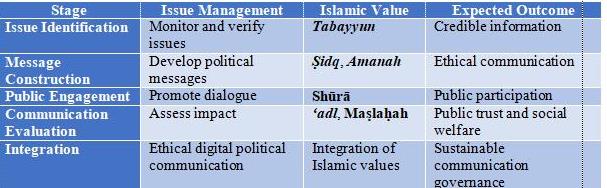
Objective: This study aims to reconstruct issue management and political communication messages from an Islamic perspective to address the ethical challenges of political communication in the digital era. Theoretical Framework: The study integrates Issue Management Theory, Political Communication Theory, and Islamic Communication Ethics, emphasizing the principles of ṣidq (honesty), amanah (responsibility), tabayyun (information verification), syūrā (deliberation), and maslahah (public benefit) as foundations for ethical political communication. Literature Review: Previous studies show that issue management issue management in digital political communication and islamic perspective on political communication messages. Method: This study employed a qualitative approach using library research. Data were collected from books, peer-reviewed journal articles, and relevant policy documents on issue management, political communication, digital media, and Islamic communication. The data were analyzed using content and thematic analysis to identify conceptual relationships and develop an integrative framework. Results: The findings indicate that issue management is essential for identifying political issues, preventing communication crises, and maintaining public trust. However, digital political communication is increasingly challenged by disinformation, political polarization, hate speech, and algorithm-driven information manipulation. Integrating Islamic communication ethics with issue management provides a normative and strategic framework for developing political messages that are transparent, accountable, and oriented toward public benefit. Implications: The proposed framework offers guidance for policymakers and political institutions in strengthening ethical digital governance and improving the quality of democratic communication. Novelty: This study introduces an Islamic Ethical Digital Issue Management Framework that integrates issue management with Islamic communication ethics, providing a new conceptual model for ethical political communication in the digital era.
References
E. Autio, R. Mudambi, and Y. Yoo, “Digitalization and globalization in a turbulent world: Centrifugal and centripetal forces,” Glob. Strateg. J., vol. 11, no. 1, pp. 3–16, Feb. 2021, doi: https://doi.org/10.1002/gsj.1396.
G. Aichholzer and G. Rose, “Experience with Digital Tools in Different Types of e-Participation,” in European E-Democracy in Practice, L. Hennen, I. van Keulen, I. Korthagen, G. Aichholzer, R. Lindner, and R. Ø. Nielsen, Eds., Cham: Springer International Publishing, 2020, pp. 93–140. doi: https://doi.org/10.1007/978-3-030-27184-8_4.
S. Bradshaw and P. N. Howard, “The Global Organization Of Social Media Disinformation Campaigns,” J. Int. Aff., vol. 71, no. 1.5, pp. 23–32, Jun. 2018, [Online]. Available: https://www.jstor.org/stable/26508115
G. Asimakopoulos, H. Antonopoulou, K. Giotopoulos, and C. Halkiopoulos, “Impact of Information and Communication Technologies on Democratic Processes and Citizen Participation,” Societies, vol. 15, no. 2. p. 40, 2025. doi: https://doi.org/10.3390/soc15020040.
M. Basori, “The Use of Digital Media in Da’wah: Ethics, Theology, and Maqashid Shariah,” Proc. Int. Conf. Da’wa Commun., vol. 7, no. 1, pp. 53–65, Nov. 2025, doi: https://doi.org/10.15642/icondac.v7i1.4272.
R. Karlsen and T. Aalberg, “Social Media and Trust in News: An Experimental Study of the Effect of Facebook on News Story Credibility,” Digit. Journal., vol. 11, no. 1, pp. 144–160, Jan. 2023, doi: https://doi.org/10.1080/21670811.2021.1945938.
W. Kulachai, S. Chayanon, and W. Srisorn, “Political communication and political success: The art of effective messaging,” Kasetsart J. Soc. Sci., vol. 45, no. 2, pp. 681–694, Apr. 2024, [Online]. Available: https://so04.tci-thaijo.org/index.php/kjss/article/view/272038
C. Okechukwu, “Media Influence on Public Opinion and Political Decision-Making,” Int. J. Polit. Sci. Stud., vol. 1, no. 1, pp. 13–24, Jan. 2024, [Online]. Available: https://forthworthjournals.org/journals/index.php/IJPSS/article/view/17
Z. Peruško, “Public Sphere in Hybrid Media Systems in Central and Eastern Europe,” Javn. - Public, vol. 28, no. 1, pp. 36–52, Jan. 2021, doi: https://doi.org/10.1080/13183222.2021.1861405.
W. T. Coombs and S. J. Holladay, “Social issue qua wicked problems: The role of strategic communication in social issues management,” J. Commun. Manag., vol. 22, no. 1, pp. 79–95, 2018, doi: https://doi.org/10.1108/JCOM-11-2016-0093.
R. L. Heath, “Strategic Issues Management,” in The Handbook of Organizational Rhetoric and Communication, 2018, pp. 383–399. doi: https://doi.org/10.1002/9781119265771.ch27.
W. T. Coombs, “Protecting Organization Reputations During a Crisis: The Development and Application of Situational Crisis Communication Theory,” Corp. Reput. Rev., vol. 10, no. 3, pp. 163–176, 2007, doi: https://doi.org/10.1057/palgrave.crr.1550049.
M. Q. Shihab, Tafsir Al-Mishbah; Message, Impressions and Harmony of the Qur’an, Vol. 12. 2009.
Sugiyono, Metode Penelitian Pendidikan (Pendekatan Kuantitatif, Kualitatif, dan R&D). Bandung: Alfabeta, 2017.
J. W. Creswell and C. N. Poth, Qualitative inquiry and research design: Choosing among five approaches (4th ed.). Thousand Oaks, CA: SAGE Publication, 2018.
L. J. Moleong, Metode Penelitian Kualitatif. Edisi Revisi. Bandung: Bandung: PT. Remaja Rosdakarya, 2014.
M. Castells, “Toward a Sociology of the Network Society,” Contemp. Sociol., vol. 29, no. 5, pp. 693–699, 2000, doi: https://doi.org/10.2307/2655234.
H. Wardle, “Perceptions, people and place: Findings from a rapid review of qualitative research on youth gambling,” Addict. Behav., vol. 90, pp. 99–106, 2019, doi: https://doi.org/10.1016/j.addbeh.2018.10.008.
C. R. Sunstein, “Neither Hayek nor Habermas,” Public Choice, vol. 134, no. 1, pp. 87–95, 2008, doi: 10.1007/s11127-007-9202-9.
L. Van Hove, “Could ‘Nudges’ Steer Us towards a Less-Cash Society?,” in Transforming Payment Systems in Europe, J. Górka, Ed., London: Palgrave Macmillan UK, 2016, pp. 70–110. doi: https://doi.org/10.1057/9781137541215_3.
G. Cosentino, “The Post-truth World Order,” in Social Media and the Post-Truth World Order: The Global Dynamics of Disinformation, G. Cosentino, Ed., Cham: Springer International Publishing, 2020, pp. 1–31. doi: https://doi.org/10.1007/978-3-030-43005-4_1.
T. A. Van Dijk, Structures of Discourse and Structures of Power. London: Routledge, 2011.
G. E. Marcus, N. A. Valentino, P. Vasilopoulos, and M. Foucault, “Applying the Theory of Affective Intelligence to Support for Authoritarian Policies and Parties,” Polit. Psychol., vol. 40, no. S1, pp. 109–139, Feb. 2019, doi: https://doi.org/10.1111/pops.12571.
B. Lund, “The questionnaire method in systems research: An overview of sample sizes, response rates and statistical approaches utilized in studies,” VINE J. Inf. Knowl. Manag. Syst., vol. 53, no. 1, pp. 1–10, 2023.
B. Moffitt, “Populism versus Technocracy: Performance, Passions, and Aesthetics,” in Populism and Passions, London: Routledge, 2019, p. 16.
H. Marita and R. Sebastiaan, “ Dimensionality of trust : an analysis of the relations between propensity, trustworthiness and trust,” SA J. Ind. Psychol., vol. 41, no. 1, pp. 1–12, Jan. 2015, doi: https://doi.org/10.4102/sajip.v41i1.1263.
W. L. Bennett, A. Segerberg, and S. Walker, “Organization in the crowd: peer production in large-scale networked protests,” Information, Commun. Soc., vol. 17, no. 2, pp. 232–260, Feb. 2014, doi: https://doi.org/10.1080/1369118X.2013.870379.
R. Entman, “Framing Media Power,” in Doing News Framing Analysis, London: Routledge, 2010, p. 25.
H. Jürgen, “Three Normative Models of Democracy,” in Constitutionalism and Democracy, London: Routledge, 2006, p. 10.
Imam Al-Mawardi, Al-Ahkam as-Sulthaniyah: Hukum-Hukum Penyelengggaraan Negara dalam Syariat Islam, Penj Fadli Basri. Bekasi: PT. Daruh Falah, 2017.
A. Poya and H. Rizapoor, “Al-Ghazali’s Theory of Real Knowledge: An Exploration of Knowledge Integration in Islamic Epistemology through Contemporary Perspectives,” Int. J. Humanit. Educ. Soc. Sci., vol. 3, no. 2, Oct. 2023, doi: https://doi.org/10.55227/ijhess.v3i2.627.
Departemen Agama RI, AL-JUMANATUL ‘ALI Al-Qur’an dan Terjemahannya. Bandung: CV. Penerbit J-ART, 2014.
Supriyanto, “Religion and State in the Perspective of Islamic Thought,” Mawa’Izh J. Dakwah Dan Pengemb. Sos. Kemanus., vol. 11, no. 2, pp. 1–13, 2020, doi: https://doi.org/10.32923/maw.v11i2.1469.
Y. Al-Qaradawi, FiFiqh al-Aqalliyyat al-Muslima –Hayat al-Muslimin Wasat al-Mujtama‘at al-Ukhra. Cairo: Dar al-Shuruq, 2001.
M. Amin, “Konsep Keadilan dalam Perspektif Filsafat Hukum Islam,” Al-Daulah J. Huk. dan Perundangan Islam, vol. 4, no. 02, pp. 322–343, 2015, doi: https://doi.org/10.15642/ad.2014.4.02.322-343.
I. bin M. Al-Shatibi, al-Muwafaqat. ttp: Dar Ibn ‘Affa, 1997.
M. S. Georgopoulou, C. Troussas, A. Krouska, and C. Sgouropoulou, “Digital Literacy in Higher Education: Examining University Students’ Competence in Online Information Practices,” Computers, vol. 14, no. 12. p. 528, 2025. doi: https://doi.org/10.3390/computers14120528.
L. Edwards, “Trust, Truth and ‘Organized Lying’ A Critical Study of the Edelman Trust Barometer,” in Routledge Handbook of the Influence Industry, London: Routledge, 2024.
J. Paterson and G. Teubner, “Changing maps Empirical legal autopoiesis 1,” in Luhmann and Socio-Legal Research, London: Routledge, 2020, p. 35.
A. Lovasz, “Niklas Luhmann and Jacques Ellul on the autonomy of technology,” Kybernetes, vol. 53, no. 10, pp. 3896–3918, 2024, doi: https://doi.org/10.1108/K-02-2023-0287.
C. Ansell and A. Gash, “Collaborative governance in theory and practice,” J. Public Adm. Res. Theory, vol. 18, no. 4, pp. 543–571, 2008, doi: https://doi.org/10.1093/jopart/mum032.
S. Cabral and D. Krane, “Civic festivals and collaborative governance,” Int. Rev. Adm. Sci., vol. 84, no. 1, pp. 185–205, 2018, doi: https://doi.org/10.1177/0020852315615196.
M. Akour and M. Alenezi, “Higher Education Future in the Era of Digital Transformation,” Education Sciences, vol. 12, no. 11. p. 784, 2022. doi: https://doi.org/10.3390/educsci12110784.