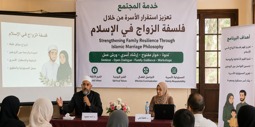
Strengthening Family Resilience Through Islamic Marriage Philosophy: A Community Engagement Approach
DOI:
https://doi.org/10.61455/wijce.v2i1.559Keywords:
family resilience, islamic marriage philosophy, community engagement, moral values, spiritual educationAbstract
Objective: This community engagement program aimed to strengthen family resilience through the philosophical understanding of marriage in Islam by promoting moral and spiritual awareness among community members. The program was developed in response to contemporary social challenges affecting family harmony, including weakening moral values, communication problems, and limited public understanding of the ethical and spiritual dimensions of marriage. Theoretical framework: The theoretical framework of this study was grounded in Islamic marriage philosophy, particularly the concepts of sakinah (tranquility), mawaddah (affection), and rahmah (compassion), as well as the principle of maqashid al-shariah in preserving human dignity and family welfare. Literature review: Previous studies have discussed Islamic marriage from legal, theological, and philosophical perspectives. However, limited attention has been given to the practical implementation of Islamic marriage philosophy within participatory community empowerment programs. This gap highlights the importance of community-based educational activities that translate Islamic moral and spiritual teachings into practical guidance for family life. Methods: This study employed a qualitative descriptive approach within a community service framework. Data were collected through observations, interviews, documentation, counseling sessions, interactive discussions, and educational workshops involving married couples, prospective spouses, youth groups, and religious leaders. The collected data were analyzed descriptively to identify changes in participants’ understanding and attitudes toward marriage and family resilience. Results: The results showed that the program significantly improved participants’ understanding of marriage as a sacred moral and spiritual commitment rather than merely a legal or social institution. Participants demonstrated increased awareness regarding ethical communication, emotional responsibility, mutual respect, and spiritual maturity in family relationships. The participatory approach also strengthened community solidarity and encouraged collective responsibility for maintaining family harmony. Implications: The implication of this program is that Islamic marriage philosophy can serve as an effective foundation for community-based family education and social resilience development. Novelty: The novelty of this study lies in integrating Islamic philosophical concepts of marriage with participatory community engagement strategies to address contemporary family challenges in Muslim society.