SDGs and Islamic Banks' Contribution to Economic Prosperity for the Muslim Community in Bangladesh
DOI:
https://doi.org/10.61455/mrsdgs.v2i02.617Keywords:
islamic banking, sdgs, economic prosperity, muslim community, bangladeshAbstract
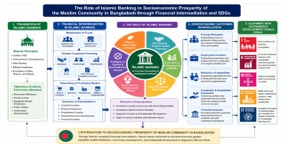
Objective: This study examines the contribution of Islamic banks to advancing the Sustainable Development Goals (SDGs), particularly SDG 1 (No Poverty), SDG 8 (Decent Work and Economic Growth), and SDG 10 (Reduced Inequalities), by promoting the economic prosperity of the Muslim community in Bangladesh. Theoretical framework: The research is grounded in Islamic economic theory and financial intermediation theory, which posit that Islamic bank function as ethical financial intermediaries by mobilizing and allocating funds through Shariah-compliant financing while fostering equitable wealth distribution and sustainable socioeconomic development. Literature review: Previous studies have demonstrated that Islamic banking supports financial inclusion, poverty reduction, entrepreneurship, and economic growth. However, limited research explicitly connects Islamic banking practices in Bangladesh with the achievement of the SDGs and the broader objective of improving the economic prosperity of Muslim communities. This study addresses that gap by integrating Islamic finance and sustainable development perspectives. Method: This research employs a qualitative descriptive approach using secondary data collected from academic literature, government publications, central bank reports, and relevant institutional documents concerning Islamic banking development in Bangladesh. Data were analyzed through thematic content analysis to identify the contribution of Islamic banks to national economic development and community welfare. Results: The findings indicate that Islamic banks have experienced steady growth and demonstrate strong resilience within Bangladesh's financial sector. By providing Shariah-compliant financing free from riba, maysir, gharar, riswah, and batil practices, Islamic banks effectively perform their intermediary function, expand financial access, support micro, small, and medium enterprises, encourage productive investment, reduce poverty, create employment opportunities, and strengthen equitable income distribution. These contributions align closely with the SDGs and reinforce sustainable economic prosperity for Muslim communities. Implications: The findings provide practical guidance for policymakers, regulators, and Islamic financial institutions to strengthen SDG-oriented Islamic banking policies and inclusive financing strategies. Novelty: This study offers an integrated analysis linking Islamic banking, SDGs, and Muslim community prosperity in Bangladesh, presenting a comprehensive framework that connects Shariah-compliant financial intermediation with sustainable socioeconomic development.