Faith-Based Pathways to SDG 16: Interfaith Engagement for Sustainable Peace
DOI:
https://doi.org/10.61455/mrsdgs.v2i02.572Keywords:
faith-based engagement, interfaith dialogue, sustainable peace, sdgs 16, social cohesionAbstract
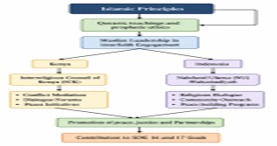
Objective: This study examines the contribution of faith-based interfaith engagement to the advancement of Sustainable Development Goal 16 (SDG 16), which seeks to promote peaceful, just, and inclusive societies. The research aims to analyse how religious values, particularly the principles of coexistence, compassion, and justice, foster constructive interreligious relations and sustainable peace in pluralistic societies. Theoretical framework: The study is grounded in faith-based peacebuilding theory, religious pluralism, and ethical approaches to interfaith dialogue. It draws on religious teachings and moral traditions that emphasise human dignity, mutual respect, social harmony, and peaceful coexistence. Literature review: Previous studies demonstrate that faith communities play a significant role in conflict prevention, social cohesion, and peacebuilding. Existing scholarship highlights the importance of interfaith dialogue, humanitarian cooperation, and religious education in strengthening peaceful relations among diverse communities. However, limited research has explicitly linked faith-based interfaith engagement to the implementation of SDG 16. Methods: This research employs a qualitative approach through an extensive literature review, historical analysis, and thematic interpretation of contemporary interfaith initiatives documented in academic publications, policy reports, and faith-based peacebuilding programs. Results: The findings indicate that faith-based interfaith engagement contributes substantially to sustainable peace through six key mechanisms: ethical dialogue, community reconciliation, humanitarian collaboration, inclusive education, social cohesion initiatives, and digital engagement against radicalisation. These mechanisms strengthen trust, reduce prejudice, promote inclusive participation, and reinforce peaceful social institutions. The study further demonstrates that such initiatives support several SDG 16 targets, including reducing violence, enhancing social inclusion, promoting access to justice, and strengthening accountable institutions. Implications: The findings suggest that policymakers, educational institutions, and religious organisations should integrate interfaith engagement into peacebuilding and development strategies to enhance social resilience and community harmony. Novelty: The study offers a novel SDG-oriented framework that connects faith-based interfaith engagement with measurable contributions to SDG 16, providing a comprehensive model for sustainable peacebuilding in multicultural societies.